The Complete Guide to Masnoon Duas
Authentic Prophetic Supplications for Every Moment of Daily Life — with Arabic Text, Transliteration & Translation
📋 Table of Contents
- 01 What Are Masnoon Duas?
- 02 The Importance of Masnoon Duas in Islam
- 03 How to Make Dua — Step-by-Step Guide
- 04 Categories of Masnoon Duas
- 05 Featured Masnoon Duas with Arabic Text
- 06 Masnoon Duas for Your Daily Routine
- 07 Spiritual Benefits of Reciting Masnoon Duas
- 08 Tips for Memorising Masnoon Duas
- 09 Frequently Asked Questions
- 10 Further Reading & Resources
What Are Masnoon Duas?
The word Masnoon (مسنون) is derived from Sunnah, meaning the traditions and practices of Prophet Muhammad ﷺ. Masnoon Duas are therefore the specific supplications that were recited, taught, or approved by the Prophet ﷺ — recorded in authentic collections of Hadith such as Sahih Bukhari, Sahih Muslim, Sunan Abu Dawud, and Jami at-Tirmidhi.
Unlike personal duas you compose yourself, Masnoon Duas carry special weight because they are the very words chosen by the Messenger of Allah ﷺ. Reciting them earns the double reward of dhikr (remembrance of Allah) and following the Sunnah simultaneously. They cover every aspect of daily life — from waking up in the morning to going to sleep at night, from entering the home to travelling great distances.
They are sometimes called Masnoon Duain (مسنون دعائیں) in Urdu, Prophetic Supplications in English, or simply Duas from the Sunnah. Whatever you call them, making them a daily habit is one of the most beloved acts to Allah ﷻ.
“Call upon Me, I will respond to you.”
— Quran 40:60 (Surah Ghafir)
The Importance of Masnoon Duas in Islam
Allah ﷻ encourages us to call upon Him at all times. The Prophet ﷺ showed us exactly how.
Dua (supplication) is the essence of worship.
— Prophet Muhammad ﷺ · Jami at-Tirmidhi 3371 (Sahih)Connection to Allah
Every Masnoon Dua is a direct conversation between you and your Creator — strengthening your bond with Allah ﷻ throughout the day.
Following the Sunnah
Reciting the Prophet’s ﷺ own words earns you the reward of practising his blessed Sunnah in addition to the act of remembrance itself.
Protection & Barakah
Many Masnoon Duas serve as spiritual shields — protecting believers from harm, evil eye, and shaytan in their daily activities.
Mindfulness & Gratitude
Associating specific duas with daily actions trains the heart and mind to remain conscious of Allah in every routine moment.
Accepted by Allah
The Prophet ﷺ said there is nothing more honourable with Allah than supplication — and these duas were handpicked by him ﷺ.
Universal Practice
Billions of Muslims across every era and every continent recite these same words — connecting the entire Ummah through one voice.
How to Make Dua — The Masnoon Way
The Prophet ﷺ taught us the best etiquettes for making dua so that our supplications are more likely to be accepted.
✦ Best Times for Duas to be Accepted ✦
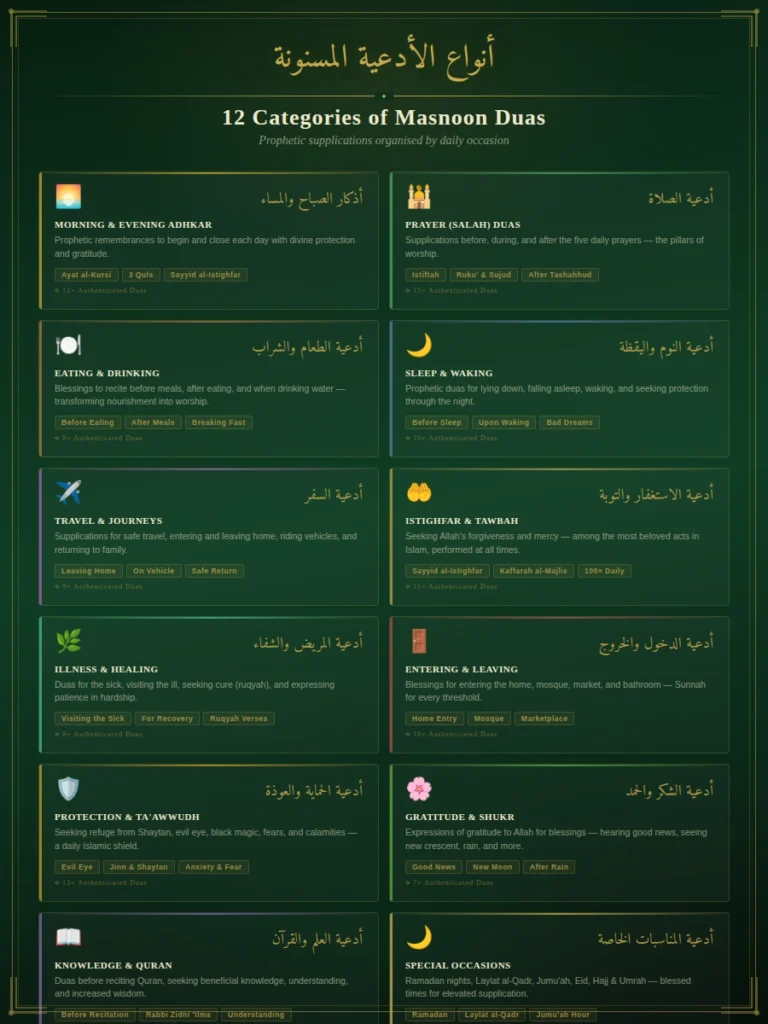
Categories of Masnoon Duas
The Prophet ﷺ taught us duas for virtually every activity of daily life. Explore by category below.
Morning & Evening Adhkar
Daily remembrances for dawn and dusk — the most important routine duas.
15+ Duas 🕌Duas in Salah
Supplications recited during the five daily prayers and Witr.
12+ Duas 🍽️Eating & Drinking
Before and after meals — making every bite an act of worship.
8+ Duas 🌙Sleeping & Waking
Protect yourself through the night and start fresh every morning.
10+ Duas 🏡Entering & Leaving Home
Duas for stepping out and returning to fill your home with barakah.
6+ Duas 🕌Entering the Masjid
Greet the house of Allah with the Prophet’s ﷺ blessed words.
4+ Duas ✈️Travel & Journey
Dua al-Safar and supplications for safe and blessed travel.
7+ Duas 💊Health & Illness
Duas for when you are unwell, visiting the sick, or seeking healing.
9+ Duas 🛡️Protection & Ruqyah
Seeking refuge from evil, shaytan, the evil eye, and calamities.
11+ Duas 🌿Seeking Forgiveness
Istighfar duas and the master supplication — Sayyidul Istighfar.
8+ Duas 💧Wudu & Toilet
Before and after wudu, entering and leaving the bathroom.
5+ Duas 🎉Special Occasions
Eid, Ramadan, Hajj, Umrah, Jumu’ah and blessed events.
14+ DuasEssential Masnoon Duas — Arabic, Transliteration & Translation
The most recited and beloved Masnoon Duas — every Muslim should know these by heart.
🌅 Dua on Waking Up
Daily“All praise is due to Allah, who gave us life after causing us to die, and to Him is the resurrection.”
📚 Sahih Bukhari · Hadith 6312
🌙 Dua Before Sleeping
Daily“O Allah, in Your name I die and I live.”
📚 Sahih Bukhari · Hadith 6314
🍽️ Dua Before Eating
Daily“In the name of Allah and with the blessings of Allah (I begin to eat).”
📚 Abu Dawud · Hadith 3767 (Hasan)
🍽️ Dua After Eating
Daily“All praise is due to Allah who fed me this and provided it for me without any power or strength on my part.”
📚 Abu Dawud · Hadith 4023 (Sahih)
🏠 Entering the Home
Daily“O Allah, I ask of You the good of the entering and the good of the leaving. In the name of Allah we enter and in the name of Allah we leave.”
📚 Abu Dawud · Hadith 5096 (Sahih)
⭐ Sayyidul Istighfar
Master Dua“O Allah, You are my Lord. There is no god but You. You created me and I am Your servant…” (The Master of Seeking Forgiveness)
📚 Sahih Bukhari · Hadith 6306 — Whoever recites this in the morning with conviction and dies that day enters Jannah.
📿 Explore more collections on DuaForAll.com · Sunnah.com · IslamicFinder
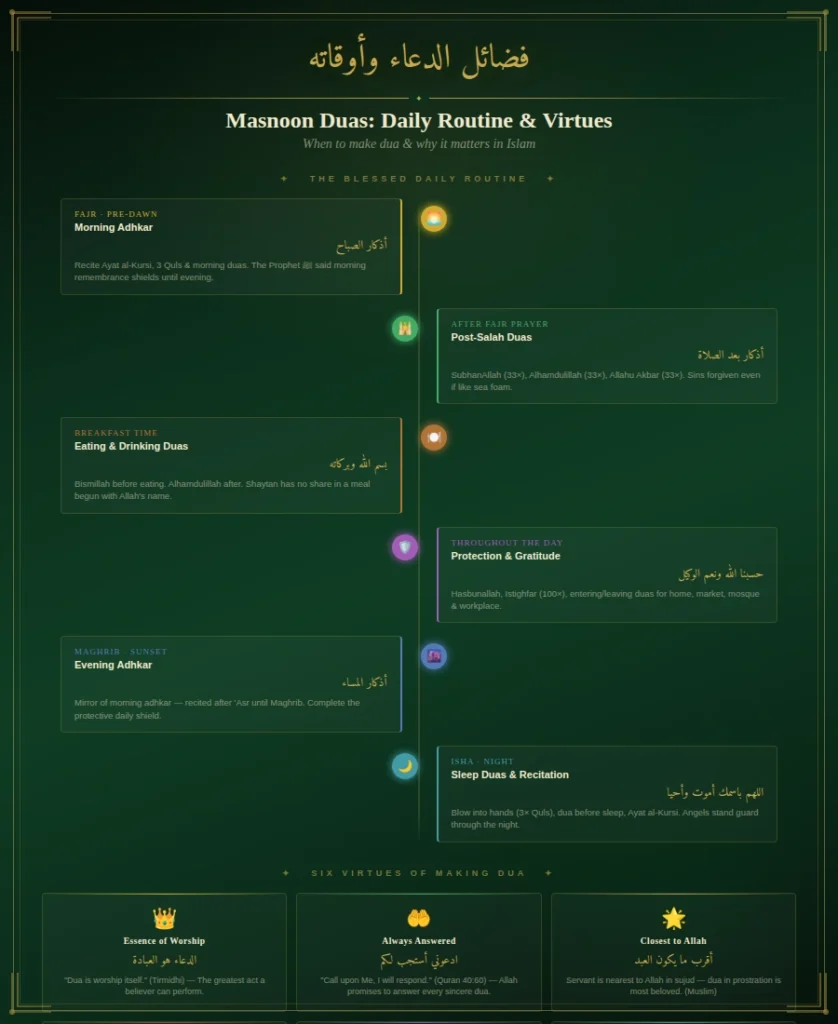
Masnoon Duas Throughout Your Day
Integrate the Prophet’s ﷺ duas into every part of your daily routine — from Fajr to Isha.
Dua-e-Qunoot & Personal Duas
The last third of the night is the best time for any personal supplication. Allah descends to the lowest heaven and asks: “Who is calling upon Me that I may answer them?” → Tahajjud Duas
Morning Adhkar (Azkar-e-Saba)
Recite Ayatul Kursi, the 3 Quls, and the morning adhkar. The Prophet ﷺ said: “Whoever says Subḥānallāhi wa biḥamdihi 100 times in the morning and evening, no one will bring more than him on the Day of Resurrection.” → Morning Adhkar
Dua Before & After Eating
Say Bismillah before eating and the hamd dua after finishing. If you forget Bismillah at the start, say: “Bismillāhi fī awwalihi wa ākhirih” — this removes shaytan from your food. → Eating Duas
Masnoon Duas in Salah
From Dua al-Istiftah at the start to the final tashahhud and salams — every moment of salah has a masnoon dua. Include Dua Qunoot in Witr. → Salah Duas
Evening Adhkar (Azkar-e-Masa)
Mirror the morning adhkar with the evening versions. These duas form a protective fortress (hisn) around the believer until the following morning. → Evening Adhkar
Sleeping Duas & Recitations
Recite Ayatul Kursi (protection throughout the night), blow into hands and wipe over the body three times, then say the sleeping dua. Recite Al-Mulk before sleeping — it protects from the punishment of the grave. → Sleeping Duas
7 Transformative Benefits of Reciting Masnoon Duas
Making Masnoon Duas a daily habit can profoundly transform your spiritual life, mindset, and relationship with Allah.
Direct Communication with Allah
Dua is the only direct hotline to Allah ﷻ available 24/7, without intermediaries or clergy.
Purification of the Heart
Regular dhikr and dua soften the heart, increase tawakkul, and replace anxiety with peace.
Spiritual Protection
Morning & evening adhkar form an invisible shield against shaytan, envy, and unseen harms.
Multiplied Rewards
Each Masnoon Dua earns you the reward of an act of worship AND the reward of following the Sunnah.
Barakah in All Affairs
Duas bring divine blessings into food, journeys, work, family — sanctifying ordinary activities.
Inner Peace & Contentment
Remembering Allah consistently fulfils the soul’s deepest need: “Verily in the remembrance of Allah do hearts find rest.” (Quran 13:28)
Following the Prophet’s Sunnah
Using his ﷺ exact words expresses love for him and qualifies you for his intercession on the Day of Judgement.
How to Memorise Masnoon Duas Effectively
Start small, stay consistent. Here’s a proven strategy for building a lifelong dua habit.
🎯 Start with 3 Duas a Week
Don’t overwhelm yourself. Master three duas per week — recite them in context (say the eating dua every meal) until they become automatic before adding new ones. Quality over quantity.
📝 Write It & Display It
Write the dua on a sticky note and place it where you’ll use it — near the bed, on the fridge, at the bathroom mirror. Visual triggers are the most powerful memory tools.
🎧 Listen & Repeat Aloud
Find audio recitations of Masnoon Duas (available on IslamicFinder) and repeat after the reciter. Oral repetition embeds the Arabic pronunciation deeply.
💡 Understand the Meaning
Memorisation is dramatically faster when you understand what you’re saying. Read the English translation carefully before trying to memorise — meaning anchors memory.
👨👩👧 Teach Your Family
Teaching others is the most powerful way to consolidate your own knowledge. Recite duas with your children at meals and bedtime. A family that makes dua together, stays together.
📱 Use a Duas App
Apps like DuaForAll, Hisnul Muslim, and IslamicFinder provide audio, transliteration, and reminders to make daily recitation easy wherever you are.
Frequently Asked Questions about Masnoon Duas
A personal dua is any supplication you make in your own words to Allah ﷻ — this is completely valid and encouraged. A Masnoon Dua is specifically a dua that was recited, taught, or approved by the Prophet Muhammad ﷺ. Masnoon Duas are recorded in authentic Hadith collections and carry the additional virtue of following the Sunnah. Think of personal duas as a free-form conversation with Allah and Masnoon Duas as following a blessed template from the Prophet ﷺ himself.
Yes, you can make dua in any language — Allah understands every tongue. For the Arabic recitations within salah (like Dua al-Istiftah), many scholars recommend learning the Arabic as it is part of the prayer’s form. However, for general Masnoon Duas outside of salah, reciting the English translation while learning the Arabic gradually is perfectly valid. The intention and sincerity of your heart matter enormously to Allah ﷻ.
There are hundreds of authentic Masnoon Duas recorded across the major books of Hadith — Sahih Bukhari, Sahih Muslim, Abu Dawud, Tirmidhi, Ibn Majah, and Nasa’i. The popular compilation Hisnul Muslim (Fortress of the Muslim) by Sa’id bin Ali bin Wahf Al-Qahtani alone contains over 200 authenticated duas covering virtually every life situation. A committed learner could study Masnoon Duas for a lifetime and still discover new gems.
Scholars recommend beginning with the most frequently used duas: Bismillah (before eating/starting anything), the waking-up dua, the sleeping dua, and Sayyidul Istighfar. Of these, Sayyidul Istighfar is perhaps the most important single dua — the Prophet ﷺ said that whoever recites it sincerely in the morning and dies that day will enter Jannah, and the same applies at night.
While dua in any language is valid, reciting Masnoon Duas in Arabic is strongly preferred because: (1) Arabic is the language the Prophet ﷺ used; (2) the precise wording carries its own spiritual weight; (3) even if you don’t fully understand every word, the sincerity of your intention and effort to follow the Sunnah are rewarded by Allah. Work on learning the Arabic while using the transliteration as a stepping stone.
The most trusted printed source is Hisnul Muslim (Fortress of the Muslim), available free online at IslamicFinder and printable from MasnoonDuas.com. For hadith references, Sunnah.com is the gold standard — fully searchable, with grading and Arabic originals.
Resources, Internal Links & References
📿 Internal Pages — Explore More Duas
جَزَاكَ اللَّهُ خَيْرًا — May Allah reward you with goodness