أَعُوذُ بِكَلِمَاتِ اللَّهِ التَّامَّاتِ مِنْ شَرِّ مَا خَلَقَ
Duas for Protection in Islam
— The Complete Pillar Guide
Authentic supplications for protection from evil eye, Shaytan, black magic, harm, and anxiety — with Arabic text, transliteration, translation, and scholarly sources.
Why Protection Duas Matter in Islam
In Islam, seeking protection is not a sign of weakness — it is an act of tawakkul (reliance on Allah). The Prophet Muhammad ﷺ himself made supplications for protection every morning and evening, teaching his companions that the strongest shield a believer can have is the remembrance of Allah (dhikr).
The Quran and authentic Hadith collections contain dozens of verified duas specifically revealed or taught to protect believers from:
- The evil eye (al-‘ayn) and envy (hasad)
- Shaytan (devil) and his whispers (waswas)
- Black magic and sorcery (sihr)
- Physical illness and spiritual harm
- Fear, anxiety, and grief
- Harm during travel, sleep, and daily activities
This comprehensive guide compiles the most authentic and widely-practised protection duas from Sahih Hadith collections (Sunnah.com), the Quran, and verified Islamic scholarship — designed to become part of your daily spiritual routine.
All duas on this page are sourced from authentic references: Sahih Bukhari, Sahih Muslim, Abu Dawud, Tirmidhi, and Ibn Majah. Cross-verified against IslamQA.info and Sunnah.com.
6 Categories of Islamic Protection
Islam provides a complete framework for protection — spiritual, physical, emotional, and communal. Here are the core categories:
🛡️ The Shield of a Believer — Protection in Islam
Each category has its own specific duas, practices, and Quranic foundations
Evil Eye (Al-Ayn)
Protection from envy and the evil glance through recitation of Ma sha Allah and specific duas
Shaytan & Jinn
Seeking refuge (ta’awwudh) from the accursed devil through Quran and morning adhkar
Black Magic (Sihr)
Ruqyah recitation and the last two chapters of the Quran as a definitive shield
Grief & Anxiety
Prophetic duas for worry relief, depression, and emotional distress
Night & Sleep
Bedtime supplications and Ayatul Kursi to protect during sleep
Travel & Daily Life
Duas for entering/exiting the home, travel safety, and marketplace protection
⚡ The Four Pillars of Quranic Protection
These four chapters form the cornerstone of Islamic protection recitation
Morning & Evening Protection Adhkar
The Prophet ﷺ consistently recited these supplications every morning and evening. They form the most complete daily shield available to a Muslim.
Recite these each morning (after Fajr) and each evening (after Asr). According to the hadith in Sunan Abu Dawud 5088, consistent recitation of morning and evening adhkar is among the greatest protections a believer has.
أَصْبَحْنَا وَأَصْبَحَ الْمُلْكُ لِلَّهِ، وَالْحَمْدُ لِلَّهِ، لَا إِلَهَ إِلَّا اللَّهُ وَحْدَهُ لَا شَرِيكَ لَهُ
Asbahna wa asbahal-mulku lillah, walhamdulillah, la ilaha illallahu wahdahu la sharika lah…
“We have entered the morning and the dominion belongs to Allah. Praise be to Allah; there is no god but Allah alone, with no partner…”
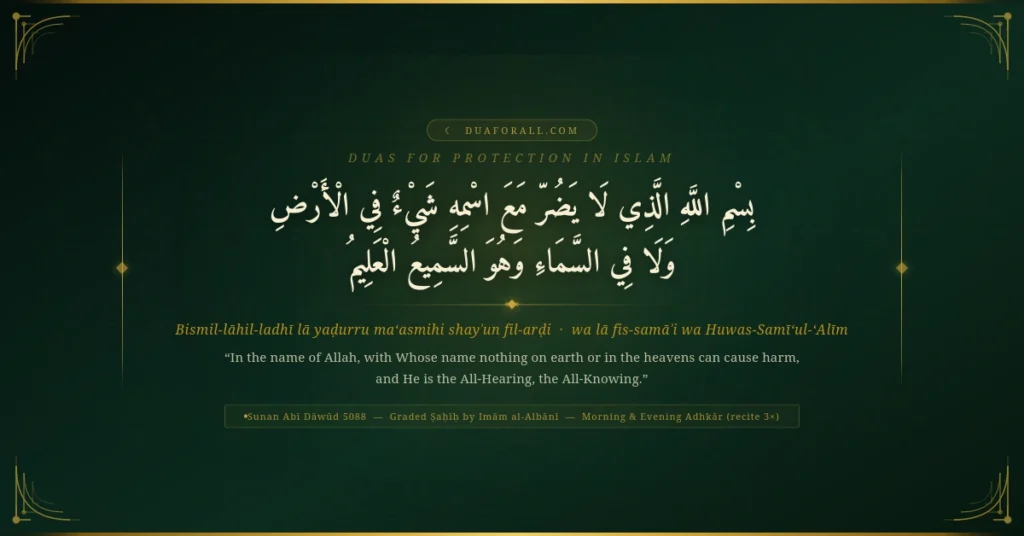
بِسْمِ اللَّهِ الَّذِي لَا يَضُرُّ مَعَ اسْمِهِ شَيْءٌ فِي الْأَرْضِ وَلَا فِي السَّمَاءِ وَهُوَ السَّمِيعُ الْعَلِيمُ
Bismillahil-lazi la yadurru ma’asmihi shay’un fil-ardi wa la fis-sama’i wa huwas-sami’ul-‘alim
“In the name of Allah with Whose name nothing can cause harm in the earth or in the heavens, and He is the All-Hearing, All-Knowing.” (Recite 3×)
اللَّهُمَّ بِكَ أَمْسَيْنَا، وَبِكَ أَصْبَحْنَا، وَبِكَ نَحْيَا، وَبِكَ نَمُوتُ، وَإِلَيْكَ الْمَصِيرُ
Allahumma bika amsayna, wa bika asbahna, wa bika nahya, wa bika namutu, wa ilakal-masir
“O Allah, by You we enter the evening and by You we enter the morning, by You we live and by You we die, and to You is the final return.”
Core Protection Duas from the Sunnah
These are the most frequently cited prophetic duas for comprehensive daily protection.
أَعُوذُ بِكَلِمَاتِ اللَّهِ التَّامَّاتِ مِنْ شَرِّ مَا خَلَقَ
A’udhu bi-kalimatil-lahit-tammati min sharri ma khalaq
“I seek refuge in the perfect words of Allah from the evil of what He has created.”
اللَّهُمَّ إِنِّي أَسْأَلُكَ خَيْرَ الْمَوْلِجِ وَخَيْرَ الْمَخْرَجِ
Allahumma inni as’aluka khayral-mawlaji wa khayral-makhraj
“O Allah, I ask You for the best of entering and the best of exiting. In the name of Allah we enter and in the name of Allah we leave.”
اللَّهُمَّ إِنِّي أَعُوذُ بِكَ مِنَ الْهَمِّ وَالْحَزَنِ، وَالْعَجْزِ وَالْكَسَلِ، وَالْبُخْلِ وَالْجُبْنِ
Allahumma inni a’udhu bika minal-hammi wal-hazani, wal-‘ajzi wal-kasali, wal-bukhli wal-jubni…
“O Allah, I seek refuge in You from anxiety and grief, from weakness and laziness, from miserliness and cowardice…”
Ayatul Kursi — The Greatest Shield in the Quran
Ayatul Kursi (Quran 2:255) is unanimously considered by Islamic scholars to be the greatest verse in the Quran. The Prophet Muhammad ﷺ said: “Whoever recites Ayatul Kursi after every obligatory prayer, nothing will prevent him from entering Paradise except death.” (An-Nasa’i, Sahih)
For protection specifically, Sahih Bukhari (3274) records that reciting Ayatul Kursi before sleep ensures an angel guards you throughout the night.
اللَّهُ لَا إِلَهَ إِلَّا هُوَ الْحَيُّ الْقَيُّومُ ۚ لَا تَأْخُذُهُ سِنَةٌ وَلَا نَوْمٌ ۚ لَّهُ مَا فِي السَّمَاوَاتِ وَمَا فِي الْأَرْضِ ۗ مَن ذَا الَّذِي يَشْفَعُ عِندَهُ إِلَّا بِإِذْنِهِ ۚ يَعْلَمُ مَا بَيْنَ أَيْدِيهِمْ وَمَا خَلْفَهُمْ ۖ وَلَا يُحِيطُونَ بِشَيْءٍ مِّنْ عِلْمِهِ إِلَّا بِمَا شَاءَ ۚ وَسِعَ كُرْسِيُّهُ السَّمَاوَاتِ وَالْأَرْضَ ۖ وَلَا يَئُودُهُ حِفْظُهُمَا ۚ وَهُوَ الْعَلِيُّ الْعَظِيمُ
“Allah — there is no deity except Him, the Ever-Living, the Sustainer of all existence. Neither drowsiness overtakes Him nor sleep. To Him belongs whatever is in the heavens and whatever is on the earth. Who is it that can intercede with Him except by His permission?…”
— Quran · Surah Al-Baqarah 2:255
After every obligatory (fard) prayer · Before sleeping · When entering your home · After reciting the Three Quls. See our full Daily Adhkar guide for a complete schedule.
The Three Quls — The Refuge Surahs
Surah Al-Ikhlas, Surah Al-Falaq, and Surah An-Nas together constitute the most powerful combination of protective recitation in the Quran. The Prophet ﷺ recited them every morning, every evening, and before sleeping.
Surah Al-Ikhlas (Purity of Faith)
Quran 112 · Equal to ⅓ of the Quran
Qul huwal-lahu ahad. Allahus-samad. Lam yalid wa lam yulad. Wa lam yakul-lahu kufuwan ahad.
“Say: He is Allah, the One. Allah, the Eternal Refuge. He neither begets nor was He born, nor is there to Him any equivalent.”
Surah Al-Falaq (The Daybreak)
Quran 113 · Protection from external evil
Qul a’udhu bi-rabbil-falaq. Min sharri ma khalaq. Wa min sharri ghasiqin idha waqab. Wa min sharrin-naffathati fil-‘uqad. Wa min sharri hasidin idha hasad.
“Say: I seek refuge in the Lord of the daybreak, from the evil of what He has created, and from the evil of darkness when it settles, and from the evil of those who blow on knots, and from the evil of an envier when he envies.”
Surah An-Nas (Mankind)
Quran 114 · Protection from internal evil (waswas)
Qul a’udhu bi-rabbin-nas. Malikin-nas. Ilahin-nas. Min sharril-waswaasil-khannas. Alladhi yuwaswisu fi sudurin-nas. Minal-jinnati wan-nas.
“Say: I seek refuge in the Lord of mankind, the Sovereign of mankind, the God of mankind, from the evil of the retreating whisperer, who whispers in the breasts of mankind — from among the jinn and mankind.”
Protection from the Evil Eye (Al-‘Ayn)
Is the Evil Eye Real in Islam?
Yes — the evil eye is affirmed in the Quran and Sunnah. Allah says in Surah Al-Qalam 68:51: “And indeed, those who disbelieve would almost make you slip with their eyes when they hear the message.” The Prophet ﷺ confirmed: “The evil eye is real and if anything were to overtake the divine decree, it would be the evil eye.” (Sahih Muslim 2188)
Quranic Protection: Say “Ma sha Allah”
When praising something or someone, always say مَا شَاءَ اللَّهُ (Ma sha Allah) — “Whatever Allah wills.” This is referenced in Surah Al-Kahf 18:39 as the prophetic practice. Omitting this when expressing admiration is considered a contributing factor to giving the evil eye unintentionally.
👁️ Evil Eye Protection — 4-Step Islamic Practice
A practical daily routine based on prophetic guidance
Morning Adhkar
Recite the Three Quls ×3 and Ayatul Kursi after Fajr prayer
Say Ma sha Allah
When praising anything or anyone, say “Ma sha Allah” to prevent giving the evil eye
Ruqyah Bath
If afflicted, the giver performs Ruqyah water washing (wudu) for the recipient
Evening Adhkar
Repeat Three Quls ×3 after Asr. Blow onto palms and wipe over body before sleep
أَعِيذُكَ بِكَلِمَاتِ اللَّهِ التَّامَّةِ مِنْ كُلِّ شَيْطَانٍ وَهَامَّةٍ، وَمِنْ كُلِّ عَيْنٍ لَامَّةٍ
U’eethuka bi-kalimatil-lahit-tammati min kulli shaytanin wa hammah, wa min kulli ‘aynin lammah
“I seek refuge for you in the perfect words of Allah from every devil and every poisonous creature, and from every evil eye.”
مَا شَاءَ اللَّهُ لَا قُوَّةَ إِلَّا بِاللَّهِ
Ma sha Allahu la quwwata illa billah
“What Allah wills — there is no power except with Allah.” Recite when seeing something you admire to protect against the evil eye.
Ruqyah — Healing Through the Quran
Ruqyah is the Islamic practice of reciting Quran and authentic duas for healing and protection. It is firmly established in the Sunnah and encouraged as the primary spiritual cure.
The Prophet ﷺ used to perform Ruqyah for himself and his family using Al-Mu’awwidhat (the Three Quls). Sahih Bukhari 5016
🛡️ Standard Ruqyah — Al-Fatihah
Al-Fatihah · Quran 1:1–7
بِسْمِ اللَّهِ الرَّحْمَنِ الرَّحِيمِ الْحَمْدُ لِلَّهِ رَبِّ الْعَالَمِينَ الرَّحْمَنِ الرَّحِيمِ مَالِكِ يَوْمِ الدِّينِ إِيَّاكَ نَعْبُدُ وَإِيَّاكَ نَسْتَعِينُ اهْدِنَا الصِّرَاطَ الْمُسْتَقِيمَ صِرَاطَ الَّذِينَ أَنْعَمْتَ عَلَيْهِمْ غَيْرِ الْمَغْضُوبِ عَلَيْهِمْ وَلَا الضَّالِّينَ
“In the name of Allah, the Most Gracious, the Most Merciful. All praise is due to Allah, Lord of all the worlds…”
Read Full Ruqyah Collection →Ruqyah must only use words from the Quran and authentic Sunnah. Any Ruqyah containing words no one understands, or seeking help from jinn, is impermissible. For detailed guidance, see IslamQA on Permissible Ruqyah.
Best Times to Recite Protection Duas
A Muslim’s day is structured around salah (prayer), and the most powerful protection adhkar are tied to these blessed times.
🌄 After Fajr — Dawn
Morning Adhkar Shield
Recite Ayatul Kursi, Three Quls ×3, “Bismillahil-lazi la yadurru” ×3, and morning adhkar from Hisnul Muslim. This sets the protection for the entire day.
☀️ Midday — Dhuhr
Midday Renewal
Say “A’udhu billahi min ash-shaytanir-rajim” before entering crowded markets, workplaces, or difficult meetings. Make istikharah if facing decisions.
🌇 After Asr — Afternoon
Evening Adhkar Shield
Mirror the morning adhkar. Recite Three Quls ×3, Ayatul Kursi, and evening supplications. This closes the daily cycle of protection.
🌆 Maghrib — Sunset
Call Children Indoors
The Prophet ﷺ advised keeping children indoors at sunset and saying “Bismillah” as this is when Shaytan spreads most. (Sahih Bukhari 3280)
🌙 Before Sleep
Bedtime Protection Routine
Blow Three Quls into cupped hands and wipe over the body ×3. Recite Ayatul Kursi. Say “Bismika Allahumma amutu wa ahya.” Sleep on your right side.
Frequently Asked Questions About Islamic Protection
What is the most powerful dua for protection in Islam?
The most comprehensive single verse for protection is Ayatul Kursi (Quran 2:255). The Prophet ﷺ described it as the greatest verse in the Quran and confirmed that reciting it after every prayer and before sleep guarantees Allah’s protection. For overall daily shielding, the combination of Three Quls + Ayatul Kursi recited morning and evening is the most complete prophetic practice.
How do I protect myself from black magic (sihr) in Islam?
The primary protection against sihr is consistent recitation of the morning and evening adhkar, Ayatul Kursi, and the Three Quls. If already afflicted, Ruqyah — reciting Surah Al-Fatiha, Ayatul Kursi, and Al-Mu’awwidhat over water and drinking/bathing with it — is the prophetic cure. See IslamQA’s detailed guidance on Ruqyah for sihr for step-by-step scholarly advice.
Is wearing a Taweez (amulet) permissible in Islam?
This is a matter of scholarly difference. The majority position, including Ibn Taymiyyah and most contemporary scholars, is that wearing written Quranic verses as amulets is prohibited because it can lead to greater shirk. The authenticated practice of the Prophet ﷺ was verbal Ruqyah only. See IslamQA’s full ruling on taweez for the detailed scholarly positions.
How many times should I recite the Three Quls for maximum protection?
The authentic sunnah is to recite them 3 times each every morning and every evening. Blow into cupped hands after each recitation and wipe over the face and body. Before sleep, also recite ×3 and wipe. The single recitation after every obligatory prayer is also established. See the complete morning & evening adhkar for the full sequence.
What dua should I say to protect my family and children?
The Prophet ﷺ used to seek protection for Al-Hasan and Al-Husain with the dua: “U’eethukuma bi-kalimatil-lahit-tammati min kulli shaytanin wa hammah, wa min kulli ‘aynin lammah” (Ibn Majah 3511). Recite Surah Al-Falaq and An-Nas over children morning and evening. Visit our Duas for Family & Children page for a complete collection.