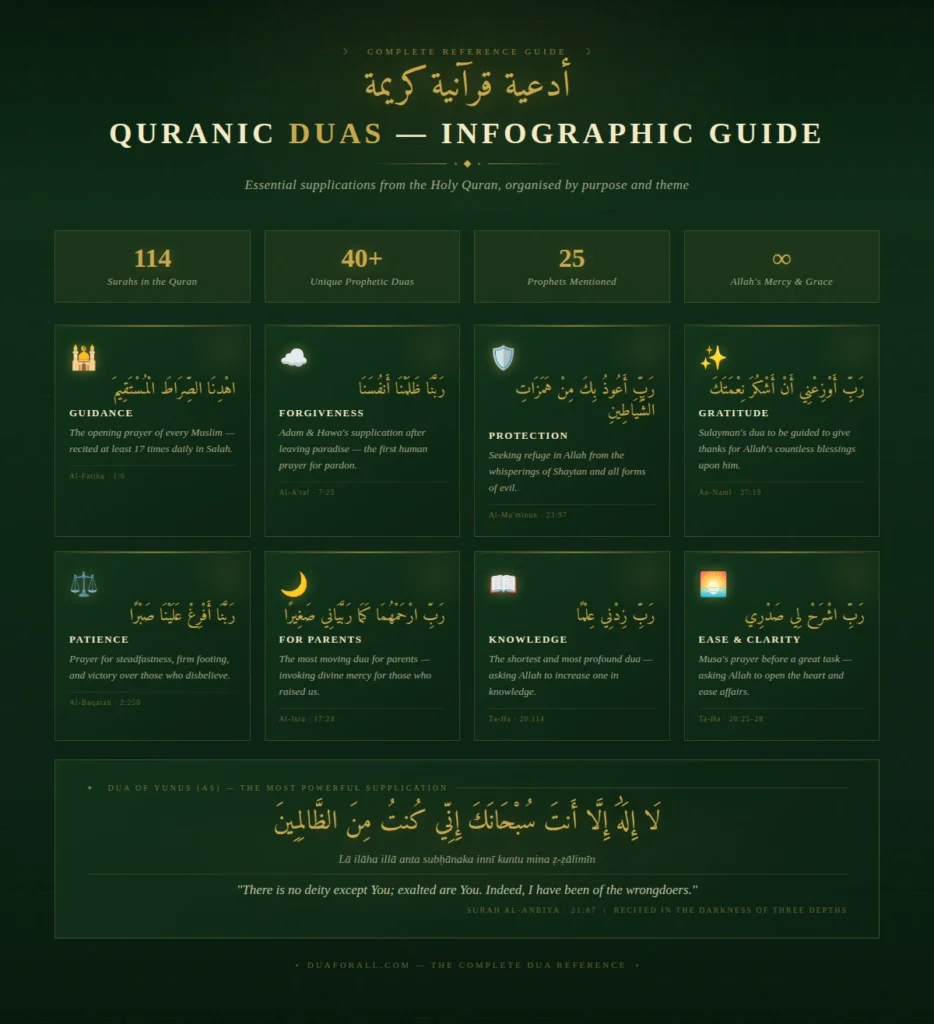
Quranic Duas — Supplications from the Holy Quran
Discover powerful duas taught directly by Allah in the Quran — with Arabic text, transliteration, full translations, and authentic tafsir. A complete guide for every Muslim seeking to deepen their connection with their Creator.
“And when My servants ask you concerning Me — indeed I am near.”
— Surah Al-Baqarah 2:186📋 Table of Contents
What Are Quranic Duas?
A Quranic Dua is a supplication whose text appears directly in the Holy Quran. Unlike hadith-based (Masnoon) duas, these words were revealed to the Prophet Muhammad ﷺ by Allah ﷻ through the angel Jibreel (AS) and are therefore among the most sacred forms of prayer a Muslim can recite.
The Arabic word du’a (دُعَاء) derives from the root da’a (دَعَا), meaning “to call out” or “to summon.” In Islamic tradition, it carries the meaning of calling upon Allah with humility, hope, and certainty. The Prophet ﷺ described dua as “the essence of worship” — “al-du’a huwa al-‘ibadah” (Sunan Abu Dawud, 1479).
Quranic duas span the breadth of human experience: seeking forgiveness, asking for guidance, protection from evil, provision of sustenance, healing of the sick, and entry into Paradise. They were uttered by Prophets Ibrahim, Musa, Yunus, Sulayman, Zakariyya, and many others (peace be upon them all).
قُلِ ادْعُوا اللَّهَ أَوِ ادْعُوا الرَّحْمَنَ
“Say: Call upon Allah, or call upon the Most Merciful. Whichever you call, to Him belong the best names.”
📖 Surah Al-Isra 17:110Why Are Quranic Duas Special?
Unlike any other form of supplication, Quranic duas carry a unique spiritual weight rooted in divine revelation.
Directly Revealed by Allah
These words were spoken by Allah ﷻ Himself or by His Prophets under divine inspiration — making them the most authentic form of supplication. Every letter carries barakah.
Double Reward
Reciting Quranic duas counts both as dhikr (remembrance of Allah) and as recitation of the Quran, potentially doubling the spiritual reward earned with each utterance.
Universal & Timeless
The needs expressed in Quranic duas — for guidance, mercy, provision, and forgiveness — transcend time and culture. They remain perfectly relevant for every human in every era.
Linguistically Perfect
The Quran is preserved word-for-word as it was revealed. Unlike other texts, there is zero possibility of alteration or corruption in Quranic duas.
Proven Etiquette
Quranic duas model ideal dua etiquette — humility, specificity, gratitude before asking, and complete reliance on Allah — teaching Muslims how to supplicate correctly.
Spiritual Healing (Shifa)
The Quran is described as a shifa (healing) for believers. Reciting Quranic verses for protection and wellbeing is an established Sunnah practice.
Quranic Duas by Category
The 8 Major Categories of Quranic Duas
Every Quranic dua can be classified into one or more of these timeless themes
Categories are approximate — many duas span multiple themes
Essential Quranic Duas
Each dua below is presented with Arabic text, transliteration, English translation, and Quranic reference.
🌟 Guidance & Daily Life
Dua for Guidance — Surah Al-Fatiha
اهْدِنَا الصِّرَاطَ الْمُسْتَقِيمَ
Ihdinā al-ṣirāṭa al-mustaqīm
“Guide us to the straight path.”
📖 Surah Al-Fatiha 1:6The most recited dua in Islam — spoken at least 17 times daily. It asks for divine guidance on the straight path, the way of those whom Allah has blessed.
Read Full Tafsir →Dua for Knowledge
رَّبِّ زِدْنِي عِلْمًا
Rabbi zidnī ‘ilmā
“My Lord, increase me in knowledge.”
📖 Surah Ta-Ha 20:114The shortest and most impactful dua for seeking knowledge. Scholars recommend reciting this before studying, reading the Quran, or attending any educational gathering.
Read Full Dua →Dua for Good in Both Worlds
رَبَّنَا آتِنَا فِي الدُّنْيَا حَسَنَةً وَفِي الْآخِرَةِ حَسَنَةً وَقِنَا عَذَابَ النَّارِ
Rabbanā ātinā fī al-dunyā ḥasanah wa-fī al-ākhirati ḥasanah wa-qinā ‘adhāba al-nār
“Our Lord, give us good in this world and good in the Hereafter, and protect us from the punishment of the Fire.”
📖 Surah Al-Baqarah 2:201Anas ibn Malik (RA) reported that the Prophet ﷺ often recited this dua. It is considered one of the most comprehensive duas in the entire Quran.
Dua of Repentance — Surah Al-Baqarah
رَبَّنَا ظَلَمْنَا أَنفُسَنَا وَإِن لَّمْ تَغْفِرْ لَنَا وَتَرْحَمْنَا لَنَكُونَنَّ مِنَ الْخَاسِرِينَ
Rabbanā ẓalamnā anfusanā wa-in lam taghfir lanā wa-tarḥamnā la-nakūnanna mina al-khāsirīn
“Our Lord, we have wronged ourselves, and if You do not forgive us and have mercy upon us, we will surely be among the losers.”
📖 Surah Al-A’raf 7:23The dua of Adam and Hawwa (AS) after they descended to earth — the first act of sincere tawbah (repentance) recorded in the Quran.
🤍 Forgiveness & Mercy
Dua of the Righteous (Surah Al-Imran)
رَبَّنَا فَاغْفِرْ لَنَا ذُنُوبَنَا وَكَفِّرْ عَنَّا سَيِّئَاتِنَا وَتَوَفَّنَا مَعَ الْأَبْرَارِ
Rabbanā faghfir lanā dhunūbanā wa-kaffir ‘annā sayyi’ātinā wa-tawaffanā ma’a al-abrār
“Our Lord, forgive us our sins and remove from us our misdeeds and cause us to die with the righteous.”
📖 Surah Al-Imran 3:193Dua of Ibrahim (AS) for Parents
رَّبِّ اغْفِرْ لِي وَلِوَالِدَيَّ وَلِمَن دَخَلَ بَيْتِيَ مُؤْمِنًا وَلِلْمُؤْمِنِينَ وَالْمُؤْمِنَاتِ
Rabbi-ghfir lī wa-liwālidayya wa-liman dakhala baytī mu’minan wa-lil-mu’minīna wal-mu’mināt
“My Lord, forgive me, my parents, and whoever enters my house as a believer, and the believing men and women.”
📖 Surah Nuh 71:28Recited by Prophet Nuh (AS), this comprehensive dua covers the supplicant, their parents, and the entire believing community.
🛡️ Protection
Dua Against Shaytan (Al-A’raf)
رَبِّ أَعُوذُ بِكَ مِنْ هَمَزَاتِ الشَّيَاطِينِ وَأَعُوذُ بِكَ رَبِّ أَن يَحْضُرُونِ
Rabbi a’ūdhu bika min hamazāti al-shayāṭīni wa-a’ūdhu bika rabbi an yaḥḍurūn
“My Lord, I seek refuge with You from the incitements of the devils, and I seek refuge with You, my Lord, lest they be present with me.”
📖 Surah Al-Mu’minun 23:97–98 More Protection Duas →Ayatul Kursi — The Verse of the Throne
اللَّهُ لَا إِلَهَ إِلَّا هُوَ الْحَيُّ الْقَيُّومُ
Allāhu lā ilāha illā huwa al-ḥayyu al-qayyūm
“Allah — there is no deity except Him, the Ever-Living, the Sustainer of existence.”
📖 Surah Al-Baqarah 2:255The Prophet ﷺ said: “Whoever recites Ayatul Kursi after every obligatory prayer, nothing will prevent him from entering Paradise except death.” (Al-Nasa’i, Al-Silsilah Al-Sahihah 972)
“Call upon your Lord with humility and in secret. Indeed, He does not like the transgressors.”
— Surah Al-A’raf 7:55Iconic Duas of the Prophets (AS)
Allah preserved the supplications of His prophets in the Quran as eternal examples for the believer.
Prophet Ibrahim (AS) 🕌
رَبَّنَا تَقَبَّلْ مِنَّا ۖ إِنَّكَ أَنتَ السَّمِيعُ الْعَلِيمُ
“Our Lord, accept [this] from us. Indeed, You are the Hearing, the Knowing.”
Surah Al-Baqarah 2:127Prophet Yunus (AS) 🐋
لَّا إِلَهَ إِلَّا أَنتَ سُبْحَانَكَ إِنِّي كُنتُ مِنَ الظَّالِمِينَ
“There is no deity except You; exalted are You. Indeed, I have been of the wrongdoers.”
Surah Al-Anbiya 21:87Prophet Ayyub (AS) 💚
رَبِّ إِنِّي مَسَّنِيَ الضُّرُّ وَأَنتَ أَرْحَمُ الرَّاحِمِينَ
“My Lord, adversity has touched me, and you are the Most Merciful of the merciful.”
Surah Al-Anbiya 21:83Prophet Musa (AS) 🏔️
رَبِّ اشْرَحْ لِي صَدْرِي وَيَسِّرْ لِي أَمْرِي
“My Lord, expand for me my breast and ease for me my task.”
Surah Ta-Ha 20:25–26Prophet Zakariyya (AS) 🤲
رَبِّ لَا تَذَرْنِي فَرْدًا وَأَنتَ خَيْرُ الْوَارِثِينَ
“My Lord, do not leave me alone [with no heir], while you are the best of inheritors.”
Surah Al-Anbiya 21:89Prophet Sulayman (AS) 👑
رَبِّ أَوْزِعْنِي أَنْ أَشْكُرَ نِعْمَتَكَ الَّتِي أَنْعَمْتَ عَلَيَّ
“My Lord, enable me to be grateful for Your favor which You have bestowed upon me.”
Surah Al-Naml 27:19How to Make Dua — Proper Etiquette
The 7-Step Dua Framework
Follow these etiquettes recommended by the Prophet ﷺ for dua to be most effective
Best Times for Dua to Be Accepted
Golden Windows of Acceptance
The Prophet ﷺ identified specific times when duas are especially likely to be answered
For a complete list, see: Jumu’ah Supplications & Ramadan Dua Guide
7 Conditions for Dua to Be Accepted
Scholars of Islam, drawing on Quranic verses and authentic hadith, have identified key conditions that facilitate the acceptance of supplications.
Halal Sustenance
The Prophet ﷺ mentioned the traveller whose food and drink are haram — “How can his dua be answered?” Ensuring halal income is paramount. (Sahih Muslim 1015)
Sincerity (Ikhlas)
Dua must be directed solely to Allah ﷻ with a heart free from showing off or seeking admiration from others.
Certainty of Response (Yaqeen)
“Call upon Allah while being certain of being answered.” (Sunan al-Tirmidhi 3479) Doubt weakens the dua.
Avoiding the Forbidden
One should not supplicate for anything sinful, the severing of family ties, or anything that contradicts Islamic law.
Persistence & Repetition
The Prophet ﷺ advised repeating a dua three times. Persistence demonstrates genuine need and trust in Allah’s wisdom and timing.
Humility & Lowliness
Surah Al-A’raf 7:55 commands calling upon Allah “in humility and privately.” The Prophet ﷺ disliked raising voices loudly in collective dua.
Not Being Hasty
The Prophet ﷺ said: “The dua of any of you will be answered as long as he is not hasty and says: ‘I called upon my Lord but He did not answer me.'” (Bukhari 6340)
📖 Learn more on authentic Islamic scholarship sites like IslamQA.info and Sunnah.com for hadith verification.
Surahs Rich in Quranic Duas
Al-Fatiha
The Opening — literally the mother of dua. Every prayer begins with this complete supplication.
Read on Quran.com →Al-Baqarah
Contains multiple duas including Ayatul Kursi, the last two verses (286), and the dua of both worlds.
Read on Quran.com →Al-Anbiya
Features the duas of many prophets — Yunus, Ayyub, Ibrahim, and Zakariyya (peace be upon them).
Read on Quran.com →Ibrahim
Surah Ibrahim (14) contains some of the most moving duas of Prophet Ibrahim (AS) for his family.
Read on Quran.com →Frequently Asked Questions
During salah (prayer), recitation must be in Arabic. However, for personal supplication (dua) outside of prayer, scholars generally permit making dua in any language you understand deeply. However, learning the Arabic duas is highly recommended as the words carry their own spiritual power and precision.
Yes. A Quranic dua appears verbatim in the Quran and counts as Quranic recitation. A Masnoon dua is one taught by the Prophet ﷺ through his words or actions (sunnah), recorded in hadith collections. Both are authentic, but Quranic duas carry the additional merit of Quranic recitation. See our Masnoon Duas collection for comparison.
Scholars differ, but many point to the dua of Prophet Yunus (AS) — “Lā ilāha illā anta subḥānaka innī kuntu mina al-ẓālimīn” — as exceptionally powerful. The Prophet ﷺ said that no Muslim ever supplicates with it except that Allah responds to him. (Sunan al-Tirmidhi 3505) Al-Fatiha is also considered the greatest surah and thus its embedded dua for guidance is profoundly significant.
Yes. Many scholars permit reciting Quranic verses, including duas, and dedicating the reward (thawab) to the deceased. The dua of Prophet Ibrahim (AS) in Surah Ibrahim 14:41 — asking forgiveness for parents and believers — is particularly suited for this purpose.
Scholars have catalogued between 40 and 70 distinct supplications in the Quran, depending on how a “dua” is defined. Some count only explicit requests, while others include all verses of praise, glorification, and seeking refuge. The most commonly cited figure is around 40 established duas.
For hadith verification, we recommend Sunnah.com (free, searchable English translations of major hadith collections), IslamQA.info for scholarly fatwas, and the work of Sheikh Al-Albani (rahimahullah) for hadith grading. For Quran, Quran.com offers multiple translations and tafsir.
Internal & External Resources
Explore More on DuaForAll
Authoritative External Resources
- Quran.com — Read & listen to the full Quran
- Sunnah.com — Authentic hadith collections
- IslamQA.info — Scholarly Islamic Q&A
- ProductiveMuslim.com — Islamic lifestyle
- SeekersGuidance.org — Free Islamic education
- Quran Corpus — Linguistic analysis of Quran
- Tanzil.net — Quran text & translations
- Al-Mawrid — Islamic research institute