The Seerah of Prophet Muhammad ﷺ & the Prophets of Islam
A comprehensive guide to the life of the Prophet ﷺ, the 25 Prophets mentioned in the Quran, key milestones of Islamic history, and timeless lessons for every Muslim.
What Is the Seerah?
Understanding the biography of the final Prophet and its place in Islamic scholarship.
The word Seerah (سِيرَة) — literally meaning “path” or “way of life” — refers to the recorded biography of Prophet Muhammad ﷺ. It is one of the most meticulously preserved life narratives in human history, compiled by Muslim scholars such as Ibn Ishaq, Ibn Hisham, and later Al-Waqidi.
Studying the Seerah is not merely a historical exercise. Allah ﷻ commands believers in the Quran to follow the example of the Prophet ﷺ: “Indeed in the Messenger of Allah you have a beautiful example to follow” (Quran 33:21). The Seerah is the living embodiment of that example.
The Seerah spans 63 years — from the Prophet’s birth in 570 CE in Makkah to his passing in 632 CE in Madinah — covering his childhood, the years before prophethood, the Makkan period, the Hijra, and the Madinan era.
For Muslims, knowledge of the Seerah deepens love for the Prophet ﷺ, enriches understanding of the Quran revealed in specific contexts, and provides a practical model for navigating every dimension of life — family, governance, trade, warfare, and worship.
“There has certainly been for you in the Messenger of Allah an excellent pattern for whoever hopes in Allah and the Last Day and who remembers Allah often.”
📖 Quran · Surah Al-Ahzab 33:21
“The best among you are those who learn the Quran and teach it.”
📚 Sahih al-Bukhari · 5027
The 25 Prophets Mentioned in the Quran
Allah ﷻ sent thousands of prophets to humanity. Twenty-five are named in the Quran — the Ulul Azm (★) are the five of the greatest resolve.
Every Prophet came with the same core message: Tawhid — the oneness of Allah ﷻ. They were chosen men, free from major sin, who conveyed divine revelation faithfully. The Ulul Azm (أولو العزم) — Nuh, Ibrahim, Musa, ‘Isa, and Muhammad ﷺ — possessed the highest rank of perseverance and mission.
★ = Ulul Azm (Prophets of Greatest Resolve) | AS = Alayhis Salam (Peace Be Upon Him)
Life of Prophet Muhammad ﷺ — A Timeline
From Makkah to Madinah — the complete chronology of the Seal of Prophets ﷺ.
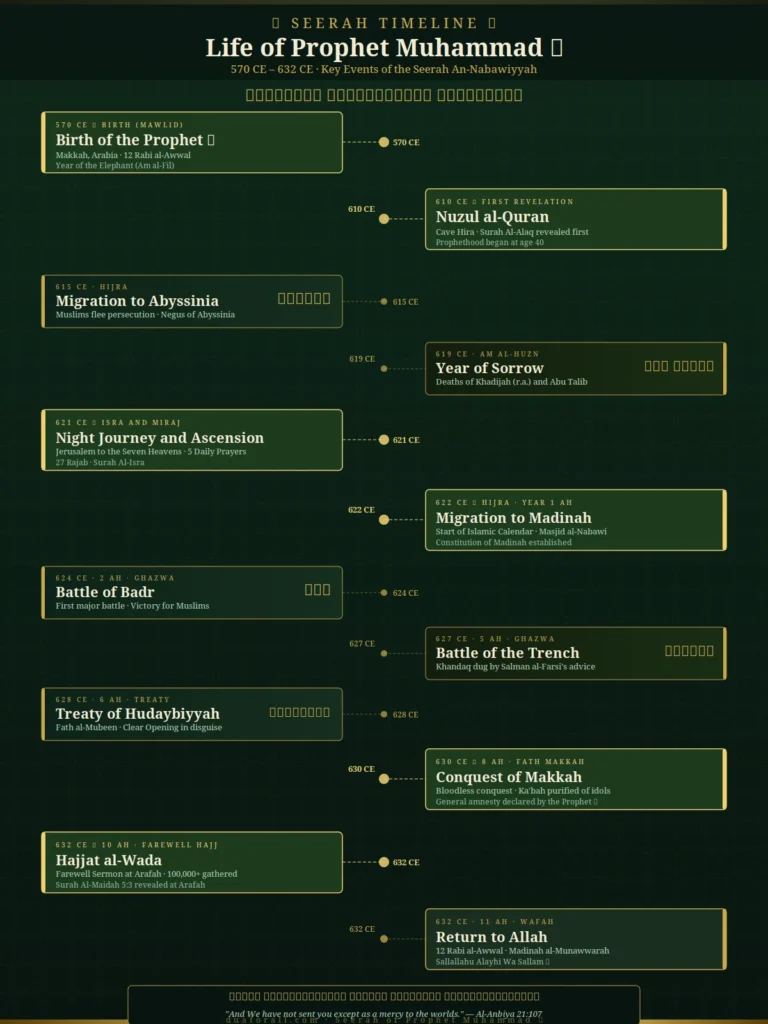
Muhammad ﷺ is born in Makkah on 12 Rabi’ al-Awwal, in the Year of the Elephant, to ‘Abdullah and Aminah of the noble Banu Hashim clan of Quraysh.
His mother Aminah passes away. He is taken in by his grandfather, then uncle Abu Talib. Known even then as Al-Amin — the Trustworthy.
The Prophet ﷺ marries the noble businesswoman Khadijah bint Khuwaylid (RA) at age 25. She becomes his greatest supporter and the first Muslim.
Angel Jibril (AS) descends with the first five verses of Surah Al-‘Alaq: “Iqra’ bismi Rabbika…” The prophethood begins. Islam is born.
Three years of private preaching end. The Prophet ﷺ calls Quraysh to Islam from Mount Safa. Persecution of early Muslims intensifies.
Unable to bear Quraysh persecution, a group of Muslims migrate to Christian Abyssinia under the just rule of Negus Ashama ibn Abjar.
Khadijah (RA) and Abu Talib both pass away within weeks. The Prophet ﷺ loses his greatest companion and his protector. A profound test from Allah ﷻ.
The miraculous Night Journey — from Makkah to Jerusalem (Al-Aqsa), then the Ascent through the heavens. The five daily prayers are made obligatory.
The Prophet ﷺ and Abu Bakr (RA) migrate to Madinah, marking the beginning of the Islamic calendar. The first mosque, Masjid Quba, is built.
The first major battle between Muslims (313 men) and Quraysh (1000+). A decisive victory for the Muslims — described in the Quran as Yawm al-Furqan.
A ten-year peace treaty with Quraysh, described by Allah ﷻ as a “clear victory” (Fath Mubeen). It opened doors for the spread of Islam across Arabia.
The Prophet ﷺ enters Makkah with 10,000 companions. He declares a general amnesty. The Ka’bah is purified of idols. Makkah becomes a city of Islam.
The Prophet ﷺ delivers the Khutbat al-Wada’ before 124,000 companions on Mount Arafah. Weeks later, on 12 Rabi’ al-Awwal, he returns to the mercy of Allah ﷻ.
Key Events of the Seerah at a Glance
Surah Al-‘Alaq 1–5 revealed — the beginning of the 23-year period of Quranic revelation to the Prophet ﷺ.
The miraculous journey through the heavens, where the Prophet ﷺ met previous prophets and received the command of five daily prayers.
Migration from Makkah to Madinah — the pivotal moment marking the start of the Islamic lunar calendar and the formation of the first Muslim community.
Islam’s defining early military victory, with 313 Muslims triumphing over a force three times their size — referred to in Quran 8:41 as Yawm al-Furqan.
The bloodless return to Makkah — a demonstration of mercy and forgiveness that showcased the character of the Prophet ﷺ and the spirit of Islam.
The Prophet ﷺ performed Hajj for the first and only time, delivering the Khutbat al-Wada’ — a timeless charter of human rights still relevant today.
“And We have not sent you, [O Muhammad], except as a mercy to the worlds.”
Quran · Surah Al-Anbiya 21:107Beloved Duas of the Prophet ﷺ
These supplications, drawn from authentic Hadith, represent the heart of the Seerah — the Prophet’s ﷺ intimate relationship with Allah ﷻ.
Allāhumma bika aṣbaḥnā, wa bika amsaynā, wa bika naḥyā, wa bika namūtu, wa ilayka al-nushūr.
Meaning: “O Allah, by You we enter the morning and by You we enter the evening, by You we live and by You we die, and to You is the resurrection.”
📚 Abu Dawud 5068Allāhumma innī as’aluka ‘ilman nāfi’an, wa rizqan ṭayyiban, wa ‘amalan mutaqabbalan.
Meaning: “O Allah, I ask You for beneficial knowledge, good lawful provision, and deeds that are accepted.”
📚 Ibn Majah 925Allāhumma ihdinī li-aḥsani al-akhlāqi lā yahdī li-aḥsanihā illā ant, wa ṣrif ‘annī sayyi’ahā lā yaṣrifu ‘annī sayyi’ahā illā ant.
Meaning: “O Allah, guide me to the best of character — none guides to the best of it but You — and protect me from the worst of character — none protects from the worst of it but You.”
📚 Sahih Muslim 771Allāhumma innī a’ūdhu bika min al-hammi wa al-ḥazani, wa a’ūdhu bika min al-‘ajzi wa al-kasali.
Meaning: “O Allah, I seek refuge in You from worry and grief, and I seek refuge in You from incapacity and laziness.”
📚 Sahih Bukhari 6369Lessons from the Seerah
The life of the Prophet ﷺ is a masterclass in patience, leadership, compassion, and unwavering faith.
Despite 13 years of persecution in Makkah — boycotts, torture of companions, personal loss — the Prophet ﷺ never abandoned his mission. Sabr (patience) is the bedrock of Islamic character.
At the Conquest of Makkah, those who had tortured and killed his companions were forgiven. “Go,” he said, “you are free.” Rahmah (mercy) was his defining trait — mirroring Allah’s own attribute.
When enemies surrounded the cave of Thawr, the Prophet ﷺ comforted Abu Bakr (RA): “Do not grieve — indeed Allah is with us.” Complete reliance on Allah, combined with effort, is the prophetic formula.
Even before prophethood, the Quraysh called him Al-Amin (the Trustworthy). His truthfulness in business, speech, and treaty was legendary — a model for Muslim professionals today.
The Prophet ﷺ regularly consulted his companions on military, political, and community matters. At Uhud and Khandaq, he adopted their counsel. Shura (consultation) is an Islamic governance principle.
Despite being the head of state, the Prophet ﷺ milked his own goat, mended his own shoes, and visited the sick. His humility was not performed — it was the natural expression of a heart devoted entirely to Allah ﷻ.
Explore related topics on DuaForAll — your trusted source for authentic Islamic supplications and guidance.
Further Reading & Resources
Deepen your knowledge of the Seerah through these scholarly and authenticated resources.
Access the complete collections of Bukhari, Muslim, Abu Dawud and other major hadith books with English translations.
Read, listen to, and study the Quran with multiple translations and scholarly tafsir commentary.
Detailed scholarly answers on Seerah, Fiqh, Aqeedah, and all aspects of Islamic practice from qualified scholars.
Free online courses on the Seerah, Islamic jurisprudence, spirituality, and Arabic — taught by qualified scholars.
Academic-quality research on Islamic history, the Seerah, and contemporary Muslim questions.
Comprehensive Islamic reference site with fatwas, articles, and detailed information on prophetic history.
Frequently Asked Questions
How many Prophets were sent to mankind in total?
What is the difference between a Nabi and a Rasul?
Who are the Ulul Azm — the five greatest Prophets?
When was the Prophet Muhammad ﷺ born and when did he pass away?
What is the best book to read for learning the Seerah?
What duas did the Prophet ﷺ recite most frequently?
Why is studying the Seerah important for Muslims today?
اللَّهُمَّ صَلِّ عَلَى مُحَمَّدٍ وَعَلَى آلِ مُحَمَّدٍ كَمَا صَلَّيْتَ عَلَى إِبْرَاهِيمَ وَعَلَى آلِ إِبْرَاهِيمَ
“O Allah, send blessings upon Muhammad and upon the family of Muhammad, as You sent blessings upon Ibrahim and the family of Ibrahim…”
Sahih al-Bukhari · 3370