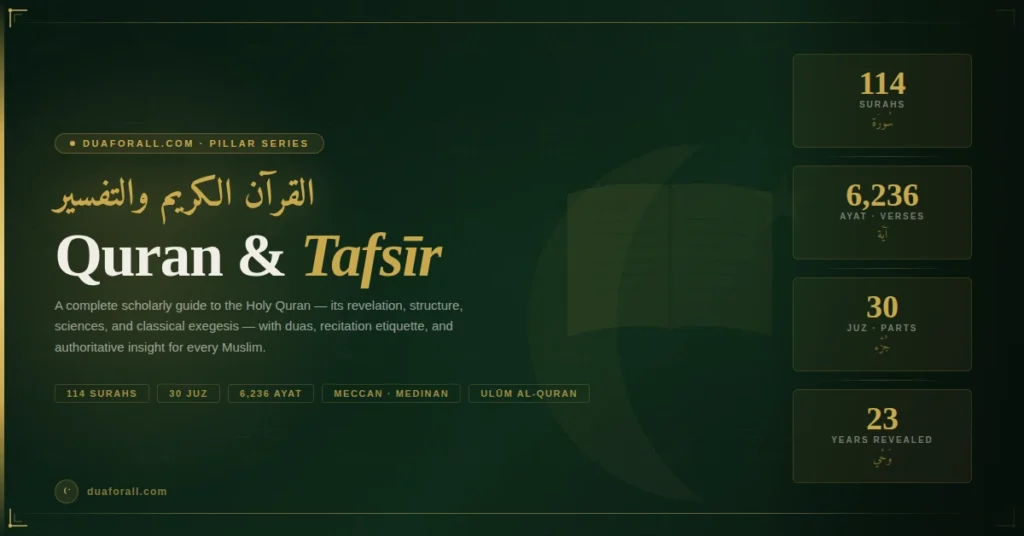
The Complete Guide to
Quran & Tafsir
Understand the structure, sciences, and classical interpretation of Allah’s Final Revelation — the eternal guide for all humanity.
What Is the Quran?
The Quran (القرآن الكريم) is the literal Word of Allah ﷻ revealed to Prophet Muhammad ﷺ over approximately 23 years through the Angel Jibreel (Gabriel). It is the primary source of Islamic law, theology, ethics, and spirituality — and the most widely memorised book on Earth.
Divine Origin
Muslims believe every word of the Quran is directly from Allah ﷻ, preserved in the Preserved Tablet (Al-Lawh Al-Mahfuz) before its revelation. Unlike hadith, which contains the Prophet’s ﷺ own words, the Quran’s wording is divine.
Period of Revelation
Revelation began in 610 CE with Surah Al-Alaq (first 5 verses) and concluded shortly before the Prophet’s ﷺ passing in 632 CE. The first revelation came in the Cave of Hira during the blessed month of Ramadan.
Compilation History
The Quran was orally transmitted and written on various materials during the Prophet’s ﷺ lifetime. Caliph Abu Bakr ؓ commissioned its compilation into a single manuscript, later standardized by Caliph Uthman ؓ into the Mushaf Uthmani that Muslims use today.
Universal Message
Unlike previous scriptures sent to specific nations, the Quran addresses all of humanity across all times. It was revealed in clear Arabic, yet over 1.8 billion Muslims across 180+ countries read it in its original language daily.
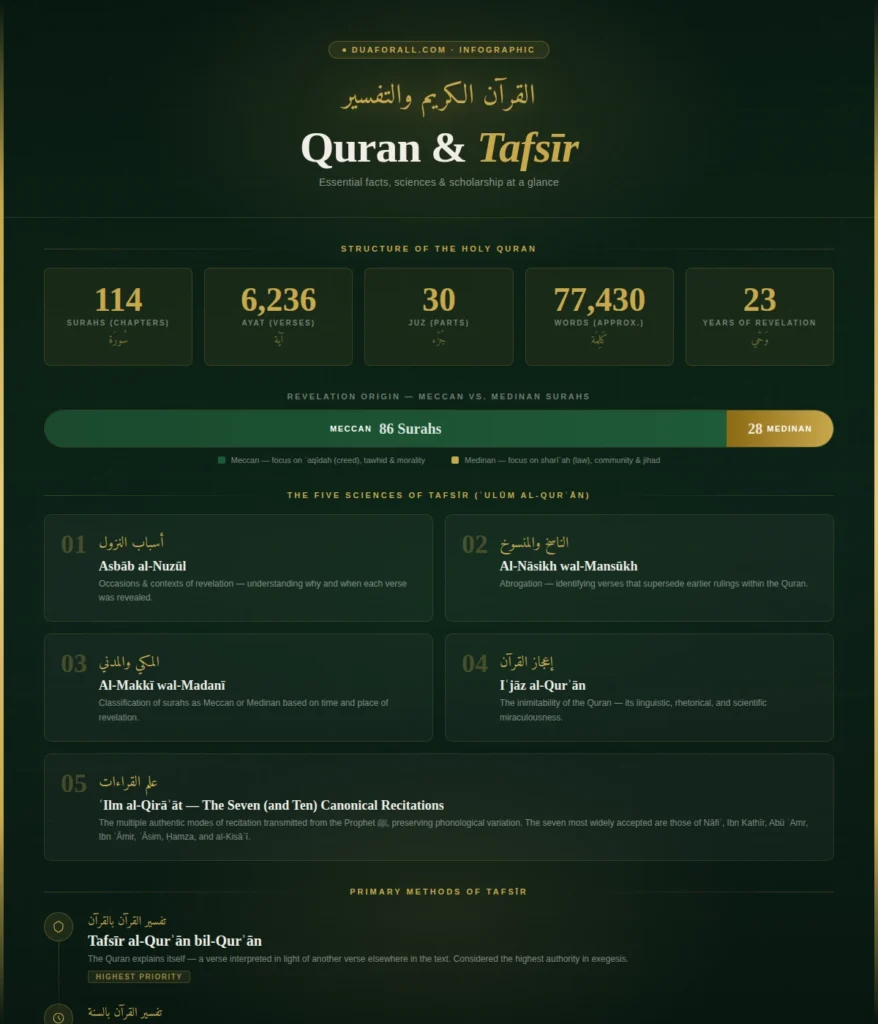
Structure of the Holy Quran
The Quran is meticulously organized into chapters, sections, and parts — enabling millions of Muslims to memorize it in its entirety and recite it in daily prayer.
What Is Tafsir?
Tafsir (تفسير) literally means “explanation” or “elucidation.” As an Islamic science, it is the scholarly interpretation of the Quran’s verses — examining their linguistic, contextual, legal, and spiritual dimensions.
Tafsir derives from the Arabic root f-s-r (فسر), meaning to uncover, expose, or make clear. Just as a doctor who yufassiru (interprets) medical symptoms arrives at a diagnosis, a scholar of Tafsir uncovers the deeper meaning of Allah’s Words.
Why Is Tafsir Necessary?
Linguistic Depth
Classical Arabic contains layers of meaning, rhetorical devices, and root-word variations that require expert analysis. A single Arabic word can carry five or more nuanced meanings depending on context.
Asbab al-Nuzul
Understanding the “Occasions of Revelation” — the historical contexts in which specific verses were revealed — is essential for correct interpretation of many Quranic passages.
Legal Rulings
Hundreds of Quranic verses contain ahkam (rulings) related to prayer, fasting, inheritance, business, family law, and more. Tafsir helps scholars correctly derive and apply these rulings.
The Four Main Types of Tafsir
Muslim scholars have categorized Tafsir into four primary methodologies, each with its own strengths and scholarly traditions.
Landmark Tafsir Works in Islamic History
Across fourteen centuries, Muslim scholars have produced hundreds of Tafsir works in Arabic and other languages. These are the most influential — studied in Islamic universities worldwide.
| Tafsir Work | Scholar | Century | Methodology | Key Feature |
|---|---|---|---|---|
| Jami’ al-Bayan (Tafsir al-Tabari) | Ibn Jarir al-Tabari | 3rd AH / 9th CE | Bil-Ma’thur | The foundational encyclopedic Tafsir; all later works reference it |
| Al-Kashf wa’l-Bayan | Al-Tha’labi | 5th AH / 11th CE | Bil-Ma’thur | Rich in stories of the Prophets and Isra’iliyyat |
| Al-Kashshaf | Al-Zamakhshari | 6th AH / 12th CE | Bil-Ra’y (Mu’tazili) | Unrivalled in Arabic rhetoric and linguistic analysis |
| Mafatih al-Ghayb (Al-Tafsir al-Kabir) | Fakhr al-Din al-Razi | 7th AH / 13th CE | Rational / Philosophical | Encyclopedic; addresses theological and philosophical objections |
| Al-Jami’ li-Ahkam al-Quran | Al-Qurtubi | 7th AH / 13th CE | Fiqhi (Maliki) | Premier legal Tafsir; derives Fiqh from every verse |
| Tafsir Ibn Kathir | Ibn Kathir | 8th AH / 14th CE | Bil-Ma’thur (Hanbali) | Most widely read globally; authenticates hadith rigorously |
| Al-Jalalayn | Al-Suyuti & Al-Mahalli | 9th AH / 15th CE | Concise / Classical | Most read in traditional madrasas; brief and authoritative |
| Fi Zilal al-Quran | Sayyid Qutb | 14th AH / 20th CE | Thematic / Contemporary | Eloquent literary style; powerful for modern audiences |
| Tafhim al-Quran | Sayyid Abul A’la Mawdudi | 14th AH / 20th CE | Thematic | Connects Quranic themes to contemporary social issues |
New students are often advised to begin with Tafsir Ibn Kathir (abridged) for its authenticity and clarity, paired with Al-Jalalayn for daily madrasah-style study. Both are available in English translation.
How to Begin Studying Tafsir
Scholars traditionally follow a structured path to approach Quranic exegesis correctly. Here is a modern roadmap suitable for committed students.
Master Tajweed & Quranic Recitation
Before interpretation, correct recitation is obligatory. Study the rules of Tajweed (مخارج الحروف — points of articulation, elongation rules, etc.) to recite the Quran as the Prophet ﷺ taught. Online platforms like Tarteel.ai and local Quran circles are excellent starting points. See also: Islamic Knowledge Hub.
Learn Basic Arabic (Quranic Arabic)
You do not need to become an Arabic scholar, but understanding Quranic vocabulary transforms your study. Use resources like Madinah Arabic Books by Dr. V. Abdur Rahim, or the free Quran Vocabulary course at bayyinah.com which covers 80% of Quranic words through the 300 most frequent roots.
Read a Reliable Translation with Commentary
Begin with a meaning-accurate translation — Saheeh International is highly recommended for English speakers. Pair it with a brief commentary such as Al-Tafsir al-Muyassar (now available in English). Avoid translations that lack scholarly credentials.
Study Asbab al-Nuzul (Occasions of Revelation)
Al-Wahidi’s Asbab al-Nuzul is the classical reference. Understanding why and when a verse was revealed prevents misapplication. Many contemporary Tafsir works integrate this directly. This is especially critical for verses on rulings (ayat al-ahkam).
Progress to a Full Tafsir Work
Once grounded, work through Tafsir Ibn Kathir or Fi Zilal al-Quran systematically — Surah by Surah. Consider enrolling in structured programs at institutions like the International Islamic University or online through Qalam Institute, SeekersGuidance, or Al-Maqasid.
Apply the Quran to Daily Life
The highest station is not knowledge alone but amal (action). Pair Tafsir study with daily Quranic Duas, Dhikr & Tasbeeh, and consistent reflection (tadabbur) on the verses you memorize.
Uloom al-Quran — The Sciences of the Quran
Tafsir is one science within the broader field of Uloom al-Quran (علوم القرآن) — the collective Islamic sciences dedicated to understanding, preserving, and applying the Book of Allah ﷻ.
Tajweed & Qira’at
The rules of proper recitation and the 10 canonical readings of the Quran (Qira’at al-Ashr), all of which are authentically traced to the Prophet ﷺ through unbroken chains of transmission (Isnad mutawatir).
Explore Tajweed basics →
Al-Nasikh wa’l-Mansukh
The science of abrogation — identifying which earlier rulings were superseded by later revelations. A critical discipline for understanding apparent contradictions and deriving legal verdicts correctly.
I’jaz al-Quran
The linguistic and scientific miraculousness of the Quran — its inimitable style, which challenged the most eloquent Arabs of its time, and the phenomena modern scholars observe in its verses.
Ilm al-Gharib
The science of unusual or rare Quranic words — crucial for correct interpretation. Al-Raghib al-Isfahani’s Mufradat alfaz al-Quran is the seminal lexicon of Quranic vocabulary.
Munasabat al-Quran
The science of inter-verse and inter-Surah coherence — demonstrating the profound logical, thematic, and structural unity of the Quran’s arrangement (Tartib al-Suar).
Ilm al-Rasm al-Uthmani
The science of the Uthmanic script — the specific orthographic conventions of the official Mushaf established by Caliph Uthman ؓ, which differ in places from standard Arabic spelling.
Deepen Your Islamic Knowledge
Explore these closely related topics to build a holistic understanding of the Quran and its application in daily Muslim life.
Authoritative Quran & Tafsir Websites
These external platforms are trusted by Islamic scholars worldwide for Quran study, Tafsir reference, and authentic Islamic knowledge.
Quran & Tafsir — Common Questions
Begin Your Quranic Journey Today
Explore authentic Quranic duas, dhikr, and Islamic guidance — curated with Arabic text, transliteration, and full source references.
© DuaForAll.com — Authentic Islamic Duas, Supplications & Quran Guidance. Content reviewed for authenticity. Not a substitute for qualified Islamic scholarship.