بِسْمِ اللَّهِ الرَّحْمَنِ الرَّحِيمِ
☪️ Islamic Living Guide
الحياة الإسلامية

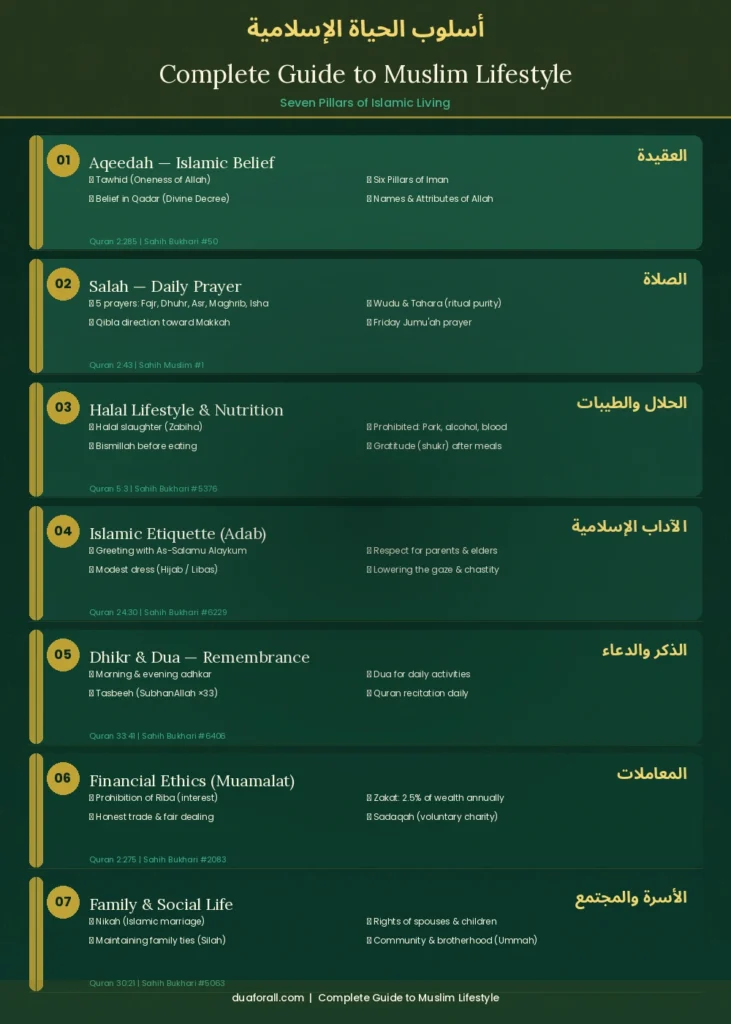
The Complete Guide to Muslim Lifestyle

How Islam shapes every dimension of daily life — from dawn prayers and halal diet to financial ethics, family bonds, and community spirit. Grounded in Quran and authentic Sunnah.

1.9BMuslims Worldwide
5Daily Prayers
114Surahs of Guidance
360°Life Coverage

What Is the Muslim Lifestyle?

Islam is not merely a religion practised on Friday afternoons — it is a complete way of life (Dīn) that provides guidance for every hour of the day, every stage of life, and every dimension of human existence. From the moment a Muslim wakes and whispers Bismillah to the moment they close their eyes reciting Ayat al-Kursi, their day is woven with remembrance of Allah.

This holistic approach to living is rooted in the Quran — the word of Allah — and the Sunnah of the Prophet Muhammad ﷺ, whose entire life stands as the most vivid example of how Islam is meant to be lived. The Prophet ﷺ said: “I have been sent to perfect good character.” (Al-Muwatta, Hadith 1614). This single statement encapsulates the Muslim lifestyle: a constant, conscious journey toward moral excellence.

The Muslim lifestyle is both vertical — maintaining one’s relationship with Allah through worship, dua, and remembrance — and horizontal — nurturing relationships with family, neighbours, community, and even the natural world. Both dimensions are inseparable in Islam.

قُلْ إِنَّ صَلَاتِي وَنُسُكِي وَمَحْيَايَ وَمَمَاتِي لِلَّهِ رَبِّ الْعَالَمِينَ
“Say: Indeed, my prayer, my rites of sacrifice, my living and my dying are for Allah, Lord of the worlds.”
Quran · Surah Al-An’am 6:162

This verse is perhaps the most succinct definition of the Muslim lifestyle: a life of total dedication to Allah — not in the sense of abandoning the world, but in orienting every worldly action toward His pleasure. Work becomes worship. Rest becomes gratitude. Parenting becomes a sacred trust. Even eating and sleeping carry spiritual significance when performed with intention (niyyah).

In this comprehensive guide, we explore the major pillars of Islamic living so that every Muslim — whether new to the faith or a lifelong practitioner — can deepen their understanding and practice of the beautiful Muslim lifestyle.

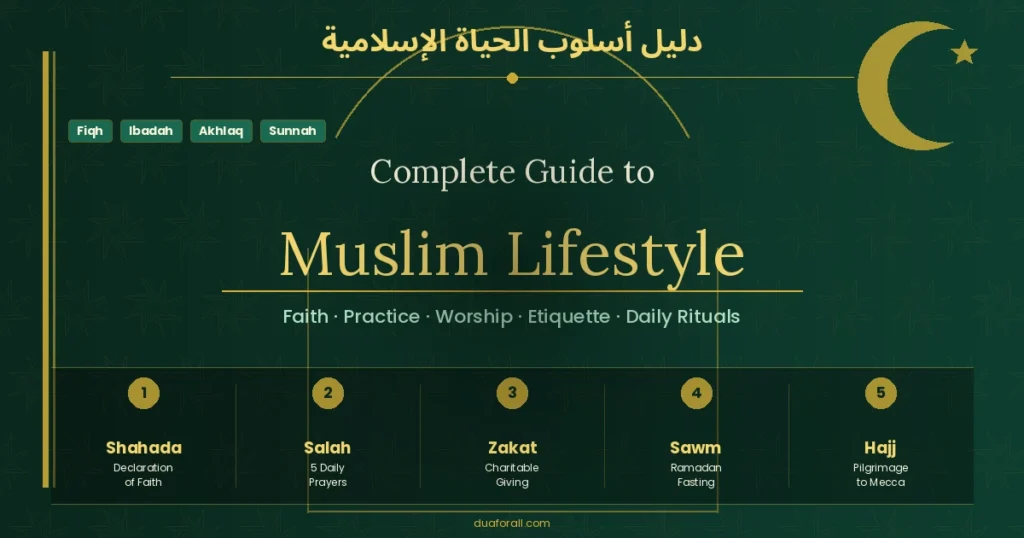
The Five Pillars as a Complete Way of Life

The Arkan al-Islam are not a checklist — they are the architecture of a God-conscious life, each pillar reinforcing the others.

🕋
Pillar 1
Shahada
الشَّهَادَة
Declaration of faith — the foundation of Muslim identity and the gateway to all practice.
🕌
Pillar 2
Salah
الصَّلَاة
Five daily prayers — the heartbeat of the Muslim day, structuring time around divine remembrance.
💛
Pillar 3
Zakat
الزَّكَاة
Obligatory charity — purifying wealth and fostering social solidarity within the Ummah.
🌙
Pillar 4
Sawm
الصَّوْم
Fasting in Ramadan — training willpower, gratitude, and empathy through monthly renewal.
🏔️
Pillar 5
Hajj
الحَجّ
Pilgrimage to Makkah — the ultimate expression of unity, equality, and submission to Allah.

Each pillar actively shapes the Muslim lifestyle. Salah ensures a Muslim pauses five times daily to reconnect with Allah — preventing heedlessness (ghaflah) from taking hold. Zakat purifies the soul from greed and builds economic justice. Sawm is an annual training camp of self-mastery. Hajj is a once-in-a-lifetime encounter with the global Ummah. Together, they create a life of intentional, God-centred rhythm.

Explore our in-depth resources on Masnoon Duas related to Salah, and discover the Dhikr & Tasbeeh that keep Allah’s remembrance alive between prayers.

The Islamic Daily Routine

A practising Muslim’s day is structured around Salah, Sunnah practices, and consistent remembrance of Allah — creating a spiritually nourishing rhythm from Fajr to Isha.

🌅
Pre-Dawn · Fajr Time
Wake with Istiftah & Fajr Prayer
Begin the day by waking before sunrise, performing wudu, and offering the two Sunnah rak’ahs of Fajr followed by the obligatory prayer. Recite morning adhkar — a comprehensive set of supplications that provide spiritual armour for the day.
🌅 Morning Duas & Adhkar →
☀️
Morning · Post-Fajr
Quran Recitation & Dhikr
Dedicate even 10–15 minutes to Quran recitation after Fajr — scholars unanimously regard this as the most blessed time for Quranic study. Follow with morning tasbeeh (SubhanAllah, Alhamdulillah, Allahu Akbar — 33 times each).
📿 Dhikr & Tasbeeh →
🌇
Midday · Dhuhr Time
Dhuhr Prayer & Sunnah
Pause work or studies for the Dhuhr prayer. The Prophet ﷺ encouraged offering four Sunnah rak’ahs before the obligatory Dhuhr. Use the lunch break to eat with Bismillah, share with family or colleagues, and avoid idle speech.
📿 Masnoon Duas →
🌆
Afternoon · Asr Time
Asr Prayer — The Critical Salah
The Prophet ﷺ warned about missing Asr: “He who misses the Asr prayer, it is as though he has lost his family and property.” (Bukhari 552). Guard Asr carefully — it marks the pivot from work to evening wind-down.
📿 Daily Duas →
🌇
Sunset · Maghrib Time
Maghrib Prayer & Family Time
Offer Maghrib promptly — it is the shortest window between any two prayers. Evening adhkar should be read after Maghrib. This is the ideal time for family Quran circles, dinner together, and talking with children about their day.
👨‍👩‍👧 Duas for Family →
🌙
Night · Isha Time
Isha, Witr & Night Reflection
Isha prayer closes the daily cycle of worship. Follow with the Witr prayer — the Prophet ﷺ never missed it even while travelling. Before sleep, recite Ayat al-Kursi, the three Quls, and sleep dua. Review the day with gratitude and seek forgiveness for shortcomings.
🌙 Night Duas →

Halal Diet & Islamic Food Ethics

Islamic dietary guidance is far more than a list of forbidden foods — it is a comprehensive philosophy of mindful, ethical, and grateful nourishment.

What is Halal?
Halal means “permissible.” For food, this includes all wholesome foods — fruits, vegetables, grains, dairy, and meat slaughtered according to Islamic rites (Zabiha) with the name of Allah invoked. The Quran commands: “Eat of the good things We have provided for you.” (Quran 2:172).
Permissible
🚫
What is Haram?
Haram means “forbidden.” Explicitly prohibited are pork and its by-products, alcohol and intoxicants, blood, carrion (dead animals), and animals slaughtered without Allah’s name. Avoiding haram is not deprivation — it is an act of trust in Allah’s wisdom and care for our wellbeing.
Prohibited
🤝
Eating Etiquette (Sunnah)
The Prophet ﷺ modelled mindful eating: begin with Bismillah, eat with the right hand, eat from what is nearest to you, avoid wasting food, and never criticise food. Moderation is key — fill one-third of the stomach with food, one-third with water, one-third with air. (Ibn Majah 3349).
Sunnah Practice
يَا أَيُّهَا النَّاسُ كُلُوا مِمَّا فِي الْأَرْضِ حَلَالًا طَيِّبًا
“O mankind, eat from whatever is on earth that is lawful and good.”
Quran · Surah Al-Baqarah 2:168

Islamic Character & Adab

Adab — Islamic etiquette and good character — is the living expression of faith. The Prophet ﷺ embodied the highest Adab, described by his wife Aisha (ra): “His character was the Quran.” (Muslim, 746).

الأخلاق ISLAMIC CHARACTER 🤝 SIDQ Truthfulness 💚 RAHMA Compassion ⚖️ ADL Justice 🧘 SABR Patience 🌱 TAWADU Humility 🎁 KARAM Generosity 🛡️ AMANA Trustworthiness 😌 HAYA Modesty
The eight core virtues of Islamic character as taught by the Quran and Sunnah.
  • 🤝
    Sidq (Truthfulness) The Prophet ﷺ said: “Truthfulness leads to righteousness and righteousness leads to Paradise.” (Bukhari 6094). Honesty in speech and action is the bedrock of Islamic character.
  • 😌
    Haya (Modesty) Haya encompasses modesty in dress, speech, behaviour, and even thoughts. “Al-Haya is part of faith.” (Bukhari 24). It is not timidity — it is dignified self-restraint.
  • 🧘
    Sabr (Patience) Mentioned over 90 times in the Quran, Sabr is active endurance through difficulty without despair. “Indeed, Allah is with the patient.” (Quran 2:153).
  • 🌱
    Tawadu (Humility) “Whoever humbles himself for the sake of Allah, Allah will raise him.” (Muslim 2588). Humility before Allah and His creation is a hallmark of the believer.
  • 💚
    Rahma (Compassion) “Show mercy to those on earth — the One in the heavens will show mercy to you.” (Tirmidhi 1924). Compassion extends to people, animals, and the environment.

Islamic Financial Principles

Islam provides a comprehensive ethical framework for earning, spending, and sharing wealth — recognising that all provision (Rizq) ultimately comes from Allah.

2.5%
Zakat on Savings
The obligatory annual charity on wealth held above the Nisab threshold — purifying wealth and redistributing it to the needy.
0%
Riba (Interest) Allowed
The Quran categorically prohibits interest-based transactions. Islamic finance offers ethical alternatives: Murabaha, Ijara, Musharaka.
1/3
Maximum Bequest (Wasiyya)
Islamic inheritance law (Mirath) distributes estate according to Quran 4:11-12, ensuring equitable care for all family members.
Sadaqah Jariyah Returns
Continuous charity — funding a well, mosque, or educational institution — generates ongoing reward even after death. (Muslim 1631).

The Islamic approach to wealth is centred on barakah (divine blessing) over mere accumulation. The Prophet ﷺ said: “The upper hand is better than the lower hand” (Bukhari 1427) — encouraging giving over perpetual receiving. Muslims are encouraged to earn through halal means, spend wisely, give generously, and avoid extravagance (israf).

Explore our Duas for Rizq & Success — authentic supplications for barakah in provision, protection from poverty, and gratitude for blessings.

Family & Social Life in Islam

The family is the most fundamental institution in Islam — the first school of character, faith, and love. The Prophet ﷺ declared: “The best of you are those who are best to their families.” (Tirmidhi 3895).

💍
Marriage (Nikah) — Half of Faith
Islamic marriage is a sacred covenant (mithaq) built on mutual respect, compassion, and mercy. The Quran describes spouses as “garments for one another” (2:187) — offering protection, warmth, and closeness. Islam encourages early marriage and views it as completing one’s faith: “When a man marries, he has completed half of his religion.” (Bayhaqi). Both partners have defined rights and responsibilities, creating a balanced partnership.
Explore Family Duas →
👶
Raising Children Islamically
Children are described as a trust (amanah) from Allah. Islamic upbringing involves the Adhan whispered in the newborn’s ear, Aqiqah celebration, teaching Quran and prayer from a young age, modelling good character, and balancing discipline with deep affection. The Prophet ﷺ kissed and played with children — establishing tender fatherhood as Sunnah. Academic excellence and Islamic identity are cultivated simultaneously.
Duas for Children →
🤲
Silat al-Rahim — Maintaining Family Ties
Maintaining family bonds is one of the most emphasised obligations in the Quran and Sunnah. “And fear Allah through Whom you demand your mutual rights, and do not cut the relations of the wombs.” (Quran 4:1). Regular visits, gifts, kind words, and shared meals strengthen what Islam calls the most blessed of social bonds — even with difficult relatives. Cutting ties is explicitly warned against as a grave sin.
Duas for Wellbeing →
🕌
The Muslim Home as a Sacred Space
Islam encourages turning the home into a place of worship and peace. Recite Quran aloud in your home; pray nawafil at home; keep the home free of music that distracts from Allah’s remembrance. Hanging Quranic calligraphy, maintaining cleanliness (taharah), welcoming guests generously, and saying Bismillah upon entering are all Sunnah practices that sanctify domestic space.
Home & Entry Duas →

Community, Ummah & Social Responsibility

Islam is profoundly communal. The believer is never an island — the Ummah (global Muslim community) is described as a single body that feels each other’s pain.

وَاعْتَصِمُوا بِحَبْلِ اللَّهِ جَمِيعًا وَلَا تَفَرَّقُوا
“And hold firmly to the rope of Allah all together and do not become divided.”
Quran · Surah Aal-Imran 3:103
🕌
The Masjid — Community Hub
The mosque in Islam is far more than a prayer hall. It is the social, educational, and civic heart of the Muslim community — where marriages are announced, disputes arbitrated, new Muslims welcomed, and scholars teach. Praying in congregation (Jama’ah) carries 27 times the reward of praying alone. (Bukhari 645).
Community Worship
🌍
Neighbour Rights (Haqq al-Jar)
The Prophet ﷺ emphasised neighbours’ rights so strongly that companions thought neighbours might become inheritors. Share food with neighbours, check on the ill, refrain from causing noise or inconvenience, and extend a smile and kind word. Rights extend to 40 houses in every direction — regardless of faith.
Social Duty
🤲
Sadaqah & Volunteering
Beyond Zakat, voluntary charity (Sadaqah) takes many forms: a smile, removing a harmful object from the road, teaching a skill, visiting the sick, or feeding the hungry. “Every act of kindness is Sadaqah.” (Bukhari 6021). Community service and Islamic volunteering are acts of worship with tremendous reward.
Charity & Service

On Fridays, the Jumu’ah prayer gathers the community in collective worship — a weekly reminder that Muslims are not meant to travel this path alone. Explore our dedicated guide on Jumu’ah Supplications and the significance of Friday in Islamic life. For spiritual growth, our Islamic Knowledge and Seerah of the Prophet ﷺ pages offer comprehensive learning resources.

Frequently Asked Questions

The Muslim lifestyle refers to the comprehensive way of life prescribed by Islam — encompassing daily prayers (Salah), ethical conduct (Adab), halal diet, modest dress, honest financial dealings, strong family bonds, and active community participation. It is not a set of restrictions but a positive, integrated framework for living with purpose, gratitude, and God-consciousness (Taqwa) in every moment.
Islam is inherently adaptable — the Quran and Sunnah provide principles, not rigid prescriptions for every modern scenario. Muslims balance contemporary careers, education, and social life with Islamic values through: praying on time at work, choosing halal food options when dining out, managing finances ethically, maintaining family ties despite busy schedules, and finding Muslim communities in their cities. Many Muslims find that Islamic practice actually improves productivity, mental health, and relationships.
Islam prescribes modest dress (Hijab in its broader sense) for both men and women. For women, this traditionally includes covering the hair and body except the face and hands in public; for men, covering at minimum from the navel to the knee, and dressing modestly and non-ostentatiously. The goal of Islamic dress is to protect dignity, reduce objectification, and shift focus from appearance to character. Scholars have broad agreement on the principles while acknowledging cultural variation in application.
An ideal Islamic morning includes: (1) Waking up for Fajr prayer with intention, (2) Performing Wudu (ablution), (3) Praying Fajr on time, (4) Reading morning adhkar (found on our Daily Duas page), (5) Reciting Quran for 10–15 minutes, (6) Making dua for the day ahead, and (7) Eating a Sunnah breakfast (such as dates or honey). Even beginning with just one or two of these practices creates a foundation that transforms the entire day.
Absolutely. Islam established environmental ethics 1,400 years ago. The Quran declares humans as stewards (Khulafa) of the Earth (2:30). The Prophet ﷺ prohibited waste of water even in ablution, forbade cutting green trees without need, and encouraged planting trees — “If the Hour comes while one of you has a seedling in his hand, let him plant it.” (Ahmad 12902). Reducing waste, avoiding pollution, and caring for animals are all Islamic duties.
In Islam, true success (Falah) is multidimensional. It encompasses success in this life — good health, righteous family, sufficient provision, and a positive impact on community — alongside success in the Hereafter through Allah’s forgiveness and entry into Jannah. The Quran distinguishes between worldly prosperity (which may or may not be a blessing) and Falah (which always is). This perspective liberates Muslims from status anxiety and anchors ambition in purpose and service.
Dua (supplication) is described by the Prophet ﷺ as “the essence of worship.” It is the direct, intimate conversation between a Muslim and Allah — no intermediary, no ritual barrier, no appointment needed. Duas accompany every significant moment of a Muslim’s day: waking, eating, travelling, entering the home, before sleep, in times of hardship, and in moments of gratitude. This constant communication with Allah is the thread that ties every part of the Muslim lifestyle to its divine source.

Start Your Muslim Lifestyle Journey Today

Browse our full collection of authentic duas, dhikr, and Islamic guides — free, always, for every Muslim.