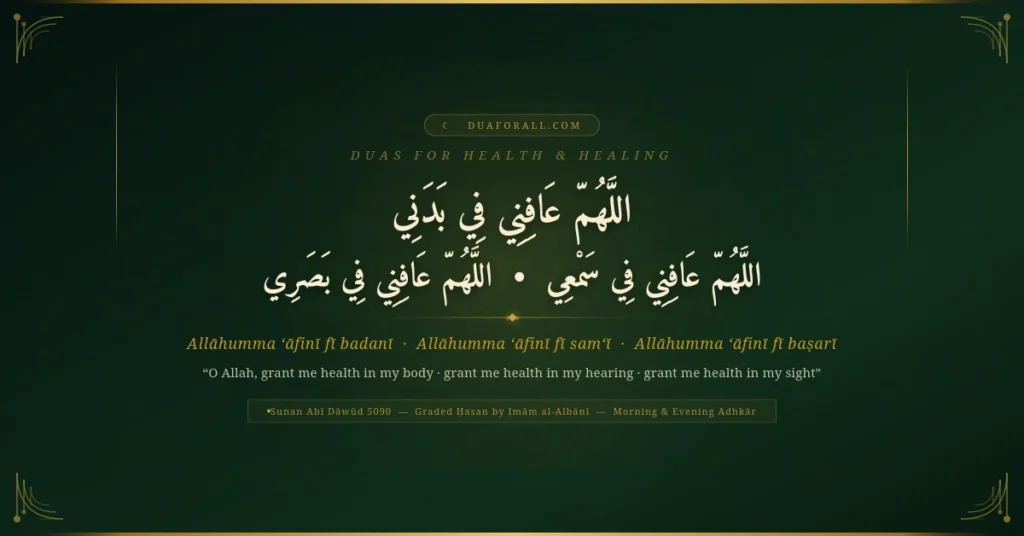
Dua for Health & Healing in Islam —
Complete Guide to Duas for Health
الشِّفَاءُ لِلَّهِ وَحْدَهُ — Healing belongs to Allah alone
Whether you need a dua for health for yourself or a loved one, this is the complete Islamic guide. Every authentic duas for health and dua for good health from the Quran and Sunnah is gathered here — each a verified health dua with Arabic text, transliteration, hadith sources, and practical guidance on how to recite with full sincerity.
🌿 Foundation
What Does Health & Healing Mean in Islam?
Islam presents a deeply holistic view of well-being — encompassing the body, mind, heart, and spirit as an inseparable whole.
Physical Health (Sihhah)
The body is an amanah (trust) from Allah. Protecting it through halal food, cleanliness (taharah), and medical care is an Islamic obligation — not merely a personal choice.
Mental & Emotional Health
Islam recognizes grief, anxiety, and sadness as real conditions. The Quran explicitly addresses emotional distress and guides believers toward inner peace through dhikr and tawakkul.
Spiritual Well-being (Ruh)
The purification of the soul (tazkiyah al-nafs) is central to Islamic healing. A heart connected to Allah through prayer and remembrance is the foundation of lasting well-being.
“Indeed, Allah has not sent down a disease except that He has also sent down its cure.”
— Prophet Muhammad ﷺ | Sahih al-Bukhari 5678This famous hadith forms the cornerstone of Islamic medical ethics. It affirms that seeking treatment is not only permissible but encouraged in Islam. Scholars like Ibn al-Qayyim elaborated extensively on the relationship between spiritual healing (al-tibb al-ruhani) and physical medicine in his landmark work Zad al-Ma’ad. Unlike approaches that see faith and medicine as competing, Islam sees them as complementary paths to Allah’s mercy.
Whether you are establishing a consistent dua health practice as a daily shield, or seeking urgent healing during an illness, the Islamic framework provides both the supplications and the spiritual context to make every recitation meaningful and anchored in authentic faith.
📖 Quranic Guidance
Quranic Verses on Health & Healing
The Quran describes itself as a shifa — a healing — for what is in the hearts. Believers who search for a quran dua for health or a dua for good health in quran will find that these verses are not merely historical recitations — they are living guidance confirmed by the Prophet ﷺ as healing. Indeed, for good health dua, the Quran remains the most authenticated primary source in the Islamic tradition. These verses are recited for physical recovery, spiritual cure, and emotional peace.
وَنُنَزِّلُ مِنَ الْقُرْآنِ مَا هُوَ شِفَاءٌ وَرَحْمَةٌ لِّلْمُؤْمِنِينَ
“And We send down of the Quran that which is a healing and a mercy for the believers.”
— Surah Al-Isra (17:82)
بِسْمِ اللَّهِ الرَّحْمَنِ الرَّحِيمِ الْحَمْدُ لِلَّهِ رَبِّ الْعَالَمِينَ
Bismillah ir-rahman ir-raheem. Al-hamdu lillahi rabb il-‘alameen…
Al-Fatiha is called Umm al-Quran (Mother of the Quran) and considered among the greatest healing surahs. The Prophet ﷺ demonstrated its use as a ruqyah for illness.
📚 Sahih al-Bukhari 5736 — Used as Ruqyah
Read Full Surah →وَأَيُّوبَ إِذْ نَادَىٰ رَبَّهُ أَنِّي مَسَّنِيَ الضُّرُّ وَأَنتَ أَرْحَمُ الرَّاحِمِينَ
Wa ayyooba idh naada rabbahu anni massani-yadurru wa anta arhamu-r-raahimeen
The dua of Prophet Ayyub (Job) ﷺ — recited during severe illness and hardship. Allah responded to this supplication and removed his affliction completely.
📚 Quran 21:83 — Dua of Prophet Ayyub ﷺ
View Full Dua →📊 Most Recited Surahs & Verses for Healing
Based on scholarly consensus and authentic hadith narrations
Source: Scholarly consensus from IslamQA.info & Sunnah.com
🤲 Supplications
Essential Duas for Health & the Sick
These prophetically verified supplications represent the best dua for good health and recovery supported by the strongest chains of narration in Islamic scholarship. If you are looking for the most powerful dua for health, scholars across the madhabs point to these very supplications as the prophetically proven starting point for any healing journey — each recited by the sick person or by someone making dua on their behalf.
اللَّهُمَّ رَبَّ النَّاسِ، أَذْهِبِ الْبَأْسَ، اشْفِ أَنْتَ الشَّافِي، لَا شِفَاءَ إِلَّا شِفَاؤُكَ، شِفَاءً لَا يُغَادِرُ سَقَمًا
Allahumma Rabb al-naas, adh-hib al-ba’s, ishfi anta al-shaafi, la shifaa’a illa shifaa’uka, shifaa’an la yughadiru saqama
“O Allah, Lord of mankind, remove the affliction. Cure, for You are the Healer. There is no cure except Your cure — a cure that leaves no illness behind.”
📚 Sahih al-Bukhari 5675 & Sahih Muslim 2191 — Recite 7 times over the sick
Read Full Guide →بِسْمِ اللَّهِ (×3) — أَعُوذُ بِاللَّهِ وَقُدْرَتِهِ مِنْ شَرِّ مَا أَجِدُ وَأُحَاذِرُ (×7)
Bismillah (×3) — A’udhu billahi wa qudratihi min sharri ma ajidu wa uhadhiru (×7)
“In the name of Allah (×3) — I seek refuge in Allah and His power from the evil of what I feel and what I fear.” (Repeat 7 times)
📚 Sahih Muslim 2202 — Place your right hand on the place of pain
View Full Dua →أَسْأَلُ اللَّهَ الْعَظِيمَ رَبَّ الْعَرْشِ الْعَظِيمِ أَنْ يَشْفِيَكَ
As’alu-llah al-‘adheem, Rabb al-‘arsh al-‘adheem an yashfiyak
“I ask Allah the Magnificent, Lord of the Magnificent Throne, to cure you.” (Recite 7 times when visiting someone who is ill)
📚 Abu Dawud 3106, Tirmidhi 2083 — Recite 7 times for the sick person
View Full Dua →🏛️ Infographic
The 5 Pillars of Islamic Healing
Understanding dua for health in Islam means recognizing that healing is multidimensional — addressing the whole person, not just the symptom. The Islamic dua for health is one essential pillar, and Islam’s framework integrates all five simultaneously for the most complete path to recovery.
🌿 A Holistic Model of Islamic Well-being
Each pillar is supported by Quranic evidence and authenticated Hadith
Supplication and remembrance of Allah — the primary spiritual cure
Reciting specific Surahs as ruqyah — Quran is explicitly called shifa
Prophetic medicine — honey, black seed, hijama, and prophetic dietary guidance
Seeking modern medicine — obligatory when life-saving, permitted always
Trust in Allah and patience during illness — itself a source of spiritual reward
This model draws from the works of Ibn al-Qayyim (Zad al-Ma’ad), Ibn Sina (Al-Qanun fi al-Tibb), and contemporary Islamic health scholars at Islamic Medicine Association.
🌾 Prophetic Medicine
Tibb al-Nabawi — The Prophet’s ﷺ Medicine
The Prophet Muhammad ﷺ recommended specific natural remedies backed by modern scientific research. Anyone seeking a dua for recovery of health after prolonged illness will find that Prophetic medicine powerfully complements and reinforces the spiritual dimension. A dua for better health is most impactful when paired with these Sunnah-aligned lifestyle practices — this is precisely what it means to pursue a dua for healthy living in the Islamic sense. These are not replacements for medical care but powerful Sunnah-aligned supplements.
🍯 Key Remedies from Prophetic Medicine
Authentic Hadith sources and modern evidence-based benefits
Called a “healing for all illnesses” (Quran 16:69). Modern science confirms antimicrobial and anti-inflammatory properties.
“A remedy for every disease except death” (Bukhari 5688). Rich in thymoquinone — clinically studied for immunity.
Recommended for eating and anointing. High in oleocanthal — a natural anti-inflammatory compound.
“The best water on earth” — regarded as a blessed drink with spiritual and physical healing properties.
“The best of your remedies is cupping” (Bukhari 5696). Now supported by WHO as complementary therapy.
“Fast and be healthy” (Ibn Sunni). Intermittent fasting is now validated by science for metabolic health.
For in-depth research, see the NIH study on Islamic prophetic medicine and Islamic Medicine Association.
“Make use of the two cures: honey and the Quran.”
— Attributed to Ibn Mas’ud رضي الله عنه | Ibn Majah 3452🧠 Inner Peace
Mental Health, Anxiety & the Healing Soul
Islam recognized mental and emotional suffering 1,400 years before modern psychiatry. For those who turn to islam dua for health during periods of emotional struggle, this section provides both the theological framework and the practical supplications — because the Quran addresses grief, fear, and anxiety with profound guidance that is as relevant today as it was at revelation.
أَلَا بِذِكْرِ اللَّهِ تَطْمَئِنُّ الْقُلُوبُ
“Verily, in the remembrance of Allah do hearts find rest.”
— Surah Ar-Ra’d (13:28) — The Quranic prescription for anxiety
Dua for Anxiety & Distress
اللَّهُمَّ إِنِّي أَعُوذُ بِكَ مِنَ الْهَمِّ وَالْحَزَنِ
Allahumma inni a’udhu bika min al-hamm wal-hazan…
“O Allah, I seek refuge in You from worry and grief, weakness and laziness, cowardice and miserliness, and from being overwhelmed by debt and overpowered by men.”
📚 Sahih al-Bukhari 6369
Read Full Dua →Islam & Modern Mental Health
Scholars and Muslim mental health professionals increasingly affirm that seeking psychological counselling is permissible and encouraged in Islam. The Islamic Medical Association of North America (IMANA) provides guidelines on integrating Islamic values with evidence-based therapy.
The concept of nafs (soul/self) in Islamic psychology aligns closely with modern understanding of psychological well-being.
Step 1 — Acknowledge the Feeling
Islam validates emotional pain. The Prophet ﷺ himself wept, felt grief, and expressed distress — it is human and honourable to acknowledge suffering.
Step 2 — Turn to Allah in Dua
Make the specific dua for anxiety (above). Combine with recitation of Surah Al-Inshirah (94), which explicitly addresses the “expansion of the chest” — a metaphor for relief from burden.
Step 3 — Maintain Salah & Dhikr
The five daily prayers serve as natural anchors that prevent rumination and provide structure. Morning and evening dhikr (adhkar) are especially protective.
Step 4 — Seek Professional Help When Needed
Consult a Muslim counsellor or mental health professional. Resources like MuslimMentalHealth.com offer directories of Muslim-friendly therapists globally.
📝 Practical Guide
How to Make Dua for the Sick — Step by Step
This step-by-step method is equally valid when making a dua for good health for someone else — a parent, a child, or a friend in need. When making duas for good health on behalf of another, simply include their name in the supplication. A sincere good health dua made for a fellow Muslim in their absence is deeply beloved in Islam — the Prophet ﷺ said the angels say “Āmīn, and for you the same” (Sahih Muslim 2732). Use the etiquette below for yourself or those you love.
Begin with Bismillah & Salawat
Start every supplication with “Bismillah” and send blessings upon the Prophet ﷺ. This is how dua “rises to the heavens without obstruction.”
Face the Qibla & Raise Your Hands
Face Makkah, raise both hands to chest level with palms open upward. This is the prophetically recommended posture for supplication.
Call Allah by His Beautiful Names
Address Allah as Al-Shafi (The Healer), Al-Rahman (The Most Merciful), or Al-Wadud (The Most Loving) — His names related to your need.
Recite the Authentic Healing Duas
Use the verified duas above — especially the ruqyah dua (Bukhari 5675) and the 7-times dua. Combine with personal supplication in your language.
Have Yaqeen (Certainty) in Allah’s Answer
The Prophet ﷺ said: “Call upon Allah while being certain of a response.” Doubt weakens dua. Trust completely in Allah’s mercy and wisdom.
✅ Best Times to Make Dua for Healing
- Last third of the night (Tahajjud time) — Allah descends to the lowest heaven
- After the obligatory prayers (Fard) — especially Fajr and Asr
- Between Adhan and Iqamah — a window when dua is not rejected
- On Fridays — especially the last hour before Maghrib
- During prostration (Sujood) — “the closest a servant is to His Lord”
- When fasting — especially at the time of breaking fast (Iftar)
- During rainfall — a narrated time when duas are accepted
- Laylat al-Qadr — the Night of Decree (last 10 nights of Ramadan)
🛡️ Quranic Healing
Ruqyah — Healing Through the Quran & Sunnah
Ruqyah is the Islamically sanctioned practice of reciting Quran and authentic supplications for protection and healing from illness, evil eye, and spiritual afflictions. For those seeking a dua for good health and long life, Ruqyah provides the most comprehensive spiritual shield — encompassing both healing from current illness and protection from future harm. The dua good health tradition in Islam is inseparable from the daily practice of Quranic recitation as a protective and healing habit.
Ruqyah Shariah
Legitimate Islamic ruqyah uses only Quran and authentic duas. It is free of innovation, charms, or unintelligible words. The Prophet ﷺ himself performed ruqyah.
Protection Duas →The Three Quls
Al-Ikhlas (112), Al-Falaq (113), and Al-Nas (114) — collectively known as the “three quls.” Recite three times each morning and evening and before sleep for comprehensive protection.
Morning Adhkar →Ayat al-Kursi
Quran 2:255 — the greatest verse in the Quran. Recited for protection from harm, evil eye (ayn), and spiritual illness. “Whoever recites it after every obligatory prayer, nothing will prevent them from entering Paradise.” (Nasa’i)
Quranic Duas →“There is no harm in ruqyah as long as it does not involve shirk.”
— Prophet Muhammad ﷺ | Sahih Muslim 2200Important Note: Ruqyah is a spiritual aid — it does not replace medical treatment. Scholars unanimously agree that combining ruqyah with medical care is the most complete approach. For verified ruqyah guidance, refer to authenticated sources like IslamQA on Ruqyah and Sheikh Ibn Baz’s fatwas on the official Ibn Baz website.
Explore Our Full Health & Healing Dua Collection
Browse 25+ authenticated duas for illness, pain, mental distress, and visiting the sick — all with Arabic text, transliteration, and hadith sources.
❓ Frequently Asked
Common Questions About Islamic Healing
Answers to the most searched questions about health, healing, and dua in Islam. For those who prefer to understand every word they recite, each dua for health in English translation is provided alongside the Arabic text — because sincere comprehension deepens the power of every supplication.
Your search for a dua for good health — whether for yourself, a parent, a child, or a dear friend — is itself an act of worship. The most powerful dua for health is not measured by words alone but by the sincerity and certainty with which it is offered to Al-Shaafi, the One who holds all cure. As you integrate these duas for health in Islam into your daily life — morning, evening, and in every moment of need — know that each authentic supplication is heard and received. Whether you seek a dua for recovery of health after illness or a dua for good health as a daily shield, return to these words, return to Allah, and trust completely in His infinite mercy. Āmīn.
📚 Further Learning
Trusted Resources & Further Reading
Deepen your knowledge with these authenticated internal and external resources on Islamic health and healing.
🔗 Internal Resources (DuaForAll)
🌐 External References
Related Topics:
May Allah Grant You Complete Shifa 🤲
Explore DuaForAll’s full collection of authenticated health and healing duas — with Arabic text, transliteration, and Hadith sources for every supplication.
اللَّهُمَّ اشْفِ مَرْضَانَا وَمَرْضَى الْمُسْلِمِينَ · O Allah, heal our sick and the sick of all Muslims