بِسْمِ اللَّهِ الرَّحْمَنِ الرَّحِيمِ
✦ Masnoon Dua — Authentic Sunnah
بِسْمِ اللَّهِ الرَّحْمَنِ الرَّحِيمِ

Dua for After Eating — Arabic, Transliteration & Meaning

Complete collection of authentic duas to recite after every meal — with Arabic text, transliteration, full translation, and verified Hadith references.

📿 4 Authentic Duas
📚 Verified Hadith Sources
✅ Scholars Approved
🕌 Daily Sunnah
⭐ Primary Dua After Eating Sunan Abi Dawud 3850
الْحَمْدُ لِلَّهِ الَّذِي أَطْعَمَنَا وَسَقَانَا وَجَعَلَنَا مِنَ الْمُسْلِمِينَ

Alḥamdu lillāhil-ladhī aṭ’amanā wa saqānā wa ja’alanā minal muslimīn

“All praise is due to Allah, Who has given us food and drink and ordained us as Muslims.”

What Is the Dua for After Eating?

Understanding the significance of this beautiful Prophetic supplication

The dua for after eating (dua after food) is a Masnoon supplication taught by the Prophet Muhammad ﷺ to express gratitude to Allah (SWT) upon completing a meal. Reciting it transforms an everyday act of eating into a form of worship (ibadah), acknowledging Allah as the sole Provider and Sustainer of all provisions. Every Muslim — young or old — is encouraged to memorise and regularly recite these duas after meals.

“Indeed, Allah is pleased with the servant who eats food and praises Him for it, or drinks a drink and praises Him for it.”

📚 Sahih Muslim, Hadith 2734 — Narrated by Anas ibn Malik (رضي الله عنه)

🌿 Is It Obligatory (Fard)?

Reciting the dua after eating is a highly recommended Sunnah (Mustahabb), not obligatory. However, it is a beloved practice of the Prophet ﷺ and carries immense spiritual reward.

⏱️ When Should It Be Recited?

Recite the dua immediately upon finishing your meal — before getting up from the table. It may be said quietly or aloud; saying it aloud encourages others, especially children, to follow.

🤲 In Arabic or English?

It is preferred to recite the dua in Arabic as narrated in the Hadith. If you are learning, you may also recite the meaning in your language while working to memorise the Arabic.

👶 Teaching Children

Teaching children the dua for after eating from a young age builds lifelong habits of gratitude. Start with the short primary dua and progress to longer ones as they grow.

All Authentic Duas After Eating

4 verified supplications from authentic Hadith collections

Dua 01 — Primary Abu Dawud 3850 · Tirmidhi

The Most Common Dua After Eating

الْحَمْدُ لِلَّهِ الَّذِي أَطْعَمَنَا وَسَقَانَا وَجَعَلَنَا مِنَ الْمُسْلِمِينَ

Alḥamdu lillāhil-ladhī aṭ’amanā wa saqānā wa ja’alanā minal muslimīn

“All praise is due to Allah, Who has given us food and drink and ordained us as Muslims.”
Narrated by Abu Sa’id al-Khudri (رضي الله عنه). This is the most widely recited dua after eating across all schools of Islamic thought.
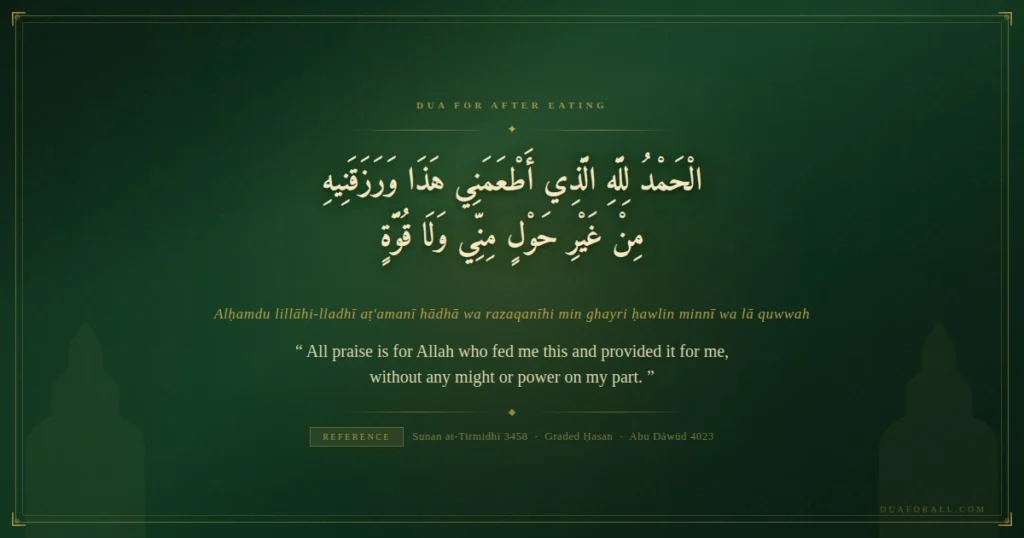
Dua 02 — Forgiveness Abu Dawud 4023 · Tirmidhi 3458

Dua That Erases Past Sins

الْحَمْدُ لِلَّهِ الَّذِي أَطْعَمَنِي هَذَا وَرَزَقَنِيهِ مِنْ غَيْرِ حَوْلٍ مِنِّي وَلَا قُوَّةٍ

Alḥamdu lillāhil-ladhī aṭ’amanī hādha wa razaqanīhi min ghayri ḥawlin minnī wa lā quwwah

“All praise is for Allah Who has fed me this and provided it for me without any might or power on my part.”
Narrated by Mu’adh ibn Anas (رضي الله عنه). The Prophet ﷺ said: Whoever recites this after eating, his preceding sins will be forgiven. (Jami’ at-Tirmidhi 3458 — Hasan)
Dua 03 — Abundant Praise Sunan at-Tirmidhi

Long Dua of Gratitude (Recited by the Prophet ﷺ)

الْحَمْدُ لِلَّهِ حَمْدًا كَثِيرًا طَيِّبًا مُبَارَكًا فِيهِ غَيْرَ مَكْفِيٍّ وَلَا مُوَدَّعٍ وَلَا مُسْتَغْنًى عَنْهُ رَبَّنَا

Alḥamdu lillāhi ḥamdan kathīran ṭayyiban mubārakan fīhi ghayra makfiyyin wa lā muwadda’in wa lā mustaghnan ‘anhu Rabbanā

“All praise is due to Allah — abundant, pure and blessed praise; a praise that can neither be forsaken nor dispensed with, O our Lord.”
Narrated by Abu Umamah (رضي الله عنه). The Prophet ﷺ regularly recited this long dua after finishing meals, expressing complete reliance on Allah’s continuous provision.
Dua 04 — Blessings & Protection Imam Malik · Muwatta

Dua for Barakah in Rizq & Protection from Hellfire

اللَّهُمَّ بَارِكْ لَنَا فِيمَا رَزَقْتَنَا وَقِنَا عَذَابَ النَّارِ

Allāhumma bārik lanā fīmā razaqtanā wa qinā ‘adhāban-nār

“O Allah! Bless us in what You have provided us and protect us from the punishment of the Fire.”
Narrated by Urwah ibn az-Zubayr and recorded by Imam Malik. It seeks both barakah (blessings) in one’s sustenance and protection from the Hellfire — a comprehensive supplication.

6 Spiritual Benefits of Reciting Dua After Eating

Why this simple act of remembrance transforms your meals into acts of worship

Benefits of Saying Dua After Eating 🤲 Acts of Worship Transforms eating into ibadah daily Sins Forgiven Dua #2 erases preceding sins 💚 Gratitude & Shukr Increases rizq & inner contentment 🛡️ Protection from Hellfire Dua #4 seeks Allah’s protection Barakah in Provision Blessings multiply in sustenance 🌱 Allah’s Pleasure Allah is pleased with the grateful Based on authentic Hadith — Sahih Muslim 2734 | Tirmidhi 3458 | Abu Dawud 3850 | duaforall.com

How to Properly Recite Dua After Eating

Follow these simple Sunnah-based steps at every meal

1

Finish Your Meal

Complete eating and set down your utensils. Do not rush — eat slowly and mindfully as the Sunnah teaches.

2

Pause & Reflect

Take a brief moment to acknowledge Allah’s blessing before rising from the table or distraction.

3

Recite the Dua

Say the primary dua or the forgiveness dua. Recite from the heart with sincerity and full awareness of meaning.

4

Teach Others

Encourage family and children to recite after every meal — spreading the Sunnah earns ongoing reward.

Complete Sunnah of Eating — At a Glance BEFORE EATING ✦ Say Bismillah ✦ Eat with right hand ✦ Eat what is near you ✦ Eat in moderation ✦ Sit while eating DURING EATING ✦ Eat slowly & mindfully ✦ Do not waste food ✦ Share with others ✦ Avoid overfilling ✦ Lick fingers after AFTER EATING ⭐ ✦ Recite Dua (Alhamdulillah) ✦ Lick plate clean ✦ Wash hands & mouth ✦ Thank the host ✦ Make dua for them KEY HADITH “1/3 food, 1/3 drink, 1/3 breath” Ibn Majah 3349 “Allah is pleased with the praiser” Sahih Muslim 2734

Gratitude in the Holy Quran

📖 Quranic Foundation
لَئِن شَكَرْتُمْ لَأَزِيدَنَّكُمْ ۖ وَلَئِن كَفَرْتُمْ إِنَّ عَذَابِي لَشَدِيدٌ

“If you are grateful, I will surely increase you [in favour]; but if you deny, indeed, My punishment is severe.”

— Surah Ibrahim, Quran 14:7

This verse forms the Quranic foundation for why Muslims recite duas after eating. Gratitude to Allah (shukr) is not merely an act of politeness — it is a pathway to increased blessings and a core pillar of the believer’s relationship with their Creator.

Frequently Asked Questions

Answers to common questions about dua after eating

The primary dua after eating in Arabic is: الْحَمْدُ لِلَّهِ الَّذِي أَطْعَمَنَا وَسَقَانَا وَجَعَلَنَا مِنَ الْمُسْلِمِينَ — transliterated as Alḥamdu lillāhil-ladhī aṭ’amanā wa saqānā wa ja’alanā minal muslimīn, meaning “All praise is due to Allah, Who has given us food and drink and ordained us as Muslims.” See our full collection of Masnoon Duas for more.
Reciting the dua after eating is a Sunnah Mustahabbah — a highly recommended practice of the Prophet ﷺ, but not obligatory (Fard). Missing it does not incur sin, but consistently reciting it earns great reward and follows the blessed example of the Prophet Muhammad ﷺ. Explore more about daily Sunnah duas here.
The dua narrated by Mu’adh ibn Anas (رضي الله عنه) is specifically mentioned in Hadith as causing the forgiveness of past sins: الْحَمْدُ لِلَّهِ الَّذِي أَطْعَمَنِي هَذَا وَرَزَقَنِيهِ مِنْ غَيْرِ حَوْلٍ مِنِّي وَلَا قُوَّةٍ. The Prophet ﷺ said: “Whoever recites this, his preceding sins shall be forgiven.” Recorded in Jami’ at-Tirmidhi 3458 and Abu Dawud 4023.
It is always best to learn and recite duas in Arabic as they were narrated. However, while learning, you may recite the meaning in your own language sincerely. Make it a goal to memorise the Arabic text — even young children can learn these short duas. Our duas for children section provides helpful learning resources.
Before eating, say بِسْمِ اللَّهِ (Bismillāh — “In the name of Allah”). If you forget before starting, say بِسْمِ اللَّهِ فِي أَوَّلِهِ وَآخِرِهِ (Bismillāhi fī awwalihi wa ākhirih) when you remember — as taught in Abu Dawud 3767. This pairs with the dua after eating to bookend your meal with remembrance of Allah.
A specific dua is mentioned in Hadith for after drinking milk: اللَّهُمَّ بَارِكْ لَنَا فِيهِ وَزِدْنَا مِنْهُ (Allāhumma bārik lanā fīhi wa zidnā minhu) — “O Allah, bless it for us and give us more of it.” For other foods and drinks, the general dua — “O Allah, bless us in it and provide us with better than it” — is recommended. Source: Abu Dawud and At-Tirmidhi.

Make Every Meal an Act of Worship

Bookmark this page, share it with family, and teach your children the beauty of Sunnah duas. Every bite becomes barakah.
✓ Copied to clipboard!