Complete Guide & Reference
Evening Adhkar
The Night Remembrances of Islam
A complete, authentic guide to the evening adhkar — the Prophetic supplications and remembrances recited after Asr until Maghrib, drawn from the Quran and verified hadith collections.
Foundation
What Are the Evening Adhkar?
📖 Table of Contents
Adhkar (أَذْكَار) is the plural of dhikr — the Arabic word for remembrance, specifically the remembrance of Allah ﷻ. The evening adhkar (أذكار المساء) refer to a collection of specific supplications, prayers of praise, and protective remembrances that the Prophet Muhammad ﷺ established as a daily evening routine for every Muslim.
These evening remembrances are typically recited after the Asr prayer until sunset (Maghrib). They mirror the morning adhkar in structure and purpose, forming together a complete daily shield of dhikr that bookends the Muslim’s day with Allah’s remembrance.
Unlike general dua which can be made at any time in any language, the evening adhkar are specific, Prophetically-transmitted formulas that appear in authentic hadith collections such as Sunan Abu Dawud, Sunan Ibn Majah, and Jami’ al-Tirmidhi.
“And remember the name of your Lord in the morning and in the evening.”
Quran — Surah Al-Insan 76:25
When to Recite
Best Time for Evening Adhkar
Scholars agree that the evening adhkar window begins after the Asr prayer and extends until sunset. The first hour after Asr is considered the most virtuous time.
🕐 Evening Adhkar — Time Window
After AsrIdeal start; the golden window opens
1st Hour After AsrMost virtuous time — scholars’ consensus
Pre-SunsetComplete all adhkar before sun sets
Maghrib AdhanEvening window closes; night begins
After MaghribNight adhkar & general dhikr resume
⚠️ If you miss the window, some scholars permit recitation shortly after Maghrib as a make-up (qada’) — but prioritise reciting on time.
The Daily Dhikr Cycle
Authentic Supplications
Complete Evening Adhkar — Arabic, Transliteration & Meaning
The following evening adhkar are drawn from the authentic Sunnah. Recite each one with presence of heart (khushu’), understanding its meaning, and the number of times indicated.
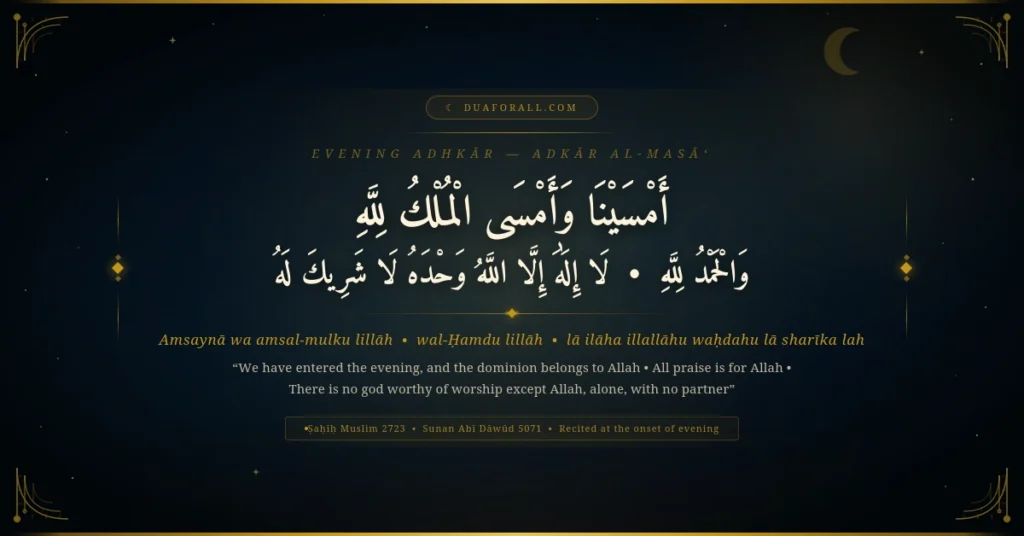
Amsaynā wa amsal-mulku lillāh, wal-ḥamdu lillāh, lā ilāha illallāhu waḥdahu lā sharīka lah, lahul-mulku walahul-ḥamdu wa huwa ʿalā kulli shay’in qadīr.
“We have entered the evening, and the dominion belongs to Allah. All praise is due to Allah. There is no god but Allah, alone, with no partner. To Him belongs the dominion and to Him is all praise, and He is over all things powerful.”
🔁 1× 🛡️ Affirms TawhidAllāhu lā ilāha illā huw, al-ḥayyul-qayyūm, lā ta’khudhuhu sinatun wa lā nawm…
“Allah — there is no deity except Him, the Ever-Living, the Sustainer of existence. Neither drowsiness overtakes Him nor sleep…” (Read full Ayat al-Kursi →)
🔁 1× 🛡️ Protection until morningQul huwallāhu aḥad… Qul aʿūdhu bi-rabbil-falaq… Qul aʿūdhu bi-rabbin-nās…
Surah Al-Ikhlas (112), Surah Al-Falaq (113), and Surah An-Nas (114) — the three surahs that encompass Allah’s oneness and seek refuge from all external and internal harm.
🔁 3× each 🛡️ Sufficient protectionAllāhumma anta rabbī lā ilāha illā ant, khalaqtanī wa anā ʿabduk, wa anā ʿalā ʿahdika wa waʿdika mastataʿt, aʿūdhu bika min sharri mā ṣanaʿt, abū’u laka biniʿmatika ʿalayy, wa abū’u laka bidhambī faghfir lī fa’innahu lā yaghfirudh-dhunūba illā ant.
“O Allah, You are my Lord; there is no god but You. You created me and I am Your slave. I am committed to my covenant and promise to You to the best of my ability. I seek refuge in You from the evil of what I have done. I acknowledge Your blessings upon me and I acknowledge my sin, so forgive me — for none forgives sins except You.”
🔁 1× ✨ Forgiveness if sincereBismillāhilladhī lā yaḍurru maʿasmihī shay’un fil-arḍi wa lā fis-samā’i wa huwas-samīʿul-ʿalīm.
“In the name of Allah, with Whose name nothing in the earth or in the heavens can cause harm, and He is the All-Hearing, the All-Knowing.”
🔁 3× 🛡️ Nothing shall harm himSubḥānallāh (33×) — Al-ḥamdulillāh (33×) — Allāhu Akbar (33×)
“Glory be to Allah” (33 times) — “All praise is due to Allah” (33 times) — “Allah is the Greatest” (33 times). Complete the hundred with: lā ilāha illallāhu waḥdahu lā sharīka lah… (Explore full Dhikr & Tasbeeh guide →)
🔁 33× each 💚 Erase major sinsAllāhumma innī as’alukal-ʿafwa wal-ʿāfiyata fid-dunyā wal-ākhirah.
“O Allah, I ask You for forgiveness and wellbeing in this world and in the Hereafter.”
🔁 3× 💚 Health & spiritual safetySpiritual & Practical
7 Powerful Benefits of Evening Adhkar
The Prophet ﷺ did not establish these evening remembrances without reason. Each benefit below is grounded in specific hadith or Quranic principles.
Benefits at a Glance
Divine Protection
Reciting the three Quls and Ayat al-Kursi grants Allah’s protection from jinn, evil eye, and harm until morning.
Forgiveness of Sins
Sayyid al-Istighfar, if recited with sincerity and one dies that evening, guarantees paradise. (Bukhari 6306)
Barakah in Provision
Regular evening dhikr opens doors of barakah in one’s rizq, time, and household — a Prophetic promise.
Inner Peace
Allah says: “Verily, in the remembrance of Allah do hearts find rest.” (Quran 13:28) — evening adhkar anchor the heart.
Spiritual Wellbeing
Asking for ‘aafiyah — comprehensive wellbeing — is among the greatest gifts one can ask Allah for every evening.
Family Guardianship
The tasbih and protective adhkar extend their shield over one’s household and loved ones by Allah’s mercy.
Closing the Day in Tawbah
Ending each day with repentance and remembrance ensures a believer’s heart is always turned toward Allah.
Step-by-Step
How to Perform Evening Adhkar
Evening adhkar are best performed in a calm, focused state. Below is the Prophetically inspired method, consistent with the practice of the Companions (Sahabah).
Perform Asr Prayer On Time
The evening adhkar window opens immediately after Asr. Guard your Asr prayer — the Prophet ﷺ warned of severe consequences for missing it. (Browse daily duas →)
Find a Quiet, Clean Space
Sit facing the Qiblah if possible, in a state of wudu. While wudu is not strictly required for dhikr, it is preferred and sets the tone for presence and focus.
Begin with “Amsayna…”
Start with the opening evening supplication that declares the sovereignty of Allah ﷻ as evening falls. This is the contextual anchor for all following adhkar.
Recite Ayat al-Kursi (1×)
The greatest verse in the Quran. The Prophet ﷺ said that whoever recites it every morning and evening will be under Allah’s protection until the next time. Read it slowly, reflecting on each attribute of Allah.
Recite the Three Quls (3× each)
Surah Al-Ikhlas, Al-Falaq, and An-Nas — each recited three times. Use your hand to wipe over your body as taught by the Prophet ﷺ. (Duas for Protection →)
Recite Sayyid al-Istighfar & Other Adhkar
Continue with the remaining adhkar in sequence: the protection dua (3×), then the wellbeing dua (3×), and complete with the tasbih of 33-33-33.
Make Personal Dua to Close
After completing the prescribed adhkar, raise your hands and make your personal supplications — for yourself, your family, and the Ummah. This is an accepted time for dua. (Family Duas →)
Common Questions
Frequently Asked Questions About Evening Adhkar
“Whoever says in the evening: ‘I seek refuge in the perfect words of Allah from the evil of what He has created’ — no harmful thing shall afflict him that night.”
Sahih Muslim — Book of Dhikr, Hadith 2709