Ramadan Duas
Essential Supplications for the Blessed Month
Every authentic dua for Ramadan — from suhoor to iftar, Tarawih to Laylat al-Qadr — with Arabic text, transliteration, and verified hadith sources.
وَإِذَا سَأَلَكَ عِبَادِي عَنِّي فَإِنِّي قَرِيبٌ ۖ أُجِيبُ دَعْوَةَ الدَّاعِ إِذَا دَعَانِ “And when My servants ask you about Me — indeed I am near.” — Al-Baqarah 2:186The Spiritual Power of Ramadan Supplications
Ramadan is the most spiritually charged month of the Islamic year — a time when the gates of Paradise are open, the gates of Hell are closed, and the shayateen are chained. The Prophet Muhammad ﷺ increased his worship and supplication tremendously during this month, and the Quran itself was revealed in Ramadan. Ramadan duas are not mere words; they are a direct conversation with Allah ﷻ at the most blessed times.
Quran 2:186 — Allah ﷻ places the ayah about dua directly within the Ramadan verses (2:183–187), signalling that supplication and fasting are inseparably linked. Ramadan is the prime season for dua to be answered.
📊 Five Pillars of Ramadan Worship
When to Make Each Ramadan Dua
Knowing when to recite specific duas maximises their spiritual impact. Here is the recommended daily structure for Ramadan supplications, aligned with the five daily prayers and the key moments of the fasting day.
🌙 The Ramadan Day — A Dua Timeline
Essential Ramadan Duas with Arabic Text
Every dua below is sourced from the Quran or authentic hadith collections (Bukhari, Muslim, Tirmidhi, Abu Dawud). The Arabic is provided in full, followed by Romanised transliteration and a clear English meaning so you can recite with understanding.
Allāhumma innī laka ṣumtu wa bika āmantu wa ‘alayka tawakkaltu wa ‘alā rizqika afṭartu
“O Allah, I fasted for You, I believe in You, I put my trust in You, and I break my fast with Your provision.”
Abu Dawud 2358 | Authenticated HadithDhahaba al-ẓamaʾu wabtallatil-‘urūqu wa thabatal-ajru in shāʾa Allāh
“The thirst is gone, the veins are moistened, and the reward is confirmed — if Allah wills.”
Abu Dawud 2357 | Ibn Umar (RA)Nawaitu ṣawma ghadin ‘an adāʾi farīḍati shahri Ramaḍāna hādhihis-sanati lillāhi ta’ālā
“I intend to fast tomorrow to fulfil the obligation of the month of Ramadan this year for the sake of Allah the Most High.”
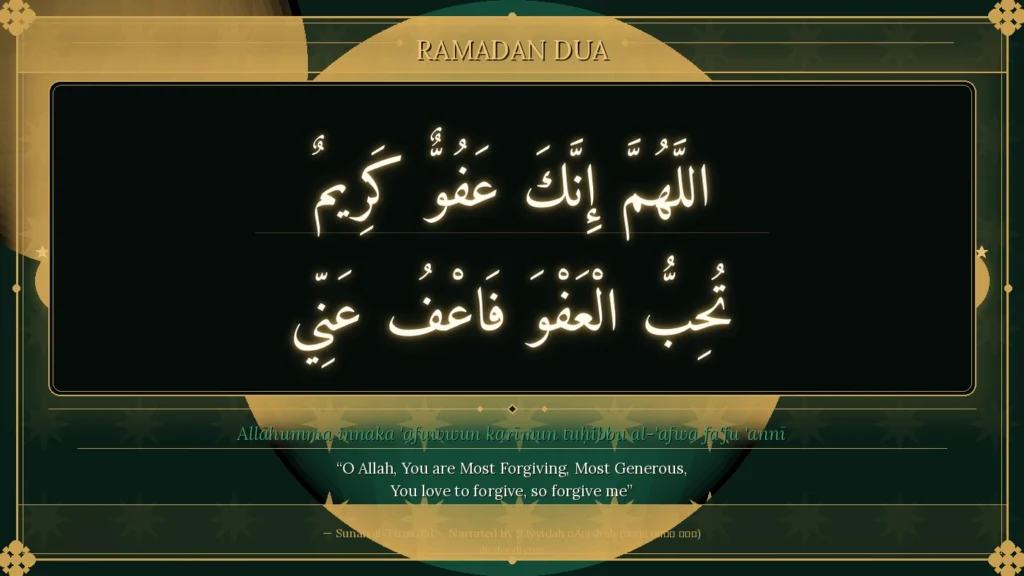
Scholarly consensus | Niyyah at heart is sufficientAllāhumma innaka ‘afuwwun tuḥibbu al-‘afwa fa’fu ‘annī
“O Allah, You are All-Pardoning and You love to pardon, so pardon me.”
Tirmidhi 3513 | Sahih — Taught by the Prophet ﷺ to Aisha (RA)Bismillāhi wa ‘alā barakatillāh
“In the name of Allah and with the blessings of Allah.”
Ibn Majah 3264 | Begin every blessed meal with thisRabbanā ighfir lanā dhunūbanā wa isrāfanā fī amrinā wa thabbit aqdāmanā wanṣurnā ‘alal-qawmil-kāfirīn
“Our Lord, forgive us our sins and our excesses in our affairs, plant our feet firmly, and give us victory over the disbelieving people.”
Quran 3:147 — Quranic Dua of the BelieversRabbanā taqabbal minnā ۖ innaka anta al-Samī’u al-‘Alīm
“Our Lord, accept from us. Indeed You are the All-Hearing, the All-Knowing.”
Quran 2:127 — Dua of Ibrahim & Ismail (AS)Subḥāna al-Maliki al-Quddūs (×3)
“Glory be to the Sovereign, the Holy One.” — Recited after Witr prayer in Tarawih, elongating the voice on the third recitation.
Nasa’i 1700 | Abu Dawud 1430 | AuthenticatedAllāhumma laka al-ḥamdu anta nūru al-samāwāti wa al-arḍi wa man fīhinn
“O Allah, to You belongs all praise. You are the Light of the heavens and the earth and all that is within them.”
Bukhari 1120 | Dua of the Prophet ﷺ at TahajjudRabbanā ātinā fī al-dunyā ḥasanatan wa fī al-ākhirati ḥasanatan wa qinā ‘adhāba al-nār
“Our Lord, give us good in this world and good in the Hereafter, and protect us from the punishment of the Fire.”
Quran 2:201 — Most beloved balanced duaRabbi irḥamhumā kamā rabbayānī ṣaghīrā
“My Lord, have mercy upon them as they brought me up when I was small.”
Quran 17:24 — Make this dua abundantly in RamadanTaqabbalallāhu minnā wa minkum
“May Allah accept (the worship) from us and from you.” — The greeting and dua shared among Muslims on the day of Eid al-Fitr.
Ibn Hajar in Fath al-Bari | Companion PracticeLast Ten Nights of Ramadan — Duas & Practices
The last ten nights of Ramadan contain Laylat al-Qadr (the Night of Decree) — a single night better than a thousand months (Quran 97:3). The Prophet ﷺ would perform i’tikaf (spiritual seclusion) during these nights and increase his worship dramatically. These are the nights to prioritise every Ramadan dua.
Which Nights to Seek Laylat al-Qadr
Prioritise the odd nights — 21st, 23rd, 25th, 27th, and 29th of Ramadan
✦ WHAT TO DO EACH NIGHT
- ① Recite the Laylat al-Qadr dua abundantly: Allāhumma innaka ‘afuwwun…
- ② Pray Tahajjud (night prayer) in the last third of the night
- ③ Recite Surah Al-Qadr (97) and Surah Al-Ikhlas frequently
- ④ Give sadaqah (charity) — its reward is multiplied on Laylat al-Qadr
- ⑤ Make a personal dua list and pour your heart out to Allah ﷻ
✦ THE NIGHTS AT A GLANCE
Begin i’tikaf — heighten ibadah
Most widely regarded as Laylat al-Qadr
21, 23, 25, 27, 29 — maximise all of them
30 Days of Ramadan — Three Sacred Phases
The Prophet ﷺ described Ramadan as having three distinct phases of divine mercy, forgiveness, and liberation. Each phase has its own emphasis on dua and worship.
🌙 The Three Ashras (Thirds) of Ramadan
Seek Allah’s boundless mercy. The opening of Ramadan is a gift of divine compassion.
Seek Allah’s forgiveness intensely. Recite Astaghfirullah and repentance duas abundantly.
Seek refuge from the Hellfire. Laylat al-Qadr falls in this ashra — maximise every odd night.
Ramadan Duas — Frequently Asked Questions
The most important Ramadan dua — particularly for the last ten nights — is the Laylat al-Qadr dua taught by the Prophet ﷺ to Aisha (RA): “Allāhumma innaka ‘afuwwun tuḥibbu al-‘afwa fa’fu ‘annī” (O Allah, You are All-Pardoning and love to pardon, so pardon me). This is narrated in Tirmidhi 3513 and is classified as sahih. For the moment of iftar, the dua “Allāhumma innī laka ṣumtu…” holds great virtue as it acknowledges fasting was done sincerely for Allah.
Yes — there is an authenticated hadith indicating that the dua of a fasting person is not rejected. The Prophet ﷺ said: “Three duas are not rejected: the dua of a fasting person at the time of breaking fast, the dua of a just ruler, and the dua of an oppressed person.” (Ibn Majah 1752 — Hasan). This is why Muslims should make the most of the moment just before iftar, when the fast has not yet been broken.
Yes, absolutely. Scholars of Islamic jurisprudence (fiqh) are agreed that personal dua — outside of the obligatory parts of prayer (Salah) — may be made in any language. Allah ﷻ hears and understands all languages. The authenticated Arabic duas have additional spiritual power due to their prophetic origin, but sincerity of heart in your native tongue is entirely valid and beloved to Allah.
The specific dua for Laylat al-Qadr recommended by the Prophet ﷺ is: “Allāhumma innaka ‘afuwwun tuḥibbu al-‘afwa fa’fu ‘annī” (O Allah, You are All-Pardoning and You love to pardon, so pardon me). This is authentically reported by Aisha (RA) in Tirmidhi 3513. Scholars recommend repeating it as many times as possible on the odd nights of the last ten nights of Ramadan, particularly the 21st, 23rd, 25th, 27th, and 29th nights.
There is no single obligatory suhoor dua, but there are several recommended practices: (1) Make the intention (niyyah) for fasting sincerely in your heart; (2) Begin the meal with Bismillah; (3) After suhoor, recite the morning adhkar including Ayat al-Kursi and the last two verses of Surah Al-Baqarah. Suhoor itself is a sunnah — the Prophet ﷺ said: “Have suhoor, for in suhoor there is barakah (blessing).” (Bukhari 1923, Muslim 1095).
Related Islamic Resources
Deepen your Ramadan worship with these curated internal resources and authoritative external references on fasting, supplications, and Islamic practice.
📂 More from DuaForAll
🔗 Trusted External Sources
In the name of Allah, the Most Gracious, the Most Merciful
May Allah Accept Your Fasting, Duas & Worship This Ramadan
Bookmark this page to return to these duas throughout the blessed month. Share with family and friends so they too may benefit — the one who guides others to goodness earns the same reward.