Journey Prayer in Islam: The Complete Guide to Dua for Traveling
Authentic Islamic supplications for every stage of travel — with Arabic text, transliteration, translation, and scholarly sources.
The Importance of Dua During Travel in Islam
In Islam, travel (Arabic: safar — سَفَر) is not merely a physical movement from one place to another — it is a spiritual opportunity. The Prophet Muhammad ﷺ taught Muslims to invoke Allah’s protection, guidance, and blessing at every stage of a journey: before departing, while riding a vehicle, upon arriving at a destination, and when returning home.
These journey prayers, collectively known as dua al-safar (دُعَاءُ السَّفَر), are among the most important Masnoon Duas a Muslim can memorise. They affirm complete reliance on Allah (tawakkul), acknowledge human vulnerability, and transform an ordinary trip into an act of worship.
Beyond supplication, Islamic law also provides the concession of Qasr prayer (shortening four-rak’ah prayers to two) for the travelling Muslim — a mercy from Allah that reflects the compassionate, practical nature of the Shari’ah.
Dua al-Safar
Specific supplications taught by the Prophet ﷺ to be recited during travel, found in authentic hadith collections.
Qasr Prayer
A concession granted by Allah to shorten four-rak’ah prayers to two when travelling a minimum distance.
Protection Duas
Supplications seeking Allah’s protection from harm at stopping places, unfamiliar areas, and overnight stays.
Return Dua
A special supplication of gratitude and repentance to be said when returning home after any journey.
Dua When Riding a Vehicle or Beginning a Journey
This is the foundational Islamic travel prayer, taken directly from Surah Az-Zukhruf (43:13–14). The Prophet ﷺ would recite this whenever he mounted any form of transport. It combines gratitude for Allah’s favour, acknowledgment of human dependence, and a reminder of the inevitable return to Allah.
Dua for Riding / Beginning the Journey
بِسْمِ اللَّهِ، سُبْحَانَ الَّذِي سَخَّرَ لَنَا هَذَا وَمَا كُنَّا لَهُ مُقْرِنِينَ، وَإِنَّا إِلَى رَبِّنَا لَمُنقَلِبُونَ
Bismillāh. Subḥānal-ladhī sakhkhara lanā hādhā wa mā kunnā lahū muqrinīn. Wa innā ilā Rabbinā la-munqalibūn.
“In the name of Allah. Glory be to the One who has subjected this for us, and we would not have been capable of it otherwise. And indeed, to our Lord we shall return.”
Then add: Allāhumma innā nas’aluka fī safarinā hādhal-birra wat-taqwā… (the full Prophetic dua of travel — see below)
Surah Az-Zukhruf 43:13–14 | Abu Dawud 2602 | Tirmidhi 3446Journey Prayer Phases at a Glance
Every Muslim traveller should learn these supplications for each stage of the journey.
Islamic Journey Prayer — Three Stages
Dua Al-Safar Guide for the Muslim Traveller
All Islamic Journey Prayers — Arabic Text, Transliteration & Translation
Each of the following Islamic supplications is rooted in the Sunnah of the Prophet ﷺ. They are among the most widely practised safar ki duas in the Muslim world.
بِسْمِ اللَّهِ، تَوَكَّلْتُ عَلَى اللَّهِ، وَلَا حَوْلَ وَلَا قُوَّةَ إِلَّا بِاللَّهِ
Bismillāhi, tawakkaltu ‘alal-lāhi, wa lā ḥawla wa lā quwwata illā billāh.
Translation: “In the name of Allah, I place my trust in Allah, and there is no might nor power except with Allah.”
The Prophet ﷺ said that a person who recites this when leaving their home will be told by an angel: “You have been guided, sufficed, and protected” — and the devils will be kept away from him. This is the perfect dua before traveling in Islam.
Abu Dawud 5095 | Tirmidhi 3426اللَّهُمَّ إِنَّا نَسْأَلُكَ فِي سَفَرِنَا هَذَا الْبِرَّ وَالتَّقْوَى، وَمِنَ الْعَمَلِ مَا تَرْضَى، اللَّهُمَّ هَوِّنْ عَلَيْنَا سَفَرَنَا هَذَا، وَاطْوِ عَنَّا بُعْدَهُ
Allāhumma innā nas’aluka fī safarinā hādhal-birra wat-taqwā, wa minal-‘amali mā tarḍā. Allāhumma hawwin ‘alaynā safaranā hādhā, waṭwi ‘annā bu’dah.
Translation: “O Allah, we ask You for righteousness and piety in this journey, and for deeds that You are pleased with. O Allah, make this journey easy for us and shorten its distance for us.”
This comprehensive traveler’s prayer in Islam was the Prophet’s ﷺ regular supplication at the start of any journey. He would recite it after mounting his conveyance and saying Alhamdulillah and the verse of Surah Az-Zukhruf. Explore our full collection of Masnoon Duas.
Muslim 1342 | Tirmidhi 3447أَعُوذُ بِكَلِمَاتِ اللَّهِ التَّامَّاتِ مِنْ شَرِّ مَا خَلَقَ
A’ūdhu bi kalimātil-lāhit-tāmmāti min sharri mā khalaq.
Translation: “I seek refuge in the perfect words of Allah from the evil of what He has created.”
The Prophet ﷺ said that whoever recites this dua for arriving at a new place will not be harmed by anything until he leaves that place. It should be said whenever stopping at a rest stop, hotel, campsite, or any unfamiliar location. See also Duas for Protection.
Sahih Muslim 2708أَسْتَوْدِعُكَ اللَّهَ الَّذِي لَا تَضِيعُ وَدَائِعُهُ
Astawdi’ukal-lāhal-ladhī lā taḍī’u wadā’i’uh.
Translation: “I entrust you to Allah, whose trusts are never lost.”
This safar ki dua is said by those remaining behind to the one departing on a journey. It is a profound affirmation of tawakkul (reliance on Allah) and an expression of love and concern.
Ibn Majah 2825 | Ahmadآيِبُونَ تَائِبُونَ عَابِدُونَ لِرَبِّنَا حَامِدُونَ
Āyibūna, tā’ibūna, ‘ābidūna, li-Rabbinā ḥāmidūn.
Translation: “Returning, repenting, worshipping, and praising our Lord.”
The complete version of this dua for returning from a journey is longer, but this phrase captures its essential spirit. The Prophet ﷺ would say this repeatedly upon approaching home and also when mounting or descending a hill. It reflects that travel should leave the believer more grateful and closer to Allah.
Sahih Muslim 1342 | Bukhari (abridged)Qasr Prayer: Shortening Your Prayers During Travel
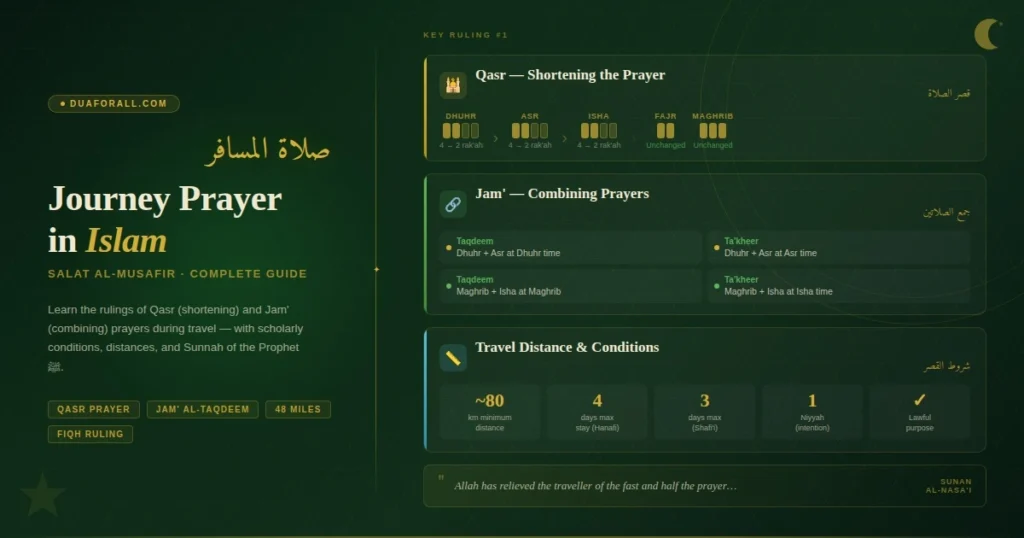
One of the most significant concessions Allah has granted to the Muslim traveller is the permission to shorten (qasr) the four-rak’ah obligatory prayers to two rak’ahs. This applies to Dhuhr, Asr, and Isha. Fajr (2 rak’ahs) and Maghrib (3 rak’ahs) remain unchanged.
Allah says in the Quran: “And when you travel in the earth, there is no blame on you if you shorten your prayers.” (Surah An-Nisa, 4:101). You can also verify current prayer times and find local masjids via IslamicFinder.
“The Prophet ﷺ used to perform two rak’ahs while on a journey and continued doing so for nineteen days.”
— Sahih al-Bukhari 1080 | Narrated by Ibn Abbas (RA)4 Conditions for Qasr Prayer to Be Valid
All four conditions must be met for a Muslim to shorten their prayers during travel
How to Perform Qasr Prayer — Step by Step
Make the intention (niyyah) for Qasr
Internally intend to perform the shortened (qasr) version of the prayer. You do not need to verbalise it — the intention in the heart is sufficient according to all four madhabs.
Pray Dhuhr, Asr, or Isha as 2 rak’ahs
Each of these normally four-rak’ah (فرض) prayers is reduced to two rak’ahs. After the second rak’ah, complete the tashahhud and salam as usual. Fajr (2) and Maghrib (3) are not shortened.
Combining prayers (Jam’ al-Salat) is also permitted
A traveller may combine Dhuhr with Asr (praying both during Dhuhr time or Asr time) and combine Maghrib with Isha. This is a separate concession that can be used alongside or independently of Qasr.
Sunnah prayers during travel are generally optional
Most scholars hold that sunnah prayers (rawatib) are waived during travel, though you may still perform nafl (voluntary) prayers if time and conditions allow. The witr prayer, however, is emphasised to be maintained.
Understanding Dua Al-Safar: Word by Word
Breaking down the meaning behind the most important Islamic journey prayer from Surah Az-Zukhruf.
Dua Al-Safar — Phrase by Phrase Breakdown
سُبْحَانَ الَّذِي سَخَّرَ لَنَا هَذَا وَمَا كُنَّا لَهُ مُقْرِنِينَ وَإِنَّا إِلَى رَبِّنَا لَمُنقَلِبُونَ
Tips for Making Your Travel Duas More Effective
The Prophet ﷺ emphasised that dua should be made with presence of heart, certainty that Allah hears, and sincerity. Here are practical ways to enhance your safar ki dua:
Learn the Arabic
Memorise the Arabic text of these duas to recite them with understanding. Begin with Surah Az-Zukhruf 43:13–14 — it is short and immensely rewarding.
Timing Matters
Say the dua when you first board the vehicle or ride, not after the journey has already begun. The intention and moment of departure carry special spiritual weight.
Teach Your Family
Make it a family habit before any car trip, flight, or outing. Children who learn these duas young carry them for life. See our Duas for Kids page for child-friendly guidance.
Be Present
Put down the phone for 30 seconds and recite the dua with full attention before a journey. Presence of heart (khushu’) is the soul of supplication in Islam.
All Journeys Count
Whether travelling by car, plane, train, bus, or even a long walk — these duas apply to all forms of travel. There is no journey too short to invoke Allah’s protection.
Maintain Your Dhikr
During long journeys, use travel time for dhikr (remembrance of Allah). Explore our comprehensive Dhikr and Tasbeeh collection.
Frequently Asked Questions About Journey Prayer in Islam
Answers to the most commonly asked questions about Islamic travel prayers, Qasr, and safar ki dua.
What is the most important dua for traveling in Islam?
The most important dua for traveling in Islam is the verse from Surah Az-Zukhruf (43:13–14): Subhana-lladhi sakhkhara lana hadha wa ma kunna lahu muqrinin, wa inna ila rabbina lamunqalibun. The Prophet ﷺ would recite this whenever mounting any vehicle or conveyance, often preceded by saying “Bismillah” three times and followed by the full prophetic travel supplication (Allahuma inna nas’aluka…).
What is Qasr prayer and when do I need to shorten my salah?
Qasr (قَصْر) means shortening. When a Muslim travels a minimum distance (approximately 80 km / 48 miles, according to the majority of scholars) with no intention of staying at the destination for more than four days, they may — and according to some scholars should — shorten the four-rak’ah prayers (Dhuhr, Asr, Isha) to two rak’ahs each. The Qasr concession begins once you leave the boundaries of your home city and ends when you return or decide to settle at a location.
Can I pray Qasr on a short trip within my city?
No. Qasr only applies when you have covered the minimum required travel distance (approximately 80 km / 48 miles according to the Hanafi, Maliki, and Shafi’i schools — some scholars set a lower threshold). Local trips within your city or town do not qualify for Qasr. For shorter journeys, pray the full number of rak’ahs as usual.
Is safar ki dua found in the Quran?
Yes — the core safar ki dua (دُعَاءُ السَّفَر) is directly drawn from the Holy Quran, Surah Az-Zukhruf (43:13–14). The Prophet Muhammad ﷺ added additional supplications to this Quranic verse, which are recorded in sahih (authentic) hadith collections including Sahih Muslim and Abu Dawud. So the Islamic journey prayer combines both Quranic verses and Prophetic sunnah.
What should I say when arriving at a hotel or unfamiliar place?
The Prophet ﷺ taught us to recite: A’udhu bi kalimatillahit-tammati min sharri ma khalaq — “I seek refuge in the perfect words of Allah from the evil of what He has created.” Recite this upon entering any hotel room, campsite, resting place, or unfamiliar building. According to the hadith in Sahih Muslim (2708), whoever says this will not be harmed at that location until they depart. This is one of the most important duas for protection for travellers.
Do I need to shorten prayers on every journey, or is it optional?
Scholars differ on this point. The Hanafi school holds that Qasr is obligatory (wajib) for the qualifying traveller — it is not merely a choice. The Maliki, Shafi’i, and Hanbali schools generally consider it a recommended sunnah (not obligatory), meaning a traveller may pray the full number of rak’ahs if they wish, though it is better to accept Allah’s concession. The Prophet ﷺ said: “Allah loves that His concessions be acted upon, just as He dislikes that His prohibitions be violated.” Always consult a knowledgeable scholar for your specific madhhab.
What dua should I say when I return home safely from a journey?
The Prophet ﷺ would say upon returning: Ayibuna, ta’ibuna, ‘abiduna, li-Rabbina hamidun — “Returning, repenting, worshipping, and praising our Lord.” He would also perform two rak’ahs of prayer upon arriving home before sitting down, as is recorded in Sahih Bukhari and Sahih Muslim. It is also sunnah to greet your family warmly and express gratitude to Allah for a safe return.
Related Duas, Tools & Islamic Resources
Deepen your knowledge and practice with these curated resources — internal guides and trusted external references.
اللَّهُمَّ أَنْتَ الصَّاحِبُ فِي السَّفَرِ وَالْخَلِيفَةُ فِي الْأَهْلِ
“O Allah, You are the Companion in travel and the Guardian of the family.”
— Sahih Muslim 1342 | Part of the full Prophetic travel supplication