Dua for Interview — 6 Authentic Supplications for Job Interview Success
Discover the most powerful dua for interview success — authentic Quranic and Prophetic duas with Arabic text, transliteration, and English translation to help you seek Allah’s guidance, ease, and confidence before your next job interview.
Why You Need a Dua for Interview Success
Job interviews can be among the most stressful experiences in a professional’s life. The anticipation, the pressure to perform, and the uncertainty of the outcome can create overwhelming anxiety. As Muslims, we are blessed with a powerful spiritual tool that brings calmness to the heart and clarity to the mind — a sincere dua for interview success, rooted in dua (supplication).
Dua is described in Jami’ at-Tirmidhi (3371) as the essence of worship. When we raise our hands before an interview, we acknowledge that all outcomes are ultimately in Allah’s hands, and this acknowledgment itself brings a deep sense of peace. While there is no single dua prescribed exclusively for interviews, the Quran and Sunnah contain many powerful supplications you can use as a dua for interview success, addressing exactly what we need: confidence, clear speech, ease, and trust in Allah’s plan.
Important Reminder: Dua and effort go hand in hand. The Prophet ﷺ taught us to tie our camel first and then place our trust in Allah. Prepare thoroughly for your interview — research the company, practise your answers, dress well — and then place your trust in Allah through sincere supplication. Explore more about balancing effort and trust in our guide to Dua for Success.
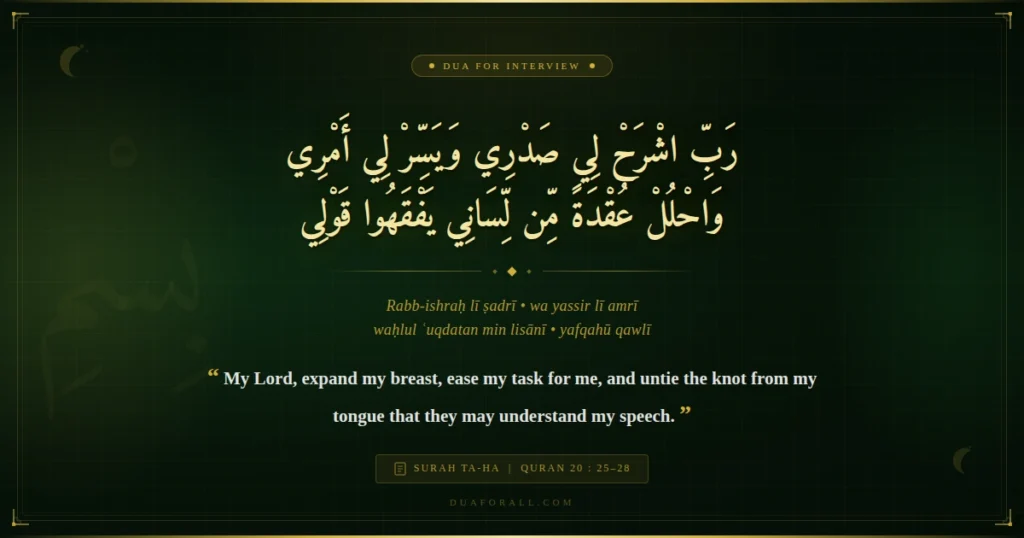
Dua of Prophet Musa (AS) — For Confidence & Clarity of Speech
This is widely considered the most powerful dua for interview success. Prophet Musa (AS) made this supplication when Allah commanded him to confront Pharaoh — one of the most daunting tasks imaginable. He asked for an expanded chest (inner confidence), ease in his task, and clear speech. These are the exact qualities needed in a job interview.
Dua for Leaving the House — For Protection & Guidance
The Prophet ﷺ taught this supplication for every time we step out of our homes. It places you under Allah’s protection from the moment you leave for your interview. According to the hadith, whoever recites this will be guided, defended, and protected, and Shaytan will stay away.
Dua for Rizq (Provision) — Asking Allah for What You Need
This is the dua of Prophet Musa (AS) when he arrived in Midian as a stranger with nothing — tired, hungry, and far from home. He sat down and made this heartfelt plea to Allah. Shortly after, Allah provided him with shelter, work, and a family. It is one of the most beloved duas for anyone seeking a job or new opportunity.
“Call upon Allah with certainty that He will answer you. Know that Allah does not respond to a dua from a heart that is heedless and distracted.”
Dua for Tawfiq — Trusting Allah for Success
Prophet Shu’aib (AS) recited this supplication when his people mocked and opposed him. Despite the difficulty, he remained steadfast in his mission, declaring that all success comes from Allah alone. This is a powerful reminder before any interview — your effort matters, but the result belongs to Allah.
Dua for Ease in Difficulty
This is a supplication for any situation that feels overwhelming. It acknowledges that only Allah can transform something difficult into something easy. Interviews, exams, and presentations — this dua covers them all.
Comprehensive Dua for Well-Being — For This World & the Hereafter
This is one of the most frequently recited duas in the entire Quran. It asks Allah for the best of this world and the Hereafter — a comprehensive supplication that covers your interview, your career, and everything beyond. The Prophet ﷺ used to make this dua regularly.
How to Prepare Spiritually on Interview Day
Combine your professional preparation with this spiritual routine for a holistic approach to interview success. This timeline guides you from the morning of your interview to the moment you walk in.
🌅 Pray Fajr on Time
Start your day in a state of spiritual purity. Praying Fajr on time sets a foundation of barakah (blessing) for the entire day.
📿 Recite Morning Adhkar
Complete your morning remembrances including Ayat al-Kursi and the three Quls. Add Dua #3 (Rizq) and Dua #6 (Well-Being) from this page. Visit Daily Duas for the full list.
🤲 Pray Two Rakat Salat al-Hajah
The prayer of need — a voluntary two-rakat prayer specifically for asking Allah’s help in important matters. Make heartfelt dua in sujood.
🚪 Recite Dua for Leaving the House
Say Bismillah, tawakkaltu ala Allah… (Dua #2) as you step out. This places you under Allah’s direct protection.
🗣️ Recite Dua of Musa (AS) Before Entering
Just before you walk in, recite Rabbi-shrah li sadri… (Dua #1) for expanded confidence and clear speech.
💚 Trust in Allah’s Plan
Keep Wa ma tawfiqi illa billah… (Dua #4) in your heart. Whatever the outcome, it is from Allah’s wisdom.
Practical Tips Alongside Dua
Islam teaches a holistic approach — combine spiritual devotion with practical effort. The Prophet ﷺ said to tie your camel and then trust in Allah. Here is how to pair your dua for interview success with practical preparation when readying for a job interview.
Research the Company
Study the organisation’s mission, products, culture, and recent news before your interview.
Practise Key Questions
Prepare answers for common questions like “Tell me about yourself” and “Why this role?”
Dress Professionally
First impressions matter. Dress modestly and professionally for your industry.
Arrive Early
Aim to arrive 10-15 minutes early. Use the waiting time to silently recite your duas.
Build Your Skills
Continuously improve through courses and certifications. Seek knowledge — Dua for Knowledge can help.
Follow Up Gracefully
Send a thank-you email after the interview and make dua for a good outcome regardless of how it went.
Pray Salat al-Istikhara: Before accepting any job offer, it is highly recommended to pray Istikhara — the prayer of guidance. Ask Allah to guide you towards what is best for your deen and dunya. This is one of the greatest blessings available to a Muslim when making important life decisions. Learn about the Masnoon Duas from the Sunnah of the Prophet ﷺ.
Related Duas You Should Know
Strengthen your spiritual toolkit beyond this dua for interview guide with these related collections of authentic supplications from DuaForAll.
Frequently Asked Questions About Dua for Interview
There is no single dua prescribed exclusively for job interviews. However, several authentic Quranic supplications — particularly the Dua of Musa (AS) from Surah Taha 20:25-28 — and Prophetic prayers are highly relevant and widely recommended by scholars for seeking ease, clarity, and confidence before any important meeting or assessment.
You can recite these duas at multiple points throughout the day: during your morning adhkar after Fajr, before leaving your house, while travelling to the venue, and silently in your heart just before the interview begins. Consistency and sincerity (ikhlas) are more important than the exact timing.
Yes, absolutely. While reciting the Arabic text carries special blessings, Islam permits personal supplication (dua) in any language. Allah understands all languages, and the sincerity of your heart is what matters most. Combine the authentic Arabic duas with personal prayers in your mother tongue for the best results.
No. Islam teaches a balanced approach — known as “tying your camel.” You should prepare thoroughly for the interview (research, practise, dress well, arrive on time) while simultaneously placing your trust in Allah through dua, Istikhara, and Tahajjud. Effort and supplication together form the Islamic approach to success.
Yes, Salat al-Istikhara is highly recommended before any significant decision, including accepting a job opportunity. It helps you seek Allah’s guidance on whether this particular role is best for both your worldly life and your Hereafter. Pray it once you have a real opportunity to consider.
Absolutely. Making dua for others is highly encouraged in Islam. A hadith in Sahih Muslim teaches that when you make dua for a fellow Muslim in their absence, an angel says “Ameen, and may you receive the same.” A parent’s dua for their child is especially powerful and is accepted by Allah without any barrier.
“And when My servants ask you concerning Me — indeed I am near. I respond to the invocation of the supplicant when he calls upon Me.”