بِسْمِ اللَّهِ الرَّحْمَٰنِ الرَّحِيمِ
☾ Riba-Free Home Finance · Scholar ReviewedIslamic Mortgage Calculator
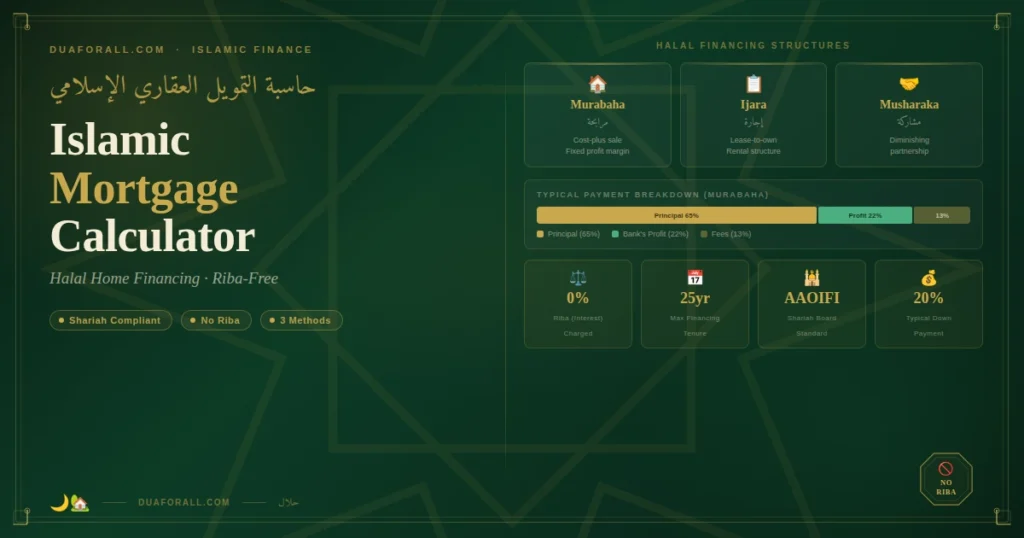
Murabaha · Ijara · Diminishing Musharakah
Model your Shariah-compliant home finance across all three mainstream structures — with a full amortisation schedule, side-by-side cost comparison charts, an ownership timeline, and an honest riba benchmark. Free, private, and calculated entirely in your browser.
Shariah-Compliant Home Finance Calculator
Choose a structure, enter your figures, and see the full cost — instalment by instalment.
Murabaha (cost-plus sale) The provider buys the property and immediately resells it to you at an agreed markup. The total sale price is fixed at signing and cannot rise afterwards, which is Murabaha’s defining protection.
Amount financed: —
Total profit / rent paid: —
Total paid over term: —
Cost of finance: —
Your Full Amortisation Schedule
Every instalment, broken into the profit or rent portion and the portion that actually buys you ownership. This is the single most useful document in any home finance decision — and the one providers are slowest to hand over.
| Year | Payment | Profit | Capital acquired | Outstanding | You own |
|---|
Figures are rounded for display; totals are computed on unrounded values, so a row may differ from the sum by a rounding unit.
Compare All Three Structures
Same property, same deposit, same term, same rate — modelled through each contract. The differences you see below come purely from how each structure calculates the return, not from any assumption that one provider is cheaper than another.
Total cost of finance by structure
Profit or rent paid over the whole term, excluding fees and takaful. Lower is not automatically better — read the trade-offs beneath the chart.
Ownership over time
The share of the property you own outright, month by month, under each structure.
Payment profile
What you actually hand over each month across the life of the plan.
What Is an Islamic Mortgage?
Strictly speaking, there is no such thing. “Islamic mortgage” is a convenient label people search for; the products themselves are home purchase plans, and they are not mortgages at all.
A conventional mortgage is a loan secured on property. The bank lends you money, you buy the house, and you repay the loan plus interest. The bank never owns the house; it owns a debt and a charge over the house. Its income comes from the passage of time applied to a sum of money. That is the definition of riba.
A Shariah-compliant home purchase plan does something structurally different. The provider acquires a real interest in the property itself — as seller, as landlord, or as co-owner — and earns its return from that asset: a profit on a sale, rent on a lease, or rent on the portion it still owns. The distinction is not cosmetic. It changes who holds title, who carries which risks, what happens if the property is destroyed, and what the provider may lawfully do if you fall behind.
The four tests every structure has to pass
- Real ownership. The provider must genuinely own the asset — even momentarily — before selling or leasing it. Selling what you do not possess is prohibited (Sahih al-Bukhari 2126).
- Real risk. Ownership must carry consequences. The provider should bear the risks of ownership for its share — structural loss, title defects — rather than transferring every conceivable risk to you while keeping the return.
- No riba in substance. The return must arise from sale or lease, not from lending. Crucially, the amount owed must not increase because time has passed or because you paid late.
- Certainty, not gharar. Price, rent, term, and the mechanics of transfer must be known and stated. Excessive uncertainty invalidates the contract.
Why Riba Is Prohibited
Understanding what the prohibition actually targets is what lets you evaluate a product rather than trust a label.
وَأَحَلَّ اللَّهُ الْبَيْعَ وَحَرَّمَ الرِّبَا
“…But Allah has permitted trade and has forbidden interest.”
— Qur’an, Surah al-Baqarah 2:275 · Read on Quran.com
This verse is the hinge of the entire discipline. It does not say wealth is forbidden, or profit, or that money must be lent for free. It draws a line between two ways of making money: bay’ (trade — where you take on an asset, bear its risk, and earn from that) and riba (where money produces more money simply because time has passed). Islamic finance exists to keep every transaction on the permitted side of that line.
The warning attached is unusually severe. Immediately after, the Qur’an addresses those who persist: “…then be informed of a war from Allah and His Messenger” (2:279). No other financial sin in the Qur’an is framed this way.
Jabir (may Allah be pleased with him) reported that the Messenger of Allah ﷺ cursed the one who consumes riba, the one who pays it, the one who records it, and its two witnesses — and said they are all equal in sin.
— Sahih Muslim 1598 Sahih · Read on Sunnah.com
Note who is included: not only the one who profits, but the one who pays, the clerk who documents it, and the witnesses. This is why buying a home matters so much to so many Muslim families — a conventional mortgage is not a passive exposure to a flawed system. It is a contract you personally sign.
The hadith that makes structure decisive
There is one narration that sits underneath the whole architecture of Islamic home finance, and it deserves to be read carefully rather than quoted in passing.
Bilal brought the Prophet ﷺ some high-quality dates. Asked where they came from, he explained he had traded two measures of ordinary dates for one measure of the better kind. The Prophet ﷺ responded that this was precisely riba, and told him not to do it — instead, to sell the ordinary dates for money, and then use the money to buy the dates he wanted.
— Sahih Muslim 1594 Sahih · Read on Sunnah.com
Two lessons pull in opposite directions here, and honest scholarship holds both:
- Structure genuinely changes the ruling. Bilal’s goal was identical before and after. The Prophet ﷺ did not tell him to abandon the objective — he told him to restructure the transaction into two real sales. Form is not a triviality in Islamic law. This is the textual foundation on which Murabaha and the two-sale structures stand.
- But the restructuring must be real. Bilal genuinely sold, genuinely received money, and genuinely bought. Had the “sales” been a fiction with the same person, executed in the same breath purely to reach a forbidden outcome, the scholars who wrote on hiyal (legal devices) would have condemned it — and many classical jurists did exactly that in other contexts.
Murabaha — The Cost-Plus Sale مُرَابَحَة
The oldest and simplest of the three. Murabaha is not a financing technique invented by banks — it is a classical sale in which the seller discloses his cost and his profit, discussed in the fiqh literature centuries before modern banking existed.
How it works
You identify the property
You find the house and agree a price with the seller. The provider is not involved in choosing it.
The provider buys it
The provider purchases the property from the seller and takes genuine ownership. This step is not paperwork theatre — if it does not really happen, the structure fails. You may be asked to sign a promise to purchase (wa’d) beforehand, which is what makes the provider willing to buy.
The provider resells it to you
Immediately, at a price of cost + a disclosed markup. Both numbers are stated. You now own the house outright; the provider holds a legal charge over it as security for the unpaid price, exactly as any seller might.
You pay the price in instalments
The total is fixed at signing and divided across the term. It cannot legitimately be increased afterwards for any reason — including if you pay late.
Where the scholars agree, and where they don’t
The permissibility of a deferred-payment sale at a higher price than the cash price is the position of the overwhelming majority across the four madhabs. A seller may charge more for credit than for cash, because he is pricing a different transaction — not lending money. The AAOIFI Shariah Standard on Murabaha to the Purchase Orderer codifies this for modern use.
The genuine points of scrutiny are narrower and more practical:
- Does the provider really own it, even for a moment? Some arrangements collapse the two sales into a single simultaneous signing where the provider’s ownership exists only on paper for seconds. Scholars differ on how much this matters; all agree it must not be entirely fictional.
- Is the promise to purchase binding? If the customer’s wa’d is legally enforceable, critics argue the provider has taken no real ownership risk — it always had a guaranteed buyer. Many Shariah boards permit a binding promise; the Islamic Fiqh Academy has addressed this and the discussion is live.
- What happens on default? If the contract lets the provider add charges to the outstanding price, the fixed-price protection is illusory and riba has re-entered through the back door.
Ijara wa Iqtina — Lease to Own إِجَارَة مُنْتَهِيَة بِالتَّمْلِيك
Also called Ijara Muntahia Bittamleek — “a lease ending in ownership”. The provider buys the property and keeps it. You are, in law, a tenant with a path to the title deed.
How it works
The provider buys and holds title
Your deposit typically goes toward the purchase price. The provider is registered as owner — it is the landlord, not a lender.
You lease the property
You sign a lease and pay rent for the use of the asset. Rent is a real payment for a real benefit (manfa’ah), which is why it is unambiguously permitted.
You pay acquisition amounts alongside the rent
A separate component of each payment goes toward eventually acquiring the property. This is kept legally distinct from the rent — bundling them into one undifferentiated sum is a structural error.
Title transfers at the end
Through an independent undertaking — a gift (hibah) or a token sale — executed as a separate contract. It must be separate: a lease that automatically converts itself into a sale merges two contracts into one, which classical fiqh does not permit.
Points of scrutiny
- Who bears ownership risk? A landlord must carry the burdens of ownership: major structural repair, total loss of the asset, and typically the property insurance or takaful. AAOIFI is explicit that these cannot all be pushed onto the tenant while the provider keeps the rent. Read the maintenance and insurance clauses closely — this is where compliance most often quietly fails in practice.
- Can the rent be reviewed? Almost always yes, usually against a market benchmark. Periodic rent review in a long lease is permissible in principle. But if the rent tracks an interest index precisely and is described internally as a “rate”, the economic resemblance to a variable-rate loan is close enough that some scholars object, even while accepting the structure.
- What if you leave early? A lease is a lease. Terminating it has consequences, and your acquisition payments’ treatment on exit varies enormously between providers.
Diminishing Musharakah — The Shrinking Partnership مُشَارَكَة مُتَنَاقِصَة
The structure most Shariah scholars consider the closest to the spirit of Islamic commercial law — and, in most scenarios, the cheapest of the three. It is the dominant model in the UK and increasingly in Pakistan and the Gulf.
How it works
Three contracts sit side by side, and their separateness is the point:
1 · Shirkat al-Milk
Co-ownership. You and the provider buy the property together in proportion to your contributions — say 20% you, 80% them. This is a genuine partnership in an asset, not a loan.
2 · Ijara
You occupy the whole property, but 80% of it isn’t yours. So you pay the provider rent — on its share only. You never pay rent on the part you already own.
3 · Bay’ (unit purchase)
Each month you buy a unit of the provider’s share. Its stake shrinks, yours grows — and because rent is charged on a shrinking base, the rent falls with it.
Why the payments fall
This is the mechanical heart of the structure and worth grasping properly. Suppose the provider starts with 80% and you buy that out evenly over 240 months. In month 1 you pay rent on 80% of the property. In month 120 you pay rent on 40%. In month 240 you pay rent on a sliver. Your monthly cheque is largest at the start and smallest at the end — the opposite shape to an annuity, and the reason total cost comes out lower.
It also means overpayment works immediately and permanently. Buy an extra unit and your rent drops the very next month, forever. There is no early-settlement penalty problem to negotiate, because you are not settling a debt — you are buying an asset you were always entitled to buy.
Points of scrutiny
- Is the rent tied to the property or to a rate? Purists argue rent should reflect the market rental value of the provider’s share. In practice nearly every provider benchmarks it to a cost-of-funds index. Most Shariah boards permit benchmarking on the basis that a benchmark is a measuring stick, not the thing measured — a well-known analogy is that using a Christian’s height to measure a Muslim’s does not make the Muslim a Christian. Some scholars remain unpersuaded.
- Are the three contracts genuinely independent? Bundling the partnership, the lease and the purchase promise into one instrument where each is a condition of the others recreates the prohibited “two contracts in one”.
- Who bears loss? In a real partnership, loss follows capital. If the property is destroyed or falls in value and the customer alone absorbs 100% of the loss while the provider’s share is guaranteed, it is not a partnership in substance.
Side-by-Side Comparison
The practical differences that will actually affect your life, rather than the marketing differences.
| Feature | Murabaha | Ijara wa Iqtina | Diminishing Musharakah | Conventional mortgage |
|---|---|---|---|---|
| Underlying contract | Sale at cost + markup | Lease + separate transfer | Partnership + lease + unit sale | Interest-bearing loan |
| Who owns the property | You, from day one | The provider, until the end | Both, in shifting proportions | You (bank holds a charge) |
| How the provider earns | Profit on a sale | Rent on an asset it owns | Rent on its share | Interest on money lent |
| Riba-free? | Yes, if structured properly | Yes, if structured properly | Yes, if structured properly | No |
| Payment shape | Level, fixed | Level, reviewable | Declining | Level or variable |
| Can the payment rise? | No — price is locked | Yes, at rent review | Yes, at rent review | Yes, unless fixed |
| Benefit from overpaying | Only via discretionary rebate | Varies by provider | Immediate and automatic | Often, subject to charges |
| Late payment penalty | Not permitted as provider income — charity-only, if any | Charged as income | ||
| Typical total cost | Highest (esp. flat markup) | Middle | Lowest | Comparable to Ijara |
| Best suited to | Those who value absolute certainty above all | Those who want provider-borne ownership risk | Those who plan to overpay or move | — |
“Typical total cost” assumes identical rates across structures, which is how the calculator models them. Real-world pricing differs between providers and may reverse this ordering.
How the Maths Works
Published in full, because a calculator you cannot audit is a calculator you should not trust. Let P = property price, D = your deposit, F = P − D (the amount financed), r = the annual rate, i = r/12 (monthly), and n = the term in months.
Murabaha — flat markup (classical form)
- Total markup: M = F × r × years
- Total sale price: T = F + M
- Monthly instalment: T ÷ n — identical every month
- Each instalment splits into a constant capital part (F ÷ n) and a constant profit part (M ÷ n)
The markup is charged on the entire financed amount for the entire term, even though you have already repaid most of it by year 15. This is why flat pricing produces the highest total — and why virtually no provider actually uses it for long-term home finance.
Murabaha — annuity-equivalent, and Ijara wa Iqtina
Both produce level payments derived from the standard annuity formula:
- Each month, the profit or rent portion is outstanding balance × i
- The remainder buys capital, so the balance falls slowly at first and quickly at the end
- Total profit or rent = (Payment × n) − F
Diminishing Musharakah
- The provider’s opening share is B = F; you buy it out in equal units of E = B ÷ n
- In month k, the provider still owns Rk = B − E × (k − 1)
- Rent that month: Rk × i — charged only on their remaining share
- Your payment: E + (Rk × i), which falls every single month
- Total rent over the term simplifies neatly to B × i × (n + 1) ÷ 2
The conventional benchmark bar
Calculated with the same annuity formula at your benchmark rate. It appears in the comparison chart purely so you can see the scale of what riba costs, and what it does not cost. It is not an option being offered to you.
What the calculator deliberately does not model
- Rate or rent reviews — every structure is modelled at a constant rate, which no variable product actually is
- Stamp duty, land registry, transfer tax and jurisdiction-specific charges, which vary enormously
- Provider-specific fee structures beyond the single one-off field
- Inflation, property appreciation, and the opportunity cost of your deposit
- Early settlement, overpayment, payment holidays and arrears
Is It Genuinely Halal? Both Views, Fairly Stated
This is the question that brought most readers to this page, and it deserves better than reassurance. There is a real disagreement among qualified scholars. Here is each side at its strongest, argued as its own proponents would argue it.
✓ The permissive position
Held by the majority of contemporary Shariah boards, AAOIFI-aligned institutions, most national fatwa councils in Muslim-majority states, and scholars including the boards of major Islamic banks.
- The Qur’an distinguishes trade from riba. If sale and loan were equivalent whenever the totals matched, 2:275 would be an empty distinction. It plainly is not. Allah drew the line at structure.
- Deferred sale at a higher price is settled fiqh. All four madhabs permit selling on credit for more than the cash price. This is not a modern innovation.
- The Bilal hadith is explicit authority for restructuring. The Prophet ﷺ preserved the objective and changed the mechanism. That is precisely what Islamic home finance does.
- Benchmarking is measurement, not identity. Using a conventional index to price rent no more makes rent into interest than using a mile marker makes your journey into a road.
- Real ownership entails real consequences. Under Ijara and Musharakah the provider genuinely holds title or a share, and genuinely bears the associated risk. A lender never does.
- The alternative is worse. Muslims in the West otherwise face a choice between indefinite renting and an unambiguously prohibited loan. Islamic law weighs necessity and hardship; shutting down the only lawful path is not neutral.
⚠ The critical position
Held by a significant minority — including some Deobandi and Salafi scholars, several academic economists writing within the field, and a number of independent muftis in the West.
- Substance over form. Classical jurists condemned hiyal — devices that reach a forbidden end through permitted-looking steps. If a product prices like a loan, moves like a loan and defaults like a loan, the paperwork does not sanctify it.
- The ownership is often momentary. When a provider “owns” a house for the seconds between two simultaneous signatures, it has assumed no meaningful risk. Ownership without risk is a formality.
- Binding promises erase the risk. If the customer is legally compelled to buy, the provider never faced the possibility of holding an unsold asset — which was supposed to be what justified the profit.
- Risk is quietly re-transferred. Many Ijara contracts push insurance, maintenance and total-loss liability onto the tenant through side agreements, leaving the provider with a guaranteed return and no exposure. That is a loan wearing a lease.
- Pricing tracks interest exactly. If the return were genuinely derived from property, it would move with rental yields, not with central bank policy.
- Necessity is being overstated. Renting is halal, available, and involves no debt. Hardship arguments (darurah) are for survival, not for preferred tenure. Not owning a home is not a necessity.
What follows from this honestly
Notice what the two sides do not disagree about. Both accept that a genuine sale is halal. Both accept that a loan at interest is haram. Both accept that a sham arrangement is haram. The disagreement is almost entirely empirical — about whether particular contracts in the market today are genuine or sham — rather than theological.
That has a practical consequence that most articles on this subject bury: the question “are Islamic mortgages halal?” has no answer. The answerable question is “is this contract, from this provider, in this country, structured genuinely?” Two products marketed under the same Arabic name can differ enough that one satisfies both camps and the other satisfies neither.
How to Apply, Step by Step
The order matters more than people expect. Doing these in the wrong sequence is how buyers end up locked into a product they never properly read.
Establish what you can actually afford
Not what a provider will lend. Model each structure in the calculator above at a rate two to three points above today’s, because Ijara and Musharakah rents are reviewable and terms run for decades.
Save a serious deposit
Islamic providers generally want more equity than conventional lenders — commonly 10–25%, and Diminishing Musharakah needs a real opening share. A bigger deposit cuts your cost in every structure.
Shortlist providers and request the actual documents
Not the brochure. Ask for the specimen contract, the Shariah board’s fatwa with its reasoning, the rent review clause, the maintenance and insurance allocation, the default clause and the early settlement policy. A provider confident in its structure will hand these over.
Have them reviewed by someone independent
Ideally a scholar with both fiqh training and familiarity with property law where you live. The provider’s own board is not independent — that is not an accusation, it is a definition.
Get a decision in principle, then find the property
Sellers take you seriously with one, and it tells you your real ceiling before you fall in love with a house.
Pray Salat al-Istikhara before you commit
Not as a formality at the end, but as a genuine part of the decision — after you have gathered knowledge and consulted people, as the Sunnah intends. See the complete Istikhara guide.
Complete — and keep every document
Store the contract, the Shariah certificate and the payment schedule together. If a dispute arises in year twelve, the documents are what you will have.
Red Flags in the Contract
Nine things to look for before you sign. Any one of them warrants a direct question; several together warrant walking away.
Penalty interest on late payment
If arrears increase what you owe as provider income, that is riba, unambiguously. A charity-donated late charge or documented administrative cost recovery is a different matter.
The word “interest” anywhere
In the terms, the illustration, the arrears letter. Sloppy drafting is sometimes just sloppy — but it suggests a conventional product with an Islamic wrapper bolted on.
Ijara where you insure the building
The owner insures the asset. If you are a tenant but carry total-loss risk, the provider has ownership’s rewards without its burdens.
No Shariah board, or an unnamed one
Named, credentialed, contactable scholars publishing reasoned opinions — or nothing. “Shariah-compliant” is not a regulated phrase in most countries.
Refusal to show the contract pre-application
You are being asked to commit before you can evaluate. In a transaction this size, that is not normal and not acceptable.
Everything bundled into one document
Musharakah, Ijara and unit purchase must be legally separable. Merging them is the classical prohibition of two contracts in one.
A guaranteed early settlement discount
Counter-intuitive, but a contractual right to a time-based rebate turns a fixed sale price back into a time-priced debt. Discretionary ibra is the compliant form.
Musharakah where you absorb all loss
If the property falls in value or is destroyed and the provider’s share is contractually protected, it is not a partnership. Loss follows capital.
“Certified by scholars” with no names
Certified by whom, on what reasoning, reviewed when? Vagueness at this point is a choice someone made.
Availability by Country
A general orientation, not a directory. Providers, regulation and tax treatment change; verify locally before relying on any of it.
| Country / region | Availability | Dominant structure | Notes |
|---|---|---|---|
| United Kingdom | Well established | Diminishing Musharakah | FCA-regulated home purchase plans. Double stamp duty on the two transfers was removed in 2003, which is what made the market viable. |
| Malaysia | Highly developed | Musharakah Mutanaqisah, Bai’ Bithaman Ajil | The most mature regulatory framework globally, with a national Shariah Advisory Council at the central bank. |
| GCC (UAE, Saudi, Qatar, Kuwait, Bahrain) | Widely available | Ijara, Diminishing Musharakah | Mainstream rather than niche. AAOIFI standards are mandatory in several of these jurisdictions. |
| Pakistan | Growing rapidly | Diminishing Musharakah | Meezan, Bank Alfalah Islamic, Faysal and others. Riba elimination has been the subject of sustained constitutional litigation. |
| United States | Limited but real | Diminishing Musharakah, Ijara, Murabaha | A handful of specialist providers with state-by-state coverage. Check your state before assuming access. |
| Canada | Limited | Murabaha, Diminishing Musharakah | A small provider set; availability varies by province. |
| Australia | Limited | Ijara, Diminishing Musharakah | A few dedicated Islamic finance institutions serving the market. |
| South Africa | Available | Murabaha, Diminishing Musharakah | Both dedicated Islamic banks and Islamic windows at conventional banks. |
| Indonesia, Bangladesh, Turkey | Established | Murabaha, Ijara | Large Islamic banking sectors; product availability and pricing vary widely by institution. |
| Continental Europe | Sparse | — | Mostly absent outside a few markets. Tax systems often double-charge transfer duty on the two sales, which kills the economics. |
DuaForAll has no commercial relationship with any provider and does not recommend or receive payment from any of them. Institution names appear only as illustrations of a market, never as endorsements.
Making the Decision: Istikhara & Dua
A house is among the largest commitments most people ever make. The Sunnah gives you a method for exactly this moment — and it is not a substitute for research, but its companion.
The Prophet ﷺ taught Salat al-Istikhara for decisions like this one, and taught it, as Jabir رضي الله عنه narrates, with the same care he taught surahs of the Qur’an (Sahih al-Bukhari 6382 Sahih). It is prayed after you have gathered knowledge and taken counsel — not instead of doing so. Our complete Istikhara guide has the full Arabic, transliteration, translation and method.
اللَّهُمَّ اكْفِنِي بِحَلَالِكَ عَنْ حَرَامِكَ وَأَغْنِنِي بِفَضْلِكَ عَمَّنْ سِوَاكَ
“O Allah, suffice me with what You have made lawful, so that I have no need of what You have made unlawful; and enrich me by Your favour, so that I have no need of anyone besides You.”
— Jami’ at-Tirmidhi 3563 Hasan · Read on Sunnah.com
The Prophet ﷺ taught this dua to Ali رضي الله عنه when he was burdened by debt. It is difficult to think of a supplication more suited to the moment a Muslim family stands between a lawful path that is harder and an unlawful one that is easier.
Frequently Asked Questions
The questions Muslim buyers actually ask — answered without hedging.
The majority of contemporary Shariah boards permit Murabaha, Ijara wa Iqtina and Diminishing Musharakah home finance, because the provider takes real ownership of an asset and earns from a sale or a lease rather than from lending money at interest. A significant minority of scholars object that some products replicate interest economically and function as a legal device (hilah).
Both camps agree a genuine sale is halal, a loan at interest is haram, and a sham is haram. So the answerable question is never “are Islamic mortgages halal” in the abstract — it is whether this specific contract is genuine. Both positions are set out in full above.
Murabaha is a cost-plus sale: the provider buys the property and resells it to you at a disclosed markup, payable in instalments. You own it immediately; the total price is locked forever.
Ijara wa Iqtina is lease-to-own: the provider owns the property throughout and you pay rent plus acquisition amounts until title transfers at the end.
Diminishing Musharakah is co-ownership: you and the provider own the property together, you pay rent only on their share, and you progressively buy that share out — so payments fall every month.
Because Islamic providers raise capital in the same markets and benchmark their profit and rental rates against the same cost of funds. Similar pricing is the expected outcome, not a scandal.
The important point is that Shariah compliance was never a claim about price. It concerns the structure of the contract — what is owned, who carries which risk, how the return is earned, and what may lawfully happen if you default. Similar pricing is neither evidence that a product is compliant nor evidence that it is not. It is simply not the test.
It depends entirely on the structure. Murabaha fixes the total sale price at signing, so instalments cannot legitimately be increased — this is its central advantage. Ijara and Diminishing Musharakah both involve rent, and rent is reviewed periodically by nearly every provider, so those payments can rise or fall. Under Diminishing Musharakah payments also decline naturally as you buy out more of the provider’s share, independently of any review.
Not as income. A charge that increases the provider’s return because payment was delayed is riba in its purest form — it is literally money for time.
AAOIFI-aligned providers may impose a late charge only on the condition that it is donated to charity rather than booked as profit, and may separately recover genuine documented administrative costs. Get this term in writing before you sign, and read it rather than trusting a summary. It is one of the sharpest tests of whether a Shariah board is doing real work.
Your primary residence is not a zakatable asset, so no Zakat is due on the home itself — that applies whether you own it outright, hold it under a purchase plan, or rent.
On the finance side, most contemporary scholars allow you to deduct only the instalments immediately due — typically the current month — from your zakatable wealth, rather than the entire outstanding balance. Deducting the full balance would eliminate Zakat for most homeowners, which contradicts the obligation’s purpose. Our Zakat Calculator handles this deduction properly.
Generally more than a conventional lender asks for — commonly 10–25%, and Diminishing Musharakah structurally requires a real opening equity share, since a partnership with a nil contribution is not a partnership. Requirements vary by country, provider, property type and your circumstances. Treat any figure you read online, including this one, as indicative only.
Under Diminishing Musharakah, usually yes and easily — you buy additional units of the provider’s share whenever you like, and your rent drops immediately and permanently. There is no debt to settle, so there is no early settlement problem.
Under Murabaha, the total sale price is already fixed, so early settlement does not automatically reduce it. Most providers grant a discretionary rebate (ibra), but it generally cannot be a contractual right — a guaranteed time-based discount would convert the fixed price back into a time-priced debt. If you expect to overpay significantly, this difference should drive your choice of structure.
Renting is unambiguously permissible and carries no debt, which is why scholars in the critical camp advise it where genuine doubt about available products remains. The permissive camp holds that a properly structured plan is lawful and that ownership brings real benefits to a family and a community.
Both positions are held by people of knowledge. What both would reject is deciding on the basis of what a stranger on the internet said — including us. Read the actual contract, take it to a qualified scholar familiar with your jurisdiction, pray Istikhara, and decide with your eyes open.
It applies the standard mathematics of each structure exactly to the figures you enter, and the formulas are published in full so you can audit them. For those inputs, it is precise.
What it does not include: provider fees beyond the single field, valuation and legal costs, stamp duty or transfer tax, takaful beyond the field provided, and — most significantly — rate or rent reviews on Ijara and Diminishing Musharakah, which are modelled at a constant rate that no variable product actually has. It is an educational estimate, never a quotation.
No. Every calculation on this page runs in your own browser. Your property price, deposit and income figures are never transmitted to DuaForAll or to anyone else, and nothing is stored. Reload the page and it is gone. See our Privacy Policy.
May Allah bless your home and your provision
If this tool helped you, share it with a family member weighing the same decision. Teaching someone how to avoid riba is knowledge that keeps giving — a sadaqah jariyah.
Sources & References
Every ruling above traces to one of the following. Primary sources first, per our sourcing hierarchy.
Qur’an
- Surah al-Baqarah 2:275 — the permission of trade and prohibition of riba. Quran.com
- Surah al-Baqarah 2:278–279 — the warning to those who persist in riba. Quran.com
- Surah al-Baqarah 2:282 — the command to document deferred transactions in writing. Quran.com
Hadith (graded)
- Sahih Muslim 1598 — the curse on all parties to riba. Sahih. Sunnah.com
- Sahih Muslim 1594 — the Bilal narration on restructuring an exchange into two sales. Sahih. Sunnah.com
- Sahih al-Bukhari 2126 — the prohibition on selling before taking possession. Sahih. Sunnah.com
- Sahih al-Bukhari 6382 — the Prophetic teaching of Salat al-Istikhara. Sahih. Sunnah.com
- Jami’ at-Tirmidhi 3563 — the dua for sufficiency through the lawful. Hasan. Sunnah.com
Contemporary standards & scholarly bodies
- AAOIFI Shariah Standards — particularly those on Murabaha to the Purchase Orderer, Ijara and Ijara Muntahia Bittamleek, and Musharakah. aaoifi.com
- Islamic Financial Services Board — prudential standards for Islamic institutions. ifsb.org
- IslamQA — rulings on home purchase plans and the riba prohibition. islamqa.info
- SeekersGuidance — scholarly answers on Islamic home finance. seekersguidance.org
- IslamWeb — fatwa archive on Murabaha, Ijara and Musharakah. islamweb.net
⚠️ Important. This Islamic Mortgage Calculator and the guidance around it are provided for education. They are not a fatwa, not financial advice, not a regulated mortgage illustration, and not a recommendation of any provider or product. DuaForAll has no commercial relationship with any Islamic finance institution and receives no payment from any of them. Shariah rulings on specific products differ among qualified scholars, and the permissibility of any plan depends on its actual contract rather than its marketing. Consult a qualified scholar and an appropriately regulated financial adviser in your own jurisdiction before entering into any home finance agreement. Verify all figures independently with the provider.