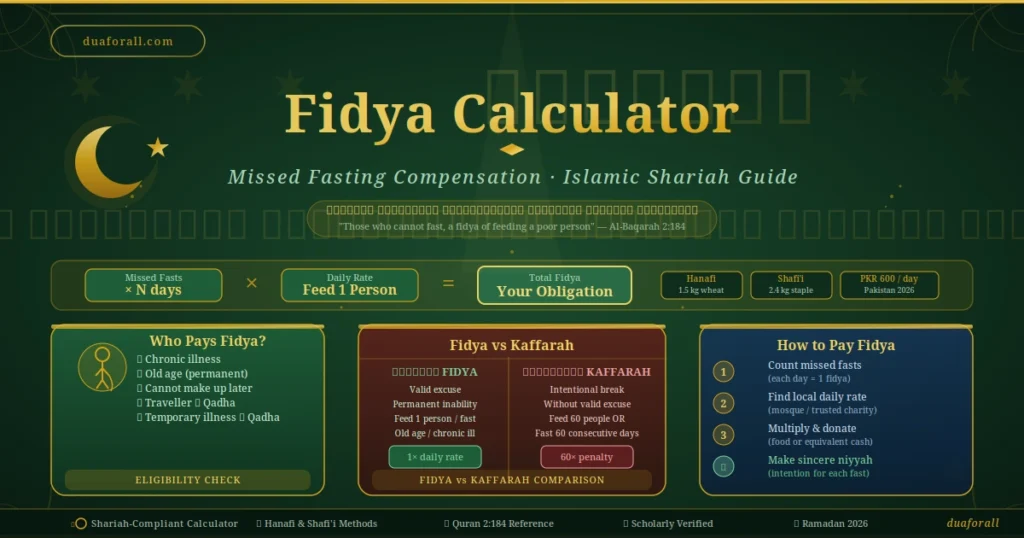
Fidya in Islam:
Calculator & Complete Guide 2026
Understand the fidya meaning in Islam — who must pay, the rules, and how to give fidya — then instantly calculate your exact amount for missed Ramadan fasts due to illness, old age, or permanent disability.
Fidya Calculator 2025–2026
Precisely calculate your Fidya payment for missed Ramadan fasts in your local currency. Updated with 2026 food price benchmarks across 12 countries.
🧮 Fidya / Missed Fasting Compensation Calculator
حاسبة الفدية🌾 Custom Food Price Calculator
Enter local staple food prices in your area for the most accurate Fidya amount. This follows the ruling that Fidya equals the price of feeding one poor person a full day’s meal.
📅 Multi-Year or Accumulated Fidya
For those who have accumulated missed fasts over multiple Ramadans. Enter each year separately for maximum accuracy, or use the total below.
What Is Fidya in Islam?
A comprehensive guide to the fidya meaning in Islam — covering the Quranic ruling, conditions, fidya rules in Islam, and the scholarly consensus on missed-fast compensation.
Fidya Meaning in Islam (فِدْيَة)
Fidya in Islam (Arabic: فِدْيَة) is a monetary or food-based compensation paid as an alternative to missed religious obligations — most commonly, missed fasting days during Ramadan. The fidya meaning in Islam comes from the Arabic root f-d-y (فدى), meaning “to ransom” or “to redeem,” reflecting its nature as a substitute act of worship paid on behalf of the person who cannot fast.
Unlike Qadha (making up missed fasts) or Kaffarah (expiation for deliberate violations), Fidya is specifically for those permanently unable to fast — such as the chronically ill, the elderly, and those with permanent disabilities. Understanding fidya Islam rulings helps ensure this obligation is fulfilled correctly.
Quranic Basis of Fidya for Fasting in Islam
The ruling for fidya for fasting in Islam is established directly in the Quran in Surah Al-Baqarah (2:184). Allah ﷻ says that for those who fast with hardship, feeding a poor person is a redemption thereof. The verse explicitly provides the concession of Fidya for those for whom fasting is a severe hardship.
This verse is the primary textual evidence (daleel) upon which all four major schools of Islamic jurisprudence (Hanafi, Maliki, Shafi’i, and Hanbali) have agreed on the legitimacy of Fidya as a substitute for missed fasts.
Key Conditions for Fidya
- The inability to fast must be permanent or highly likely to remain
- Fidya is paid once per missed day — not retrospectively accumulated
- It must be given to the poor and needy (fuqara), not wealthy people
- Food is preferred over cash in classical rulings; most contemporary scholars permit cash
- It can be paid all at once or daily throughout Ramadan
Fidya Rules in Islam
The core fidya rules in Islam are derived from Surah Al-Baqarah 2:184 and subsequent scholarly consensus (ijma’). The most essential rules every Muslim must know:
- Permanence is the trigger: Fidya for fasting in Islam applies only when inability to fast is permanent or near-permanent — temporary illness requires Qadha (makeup fasts), not Fidya.
- One poor person per day: Each missed Ramadan fast requires feeding one needy Muslim. A single day’s Fidya cannot be split across multiple people under the Hanafi school.
- Amount follows the madhab: Hanafi — 1.75 kg wheat or 2 kg flour; Shafi’i/Hanbali — approx. 0.51 kg wheat; Maliki — approx. 1.05 kg (2 Mudd) per day.
- Cash is permissible: Contemporary scholars widely permit paying the monetary equivalent rather than physical grain, for ease and to allow donation through Islamic charities.
- No Qadha required: Once Fidya is paid for a permanent inability, the missed fasts do not need to be made up later.
- Must precede the next Ramadan: While scholars differ on strict deadlines, it is strongly recommended to pay Fidya before the following Ramadan begins.
📚 Scholarly References
Who Must Pay Fidya?
Islamic scholars classify people into those for whom Fidya is obligatory, those who need Qadha, and those who are fully exempt.
Elderly Person
Very old individuals who lack the physical strength to fast and whose condition will not improve with time.
Chronically Ill
Those with permanent, incurable conditions — such as severe diabetes, kidney failure, or terminal illness — where fasting is medically dangerous.
Permanently Disabled
Individuals with permanent physical or cognitive disabilities that make fasting impossible or medically harmful.
Pregnant / Nursing
Most scholars require Qadha (making up the fasts later), not Fidya, unless there is genuine permanent inability. Some Shafi’i views allow Fidya + Qadha.
Traveller
Travellers who skip fasting during Ramadan must make up the missed fasts (Qadha) when they return — Fidya does not apply.
Temporarily Ill
Those sick during Ramadan but expected to recover should make Qadha after recovery. Fidya is only for those who cannot ever make up the fast.
📌 Important Note: If a person who paid Fidya subsequently recovers, the majority of scholars say they do not need to repeat the fasts. However, it is highly recommended to consult a qualified Islamic scholar or your local mosque for a ruling specific to your circumstances. See IslamQA — Fidya conditions.
How to Calculate Fidya
Follow these four steps to determine your exact Fidya obligation according to Islamic law.
Count Missed Days
Count every day of Ramadan you were unable to fast due to a permanent condition. Maximum 30 per Ramadan year.
Determine Mudd Amount
Based on your Madhab: Hanafi requires 1.75 kg wheat or 2 kg flour per day; Shafi’i/Hanbali: 0.51 kg per day.
Calculate Monetary Value
Multiply the grain weight by its current local price, or estimate the cost of one full day’s basic meal for one person.
Give to the Poor
Distribute directly as food or cash to deserving Muslims in your community, or via a verified Islamic charity organisation.
Fidya Calculation Examples
Real-world calculations across different countries and school of thoughts.
🇵🇰 Pakistan — Hanafi (30 Days)
🇬🇧 United Kingdom — Hanafi (15 Days)
🇺🇸 United States — Shafi’i (30 Days)
🇸🇦 Saudi Arabia — Maliki (10 Days)
How to Give Fidya in Islam
Once you have calculated your amount, here is the complete step-by-step guide on how to give fidya in Islam correctly and acceptably.
Step 1 — Make Your Intention (Niyyah)
Before giving your Fidya, make a sincere intention in your heart: “I am paying this Fidya in place of my missed fasting days, seeking the pleasure of Allah ﷻ.” The Niyyah is essential for the act to be valid as an act of worship (ibadah).
Step 2 — Give Food or Its Cash Equivalent
Classically, Fidya in Islam is given as food — wheat, flour, dates, or rice — equal to one Mudd (or two Mudd for Hanafi) per missed day. However, giving the cash value of that food is widely accepted today by all major scholars. Use our calculator above to determine the exact monetary amount for your country.
Step 3 — Choose a Recipient
Fidya must go to a deserving Muslim who is poor (faqir) or needy (miskeen). You may give it:
- Directly to a poor Muslim individual or family (food or cash)
- Through a reputable Islamic charity such as Islamic Relief, Islamic Aid, or your local mosque’s food bank
- To poor relatives who are not your direct dependents (spouse, children, parents)
Step 4 — When to Give
You may give Fidya at any time — before, during, or after Ramadan. Many Muslims prefer to pay it upfront at the start of Ramadan for all 30 expected missed fasts. For accumulated Fidya from past years, pay as soon as possible using current year rates. Delaying does not multiply the obligation, but prompt payment is always recommended.
🌐 Trusted Charity Channels
Fidya Amounts by Country 2025–2026
Approximate Fidya Islam rates for 2026 based on current staple food prices. Always verify with your local mosque, Islamic Aid, Islamic Relief, or other recognised charity for the most current certified figure.
| Country | Currency | Fidya / Day (Hanafi) | Fidya / Day (Shafi’i) | Full Ramadan (30d) |
|---|---|---|---|---|
| 🇵🇰 Pakistan | PKR | PKR 180–220 | PKR 80–100 | PKR 5,400–6,600 Popular |
| 🇬🇧 United Kingdom | GBP | £4.00–£5.00 | £2.00–£3.00 | £120–£150 |
| 🇺🇸 United States | USD | $7–$10 | $4–$6 | $210–$300 |
| 🇸🇦 Saudi Arabia | SAR | SAR 10–15 | SAR 5–8 | SAR 300–450 |
| 🇦🇪 UAE | AED | AED 20–30 | AED 10–15 | AED 600–900 |
| 🇧🇩 Bangladesh | BDT | BDT 110–150 | BDT 50–70 | BDT 3,300–4,500 |
| 🇮🇳 India | INR | INR 60–80 | INR 30–45 | INR 1,800–2,400 |
| 🇲🇾 Malaysia | MYR | MYR 7–10 | MYR 3–5 | MYR 210–300 |
| 🇨🇦 Canada | CAD | CAD 9–13 | CAD 5–7 | CAD 270–390 |
| 🇦🇺 Australia | AUD | AUD 10–14 | AUD 5–8 | AUD 300–420 |
⚠️ Rates are indicative based on 2025–2026 staple food prices. Consult NZF UK, Islamic Relief USA, or Islamic Aid for certified current rates.
Fidya vs Kaffarah — What’s the Difference?
These are two distinct Islamic obligations often confused with each other. Understanding the difference is essential.
Do I Need to Pay Fidya?
Answer a few quick questions to determine whether Fidya, Kaffarah, or Qadha applies to your situation.
1. Did you miss fasting days during Ramadan?
Islam Fidya FAQs — Scholar-Verified Answers 2026
Common questions about fidya in Islam for missed Ramadan fasts, answered with references to authentic Islamic sources.
Related Islamic Resources
Deepen your knowledge of Islamic financial obligations and worship with these curated resources.
Zakat Calculator
Calculate your annual Zakat obligation with our advanced nisab-based tool covering gold, silver, and savings.
Use Calculator →Duas for Ramadan
Authentic supplications for every day of Ramadan, including the famous Laylat ul-Qadr dua.
Explore Duas →IslamQA — Fasting Rulings
Sheikh Munajjid’s comprehensive fatwa database on all aspects of Sawm (fasting) jurisprudence.
Read Fatwas →Islamic Relief — Pay Fidya Online
Trusted international charity accepting Fidya payments on behalf of Muslims worldwide since 1984.
Pay Online →Islamic Aid — Fidya Donations
UK-based Islamic charity distributing Fidya to poor communities globally, with scholar-verified rates updated annually.
Pay Fidya →National Zakat Foundation UK
Annual UK Fidya rates published by NZF, updated each Ramadan with verified scholarly oversight.
View Rates →Sunnah.com — Hadith Library
Search authentic ahadith on fasting, expiation, and Ramadan obligations in Arabic and English.
Search Hadith →Ready to Fulfil Your Fidya Obligation in Islam?
Use our 2026 Fidya calculator above to get your exact amount, then donate through a verified Islamic charity — Islamic Relief, Islamic Aid, or your local mosque — to fulfil this important obligation.