بِسْمِ اللَّهِ الرَّحْمَنِ الرَّحِيمِ
Dua for Istikhara
The Prayer for Divine Guidance
Complete Arabic text, transliteration, translation, and a step-by-step guide to performing Salat al-Istikhara — authenticated from Sahih al-Bukhari.
What is Istikhara? Meaning & Significance
The word Istikhara (اسْتِخَارَة) derives from the Arabic root khayr (خير), meaning goodness or blessing. Linguistically, it means “to seek the best course” or “to ask Allah to guide you to what is right.”
In Islamic practice, Salat al-Istikhara is a voluntary prayer of two rak’ahs accompanied by a specific supplication (the dua for Istikhara) that a Muslim performs whenever they face a decision and are uncertain about the right path. It is one of the most beautiful expressions of tawakkul (trust in Allah) in the Islamic tradition.
The Prophet Muhammad ﷺ valued Istikhara so deeply that, according to Jabir ibn Abdullah, he would teach his companions the dua for Istikhara in all matters, just as he taught them Surahs from the Qur’an — placing it at the heart of Muslim spiritual life.
Word Root
خ — ي — ر
Kha · Ya · Ra
Quranic root appearing 176× in the Quran
Quranic Basis: While the specific Istikhara supplication comes from the Sunnah, its spiritual foundation is woven throughout the Quran. Allah SWT says: “And when you have decided, then rely upon Allah. Indeed, Allah loves those who rely upon Him.” (Al-Imran 3:159) — and the opening of every prayer, Al-Fatiha, itself contains the plea: “Guide us to the straight path.” (1:6)
The Complete Dua for Istikhara
Arabic text, transliteration, and English translation — from Sahih al-Bukhari, narrated by Jabir ibn Abdullah (may Allah be pleased with him).
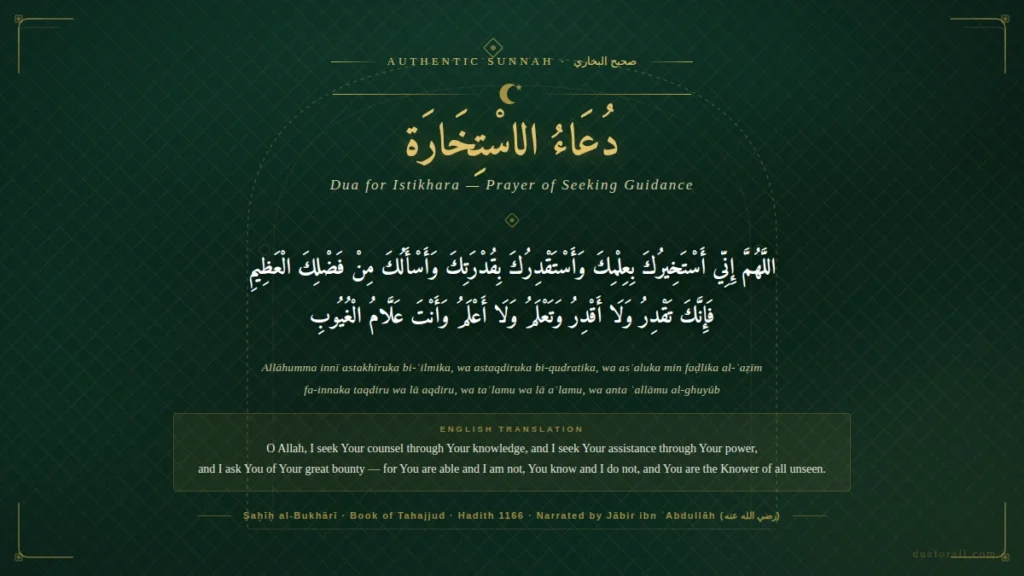
اللَّهُمَّ إِنِّي أَسْتَخِيرُكَ بِعِلْمِكَ، وَأَسْتَقْدِرُكَ بِقُدْرَتِكَ،
وَأَسْأَلُكَ مِنْ فَضْلِكَ الْعَظِيمِ، فَإِنَّكَ تَقْدِرُ وَلَا أَقْدِرُ،
وَتَعْلَمُ وَلَا أَعْلَمُ، وَأَنْتَ عَلَّامُ الْغُيُوبِ.
اللَّهُمَّ إِنْ كُنْتَ تَعْلَمُ أَنَّ هَذَا الْأَمْرَ — [اذكر أمرك هنا] —
خَيْرٌ لِي فِي دِينِي وَمَعَاشِي وَعَاقِبَةِ أَمْرِي،
فَاقْدُرْهُ لِي وَيَسِّرْهُ لِي ثُمَّ بَارِكْ لِي فِيهِ.
وَإِنْ كُنْتَ تَعْلَمُ أَنَّ هَذَا الْأَمْرَ شَرٌّ لِي فِي دِينِي وَمَعَاشِي وَعَاقِبَةِ أَمْرِي،
فَاصْرِفْهُ عَنِّي وَاصْرِفْنِي عَنْهُ، وَاقْدُرْ لِيَ الْخَيْرَ حَيْثُ كَانَ ثُمَّ أَرْضِنِي بِهِ.
Transliteration
Allāhumma innī astakhīruka bi’ilmika, wa astaqdiruka biqudratika, wa as’aluka min faḍlika al-‘aẓīm. Fa innaka taqdiru wa lā aqdiru, wa ta’lamu wa lā a’lamu, wa anta ‘allāmul-ghuyūb.
Allāhumma in kunta ta’lamu anna hādhal-amra — [mention your matter here] — khayrun lī fī dīnī wa ma’āshī wa ‘āqibati amrī, faqdurhu lī wa yassirhu lī thumma bārik lī fīh.
Wa in kunta ta’lamu anna hādhal-amra sharrun lī fī dīnī wa ma’āshī wa ‘āqibati amrī, fasrifhu ‘annī wasrifnī ‘anhu, waqdur liya al-khayra ḥaythu kāna thumma arḍinī bih.
English Translation
“O Allah, I seek Your guidance by virtue of Your knowledge, and I seek Your assistance by virtue of Your power, and I ask You of Your great bounty. For You have power and I have none, and You know and I know not, and You are the Knower of unseen things.
O Allah, if You know that this matter — [mention your matter] — is good for me in my religion, my livelihood, and my worldly and future affairs, then ordain it for me, make it easy for me, and bless it for me.
But if You know that this matter is bad for me in my religion, my livelihood, and my worldly and future affairs, then turn it away from me and turn me away from it; and ordain for me the good wherever it may be, and then make me content with it.”
💡 Important Note: When you reach “hādhā al-amr” (“this matter”) in the dua, pause and think of — or quietly say — the specific decision you are seeking guidance about (e.g., a job offer, a marriage proposal, a business decision). You do not need to replace the Arabic phrase; simply hold the matter in your heart at that moment.
How to Perform Salat al-Istikhara
Follow these authenticated steps derived from the hadith of Jabir ibn Abdullah in Sahih al-Bukhari (6382) to perform the Istikhara prayer correctly.
Make Wudu
Perform ablution (wudu) to be in a state of ritual purity, as is required for any formal prayer.
Set Your Intention (Niyyah)
Form the intention in your heart that these two rak’ahs are nafl (voluntary) prayer for the purpose of seeking Allah’s guidance on your specific matter.
Pray Two Rak’ahs
Pray two rak’ahs of non-obligatory prayer. Many scholars recommend reciting Surah Al-Kafirun (109) in the first and Surah Al-Ikhlas (112) in the second, after Al-Fatiha.
Recite the Dua
After completing the prayer (after the final Salam), remain seated facing the Qibla and sincerely recite the Istikhara dua. Mention your matter at the appropriate place.
Trust in Allah
After performing Istikhara, place your complete trust (tawakkul) in Allah and proceed with your decision. Observe how Allah eases or restricts the path before you.
Repeat if Needed
If clarity has not emerged, scholars have noted you may repeat up to seven times. You do not need to wait for a dream — guidance may come through circumstances, feelings of ease, or istishara (consultation).
Istikhara at a Glance — Infographic
When Should You Perform Istikhara?
The Prophet ﷺ taught Istikhara for all matters — not only major life decisions. The early generations of Muslims sought Allah’s guidance even for everyday choices. Here are common occasions and the best times to perform it:
Common Occasions for Istikhara
- 💍 Marriage When considering a potential spouse — one of the most recommended uses of Istikhara
- 💼 Career Before accepting a job offer, starting a business, or changing careers
- 🏡 Relocation When deciding to move to a new city, country, or home
- 📚 Education Choosing between academic programs, universities, or courses of study
- 🌍 Travel Major journeys, Hajj, or Umrah planning decisions
Best & Prohibited Times
📖 Combine with Istishara: The Prophet ﷺ paired Istikhara with istishara — consultation with knowledgeable, righteous people you trust. Seeking knowledge and wise counsel alongside your dua is a complete Prophetic model for decision-making.
Common Myths & Misconceptions About Istikhara
Many cultural beliefs have built up around Istikhara that lack authentic scholarly backing. Here are the most important clarifications:
❌ Myth
“I must see a dream after Istikhara”
Guidance through Istikhara is not necessarily conveyed through dreams. It often manifests as feelings of ease or restriction, or through how circumstances unfold. Waiting only for a dream has no authentic basis.
❌ Myth
“Someone else can do Istikhara for me”
The overwhelming majority of scholars hold that Istikhara is a personal act of worship. You can ask others to make general dua for your guidance, but the Istikhara prayer itself should come from you.
❌ Myth
“Green = yes, red = no”
Colour interpretations of Istikhara dreams are cultural folklore, not Islamic scholarship. There is no authentic hadith or scholarly consensus supporting such colour-coded readings.
❌ Myth
“Istikhara replaces personal effort”
Istikhara accompanies personal effort, research, and consultation — it does not replace them. Islam emphasises tying your camel (doing your part) before placing trust in Allah.
📿 Explore More Masnoon Duas
Discover our verified collection of prophetic supplications — with Arabic text, transliterations, translations, and hadith references for every occasion in your daily life.
Frequently Asked Questions About Dua for Istikhara
Authoritative Sources & Further Reading
The dua for Istikhara and its method are thoroughly documented in classical scholarship. We recommend these trusted resources for deeper learning: