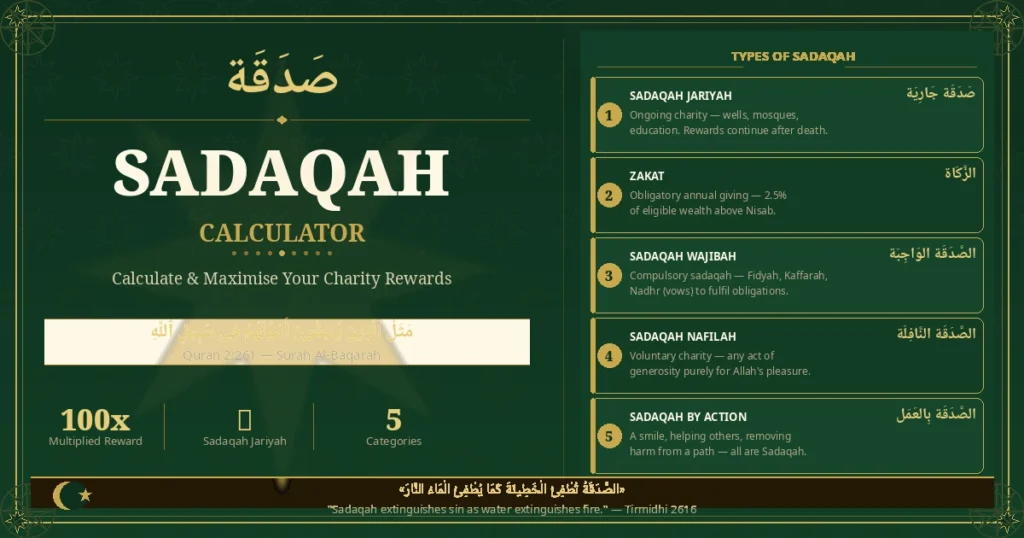
Free Sadaqah Calculator
— Give with Intention
Calculate your voluntary charity, discover every type of Sadaqah, and give with the wisdom of authentic Hadith — all in one place.
"Sadaqah extinguishes sin as water extinguishes fire.”
— Sunan al-Tirmidhi 2616 (Sahih)
Sadaqah Calculator
Enter your income to calculate your recommended Sadaqah — monthly, annual, and daily
Your Sadaqah Breakdown
"O Allah, make it (this Sadaqah) accepted.”
— Dua when giving charityWhat is Sadaqah? — The Islamic Definition
Understanding the meaning, root, and profound importance of voluntary charity in Islam
Voluntary Giving
Sadaqah is any voluntary charitable act — financial donation, act of kindness, or good deed — given sincerely for the sake of Allah (SWT) without expectation of worldly reward.
No Fixed Minimum
Unlike Zakat, Sadaqah has no nisab threshold. The Prophet ﷺ said: "Even half a date (tamrah) given in charity is accepted by Allah.” Every amount counts.
Purifies Wealth & Soul
The Quran and Sunnah confirm that Sadaqah purifies wealth, increases barakah, wards off calamity, and brings the giver closer to Allah’s mercy.
Broader than Money
Every good deed is Sadaqah — removing harm from a path, teaching knowledge, a kind word, or a smile. Use our Duas for Barakah & Rizq to complement your giving.
The word Sadaqah shares its Arabic root with ṣidq (صِدْق), meaning sincerity and truthfulness — affirming that genuine charity must flow from a sincere heart. Allah (SWT) dedicates extensive passages in Surah Al-Baqarah to the etiquette and rewards of giving, making it one of the most discussed acts of worship in the Quran. Our Sadaqah Calculator above helps you translate sincere intention into a consistent, measurable habit.
7 Types of Sadaqah in Islam
From financial giving to acts of kindness — every sincere good deed earns reward with Allah
Sadaqah Maaliyah
Financial charity given voluntarily at any amount, any time. The most common form and what our Sadaqah Calculator helps you plan systematically.
FinancialSadaqah Jariyah
Continuous charity — its benefit flows and your reward accumulates even after your death. Building a masjid, well, hospital, or spreading Islamic knowledge.
Ongoing RewardSadaqah in Food
Feeding the hungry, your neighbour, or sponsoring iftar for fasting Muslims. The Prophet ﷺ had special praise for feeding others as an act of worship.
NourishmentSadaqah of Knowledge
Teaching Quran, Islamic knowledge, or useful skills. The Prophet ﷺ said: "Whoever guides someone to goodness earns the same reward as the doer.”
KnowledgeSadaqah of a Smile
"Your smile in your brother’s face is Sadaqah.” (Tirmidhi) — Every warm greeting, kind word, and sincere gesture of goodwill is rewarded by Allah.
Daily ActsRemoving Harm
Clearing a stone, branch, or obstacle from the path. One of the 70+ branches of Imaan — a simple, powerful daily Sadaqah accessible to everyone.
Good DeedsSadaqah of Du’a
Making du’a for a fellow Muslim — especially the deceased — is a profound and powerful act of charity. Explore our complete du’a collection.
SpiritualHow Sadaqah Multiplies — The Divine Promise
Allah (SWT) has promised to multiply every act of sincere charity — understand the spiritual journey of your giving
Intention (Niyyah)
Pure intention for the sake of Allah alone — the foundation of any accepted act
The Giving
Money, time, food, or kindness — from what you love most (Quran 3:92)
Worldly Growth
Barakah in your wealth, protection from calamity, and accepted du’as
Akhirah Reward
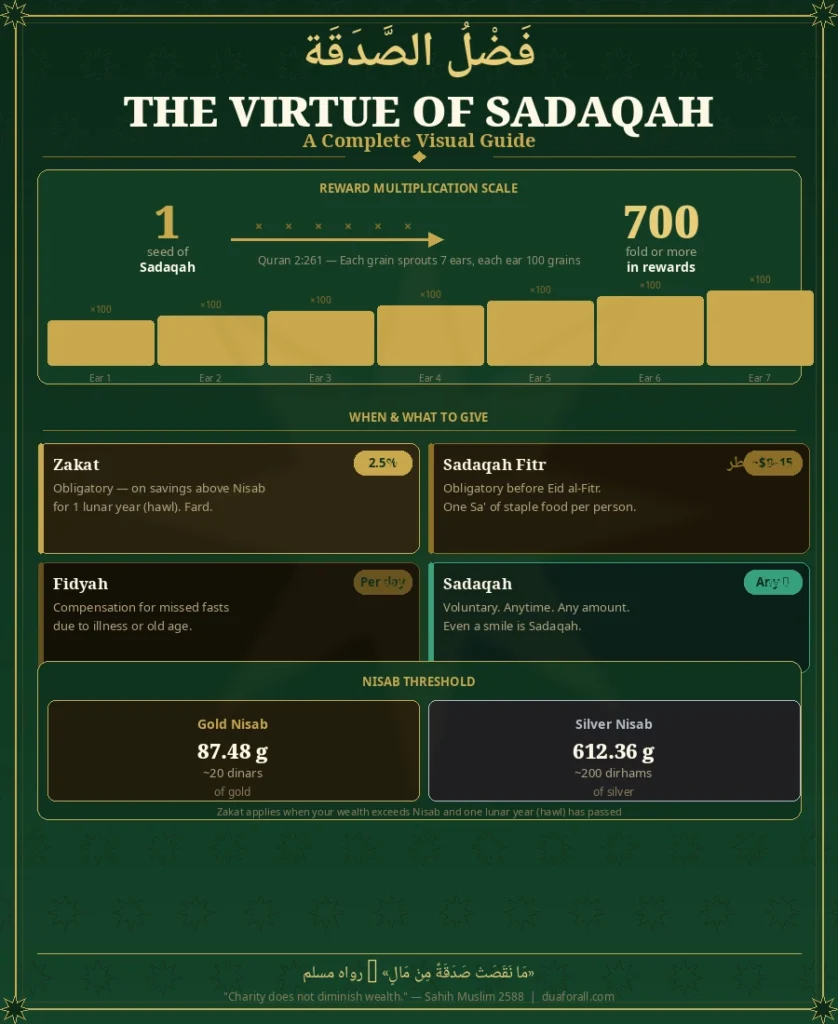
Reward multiplied up to 700× — heavy on your Scale (Meezan) on Qiyamah
"The example of those who spend their wealth in the way of Allah is like a seed of grain which grows seven spikes; in each spike is a hundred grains. And Allah multiplies [His reward] for whom He wills. And Allah is all-Encompassing and Knowing.”
— Quran, Surah Al-Baqarah 2:2619 Benefits of Sadaqah — Proven by Quran & Hadith
From authenticated narrations in Sahih Bukhari, Muslim, Tirmidhi, and Quranic ayat
Sadaqah wipes away sins as water extinguishes fire (Tirmidhi 2616 — Sahih)
Every dirham can return 700-fold or more in Akhirah (Quran 2:261)
Sadaqah Jariyah earns reward continuously even after you die (Muslim 1631)
Charity wards off evil, illness, and 70 gates of calamity (Hadith scholars)
"Charity does not decrease wealth.” (Sahih Muslim 2588) — barakah increases
The generous will be shaded by their charity on the Day of Judgement
"Treat your sick with charity.” — a profound Sunnah practice (Ibn Hibban)
Sadaqah builds brotherhood, reduces poverty, and uplifts the entire ummah
Sadaqah cools the anger of the Lord and ensures a good ending (Tirmidhi)
Sadaqah vs Zakat — Key Differences Explained
Know when each applies — and use our dedicated Zakat Calculator for your obligatory giving
| Aspect | Sadaqah (صَدَقَة) | Zakat (زَكَاة) |
|---|---|---|
| Obligation | Voluntary (Nafl) — never obligatory | Obligatory — 3rd Pillar of Islam |
| Minimum Amount | No minimum — even half a date | Fixed 2.5% on qualifying wealth above nisab |
| Nisab Threshold | None required | Approx. 85g gold or 595g silver equivalent |
| Timing | Any time — no restriction | Once per Islamic lunar year (Hawl = 354 days) |
| Recipients | Anyone — Muslim, non-Muslim, family | 8 specific categories only (Quran 9:60) |
| Can give to family? | Yes, including parents & children | No — cannot give to direct dependants |
| Niyyah (Intent) | Required — for Allah’s sake | Required — Niyyah for Zakat specifically |
| Consequence if neglected | Loss of great reward — not sinful | Major sin — severe punishment in Akhirah |
Authentic Hadith on Sadaqah
Verified narrations from Sahih Bukhari, Sahih Muslim, Sunan al-Tirmidhi, and other trusted hadith collections
الصَّدَقَةُ تُطْفِئُ الْخَطِيئَةَ كَمَا يُطْفِئُ الْمَاءُ النَّارَ"Sadaqah extinguishes sins just as water extinguishes fire.”
Sunan al-Tirmidhi 2616 — Sahih
مَا نَقَصَتْ صَدَقَةٌ مِنْ مَالٍ وَمَا زَادَ اللَّهُ عَبْدًا بِعَفْوٍ إِلَّا عِزًّا"Charity does not decrease wealth. Allah does not increase a servant in anything by pardoning (others) except honour, and no one humbles himself for the sake of Allah but Allah raises his status.”
Sahih Muslim 2588
إِذَا مَاتَ الْإِنْسَانُ انْقَطَعَ عَنْهُ عَمَلُهُ إِلَّا مِنْ ثَلَاثَةٍ: إِلَّا مِنْ صَدَقَةٍ جَارِيَةٍ أَوْ عِلْمٍ يُنْتَفَعُ بِهِ أَوْ وَلَدٍ صَالِحٍ يَدْعُو لَهُ"When a person dies, all their deeds end except three: Sadaqah Jariyah (ongoing charity), beneficial knowledge that others act on, or a righteous child who prays for them.”
Sahih Muslim 1631
تَبَسُّمُكَ فِي وَجْهِ أَخِيكَ لَكَ صَدَقَةٌ وَأَمْرُكَ بِالْمَعْرُوفِ وَنَهْيُكَ عَنِ الْمُنْكَرِ صَدَقَةٌ"Your smiling in the face of your brother is Sadaqah, and your enjoining good and forbidding evil is Sadaqah, and your guiding a man in a land of misguidance is Sadaqah for you.”
Sunan al-Tirmidhi 1956 — Sahih
How to Give Sadaqah — A Step-by-Step Sunnah Guide
Follow this practical framework to give Sadaqah in accordance with the Prophet’s ﷺ guidance
Make a Sincere Intention (Niyyah)
Before giving, form a sincere intention in your heart that this is for Allah’s sake alone. Niyyah separates worship from habit. A small gift with pure niyyah outweighs a large donation given for show (riya).
Use the Sadaqah Calculator to Set a Regular Amount
The Prophet ﷺ loved the most consistent deeds, even if small. Use our Sadaqah Calculator above to set a monthly or weekly target — whether 2.5%, 5%, or 10% of your income.
Choose What to Give — and Ensure It Is Halal
Money, food, clothing, time, or knowledge — give what is pure and permissible. The Quran (3:92) teaches: "You will never attain righteousness until you spend from what you love most.”
Select a Worthy Recipient
Family in need, local poor, orphans, widows, students of knowledge, or verified Islamic charities like Muslim Aid USA, LaunchGood, or Human Appeal.
Give in Secret When Possible
The Quran praises those who give secretly (2:271): "If you conceal them [charities] and give them to the poor, it is better for you.” Giving quietly guards sincerity. You may also give openly to inspire others.
Recite the Du’a for Giving Charity
Say: اللَّهُمَّ اجْعَلْهَا مَقْبُولَةً — "O Allah, make it accepted.” Explore our full Duas for Rizq & Success and Daily Adhkar to complete your practice.
Frequently Asked Questions — Sadaqah Calculator
Concise answers to the most common questions about Sadaqah — with scholarly references
Sadaqah is voluntary charity given for the sake of Allah with no fixed minimum, timing, or recipient restriction. Zakat is an obligatory pillar of Islam — a fixed 2.5% on qualifying wealth above the nisab threshold, given annually to 8 specific categories (Quran 9:60). Use our Zakat Calculator to handle your obligatory giving separately.
There is no fixed monthly requirement — any sincere amount is rewarded. Scholars commonly recommend 2.5% to 10% of your income regularly. The Prophet ﷺ loved the most consistent deeds, even if small. Use our Sadaqah Calculator above to set a personalised monthly target based on your income and percentage preference.
Sadaqah Jariyah (صَدَقَة جَارِيَة) means "flowing charity” whose benefit and reward continue indefinitely — even after the donor’s death (Muslim 1631). Best forms include: contributing to a masjid, funding a clean-water well, sponsoring Islamic education, planting a productive tree, or helping train an Islamic scholar. Select "Sadaqah Jariyah” in our calculator to plan this giving specifically.
Yes — giving Sadaqah on behalf of a deceased person is permissible and strongly recommended by scholars. It is one of the best gifts you can give your deceased parents or loved ones. You can donate money, sponsor a well, fund Quranic education — all on their behalf. The reward reaches them, insha’Allah. Also recite du’a for the deceased regularly.
Yes — Sadaqah in Ramadan carries multiplied reward as all good deeds are magnified in this blessed month. The Prophet ﷺ was described as "more generous than the blowing wind” during Ramadan (Bukhari). Giving on Laylatul Qadr (Night of Power) in the last 10 nights equals over 83 years of worship. See our Ramadan 2026 Guide.
Yes — Sadaqah can be given to non-Muslims, which is a key difference from Zakat. The Prophet ﷺ showed great generosity to non-Muslims and the Quran (60:8) explicitly permits goodness and equity toward those who have not fought against Muslims. Feeding a non-Muslim neighbour, helping a non-Muslim in genuine need — all of these are rewarded Sadaqah, insha’Allah.
Any time is good for Sadaqah, but scholars highlight: Friday (Jumu’ah), the first 10 days of Dhul Hijjah, Ramadan (especially Laylatul Qadr), after Fajr prayer, when you have a pressing need or du’a (as Sadaqah removes obstacles), and before medical treatment. The Prophet ﷺ advised giving Sadaqah first thing in the morning as it sets a barakah-filled day.
Give Sadaqah — Start Today, Not Tomorrow
Every act of giving, however small, is recorded with precision by Allah (SWT). Use our calculator above to set a regular sadaqah habit and transform your rizq into lasting akhirah reward.