Duas for Qunoot
Complete guide to Dua Qunoot for Witr prayer and Qunoot Nazilah — with authentic Arabic text, transliteration, translation, and verified hadith sources from Sunan Abu Dawud and Tirmidhi.
What is Dua Qunoot?
The word Qunoot (قُنُوت) in Arabic carries multiple meanings — obedience, humility, standing in devotion before Allah. In Islamic jurisprudence, it refers specifically to a supplication recited during the standing position (qiyam) of prayer.
🔤 Linguistic Meaning
From the root q-n-t (قنت) meaning sustained devotion, obedience, and humble standing before Allah. It denotes a state of complete submission and attentiveness in worship.
📖 Juristic Meaning
A specific supplication made during the standing position (qiyam) in prescribed prayers — particularly in Witr prayer and during times of community calamity (Qunoot Nazilah).
📚 Primary Source
The Prophet Muhammad ﷺ taught the Qunoot dua to his grandson Hasan ibn Ali (RA) for the Witr prayer. Recorded in Abu Dawud 1425 and Tirmidhi 464.
🌙 Occasion
Primarily recited in the Witr prayer — the odd-numbered prayer performed after the ‘Isha prayer — and in Qunoot Nazilah during any obligatory prayer when the Muslim community faces hardship.
📿 The Meaning of Qunoot at a Glance
Duas for Qunoot — Complete Arabic Texts
Every dua below is presented with the original Arabic, phonetic transliteration, English translation, and its authentic hadith source. These are the duas authenticated by reliable chains of narration.
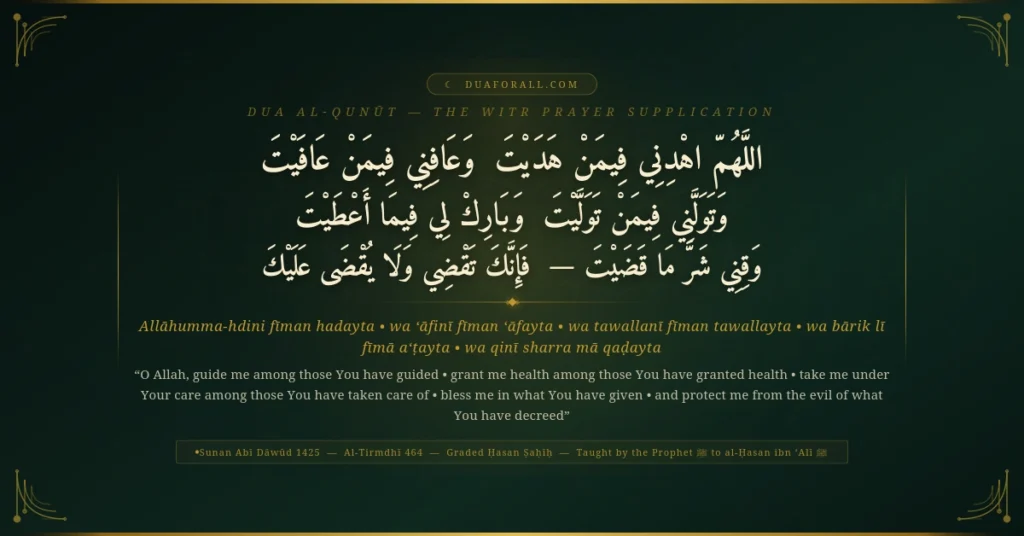
The Prophet Muhammad ﷺ taught this dua to his grandson Al-Hasan ibn Ali (RA) to recite in Witr prayer. It is the most authentic and widely practised Qunoot supplication.
Allāhumma-hdinī fīman hadayt, wa ‘āfinī fīman ‘āfayt, wa tawallanī fīman tawallayt, wa bārik lī fīmā a’ṭayt, wa qinī sharra mā qaḍayt, fa innaka taqḍī wa lā yuqḍā ‘alayk, wa innahu lā yadhillu man wālayt, tabārakta rabbanā wa ta’ālayt.
O Allah, guide me among those You have guided, grant me wellbeing among those to whom You have granted wellbeing, take me under Your care among those whom You have taken under Your care, bless me in what You have given me, protect me from the evil of what You have decreed — for verily You decree and nothing is decreed against You. Indeed, he whom You befriend is never humbled. Blessed and Exalted are You, our Lord.
This extended Qunoot is widely recited in the Hanafi tradition. It is traced back to Umar ibn al-Khattab (RA) and the early companions. Reported in al-Bayhaqi’s Sunan al-Kubra and other compilations.
Allāhumma innā nasta’īnuka wa nastaghfiruk, wa nu’minu bik, wa natawakkalu ‘alayk, wa nuthnī ‘alaykal-khayr, wa nashkuruk, wa lā nakfuruk, wa nakhla’u wa natruku man yafjuruk. Allāhumma iyyāka na’budu, wa laka nuṣallī wa nasjud, wa ilayka nas’ā wa naḥfid, wa narjū raḥmatak, wa nakhshā ‘adhabak, inna ‘adhabaka bil-kuffāri mulḥiq.
O Allah, we seek Your help and ask Your forgiveness, and we believe in You and put our trust in You, and we praise You in the best way, and we thank You and are not ungrateful to You, and we forsake and turn away from the one who disobeys You.
O Allah, You alone we worship, and to You we pray and prostrate, and towards You we hasten and strive, and we hope for Your mercy and we fear Your punishment. Truly, Your punishment will surely reach the disbelievers.
Qunoot Nazilah is a special supplication recited by the imam in any obligatory prayer — after rising from rukū’ in the final rak’ah — when the Muslim community faces a major calamity or hardship. The Prophet ﷺ frequently practised this.
Allāhumma-ghfir lil-mu’minīna wal-mu’mināt, wal-muslimīna wal-muslimāt, wa allif bayna qulūbihim, wa aṣliḥ dhāta baynahum, wanṣurhum ‘alā ‘aduwwika wa ‘aduwwihim.
O Allah, forgive the believing men and women, and the Muslim men and women, and unite their hearts, and reconcile between them, and grant them victory over Your enemy and their enemy.
📌 Note: Qunoot Nazilah is flexible — the imam may add personal or community-specific supplications in Arabic or any language. The above represents a foundational form. Scholars agree that any sincere dua in this context is valid.
The Two Types of Qunoot
Islamic scholarship distinguishes two primary forms of Qunoot, each with its own occasion, ruling, and method.
When is Qunoot Recited?
The timing of Qunoot varies between the schools of jurisprudence. Here is a clear breakdown of when each prayer incorporates Qunoot according to scholarly consensus.
Witr Prayer
After ‘Isha, in the final odd rak’ah. Hanafi: every night; Shafi’i/Hanbali: last half of Ramadan.
Fajr Prayer
Shafi’i madhab holds that Qunoot in Fajr is Sunnah — recited before going into rukū’ in the second rak’ah.
Any Fard Prayer
Qunoot Nazilah can be recited in any obligatory prayer during community calamity, by consensus of scholars.
Jumu’ah Prayer
Some scholars permit Qunoot Nazilah in Jumu’ah in extreme situations. Not a regular occurrence.
How to Perform Qunoot in Witr
Follow these steps for the standard Witr Qunoot as practised in the Hanafi tradition — the most widely followed method globally.
Complete Your Isha Prayer
Perform the obligatory 4 rak’ahs of Isha, followed by the 2 sunnah rak’ahs. Witr is performed after these.
Begin Witr — 3 Rak’ahs (Hanafi) or 1 Rak’ah
Hanafi: perform 3 rak’ahs with one set of salam. Shafi’i/Hanbali/Maliki: Witr is 1 rak’ah after even-numbered nawafil.
In the Final Rak’ah — After Surah Recitation
After completing the Surah recitation in qiyam of the final rak’ah, say Allahu Akbar (raising your hands before rukū’ — Hanafi) to signal Qunoot.
اللَّهُ أَكْبَرُRecite Dua Qunoot with Hands Raised
Hold your hands at chest level in the du’a position (palms facing upward). Recite the Qunoot dua in a low voice (in individual prayer) or audibly (if imam in Witr congregation).
Perform Rukū’ then Complete the Rak’ah
After Qunoot, say Allahu Akbar and go into rukū’. Then complete sujūd, tashahhud, and salām as normal.
اللَّهُ أَكْبَرُ"Al-Hasan ibn Ali said: The Messenger of Allah ﷺ taught me words to say in Qunoot in Witr prayer…” and he recited the famous supplication beginning with Allāhumma-hdinī fīman hadayt…
Qunoot Across the Four Madhabs
The four major schools of Sunni jurisprudence each have a nuanced position on the ruling, timing, and form of Qunoot. All four agree that Qunoot Nazilah is legislated during calamities.
Qunoot in Witr is Wajib (necessary) and is performed every night of the year in the 3rd rak’ah of Witr, before rukū’. The extended two-part dua is predominantly used.
Wajib in Witr — NightlyQunoot in Witr is not legislated as a regular practice. Qunoot Nazilah in Fajr after the death of the Prophet ﷺ’s companions is a documented narration but not considered ongoing Sunnah.
Not Regular — Nazilah OnlyQunoot is Sunnah in Fajr prayer (before rukū’) throughout the year, and in Witr during the last half of Ramadan. Raising hands is recommended. Ameen is said by congregation.
Sunnah — Fajr & Ramadan WitrQunoot in Witr is Sunnah, practised in the second half of Ramadan. After rukū’ in the final rak’ah of Witr. Qunoot Nazilah is also established Sunnah in any prayer.
Sunnah — Second Half of RamadanSpiritual Benefits of Dua Qunoot
Reciting Dua Qunoot carries profound spiritual significance and manifold benefits for the believer’s connection with Allah ﷻ.
Direct Connection to Allah
Standing in devoted supplication creates an intimate, direct channel of communication with Allah ﷻ — the essence of Qunoot.
Divine Protection
"Protect me from the evil of what You have decreed” — seeking Allah’s shield from trials in every Witr.
Guidance & Wellbeing
Asking for guidance, pardon, and divine care — three of Islam’s most comprehensive blessings — in a single supplication.
Following the Sunnah
The Prophet ﷺ personally taught this dua — reciting it faithfully is a cherished act of following the blessed Sunnah.
Sealing the Night
Witr is the "seal” of the night prayers. Closing your night worship with Qunoot is a beautifully intimate end to the day.
Community Intercession
Qunoot Nazilah unites the ummah in collective supplication — the power of the congregation’s Ameen behind the imam.
Related Duas & Islamic Resources
Deepen your practice with these carefully curated resources from DuaForAll.
Frequently Asked Questions About Qunoot
Common questions about Dua Qunoot answered with reference to authentic Islamic scholarship.
It depends on the madhab. In the Hanafi school, Qunoot in Witr is wajib (necessary) — leaving it intentionally requires a prostration of forgetfulness (sajda sahw). In the Shafi’i and Hanbali schools, it is Sunnah (recommended). In the Maliki school, it is generally not recommended as a regular practice. Regardless of madhab, its recitation is spiritually highly meritorious.
This is one of the most discussed points. The Hanafi school holds that Qunoot in Witr is recited before going into rukū’ — after completing the Surah recitation in the final rak’ah, saying Allahu Akbar and then reciting the dua before bowing. The Shafi’i, Hanbali, and Maliki schools generally hold that Qunoot is recited after rising from rukū’ in the final rak’ah, before prostration. Both positions have sound evidence from the hadith literature.
In the Hanafi school, there is a known position allowing Qunoot in one’s native language if one cannot recite it in Arabic, though learning the Arabic text is the ideal. The Shafi’i school is generally stricter, requiring Arabic. Most contemporary scholars recommend making personal du’a in any language after Salah rather than replacing the Arabic Qunoot text within the prayer. Beginners are strongly encouraged to memorise the shorter version (Dua #1) taught by the Prophet ﷺ, as it is concise and deeply comprehensive.
In individual Witr prayer, Qunoot is recited silently (sirr). When performing Witr in congregation (common in Ramadan Tarawih), the imam recites Qunoot aloud and those praying behind say Ameen at the end of each segment of supplication. This is the practice followed in most mosques worldwide during Ramadan.
Qunoot Witr is a specific supplication recited as part of the regular Witr prayer — its text is largely fixed, most importantly the dua the Prophet ﷺ taught Al-Hasan ibn Ali (RA). Qunoot Nazilah is an emergency supplication led by the imam in any obligatory prayer when the Muslim community faces a calamity (war, plague, drought, oppression). Its text is more flexible — the imam may compose appropriate supplications in Arabic. The Prophet ﷺ frequently performed Qunoot Nazilah in Fajr prayer during times of hardship, as recorded in Bukhari and Muslim.
Yes, your Witr prayer remains valid. In the Hanafi school, since Qunoot is wajib, forgetting it requires a sajda sahw (prostration of forgetfulness) to be performed at the end of the prayer. If one intentionally skips it without a valid reason, the prayer is still valid but sinful — it should ideally be repeated. In other madhabs (where Qunoot is Sunnah), the prayer is fully valid and there is no sajda sahw required for omitting it.
Verified External Resources
For further study on Dua Qunoot, these authoritative Islamic resources are recommended by scholars worldwide.
📚 Hadith — Abu Dawud 1425
The primary source hadith in which the Prophet ﷺ teaches Al-Hasan ibn Ali the Witr Qunoot supplication.
📚 Hadith — Tirmidhi 464
Tirmidhi’s narration of the Qunoot dua, graded Hasan by Imam al-Tirmidhi and confirmed by later hadith scholars.
🎓 IslamQA — Validity of Qunoot
Comprehensive fatwa on the ruling of Qunoot in Witr and the scholarly difference of opinion across madhabs.
🎓 SeekersGuidance — Hanafi Witr
Detailed explanation of how Witr prayer, including Qunoot, is performed according to the Hanafi school of fiqh.
🌟 Yaqeen Institute — Night Prayer
In-depth research paper on Qiyam al-Layl (night prayer) covering the theological and spiritual dimensions of Witr.
🔬 IslamWeb — Qunoot Rulings
Fatwa and scholarly discussion on various rulings related to Qunoot — timing, position, wording, and omission.
Explore More Authentic Islamic Duas
DuaForAll is your complete library of verified supplications — with Arabic, transliteration, and scholarly sources for every dua.