Dua for Parents in Islam
A complete guide to authentic supplications for your parents — living, elderly, or deceased — drawn directly from the Quran and Sunnah, with Arabic text, transliteration, translation, and source references.
Why Dua for Parents is Central to Islam
Understanding the immense status of parents is the first step to making heartfelt supplications for them.
"When the human being dies, his deeds end except for three: ongoing charity, beneficial knowledge, or a righteous child who prays for him.”— Prophet Muhammad ﷺ · Sahih Muslim 1631
In Islam, the status of parents is so elevated that Allah (سُبْحَانَهُ وَتَعَالَى) links gratitude to parents directly with gratitude to Himself in the Quran (31:14). On four separate occasions in the Quran, the command to worship Allah alone is immediately followed by the command to honour one’s parents — a pairing no other obligation receives.
Making dua for your parents is among the most beloved acts of worship you can perform. It benefits them both in this world and the next, and the supplication of a righteous child for their parent is a form of sadaqah jariyah (continuous charity) that continues long after a parent’s passing.
The Prophet ﷺ also famously stated that Paradise lies beneath the feet of your mother (Sunan an-Nasa’i 3104), and that after one’s mother, one’s father holds the next highest claim on our good treatment (Sahih Bukhari & Muslim).
Quranic Duas for Parents
These supplications are the words of Allah Himself, making them the most powerful duas you can recite for your parents.
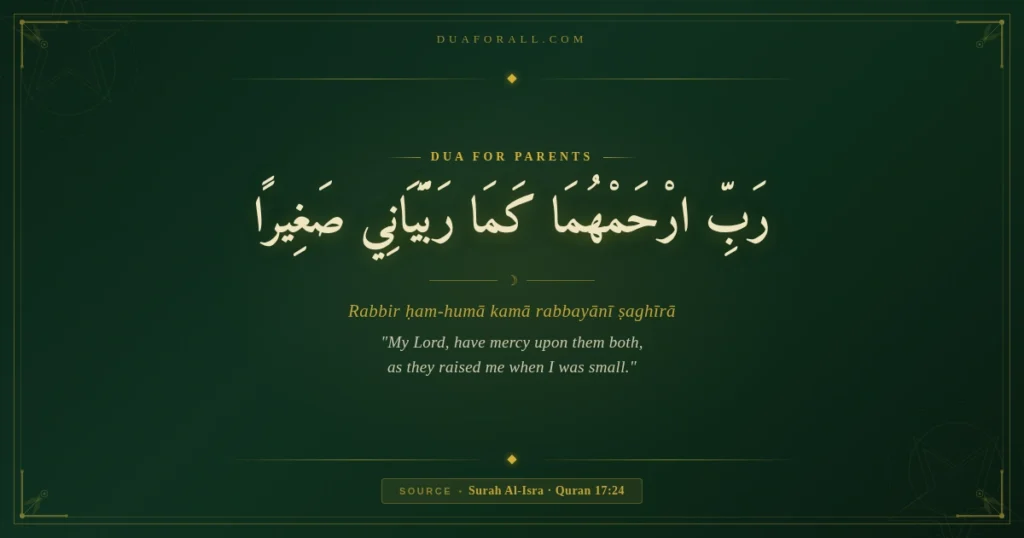
Rabbi-rhamhumaa kamaa rabbayaanee sagheeraa
Translation: "My Lord, have mercy upon them both as they raised me when I was small.”
Rabbanagh-fir lee wa liwaalidayya wa lilmu’mineena yawma yaqoomul-hisaab
Translation: "Our Lord! Forgive me, my parents, and the believers on the Day when the reckoning will be established.”
Rabbi-ghfirlee wa liwaalidayya wa liman dakhala baytiya mu’minan wa lilmu’mineena walmu’minaat
Translation: "My Lord! Forgive me, my parents, and whoever enters my house as a believer, and all believing men and believing women.”
Rabbi awzi’nee an ashkura ni’matakal-latee an’amta ‘alayya wa ‘alaa waalidayya wa an a’mala saalihan tardaahu wa aslih lee fee dhurriyyatee
Translation: "My Lord, enable me to be grateful for Your favour which You have bestowed upon me and upon my parents, and to work righteousness of which You will approve, and make righteous for me my offspring.”
Allahumma-ghfir lee wa liwaalidayya war-hamhumaa kamaa rabbayaanee sagheeraa
Translation: "O Allah, forgive me and my parents, and have mercy upon them as they raised me when I was small.”
Allahumma-ghfir lahu war-hamhu wa ‘aafihi wa’fu ‘anhu
Translation (for father): "O Allah, forgive him, have mercy on him, grant him well-being and pardon him.”
For mother, say: lahaa instead of lahu
Rabbi-j’alnee muqeemas-salaati wa min dhurriyyatee Rabbanaa wa taqabbal du’aa’
Translation: "My Lord, make me an establisher of prayer, and [many] from my descendants. Our Lord, and accept my supplication.”
A beautiful dua for both yourself and your family’s commitment to prayer — the foundation of Islamic life.
🕊️ Duas for Deceased Parents
Losing a parent is among life’s most profound griefs. Yet Islam brings comfort: the connection between parent and child does not end at death. Your dua, charity given on their behalf, and your own righteous deeds continue to reach them.
Rabbanagh-fir lee wa liwaalidayya wa lilmu’mineena yawma yaqoomul-hisaab
"Our Lord! Forgive me, my parents, and the believers on the Day the reckoning is established.” — Quran 14:41
In addition to dua, consider performing Sadaqah Jariyah (building a well, sponsoring an orphan, or donating a Quran) in your parent’s name, as well as reciting Surah Yasin and sending the reward to them.
Parents in Islam — Infographic
A visual summary of the rank of parents in Islam and the impact of dua on both parents and children.
Rights of Parents in Islam
Dua is one expression of honouring parents. Islam prescribes a comprehensive code of conduct towards them.
Never Say a Word of Disrespect
Allah commands in Quran 17:23 not to say even "uff” — the smallest expression of irritation — to your parents, whether living or upon recollection after their passing.
Speak to Them with Kindness
The Quran commands: "Speak to them kind words” (17:23). Use respectful language, a gentle tone, and be patient — especially in their old age when they may be more demanding.
Lower the Wing of Humility
"Lower to them the wing of humility out of mercy” (17:24) — a beautiful Quranic metaphor meaning to humble yourself before them unconditionally, as a bird lowers its wing to protect its young.
Financial Support in Old Age
The Prophet ﷺ confirmed that spending on one’s parents is charity: "When a man spends on his family, seeking reward for that, that is an act of charity” (An-Nasa’i 2545).
Make Regular Dua for Them
The act of making dua for parents is itself an obligation — it is included in the Quran’s command of ihsan (excellence) towards parents and the hadith of sadaqah jariyah.
Keep Their Relationships Alive After Death
The Prophet ﷺ said: "The most generous act of birr (righteousness) is that you keep ties with those your father loved, after he passes away.” (Sahih Muslim 2552)
Frequently Asked Questions
🤲 Share the Reward
If this page helped you, share it with someone who loves their parents — or is grieving theirs. Every time they recite a dua because of your share, you receive a portion of the reward.