Dua for Anxiety and Stress
Find tranquillity through supplication — 10+ verified duas from the Quran & Sunnah with Arabic text, transliteration, and sources
Why Islam Addresses Anxiety & Stress
Islam recognised the burden of anxiety centuries before modern psychology. The Quran and the prophetic tradition offer timeless remedies for a troubled heart.
Anxiety and stress are universal human experiences. Whether caused by financial pressure, family difficulties, health concerns, or uncertainty about the future, these feelings can feel overwhelming. The Prophet Muhammad ﷺ himself taught specific supplications to seek relief from distress (hamm) and grief (hazan), demonstrating that turning to Allah is the primary cure for an anxious heart.
The Quran assures believers in Surah Ar-Ra’d 13:28: "Verily, in the remembrance of Allah do hearts find rest.” This is not merely spiritual poetry — it is a divine prescription. Reciting dua for anxiety and stress grounds the believer, shifts focus from worry to trust in Allah (tawakkul), and activates a state of mindful presence that modern clinical research increasingly validates as beneficial to mental wellbeing.
The duas below are drawn directly from the Quran and authenticated hadith collections (Sahih Bukhari, Sahih Muslim, Abu Dawud, Tirmidhi). Every supplication is presented with its Arabic text, transliteration, English translation, and a verified source link so you can recite with confidence and full understanding.
10 Powerful Duas for Anxiety and Stress
Each dua below is verified from the Quran or Sunnah. Recite them with sincerity, presence of heart, and full trust in Allah.
Lā ilāha illā Anta subḥānaka innī kuntu mina al-ẓālimīn
"There is no god except You; Glory be to You. Indeed, I have been of the wrongdoers.”
📖 Quran 21:87 — Surah Al-AnbiyaThis is the dua Yunus (AS) recited from within the whale. The Prophet ﷺ said: "No Muslim supplicates with it for anything ever, except that Allah responds to him.” (Tirmidhi 3505)
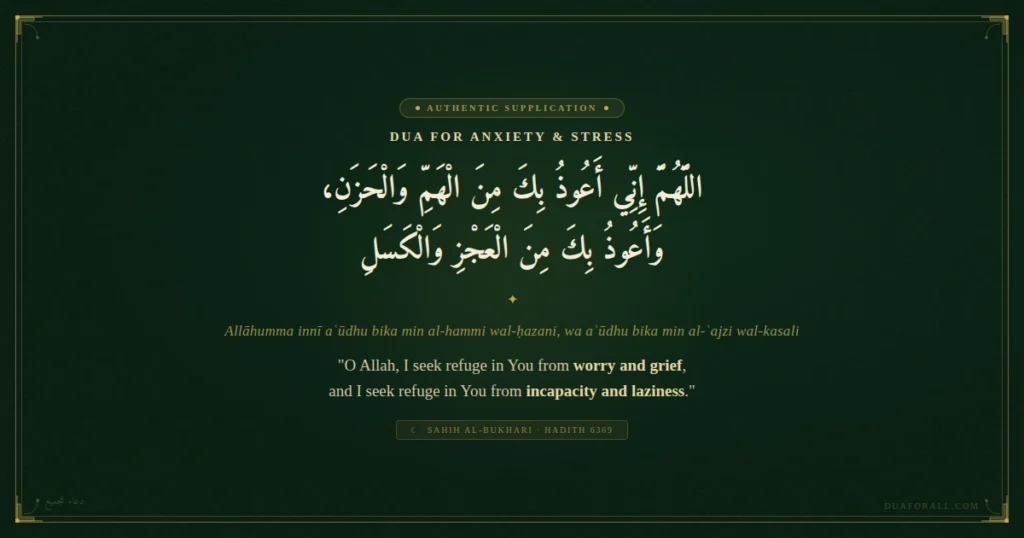
Allāhumma innī aʿūdhu bika minal-hammi wal-ḥazan, wal-ʿajzi wal-kasal, wal-jubni wal-bukhl, wa ḍalaʿid-dayn wa ghalabatir-rijāl
"O Allah, I seek refuge in You from worry and grief, from helplessness and laziness, from cowardice and miserliness, from the burden of debt and from being overpowered by men.”
📚 Sahih Bukhari 2893This comprehensive dua covers eight major sources of human suffering. The Prophet ﷺ recited it regularly and taught it to his companions as a morning and evening supplication.
Ḥasbunallāhu wa niʿmal-wakīl
"Sufficient for us is Allah, and [He is] the best Disposer of affairs.”
📖 Quran 3:173 — Surah Al-ImranThis was the statement of Prophet Ibrahim (AS) as he was thrown into the fire, and of the companions when told that armies gathered against them. It is a declaration of absolute trust in Allah.
Allāhumma raḥmataka arjū falā takilnī ilā nafsī ṭarfata ʿayn wa aṣliḥ lī shaʾnī kullahu lā ilāha illā Ant
"O Allah, it is Your mercy that I hope for, so do not leave me in charge of my affairs even for the blink of an eye. And rectify for me all of my affairs. None has the right to be worshipped except You.”
📚 Abu Dawud 5090 (Hasan)This beautiful dua acknowledges complete dependence upon Allah, which is the antidote to the illusion of control that drives much of human anxiety.
Lā ḥawla wa lā quwwata illā billāh
"There is no power nor strength except with Allah.”
📚 Sahih Bukhari 7386The Prophet ﷺ described this as a treasure from the treasures of Paradise (Bukhari). Reciting it frequently during stress offloads the burden of personal capacity onto the infinite power of Allah.
Allāhumma innī ʿabduka, ibnu ʿabdika, ibnu amatika, nāṣiyatī biyadika, māḍin fiyya ḥukmuka, ʿadlun fiyya qaḍāʾuka… an tajʿalal-Qurʾāna rabīʿa qalbī wa nūra ṣadrī wa jalāʾa ḥuznī wa dhahāba hammī
"O Allah, I am Your servant, son of Your servant, son of Your maidservant. My forelock is in Your hand. Your command over me is forever executed and Your decree over me is just… Make the Quran the spring of my heart, the light of my chest, the banisher of my sadness and the reliever of my distress.”
📚 Musnad Ahmad 3704 (Sahih)This is one of the most comprehensive duas for anxiety. The Prophet ﷺ said: "There is no-one who is afflicted with distress or grief and says this, except that Allah will remove his distress and grief and replace it with joy.” (Ahmad)
Rabbanā afrigh ʿalaynā ṣabran wa thabbit aqdāmanā wanṣurnā ʿalal-qawmil-kāfirīn
"Our Lord, pour upon us patience, make our feet firm, and give us victory over the disbelieving people.”
📖 Quran 2:250 — Surah Al-BaqarahThis was the dua of Talut’s army before battle. It is perfect when anxiety stems from ongoing challenges or sustained trials that require sabr (patient perseverance).
Innā lillāhi wa innā ilayhi rājiʿūn
"Indeed, we belong to Allah, and indeed to Him we will return.”
📖 Quran 2:156 — Surah Al-BaqarahAllah promises those who say this upon calamity that He will send His blessings and mercy upon them (Quran 2:157). This acknowledgement of divine ownership immediately reframes anxiety rooted in loss.
Allāhu lā ilāha illā Huwal-Ḥayyul-Qayyūm. Lā taʾkhudhuhu sinatun wa lā nawm. Lahū mā fis-samāwāti wa mā fil-arḍ…
"Allah — there is no god except Him, the Ever-Living, the Sustainer of existence. Neither drowsiness overtakes Him nor sleep. To Him belongs whatever is in the heavens and whatever is on the earth…”
📖 Quran 2:255 — Ayat al-KursiReciting Ayat al-Kursi after every obligatory prayer keeps one under the protection of Allah until the next prayer (Nasa’i). Its majestic reminder of Allah’s all-encompassing power dissolves the fears that fuel anxiety.
Allāhumma lā sahla illā mā jaʿaltahu sahlā, wa Anta tajʿalul-ḥazna idhā shiʾta sahlā
"O Allah, there is no ease except that which You make easy, and You make difficulty easy when You will.”
📚 Ibn Majah 3887 (Sahih)This short, powerful dua is a profound declaration that all ease flows from Allah alone. Recite it before a difficult meeting, exam, medical appointment, or any anxiety-inducing moment.
How to Make Your Dua More Effective
The etiquette of dua (adab al-dua) significantly increases the likelihood of acceptance. Follow these steps to approach Allah with the heart’s full presence.
- Begin with Wudu (Ablution)Purity of the body opens the door to purity of the heart. The Prophet ﷺ consistently made wudu before raising his hands in supplication during important matters.
- Face the Qiblah & Raise Your HandsTurn towards Mecca, raise your hands to shoulder level, palms upward. This physical posture signals complete humility and openness before Allah.
- Praise Allah & Send SalawatBegin with "Alhamdulillah” and send blessings upon the Prophet ﷺ. The Prophet ﷺ said that every dua is blocked until salawat is sent upon him (Tirmidhi 486).
- Make Your Dua with Certainty (Yaqeen)Supplicate with the firm belief that Allah will answer. The hadith warns: "Do not say ‘O Allah, forgive me if You will’ — but ask firmly, for no one can compel Allah.” (Bukhari)
- Use the Best Times: Sujud, Last Third of Night & Between AdhaanThe closest a servant is to his Lord is in prostration (Muslim). The last third of the night is when Allah descends and asks: "Who will call upon Me that I may answer him?” (Bukhari)
- Persist — Do Not Grow ImpatientThe Prophet ﷺ said: "The supplication of any one of you will be answered, so long as he does not get impatient and say, ‘I made dua but it was not answered.'” (Bukhari 6340). Consistency is the key.
Each element reinforces the others — building a complete shield of serenity around the believer’s heart.
🔗 Explore Related Duas on DuaForAll
Deepen your spiritual practice with our complete library of authenticated supplications and Islamic resources.
Frequently Asked Questions
📚 Scholarly References & Islamic Resources
May Allah Grant You Peace & Relief
Explore our full library of 500+ authenticated duas, dhikr, and Islamic supplications for every moment of life.