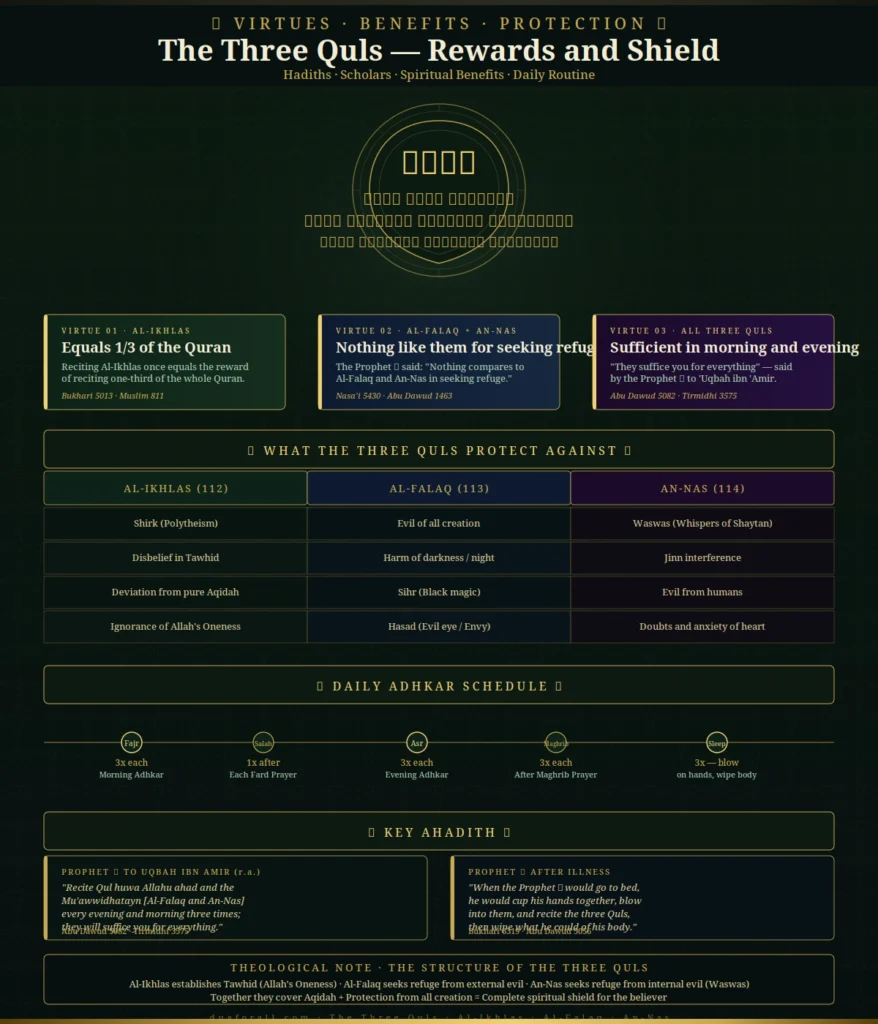
قُلْ هُوَ اللَّهُ أَحَدٌ · قُلْ أَعُوذُ بِرَبِّ الْفَلَقِ · قُلْ أَعُوذُ بِرَبِّ النَّاسِ
The Three Quls — Al-Ikhlas, Al-Falaq & An-Nas
The three final surahs of the Quran that the Prophet ﷺ never slept without reciting. Learn their Arabic text, transliteration, translation, and profound virtues — your complete guide.
What Are the Three Quls?
Three short, powerful surahs — each beginning with the word Qul (قُلْ, "Say”) — that encompass the complete protection of a believer.
The Three Quls refer to the last three chapters of the Holy Quran: Surah Al-Ikhlas (112), Surah Al-Falaq (113), and Surah An-Nas (114). They are called the "Three Quls” because each one opens with the divine command "Qul” (قُلْ) — meaning "Say” — addressed to the Prophet Muhammad ﷺ and, through him, to all believers.
Together, they form a comprehensive shield: Al-Ikhlas affirms the absolute oneness of Allah; Al-Falaq seeks protection from external harms; An-Nas seeks refuge from the internal whisperings of Shaytan. The Prophet ﷺ described reciting them three times in the morning and evening as being sufficient protection for everything, as recorded in authentic hadith collections.
The Three Quls — Surahs 112, 113, 114 — comprise 17 ayaat and form the final, protective conclusion of the Holy Quran.
Surah Al-Ikhlas — Purity of Faith
Surah 112 · 4 Ayaat · Makki · Equal to one-third of the entire Quran
بِسْمِ اللَّهِ الرَّحْمَٰنِ الرَّحِيمِ
قُلْ هُوَ اللَّهُ أَحَدٌ ١
اللَّهُ الصَّمَدُ ٢
لَمْ يَلِدْ وَلَمْ يُولَدْ ٣
وَلَمْ يَكُن لَّهُ كُفُوًا أَحَدٌ ٤
Transliteration
Bismillāhir-raḥmānir-raḥīm
1. Qul huwa Allāhu aḥad
2. Allāhu ṣ-ṣamad
3. Lam yalid wa lam yūlad
4. Wa lam yakun lahū kufuwan aḥad
English Translation
In the name of Allah, the Most Gracious, the Most Merciful.
1. Say: He is Allah, the One.
2. Allah, the Eternal Refuge.
3. He neither begets nor is born.
4. Nor is there to Him any equivalent.
- The Prophet ﷺ said it is equal to one-third of the Quran in reward. (Sahih Bukhari 5013)
- It describes the complete essence of Tawheed — Allah’s absolute, unique oneness — in only four ayaat.
- Loving this surah is a sign of love for Allah; the Prophet ﷺ praised a companion who recited it in every rakah. (Sahih Bukhari 7375)
- Al-Ikhlas is one of the Al-Mu’awwidhat — along with Al-Falaq and An-Nas — recited for morning and evening protection. (Abu Dawud 5082)
- Reciting it ten times results in a house being built for the believer in Paradise. (Ibn Majah 3786)
Surah Al-Falaq — Dawn & Protection
Surah 113 · 5 Ayaat · Makki · Refuge from all external harms
بِسْمِ اللَّهِ الرَّحْمَٰنِ الرَّحِيمِ
قُلْ أَعُوذُ بِرَبِّ الْفَلَقِ ١
مِن شَرِّ مَا خَلَقَ ٢
وَمِن شَرِّ غَاسِقٍ إِذَا وَقَبَ ٣
وَمِن شَرِّ النَّفَّاثَاتِ فِي الْعُقَدِ ٤
وَمِن شَرِّ حَاسِدٍ إِذَا حَسَدَ ٥
Transliteration
Bismillāhir-raḥmānir-raḥīm
1. Qul a’ūdhu bi-rabbi l-falaq
2. Min sharri mā khalaq
3. Wa min sharri ghāsiqin idhā waqab
4. Wa min sharri n-naffāthāti fi l-‘uqad
5. Wa min sharri ḥāsidin idhā ḥasad
English Translation
In the name of Allah, the Most Gracious, the Most Merciful.
1. Say: I seek refuge with the Lord of the daybreak,
2. From the evil of that which He created,
3. And from the evil of darkness when it settles,
4. And from the evil of the blowers in knots,
5. And from the evil of an envier when he envies.
- The Prophet ﷺ was instructed to seek refuge specifically through Al-Falaq and An-Nas when experiencing difficulty and sickness. (Sahih Bukhari 4439)
- These surahs (Al-Falaq & An-Nas) are called Al-Mu’awwidhatain — the two surahs of seeking refuge — and together cover protection from all imaginable evils.
- The Prophet ﷺ said: "Have you not seen verses revealed tonight the like of which have never been seen before? They are Al-Falaq and An-Nas.” (Sahih Muslim 814)
- Reciting Al-Falaq provides protection from black magic, envy (hasad/evil eye), and darkness — including the whispers of Shaytan that intensify at night.
Surah An-Nas — Refuge from Shaytan
Surah 114 · 6 Ayaat · Makki · Protection from the whisperings of Shaytan
بِسْمِ اللَّهِ الرَّحْمَٰنِ الرَّحِيمِ
قُلْ أَعُوذُ بِرَبِّ النَّاسِ ١
مَلِكِ النَّاسِ ٢
إِلَٰهِ النَّاسِ ٣
مِن شَرِّ الْوَسْوَاسِ الْخَنَّاسِ ٤
الَّذِي يُوَسْوِسُ فِي صُدُورِ النَّاسِ ٥
مِنَ الْجِنَّةِ وَالنَّاسِ ٦
Transliteration
Bismillāhir-raḥmānir-raḥīm
1. Qul a’ūdhu bi-rabbi n-nās
2. Maliki n-nās
3. Ilāhi n-nās
4. Min sharri l-waswāsi l-khannās
5. Alladhī yuwaswisu fī ṣudūri n-nās
6. Mina l-jinnati wa n-nās
English Translation
In the name of Allah, the Most Gracious, the Most Merciful.
1. Say: I seek refuge with the Lord of mankind,
2. The King of mankind,
3. The God of mankind,
4. From the evil of the retreating whisperer,
5. Who whispers in the breasts of mankind,
6. Among jinn and among people.
- An-Nas specifically addresses the Waswas al-Khannas — the retreating whisperer (Shaytan), who withdraws when Allah is remembered and returns when He is forgotten.
- The Prophet ﷺ said that whoever recites Al-Falaq and An-Nas three times each morning and evening will be protected against everything. (Abu Dawud 5082, Tirmidhi 3575)
- These two surahs address both the external world of jinn and the internal whispers within human hearts — making them comprehensive ruqyah.
- An-Nas invokes three of Allah’s attributes: Rabb (Lord), Malik (King), and Ilah (God) — a unique threefold appeal not found elsewhere in this form.
"Recite Qul huwa Allahu ahad and the Mu’awwidhatain (Al-Falaq and An-Nas) three times in the morning and evening — they will suffice you against everything.”
Prophet Muhammad ﷺ · Abu Dawud 5082 · Tirmidhi 3575 — Graded Hasan
Benefits of the Three Quls
Authentic hadith establish profound spiritual, protective, and healing benefits for those who recite them consistently.
Recited three times each morning and evening, they provide comprehensive protection against all harm throughout the day and night.
Surah Al-Ikhlas alone carries the reward of reciting one-third of the Quran due to its perfect encapsulation of Tawheed.
The Prophet ﷺ would blow on his palms after reciting the Three Quls before sleeping, then wipe over his body three times.
The Prophet ﷺ used Al-Falaq and An-Nas as ruqyah (spiritual healing) when ill, reciting them and blowing over his hands.
Surah Al-Falaq specifically seeks refuge from the harm of an envier — addressing hasad (evil eye), one of the most widely recognised spiritual harms.
Reciting Al-Ikhlas ten times in a sitting earns a house in Paradise, according to a hadith in Ibn Majah — a magnificent reward for so few words.
Incorporating the Three Quls into your daily routine ensures protection from morning to night, following the established Sunnah of the Prophet ﷺ.
When & How to Recite the Three Quls
The Prophet ﷺ established specific times and methods for reciting the Three Quls, each backed by authentic narrations.
The Three Quls — Comparison Table
A side-by-side overview of all three surahs for easy study and memorisation.
| Attribute | Surah Al-Ikhlas (112) | Surah Al-Falaq (113) | Surah An-Nas (114) |
|---|---|---|---|
| Arabic Name | الْإِخْلَاصُ | الْفَلَقُ | النَّاسُ |
| Meaning of Name | The Purity / Sincerity | The Daybreak / Dawn | Mankind / People |
| Surah No. | 112 | 113 | 114 |
| No. of Ayaat | 4 | 5 | 6 |
| Revelation | Makki | Makki | Makki |
| Core Theme | Tawheed — Absolute Oneness of Allah | Refuge from external evil & harm | Refuge from Shaytan’s whispers |
| Key Virtue | Equal to ⅓ of the Quran | Al-Mu’awwidhatain (protection pair) | Al-Mu’awwidhatain (protection pair) |
| Primary Hadith | Bukhari 5013 | Abu Dawud 5082 | Abu Dawud 5082 |
| Times to Recite | 3× morning, evening, before sleep | 3× morning, evening, before sleep | 3× morning, evening, before sleep |
Related Duas & Supplications
Deepen your practice with related content from our authentic Islamic resources library.
Frequently Asked Questions
Answers to the most common questions about the Three Quls, based on authentic sources.
They are called the "Three Quls” because each of the three surahs — Al-Ikhlas (112), Al-Falaq (113), and An-Nas (114) — begins with the word Qul (قُلْ), meaning "Say.” This Arabic command is addressed by Allah to the Prophet ﷺ, instructing him to proclaim these specific words to humanity. Together, the three surahs are also known as Al-Mu’awwidhat (the seeking-refuge surahs), though technically Al-Ikhlas is sometimes treated separately, with Al-Falaq and An-Nas forming the pair called Al-Mu’awwidhatain.
The Prophet ﷺ prescribed reciting each of the Three Quls three times in the morning (after Fajr) and three times in the evening (after Asr). Regarding bedtime, they are recited once per surah (or three times each, according to some scholars), then the believer blows gently on their palms and wipes over their body, repeating this action three times. Reciting them once after every obligatory prayer is also a Sunnah, with the recommendation of three times after Fajr and Maghrib specifically. See Abu Dawud 5082 and Sahih Bukhari 5017.
Yes, this is established in authentic hadith. The Prophet ﷺ confirmed: "Does any one of you find it difficult to recite one third of the Quran in a night? They asked: ‘How could anyone recite one third of the Quran?’ He replied: ‘Qul huwa Allahu ahad is equivalent to one third of the Quran.'” (Sahih Bukhari 5013; Sahih Muslim 811). Scholars explain that the Quran deals with three broad themes: rulings, stories, and the Names and Attributes of Allah (Tawheed). Surah Al-Ikhlas exclusively covers the third category in its entirety — hence it is equal in reward to reciting a full third.
Yes. It is authentically reported that when the Prophet ﷺ was ill, ‘Aisha (may Allah be pleased with her) described how he would recite the Mu’awwidhat (Al-Falaq and An-Nas), blow on his hands, and wipe over his body seeking healing (Sahih Bukhari 4439). In his final illness, when he was too weak to recite himself, ‘Aisha would recite them and wipe his hands over his body. This makes Al-Falaq and An-Nas among the most authentic forms of Quranic ruqyah (spiritual healing) alongside Ayat al-Kursi and Al-Fatiha.
While both surahs seek refuge, they protect from different categories of harm. Surah Al-Falaq seeks protection from external evils: the general evil of all creation, the harm of darkness at night, the evil of magic and those who blow on knots, and the harm of those who envy. Surah An-Nas seeks refuge from internal evil: specifically the whispering of Shaytan (Iblis) who whispers into the hearts of people. An-Nas uniquely invokes Allah using three attributes — Rabb (Lord and Sustainer), Malik (King), and Ilah (God) — making it a comprehensive appeal. Together they guard the believer from every conceivable harm, both visible and invisible.
Yes. ‘Aisha (may Allah be pleased with her) reported: "Every night when the Prophet ﷺ went to bed, he would cup his hands together and blow into them, and recite into them Qul huwa Allahu ahad, Qul a’udhu bi rabbi l-falaq, and Qul a’udhu bi rabbi n-nas. Then he would wipe as much of his body as he could with them, starting with his head and face and the front of his body, doing that three times.” (Sahih Bukhari 5017). This is a confirmed regular practice of the Prophet ﷺ and is one of the most recommended nightly adhkar in Islamic tradition.
Trusted Islamic Resources
Verified external sources for deeper study of the Three Quls and Quranic sciences.
Strengthen Your Daily Adhkar
Explore our full collection of morning and evening supplications, Masnoon Duas, and Quranic recitations — all with verified Arabic, transliteration, and source references.
📿 Masnoon Duas 🌅 Morning Adhkar 🛡️ Protection Duas