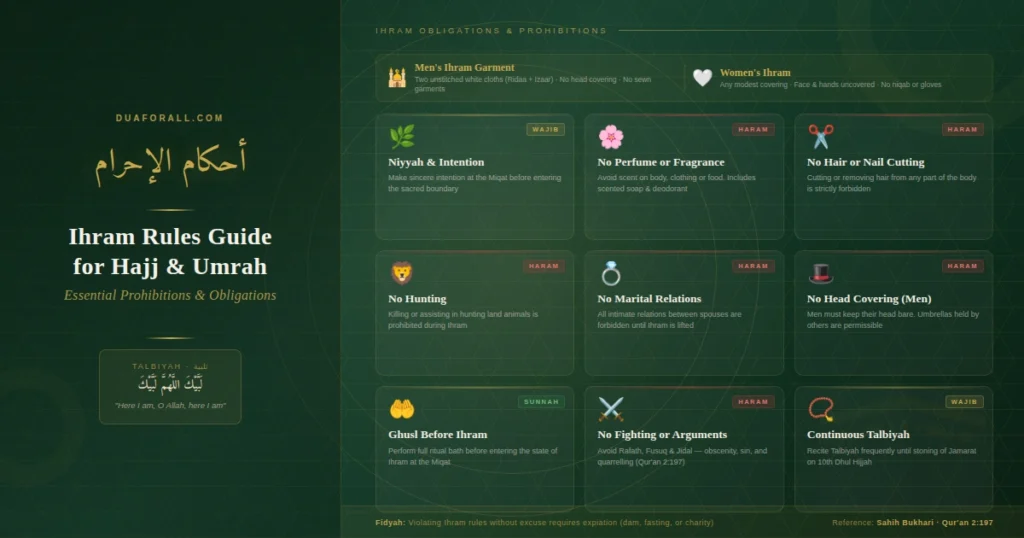
Ihram Rules: The Complete Guide for Hajj & Umrah Garments · Miqat · Prohibitions · Fidyah · Madhab Differences
Everything you need to enter, maintain and exit the sacred state of Ihram correctly — the two garments, the five Miqat stations, all 13 prohibitions, women-specific rulings, expiation for mistakes, and the differences between the four madhabs. Every ruling traced to the Qur’an, authenticated Hadith and classical fiqh.
Last reviewed: 16 July 2026 · Applicable to Hajj 1448 AH / 2027 and year-round Umrah
What Ihram Actually Is
Ihram (إِحْرَام) comes from the Arabic root ḥ-r-m — the same root as ḥarām (forbidden) and ḥaram (sanctuary). Linguistically it means to make something forbidden upon yourself. In fiqh, Ihram is the sacred state a pilgrim enters with a binding intention (niyyah) to perform Hajj or Umrah, after which a set of otherwise-permissible acts becomes temporarily forbidden.
The single most common misconception
Ihram is not the two white cloths. The cloths are a Sunnah of the state, not the state itself. A man who wraps the towels but never forms the intention has not entered Ihram. A man who forms the intention at the Miqat while still in his trousers has entered Ihram — he is simply now in violation and must change immediately. Ihram is the niyyah; the garments follow it.
This distinction has practical consequences all through your journey, and it is why every ruling below turns on the moment the intention is made — not on what you are wearing.
“Hajj is [during] well-known months, so whoever has made Hajj obligatory upon himself therein — there is no sexual relations, no disobedience and no disputing during Hajj.”
Qur’an Surah al-Baqarah 2:197 — read on Quran.com
Notice what the verse emphasises. Before it lists any dress code, it names the three real prohibitions: lust, sin and quarrelling. The physical restrictions of Ihram exist to serve that inner discipline — stripping away rank, wealth and vanity so that two million people stand before Allah in the same two pieces of unsewn cloth. If you want the wider context of the pilgrimage itself, our complete Hajj 2027 guide covers the rites in sequence.
The Ihram Garments
The requirement differs sharply by gender, and this is where most first-time pilgrims get confused.
For men: two unsewn white sheets
- Izār (إزار) — wrapped around the lower body from the navel to below the knees. A belt or money-belt over it is permitted by consensus.
- Ridā’ (رداء) — draped over the shoulders and upper body.
- Footwear — sandals or slippers that leave the ankle bones and heel exposed.
White is Sunnah, not obligatory — the requirement is that the cloth be unsewn and untailored to the shape of the limb. This is why safety pins are permitted by the majority (they fasten, they do not tailor) while a stitched hooded robe is not.
For women: her normal modest clothing
There is no special garment for women in Ihram. She wears her ordinary clothing that fulfils the standard conditions of Islamic covering: loose, opaque, non-attention-drawing, covering everything except the face and hands. Any colour is permitted; the widespread assumption that women must wear white has no basis in the Sunnah. Our guide to Taharah and cleanliness in Islam covers the purity prerequisites she should attend to beforehand.
Practical buying advice
Bring two complete sets of Ihram garments. Towelling cloth grips better and slips less than smooth cotton; a 2.5m × 1.2m izar suits most builds. An Ihram belt with pockets solves the money problem without breaking any ruling.
How to Enter Ihram: Step by Step
This is the Prophetic sequence ﷺ, performed at or before the Miqat.
Personal grooming — before Ihram
Trim your nails, remove underarm and pubic hair, trim the moustache and shape the beard. Once you enter Ihram all of this becomes forbidden, so it is done now. These are the Sunan al-Fitrah — the natural practices of hygiene the Prophet ﷺ prescribed.
Perform ghusl (full bath)
Ghusl before Ihram is a confirmed Sunnah for everyone — including women in menstruation or post-natal bleeding, who perform it for cleanliness even though it does not lift their state of impurity. If ghusl is impossible, wudhu suffices.
Apply perfume to the body — not the garments
Applying scent to the body before entering Ihram is Sunnah, and its lingering fragrance afterwards causes no harm. Applying it to the cloth is avoided, because the cloth accompanies you into the sacred state.
‘A’ishah (may Allah be pleased with her) said she used to apply perfume to the Messenger of Allah ﷺ for his Ihram before he entered it, and for his exit from Ihram before he circumambulated the House.
Sahih Sahih al-Bukhari 1539 — view on Sunnah.com
Put on the Ihram garments
Men change into the izar and rida. Women simply ensure their clothing meets the conditions above and remove any niqab or gloves.
Pray two rak’ah (where the time permits)
The majority hold two rak’ah before Ihram to be recommended. If you arrive during a disliked time for voluntary prayer, or an obligatory prayer is due, the fard prayer serves the purpose. The Malikis and Hanafis consider it Sunnah; the position that it is a distinct “Salat al-Ihram” prayer is weak.
Make the intention (niyyah) — this is the actual entry
Form the intention in the heart for the rite you are performing. Verbalising it is Sunnah in the Shafi’i and Hanbali schools:
لَبَّيْكَ اللَّهُمَّ عُمْرَةً
Labbayk Allāhumma ʿUmrah — “Here I am, O Allah, for Umrah.”
For Hajj: Labbayk Allāhumma Ḥajjan.
Add the conditional stipulation (ishtirāṭ) if you have a genuine concern
If illness, a visa problem or any real obstacle might prevent you from completing the rite, add:
اللَّهُمَّ مَحِلِّي حَيْثُ حَبَسْتَنِي
Allāhumma maḥillī ḥaythu ḥabastanī — “O Allah, my place of exiting Ihram is wherever You prevent me.”
Sahih Sahih al-Bukhari 5089; Sahih Muslim 1207 — view on Sunnah.com. This clause allows you to exit Ihram without Fidyah or a make-up obligation if the obstacle materialises.
Begin the Talbiyah
Recite it immediately, loudly for men, quietly for women — and keep reciting throughout the journey.
The Five Miqat Stations
The Mawaqit (مواقيت) are the geographical boundaries fixed by the Prophet ﷺ. No one intending Hajj or Umrah may cross them without being in Ihram. Crossing one knowingly without Ihram obliges you to return to it, or to slaughter a sheep (dam) in Makkah.
Ibn ‘Abbas (may Allah be pleased with him) reported that the Prophet ﷺ appointed Dhul-Hulayfah for the people of Madinah, Al-Juhfah for the people of Sham, Qarn al-Manazil for the people of Najd, and Yalamlam for the people of Yemen — and added that these stations serve those peoples and anyone else who passes through them intending Hajj or Umrah. Whoever lives closer to Makkah enters Ihram from where they begin, and the people of Makkah enter from Makkah itself.
Sahih Sahih al-Bukhari 1524; Sahih Muslim 1181 — view on Sunnah.com. Dhat ‘Irq was designated later for the people of Iraq (Sahih Muslim 1183).
| Miqat | Modern name | Approx. distance to Makkah | Who enters Ihram here |
|---|---|---|---|
| Dhul-Ḥulayfah | Abyār ʿAlī | ~450 km (N) | Pilgrims from or via Madinah. The furthest Miqat. |
| Al-Juḥfah | Rābigh | ~190 km (NW) | Egypt, the Levant, North Africa, Europe, the Americas approaching by land or sea. |
| Qarn al-Manāzil | As-Sayl al-Kabīr | ~75 km (E) | Najd, Taif, the Gulf states. The Miqat crossed by most flights into Jeddah. |
| Yalamlam | As-Saʿdiyyah | ~100 km (S) | Yemen, India, Pakistan, Bangladesh, Indonesia, Malaysia. |
| Dhāt ʿIrq | Aḍ-Ḍarībah | ~85 km (NE) | Iraq, Iran, Central Asia. |
| Inside the Miqat | — | — | Residents of Jeddah, Taif, etc. enter from their own home or locality. |
| Makkah itself | — | — | For Hajj: from your residence in Makkah. For Umrah: exit to the Ḥill — Masjid ʿA’ishah at at-Tanʿīm is the usual choice. |
If you are flying — read this carefully
The Miqat is a place, not a building. It extends upward: your aircraft crosses it at cruising altitude, typically 30–60 minutes before landing, and the cabin crew or captain will normally announce it. You must have formed the intention and put on the garments before that moment — which in practice means changing at your departure airport or during the flight. Landing in Jeddah and only then putting on Ihram means you have crossed the Miqat unlawfully and owe a dam. Our Hajj flight schedule guide covers airport-side logistics.
One nuance worth knowing: Jeddah is inside the Miqat boundaries. It is a valid Miqat only for its own residents and for those whose journey does not pass over any of the five stations — a genuinely rare case for international pilgrims.
The Talbiyah
The Talbiyah is the pilgrim’s answer to Allah’s call — the sound of Hajj itself. It begins the moment you enter Ihram and continues until you begin the Tawaf of Umrah, or until you stone the Jamrat al-‘Aqabah on the day of Eid for Hajj.
Labbayk Allāhumma labbayk. Labbayka lā sharīka laka labbayk. Inna-l-ḥamda wa-n-niʿmata laka wa-l-mulk. Lā sharīka lak.
“Here I am, O Allah, here I am. Here I am, You have no partner, here I am. Indeed all praise, grace and sovereignty belong to You. You have no partner.”
Sahih Sahih al-Bukhari 1549; Sahih Muslim 1184 — view on Sunnah.com
- Men raise their voices with it. Ibn ‘Abbas reported the Prophet ﷺ instructed his companions to do so (Sunan Abu Dawud 1814, graded Sahih).
- Women recite it audibly to themselves without raising the voice.
- Renew it at every change of state — mounting transport, descending a valley, meeting other pilgrims, after each prayer, at dawn.
For the full set of supplications tied to each rite, see our complete collection of authentic Hajj duas, and our duas for the traveller for the journey itself.
Tamattuʿ, Qirān or Ifrād? Choosing Before You Intend
You must decide which type of Hajj you are performing at the moment of intention, because the type determines how long you stay in Ihram and whether you owe a sacrifice.
| Type | What you do | Ihram duration | Hady (sacrifice)? | Best for |
|---|---|---|---|---|
| Tamattuʿ Most common | Umrah first, exit Ihram fully, then re-enter Ihram for Hajj on 8th Dhul-Hijjah. | Two short periods, with normal life in between. | Yes — obligatory | Almost all international pilgrims. Physically easiest. |
| Qirān | Umrah and Hajj combined under a single Ihram, without exiting in between. | Continuous — from Miqat until the 10th. | Yes — obligatory | Those arriving close to Hajj, or bringing the sacrificial animal with them. |
| Ifrād | Hajj alone, no Umrah attached. | Continuous — from Miqat until the 10th. | No — not required | Makkah residents and those inside the Miqat. |
Why Tamattuʿ is usually recommended
The Prophet ﷺ in the Farewell Hajj instructed his companions who had not brought sacrificial animals to convert their intention to Umrah and exit Ihram (Sahih al-Bukhari 1568), and Ibn ‘Abbas held Tamattuʿ to be superior. It also spares you days of Ihram restrictions in Makkah’s heat.
If you are budgeting for the hady, our Qurbani & Udhiyah calculator explains the animal-share rules that apply equally to the Hajj sacrifice, and the Hajj 2027 packages comparison shows which tiers include it.
The 13 Prohibitions of Ihram
These fall into three groups: those applying to everyone, those applying to men only, and those applying to women only. Intent matters — a violation done deliberately, knowingly and by choice carries expiation; one done by genuine forgetfulness, ignorance or compulsion generally does not, according to the majority.
Applying to everyone
Applying to men only
Applying to women only
Ibn ‘Umar (may Allah be pleased with him) reported the Prophet ﷺ forbidding the woman in Ihram from wearing the niqab and gloves, and — in the same narration — forbidding the man in Ihram from shirts, turbans, trousers, hooded cloaks, and leather socks unless he cannot find sandals, in which case he cuts them below the ankles.
Sahih Sahih al-Bukhari 1838; Sahih Muslim 1177 — view on Sunnah.com
What is not prohibited — a list worth reading twice
Washing and showering with unscented soap · brushing your teeth (see our miswak guide) · wearing a watch, ring, glasses or hearing aid · using a belt, money pouch or backpack · carrying an umbrella · sheltering in a tent or vehicle · killing harmful creatures (snake, scorpion, rat, aggressive dog, crow, kite) · taking medication and injections · changing your Ihram garments · washing the garments · scratching gently.
Ihram Rules for Women
Women’s Ihram is in most respects simpler than men’s — the confusion usually comes from rulings that get over-applied.
The niqab ruling, precisely
What is prohibited is the tailored face-veil tied onto the face, not the covering of the face as such. The majority — including the Hanafis, Shafi’is and Hanbalis — permit a woman to drape a loose cloth down over her face from above when non-mahram men are present, provided it does not press against the face. ‘A’ishah described the female pilgrims doing exactly this when riders passed them (Sunan Abu Dawud 1833, graded Hasan).
Menstruation and post-natal bleeding
A woman in her period enters Ihram normally — she performs ghusl, makes the intention, recites the Talbiyah and joins every rite except Tawaf and prayer. She may perform Sa’i. Asma’ bint ‘Umays gave birth at Dhul-Hulayfah and the Prophet ﷺ instructed her to perform ghusl, bind herself with a cloth and enter Ihram (Sahih Muslim 1218).
Medication to delay menstruation
Contemporary scholarly bodies permit period-delaying medication for Hajj and Umrah on the condition that it causes no harm and is taken with medical advice. Because Tawaf al-Ifadah cannot be skipped and cannot be compensated for, many women on fixed-length packages choose this. It is a permission, not an obligation — and a health decision as much as a fiqh one, so consult your doctor.
- Colour: any modest colour. White is not required.
- Footwear: women may wear ordinary closed shoes and socks — the ankle-exposure rule is for men only.
- Head: must be covered as normal; only the face and hands are left uncovered.
- Hair at tahallul: she gathers her hair and cuts a fingertip’s length (~2.5 cm) from the end of it. Women never shave.
- Talbiyah: audible to herself, not raised.
Where the Four Madhabs Differ
The core of Ihram is agreed upon. These are the genuine points of difference you may encounter — presented so that you can follow your school with confidence rather than assume another group is in error.
| Issue | Ḥanafī | Mālikī | Shāfiʿī | Ḥanbalī |
|---|---|---|---|---|
| Verbalising the niyyah | Recommended | Permitted, not emphasised | Sunnah | Sunnah |
| Talbiyah’s status | A condition of validity alongside the intention | Wājib — dam if omitted | Sunnah | Sunnah |
| Perfume on the body before Ihram | Permitted | Disliked if the scent persists | Permitted | Permitted |
| Ishtirāṭ (conditional stipulation) | Considered of limited effect | Not adopted | Valid and effective | Valid and effective |
| Woman covering her face with a hanging cloth | Permitted | Only if strictly needed | Permitted | Permitted |
| Shaving vs. trimming for men | Both valid; shaving superior | Both valid; shaving superior | Both valid; shaving superior | Both valid; shaving superior |
| Crossing the Miqat without Ihram, then returning | Dam waived if you return and enter Ihram there | Dam waived on return | Dam waived on return | Dam waived on return |
Compiled from the standard manuals of the four schools and cross-checked against contemporary rulings from IslamQA and SeekersGuidance. Where your group’s scholar or guide follows a different position within these schools, follow them.
Fidyah & Dam: What to Do If You Slip
Almost every pilgrim breaks something. This is not a catastrophe — the Shariah legislated the remedy in the same breath as the rule.
“And whoever among you is ill or has an ailment of the head [making shaving necessary] — then a ransom of fasting, or charity, or sacrifice.”
Qur’an Surah al-Baqarah 2:196 — read on Quran.com. The Prophet ﷺ specified the three options to Ka’b ibn ‘Ujrah as: fast three days, feed six poor people, or slaughter a sheep (Sahih al-Bukhari 1814).
| Violation | Expiation | Notes |
|---|---|---|
| Shaving / cutting hair, clipping nails, wearing perfume, wearing sewn clothing, covering the head | Fidyat al-Adhā — your choice of: fast 3 days · feed 6 poor people · slaughter a sheep | The classic three-way choice. Feeding is roughly half a sa’ of staple food per person. |
| Deliberate intercourse before the first tahallul | Hajj is invalidated; a badanah (camel) is due; you must complete this Hajj anyway and repeat it next year | The most severe ruling in the entire chapter. |
| Intercourse after the first tahallul but before the second | Hajj remains valid; a sheep is due | The rite is not lost. |
| Foreplay without intercourse | A sheep, per the majority | Hajj remains valid. |
| Hunting land game | An equivalent domestic animal, or its value in food to the poor, or fasting a corresponding number of days | Qur’an 5:95. Judged by two just persons. |
| Crossing the Miqat without Ihram and not returning | A sheep (dam) | Avoided entirely if you go back to the Miqat and enter Ihram there. |
| Missing a wājib of Hajj (e.g. leaving Muzdalifah early, omitting the farewell Tawaf) | A sheep (dam) | The rite remains valid. |
| Any violation done forgetfully, ignorantly or under compulsion | Nothing — per the majority. Stop the act as soon as you realise. | The Hanafis take a stricter view on some cases; ask your guide. |
Where the sacrifice must happen
Any dam or hady must be slaughtered within the Haram of Makkah and distributed to its poor. You cannot fulfil it by having an animal slaughtered in your home country. The official Adahi/Nusuk channels and licensed banks in Makkah handle this — and give you a receipt. Do not use unlicensed street brokers.
Exiting Ihram (Taḥallul)
For Umrah — one exit
After completing Tawaf and Sa’i, you shave (halq) or trim (taqsir) your hair. At that moment Ihram ends completely and everything becomes lawful again. Shaving carries the greater reward — the Prophet ﷺ supplicated for those who shave three times before mentioning those who trim (Sahih al-Bukhari 1728).
For Hajj — two exits
First taḥallul (تحلل أصغر)
Achieved by completing any two of: stoning Jamrat al-‘Aqabah · shaving or trimming · Tawaf al-Ifadah with Sa’i.
Now lawful: normal clothing, perfume, cutting hair and nails, everything else.
Still forbidden: sexual intercourse and its preliminaries.
Second taḥallul (تحلل أكبر)
Achieved once all three of the above are complete.
Now lawful: everything, including intimacy with one’s spouse. Ihram has ended entirely.
Men: when shaving, the whole head is shaved — partial shaving does not fulfil it. Women: gather the hair and cut approximately a fingertip’s length from the ends.
Common Mistakes to Avoid
- Boarding the plane in ordinary clothes, planning to change in Jeddah. You will cross the Miqat in the air. Change before departure or on board.
- Using scented soap, wipes or deodorant. Buy unscented before you travel — it is far harder to find in Makkah than you expect.
- Believing the two cloths are Ihram. Without the niyyah, you are simply a man in a towel.
- Assuming women must wear white. No basis in the Sunnah.
- Touching or kissing the Black Stone when it is crowded, and arguing to get there. Jidāl is a prohibition of Ihram. ‘Umar reminded people that the stone neither harms nor benefits.
- Wearing socks or closed shoes as a man because the marble is hot. Sandals only; sit if you must.
- Panicking after a violation and doing nothing. Stop the act, ask your group’s scholar, arrange the fidyah calmly.
- Omitting the ishtirāṭ despite a real health concern. It costs one sentence and can save an entire obligation.
- Neglecting the inner Ihram. The verse forbids sin and disputing before it forbids anything else.
Frequently Asked Questions
Men cannot. Underwear is tailored to the shape of the limb and falls squarely under the prohibition of sewn clothing reported in Sahih al-Bukhari 1838. A proper izar of adequate width, fastened with a belt or pins, secures modesty without it. Women wear their normal clothing including underwear without restriction.
Yes — by consensus. These are not garments tailored to the body; they are carried items. The Prophet’s companions carried their provisions in Ihram. Wearing a watch, ring, glasses, hearing aid or medical device is likewise permitted.
The majority of scholars hold that a violation done in genuine forgetfulness or ignorance carries no expiation. Wash it off as soon as you realise, and continue. Deliberately applying it, however, obliges Fidyat al-Adha — fasting three days, feeding six poor people, or slaughtering a sheep.
She enters Ihram, recites the Talbiyah, and travels — but she cannot perform Tawaf, which is a pillar of Umrah. So she remains in Ihram until she becomes pure, then performs Tawaf and Sa’i and exits. If her travel schedule makes this impossible, she should consult a scholar; this is precisely the situation the ishtirat clause is designed for.
Yes. Ibn ‘Abbas and Al-Miswar disputed this and asked Abu Ayyub al-Ansari, who demonstrated washing his head while in Ihram, saying he had seen the Prophet ﷺ do so (Sahih al-Bukhari 1840). Use unscented products and wash gently so as not to pull hair out deliberately.
No. The prohibition is on covering that touches the head directly — a cap, turban or hood. Shade that does not rest on the head is permitted: umbrellas, tents, vehicle roofs. Umm al-Husayn reported that Usamah and Bilal held a garment up to shade the Prophet ﷺ from the heat during his Hajj (Sahih Muslim 1298).
If you realise in time, return to the Miqat and enter Ihram there — the obligation is then fully discharged with nothing owed. If returning is not feasible, enter Ihram from where you are and slaughter a sheep in Makkah, distributed to its poor. Your Hajj or Umrah remains valid either way.
For Umrah, typically a few hours to a day — from the Miqat until you trim your hair after Sa’i. For Hajj Tamattu’, a second Ihram from 8th to 10th Dhul-Hijjah. For Qiran and Ifrad, continuously from the Miqat until the 10th, which can mean many days.
No — and the majority hold that a contract concluded in Ihram is invalid, not merely sinful. ‘Uthman reported the Prophet ﷺ saying that the person in Ihram does not marry, is not given in marriage, and does not propose (Sahih Muslim 1409). This applies to acting as a guardian or agent for someone else’s contract too.
Yes, without restriction, as long as it is not scented. Injections, inhalers, tablets, insulin and IV drips are all permitted. If a medical procedure requires removing hair — for instance shaving for surgery — that falls under the very case Qur’an 2:196 addresses, and Fidyat al-Adha applies.
Sources, Methodology & Authors
How this guide was verified
Every ruling above is traced to a primary text — the Qur’an or a graded Hadith — and cross-checked against the standard manuals of the four Sunni schools. Where the schools differ, we have said so rather than presenting one position as the Islamic ruling. Hadith gradings follow the classifications of the classical critics. Full detail on our sourcing hierarchy is on our Editorial Standards page.
This guide is educational, not a substitute for a qualified scholar. Ihram cases are highly fact-specific. If you are unsure about your own situation — particularly regarding fidyah or a health-related exemption — ask a scholar directly, and consult a doctor for any medical question.
Primary sources cited
- Qur’an: Surah al-Baqarah 2:196–197, Surah al-Ma’idah 5:95–96
- Sahih al-Bukhari, Book of Hajj — nos. 1524, 1539, 1549, 1568, 1728, 1814, 1838, 1840
- Sahih Muslim, Book of Hajj — nos. 1177, 1181, 1183, 1184, 1207, 1218, 1298, 1409
- Sunan Abu Dawud — nos. 1814, 1833
- Contemporary rulings: IslamQA — Ihram rulings · SeekersGuidance · IslamWeb
- Official pilgrimage procedure: Nusuk — Saudi Ministry of Hajj and Umrah platform
Continue Your Preparation