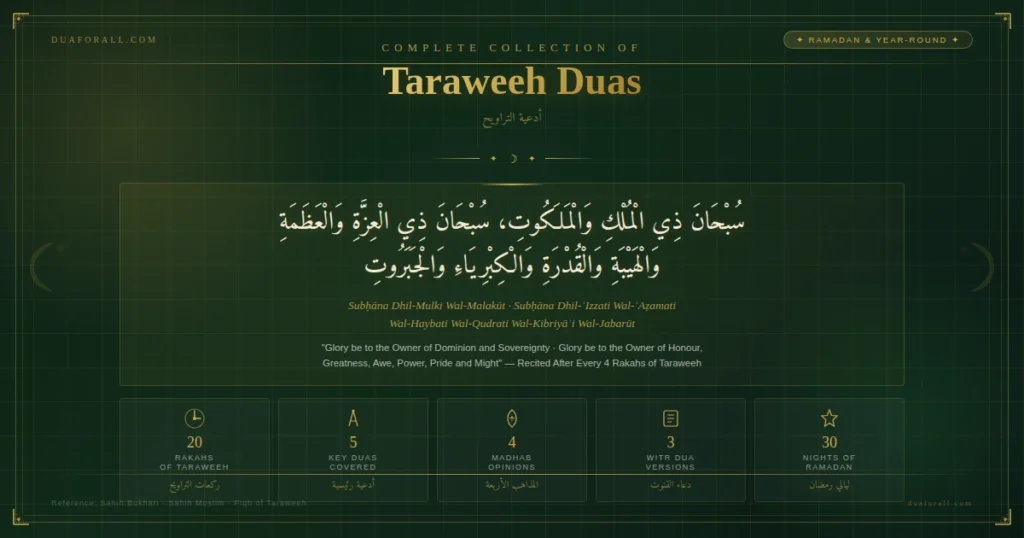
Taraweeh Duas — Complete Guide with Arabic, Transliteration & Translation
The complete, authentic collection of Taraweeh Duas — including Tasbeeh e Taraweeh, Dua Qunoot, and the Kamilin Dua — with full Arabic text, easy transliteration, and English meaning for every night of Ramadan.
Understanding Taraweeh Duas
Taraweeh Duas are the supplications recited during or between the sets of Taraweeh prayer — the blessed night prayers of Ramadan performed after the obligatory Isha and before the Witr prayer. The word “Taraweeh” (تَرَاوِيح) comes from the Arabic root meaning to rest or relax, referring to the short breaks taken after every four rakats.
While no single, fixed dua is explicitly mandated in the authentic hadith for the break between rakats, Muslim scholars unanimously agree that engaging in dhikr (remembrance of Allah), personal supplication, and recitation of Quranic verses during these intervals is highly praiseworthy. The commonly recited Tasbeeh e Taraweeh has been passed down through generations and carries beautiful meaning — as long as it is not treated as an obligatory ritual.
Scholarly Note: Scholars from the Hanafi, Maliki, Shafi’i, and Hanbali schools all affirm that Taraweeh is a Sunnah Mu’akkadah (strongly emphasised Sunnah). The Prophet ﷺ said: “Whoever stands (in prayer) during Ramadan with faith and hoping for reward, his previous sins will be forgiven.” — Riyad as-Salihin 1187 (Bukhari & Muslim).
“And when My servants ask you about Me — indeed I am near. I respond to the invocation of the supplicant when he calls upon Me.”
Complete Taraweeh Duas with Arabic Text
Select any dua below to view its full Arabic text, transliteration, English translation, and scholarly notes.
Tasbeeh e Taraweeh — After Every 4 Rakats
Subhāna Dhil-Mulki wal-Malakūt, Subhāna Dhil-‘Izzati wal-‘Azhamati wal-Haybati wal-Qudrati wal-Kibriyā’i wal-Jabarūt, Subhānal-Malikil-Hayyil-Ladhī lā Yanāmu wa lā Yamūt, Subbūhun Quddūsun Rabbunā wa Rabbul-Malā’ikati war-Rūh, Allāhumma Ajirnā minan-Nāri yā Mujīr, yā Mujīr, yā Mujīr.
📌 This Tasbeeh is recited silently after every 4 rakats of Taraweeh during the rest interval. It is not an obligatory recitation but a widely loved tradition, especially in South Asian and Southeast Asian communities. You may also make personal dua or recite any other dhikr during this break.
Dua Qunoot — Recited in Witr Prayer
Allāhummahdina fīman hadayt, wa ‘āfinā fīman ‘āfayt, wa tawallanā fīman tawallayt, wa bārik lanā fīmā a’tayt, wa qinā sharra mā qaḍayt, fa innaka taqḍī wa lā yuqḍā ‘alayk, wa innahu lā yadhillu man wālayt, wa lā ya’izzu man ‘ādayt, tabārakta Rabbanā wa ta’ālayt.
📌 Dua Qunoot is recited in the standing position (before or after ruku’) in the final rakat of Witr prayer, which follows Taraweeh. It is an authentic, well-established Sunnah of the Prophet ﷺ. See the full hadith at Sunnah.com.
Dua for Starting Night Prayer (Qiyam al-Layl)
Allāhumma lakal-hamd, anta nūrus-samāwāti wal-arḍi wa man fīhinn, wa lakal-hamd, anta qayyimus-samāwāti wal-arḍi wa man fīhinn, wa lakal-hamd, antal-Haqq.
📌 This beautiful supplication was the Prophet’s ﷺ own opening dua when rising for night prayer. Reciting it before your Taraweeh beautifully connects you with his Sunnah. Read the full hadith at Sunnah.com.
Dua Kamilin — After Completing Taraweeh
Allāhummaj’alnā bil-īmāni kāmilīn, wa lil-farā’iḍi mu’addīn, wa liṣ-ṣalāti ḥāfiẓīn, wa liz-zakāti fā’ilīn, wa limā ‘indaka ṭālibīn, wa li’afwika rājīn, wa bil-hudā mutamassikīn, wa ‘anil-laghwi mu’riḍīn.
📌 The Kamilin Dua is a comprehensive supplication covering the core pillars of a believer’s life — faith, prayer, zakat, and righteous conduct. It is a beautiful way to seal the night’s worship with intention and aspiration.
How Taraweeh is Structured — Visual Guide
The Taraweeh prayer is performed after Isha and before Witr. Here is how a full night of Taraweeh prayer is structured, showing when each dua is recited.
Benefits of Taraweeh Prayer and Its Duas
Taraweeh is among the greatest acts of Ibadah in Ramadan. Beyond spiritual reward, reciting its duas with understanding transforms the entire night experience.
Forgiveness of Sins
The Prophet ﷺ promised that whoever prays Taraweeh with sincere faith will have their past sins forgiven.
Spiritual Purification
Each rakat and every dua recited in Taraweeh cleanses the heart and strengthens the soul’s connection to Allah.
Laylat al-Qadr
Consistent Taraweeh attendance through the last 10 nights maximises the chance of witnessing the Night of Power.
Quran Completion
Congregational Taraweeh completes one full recitation of the Quran over Ramadan — a living connection to revelation.
Community Worship
Praying in congregation multiplies rewards and strengthens the bonds of the Muslim Ummah locally and globally.
Inner Peace
The rhythmic pattern of prayer and dua cultivates mindfulness, patience, and tranquillity that persists beyond Ramadan.
How to Recite Taraweeh Duas — Step-by-Step Guide
Follow this practical guide to integrate the Taraweeh Duas correctly into your night prayers.
- 1
Perform Your Isha Prayer First
Taraweeh begins after the obligatory Isha prayer (and its Sunnah rakats). Ensure your Isha prayer is complete before starting Taraweeh. Browse evening duas →
- 2
Make Intention (Niyyah) for Taraweeh
Make a sincere internal intention to pray Taraweeh for the sake of Allah. You may open with the Prophet’s ﷺ dua for night prayer (see Panel 3 above) for an authentic Sunnah start.
- 3
Pray 4 Rakats (2+2) Then Rest
Pray 2 rakats with Salam, then 2 more. After completing these 4 rakats, sit or stand during the rest interval. During this break, recite the Tasbeeh e Taraweeh quietly, or engage in personal dua and dhikr.
- 4
Repeat for All 20 Rakats (or 8)
Continue praying sets of 4 rakats, reciting the Tasbeeh at each break. The majority practice (following the Caliph Umar RA and the consensus of scholars) is 20 rakats. Some follow the practice of 8 rakats as reported from the Prophet ﷺ. Both are valid. See IslamQA’s detailed ruling.
- 5
Pray Witr with Dua Qunoot
Complete the night with the Witr prayer (3 rakats). In the final rakat, after the ruku’ (or before it, according to your school), recite the Dua Qunoot. This is a firmly established Sunnah. View full hadith →
- 6
Close with the Kamilin Dua
After completing your Witr prayer, recite the Dua Kamilin as a comprehensive closing supplication, asking Allah to perfect you in all aspects of faith and action. Then make personal dua — this is a blessed moment of acceptance.
Tip for memorisation: The Tasbeeh e Taraweeh is best memorised by listening to it a few times. You can also find the Ramadan calendar and Taraweeh tips on DuaForAll →. Learning the meaning of each word makes the dua far more impactful and spiritually alive.
8 Rakats or 20 Rakats? The Scholarly View
One of the most common questions about Taraweeh concerns the number of rakats. Both 8 and 20 are rooted in authentic scholarship:
Both positions are valid within the broad mercy of Islamic scholarship. Follow your local imam’s practice when praying in congregation. For an authoritative scholarly discussion, see IslamQA on the number of Taraweeh rakats.
Frequently Asked Questions About Taraweeh Duas
Explore More — Internal Resources
Continue your Ramadan spiritual journey with these related collections from DuaForAll:
Ramadan Calendar 2026
Full Suhoor, Iftar, and Taraweeh schedule with daily duas
Daily Duas Collection
500+ verified morning, evening, and situational duas
Masnoon Duas
Authentic duas directly from the Sunnah of the Prophet ﷺ
Dhikr & Tasbeeh
Complete guide to remembrance of Allah — ideal for Taraweeh breaks
Quranic Duas
Supplications directly from the Quran — perfect for night prayers
Jumu’ah Duas
Special Friday supplications, including the powerful hour of acceptance
Trusted External References
For deeper scholarly research on Taraweeh, we recommend these authoritative Islamic sources:
Sunnah.com — Taraweeh Hadith
Primary hadith sources on Qiyam Ramadan in Riyad as-Salihin
↗ sunnah.comIslamQA — Number of Rakats
Authoritative ruling on 8 vs 20 rakats with scholarly references
↗ islamqa.infoIslamQA — Tasbeeh Authenticity
Scholarly analysis on the Tasbeeh recited between Taraweeh sets
↗ islamqa.infoQuran.com — Al-Baqarah 2:186
The Quranic verse on Allah’s nearness and His response to dua
↗ quran.com“Our Lord, accept from us. Indeed, You are the All-Hearing, the All-Knowing.”
Content verified against authentic hadith collections. All Arabic text, transliterations, and translations are provided for educational purposes. Always consult a qualified Islamic scholar for personal rulings. | DuaForAll.com