Dua for Pain — Authentic Supplications from Quran & Sunnah
Verified duas for physical pain, headache, chronic illness, and Ruqyah — with Arabic text, transliteration, translation, and hadith source for every supplication.
Islam teaches that pain — whether physical, emotional, or spiritual — is never without purpose. The Prophet Muhammad ﷺ assures believers that every hardship a Muslim endures is an expiation of sins, even the prick of a thorn. This transforms suffering from a source of despair into an opportunity for closeness to Allah.
Alongside this spiritual understanding, Islam strongly encourages seeking medical treatment. The Prophet ﷺ said: “Make use of medical treatment, for Allah has not made a disease without appointing a remedy for it” (Abu Dawud 3855). Dua and medicine work together — one is not a substitute for the other.
“No fatigue, illness, anxiety, sorrow, harm or sadness afflicts any Muslim — even the prick of a thorn — without Allah expiating some of his sins thereby.”
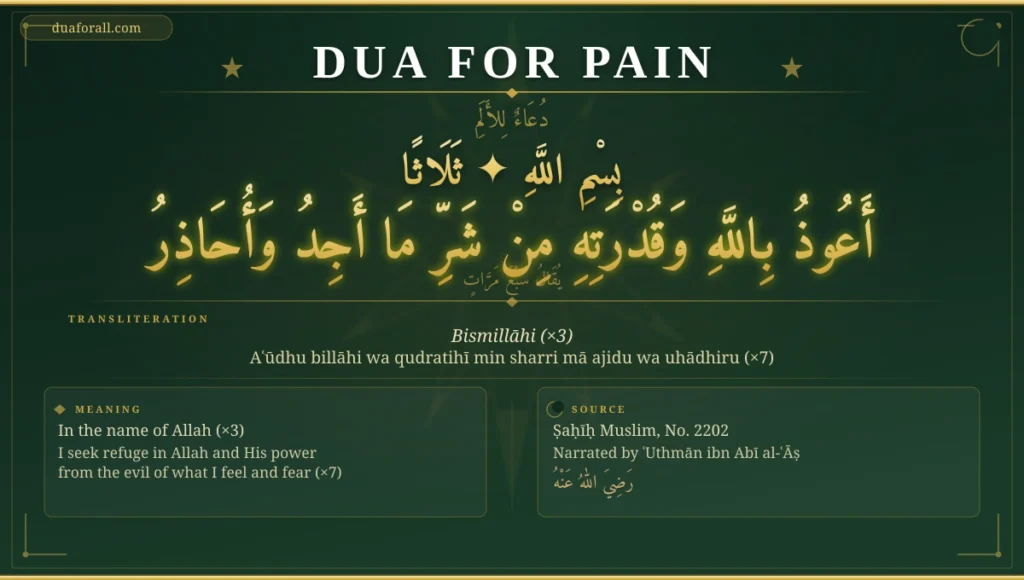
This supplication, recorded in Sahih Muslim (Hadith 2202), is the most authenticated dua specifically taught by the Prophet ﷺ for relieving physical pain.
Bismillah (three times) A’udhu billahi wa qudratihi min sharri ma ajidu wa uhadhiru (seven times)
“In the name of Allah.” (×3) — “I seek refuge in Allah and in His power from the evil of what I find and what I fear.” (×7)
📖 Method (Sunnah): Place your hand on the area of pain. Say Bismillah three times, then recite the full refuge dua seven times. Uthman ibn Abi al-‘As ؓ reported that when he came to the Prophet ﷺ complaining of pain, the Prophet ﷺ taught him this dua exactly.
📿 Complete Collection
8 Authentic Duas for Pain Relief
Every dua below is sourced from the Quran or authenticated hadith collections. We include the Arabic text, transliteration, full English translation, and hadith reference.
Allahumma Rabb an-nasi, adhhib il-ba’s, washfi anta ash-Shafi, la shifa’a illa shifa’uk, shifa’an la yughadiru saqama
“O Allah, Lord of mankind, remove the affliction and heal — You are the Healer. There is no healing except Your healing, a healing that leaves no illness behind.”
📖 When to Recite: Recite while passing your right hand over the person in pain. The Prophet ﷺ would recite this and blow lightly. Also recite for yourself when in pain.
Dua of Prophet Ayyub ؑ — For Chronic & Severe Pain
Rabbi anni massaniya ad-durru wa anta arhamur-rahimin
“My Lord, indeed adversity has touched me, and You are the Most Merciful of the merciful.”
📖 Significance: Prophet Ayyub (Job) ؑ endured severe physical affliction for years and called upon Allah with this heartfelt supplication. Allah responded by removing his hardship and restoring his health — making this dua especially powerful for those enduring long-term or chronic pain.
Bismillahi alladhi la yadurru ma’a ismihi shay’un fil-ardi wa la fis-sama’i wa huwa as-Sami’ul-‘Alim
“In the name of Allah, with Whose name nothing can cause harm on earth or in the heaven, and He is the All-Hearing, All-Knowing.”
📖 Sunnah Method: Recite three times in the morning and three times in the evening. The Prophet ﷺ said that whoever recites this will not be harmed by anything that day or night.
La ilaha illa anta subhanaka inni kuntu minaz-zalimin
“There is no deity except You; exalted are You. Indeed, I have been of the wrongdoers.”
📖 Prophetic Assurance: The Prophet ﷺ said that no Muslim calls upon Allah with this dua except that Allah will answer him. It combines sincere acknowledgment of Allah’s greatness with humility — a powerful combination for any form of pain or suffering.
Adhhib il-ba’s Rabb an-nasi, washfi anta ash-Shafi, la shifa’a illa shifa’uk
“Remove the pain, O Lord of mankind, and heal — You are the Healer. There is no healing except Your healing.”
📖 Ruqyah Practice: ‘A’isha ؓ narrated that the Prophet ﷺ used to recite this dua and pass his right hand over the sick person. This shorter version is especially suitable for memorisation by children and new Muslims.
Allahumma inni a’udhu bika minal-hammi wal-hazani, wal-‘ajzi wal-kasali, wal-bukhli wal-jubni, wa dhala’id-dayni wa ghalabatir-rijal
“O Allah, I seek refuge in You from worry and grief, from helplessness and laziness, from cowardice and miserliness, from the burden of debt and from being overpowered by people.”
📖 Context: This dua addresses the emotional dimension of pain — anxiety, grief, and inner anguish. Islam recognises psychological suffering as real pain, and this supplication comprehensively covers multiple forms of inner distress.
Allahumma ‘afini fi badani, Allahumma ‘afini fi sam’i, Allahumma ‘afini fi basari, la ilaha illa ant
“O Allah, grant me health in my body. O Allah, grant me health in my hearing. O Allah, grant me health in my sight. There is no god but You.”
📖 Recitation Time: Abu Bakrah ؓ reported that the Prophet ﷺ taught him to recite this every morning and evening. It is a comprehensive supplication for the health of the entire body — particularly the back, joints, and sensory organs.
📊 Visual Guide
Duas for Specific Types of Pain
The Prophetic tradition addresses many kinds of pain — physical, emotional, and spiritual. Use this guide to find the right dua for your situation.
🗂️ Islamic Dua for Pain — Quick Reference Infographic
Match your pain type to the most suitable Prophetic supplication
📋 Step-by-Step Method
How to Perform the Dua for Pain — The Prophetic Way
The Prophet ﷺ demonstrated a specific method for reciting the dua for pain. Following this sunnah method maximises the spiritual benefit of the supplication.
1
🕌
Make Wudu (if possible)
Begin in a state of ritual purity. If pain prevents this, tayammum (dry ablution) is permitted.
2
🤲
Face the Qibla
Orient yourself toward the Ka’bah if able. Raise your hands in the posture of supplication.
3
✋
Place Hand on Pain Area
Place your right hand gently on the area of pain, following the Sunnah of the Prophet ﷺ.
4
📿
Recite “Bismillah” × 3
Begin with the name of Allah three times with full presence of heart (khushu’).
5
🔁
Recite the Refuge Dua × 7
Recite the full dua seven times: “A’udhu billahi wa qudratihi…” each time with sincere focus.
6
🌟
Make Personal Du’a
After the Prophetic dua, add your own personal supplication asking Allah for complete healing.
⏰ Best Times to Make Dua for Pain
Certain times carry special blessings for supplication — seek healing at these blessed moments
💡
Prophetic Tip: Consistency is Key
Uthman ibn Abi al-‘As ؓ reported that the Prophet ﷺ instructed him to recite the dua for pain every time he experienced the pain — not just once. Consistency in supplication is a sign of true dependence on Allah (tawakkul).
📖 Quranic Healing
Ruqyah — Quranic Healing for Pain
Ruqyah is the Islamic practice of reciting specific Quranic verses and supplications for healing. It is a Sunnah practice — the Prophet ﷺ performed Ruqyah on himself, his family, and his companions. For pain relief, the following surahs and verses are most commonly used:
“And We send down of the Quran that which is a healing and a mercy for the believers.”
📚 Quran — Surah Al-Isra (17:82)
📖
Surah Al-Fatiha
The Prophet ﷺ demonstrated Al-Fatiha as Ruqyah for physical pain. Recite over the affected area and blow gently. (Bukhari 5736)
🌙
Al-Mu’awwidhat (Last 3 Surahs)
Surah Al-Ikhlas, Al-Falaq, and An-Nas — recited three times each, blowing into cupped hands and wiping over the body. (Bukhari 5017)
✨
Ayat al-Kursi (2:255)
The greatest verse of the Quran, providing protection and peace. Recited at night for pain-free rest and protection from harm during sleep.
💧
Ruqyah Water
Reciting Quranic verses over water and drinking it is an established Sunnah practice. Scholars recommend Surah Al-Fatiha, Al-Ikhlas and the refuge duas over water.
⚠️
Important: Ruqyah & Medical Treatment
Ruqyah is a spiritual supplement — never a replacement for medical care. The Prophet ﷺ explicitly encouraged visiting doctors. If you are experiencing serious or chronic pain, always consult a qualified medical professional alongside making dua. See: IslamQA on seeking medical treatment.
🌟 Islamic Framework
5 Pillars of Islamic Pain Management
Islam provides a complete framework for dealing with pain and illness — combining spiritual, physical, and psychological dimensions into a unified approach to healing.
🕌 The 5 Islamic Pillars for Dealing with Pain
A holistic approach combining dua, medicine, patience, community, and gratitude
What is the most authentic dua for pain in Islam?+
The most authenticated dua specifically for pain is: Say Bismillah three times, then say A’udhu billahi wa qudratihi min sharri ma ajidu wa uhadhiru seven times, placing your hand on the area of pain. This is recorded in Sahih Muslim (Hadith 2202).
Which Surah should I recite for pain relief?+
Surah Al-Fatiha is considered the most powerful surah for healing — the Prophet ﷺ demonstrated its use as Ruqyah. Additionally, recite Surah Al-Ikhlas, Al-Falaq, and An-Nas (the last three surahs) three times each, blowing into your cupped hands and wiping over your body. See Sahih al-Bukhari 5017.
How many times should I repeat the dua for pain?+
The Sunnah method (from Sahih Muslim 2202) is: Bismillah three times, followed by the refuge dua seven times. You may repeat the entire sequence as many times as needed, especially if the pain persists. Consistency and sincerity are more important than a fixed number.
Is there a dua for headache specifically?+
The main prophetic dua for pain (Muslim 2202) applies to headache pain. Additionally, the short healing dua — Adhhib il-ba’s Rabb an-nasi, washfi anta ash-Shafi (Bukhari 5740) — is particularly recommended for headache and fever. Place your hand on your head and recite with full sincerity.
Can dua alone cure chronic pain without medication?+
Islam teaches that dua and medicine work together — one does not replace the other. The Prophet ﷺ said: “Make use of medical treatment, for Allah has not made a disease without appointing a remedy for it” (Abu Dawud 3855). Always seek proper medical care. Dua strengthens your spiritual state and is a means through which Allah may grant healing — but consulting a doctor is equally an Islamic obligation.
Is it sunnah to place your hand on the area of pain during dua?+
Yes. The hadith in Sahih Muslim (2202) specifically mentions placing the hand on the area of pain while reciting the dua. The Prophet ﷺ also placed his right hand on the person he was making Ruqyah for (Bukhari 5675). This physical touch while reciting is part of the Sunnah method.
📚 Learn More
Further Islamic Reading on Healing & Dua
Deepen your understanding of Islamic healing by exploring these topics from our collection and verified Islamic scholarship: