Dua for Breaking Fast — Iftar Supplication
The authentic supplications to recite at Iftar, with Arabic text, transliteration, English translation and verified hadith sources.
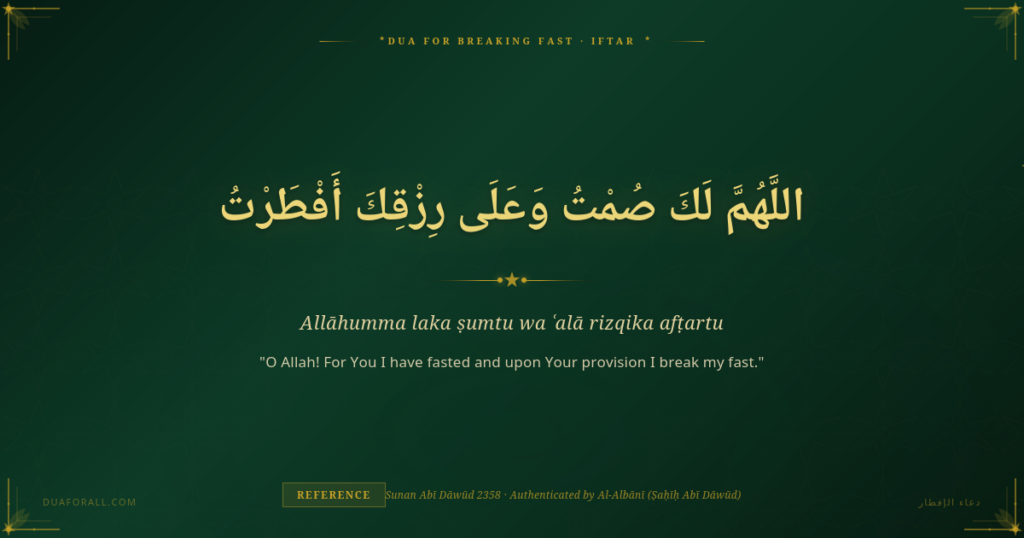
The Dua for Breaking Fast
This is the most widely recited dua for breaking the fast, reported by Abu Dawud and graded as hasan (good). Recite it immediately as the fast ends at Maghrib.
The Shorter & Stronger Iftar Dua
This brief supplication carries a saheeh (authentic) chain and was personally recited by the Prophet ﷺ upon breaking his fast. Many scholars consider it the most established dua for Iftar.
When Exactly to Recite the Dua for Breaking Fast
The dua for breaking fast is recited at the moment of Iftar — as soon as the Maghrib adhān begins or when the sun has definitively set. This is established from the Prophet’s ﷺ practice of hastening to break the fast.
The Messenger of Allah ﷺ said: “The people will remain on good as long as they hasten to break the fast.” — Sahih al-Bukhari 1957.
You may recite the dua before you eat (i.e., just as you pick up a date or water) or during the first sip of water. Both are established in scholarly practice. There is no need to wait until after eating.
The Sunnah Way of Breaking Your Fast
Follow the Prophet’s ﷺ complete method for a spiritually enriching Iftar.
Hasten to Break at Maghrib
Do not delay breaking your fast once the sun has set. The Prophet ﷺ said: “People will remain on good so long as they hasten to break the fast.” — Bukhari 1957
Raise Your Hands & Recite the Dua
Raise your hands in supplication and recite: Allahumma inni laka sumtu wa bika aamantu… or Dhahaba al-zama’u… — both are authentic.
Break with Dates or Water
The Prophet ﷺ would break his fast with fresh dates, then dried dates, then water if none were available. — Abu Dawud 2356
Pray Maghrib Before the Main Meal
It is Sunnah to eat just a few dates to break the fast, pray Maghrib, and then return for the main meal. This prioritises worship over appetite.
Make Extra Dua at Iftar Time
Iftar is one of three times when a fasting person’s dua is not rejected. Spend a few moments supplicating for yourself and others before you eat. See our Daily Duas collection.
Why the Iftar Dua Carries Such Immense Reward
Breaking the fast is not merely a physical act — it is a declaration of gratitude and submission to Allah. The dua encapsulates four pillars of a Muslim’s relationship with Allah:
- Worship (ʿIbādah): “I fasted for You” — affirming the fast was solely for Allah.
- Faith (Imān): “I believe in You” — renewing one’s testimony of faith.
- Reliance (Tawakkul): “I put my trust in You” — surrendering outcomes to Allah.
- Gratitude (Shukr): “I break my fast with Your sustenance” — acknowledging that all provision comes from Allah alone.
The Prophet ﷺ said: “The fasting person has at the time of breaking his fast a supplication that is not rejected.” — Ibn Majah 1753. This makes Iftar one of the most powerful moments for accepted dua in the entire day.
For more on making the most of fasting duas, visit our Ramadan & Fasting guide and our full Masnoon Duas collection.
Voluntary Fasts (Nafl) — Same Dua?
Yes. The same duas apply whether you are fasting during Ramadan, on Mondays and Thursdays, the Days of ʿĀshūrāʾ, or any voluntary fast. The reward for the accepted dua is tied to the act of fasting, not to the specific month.
Learn more about voluntary fasting in our Muslim Lifestyle section.
More Duas to Recite at Iftar Time
These supplications are appropriate during the blessed window of Iftar.
Frequently Asked Questions
Answers to the most common questions about the dua for breaking fast.
Trusted External References
Deepen Your Connection During Ramadan
Explore our full Ramadan guide — Suhoor duas, Tarawih prayers, Laylat al-Qadr supplications, and more.