بِسْمِ اللَّهِ الرَّحْمَنِ الرَّحِيمِ
Tahajjud Dua
Complete guide to authentic supplications for the night prayer — with Arabic text, transliteration, and meaning
What is Tahajjud Prayer?
Tahajjud (تَهَجُّد) is a voluntary night prayer performed after sleeping and before Fajr. It is also known as Qiyam ul-Layl (قِيَامُ اللَّيْل) — the standing of the night — and is widely regarded as the most virtuous of all voluntary (nafl) prayers.
Allah ﷻ praised those who rise at night for worship in Surah As-Sajdah: “Their sides forsake their beds, to invoke their Lord in fear and hope.” (Quran 32:16). The tahajjud dua recited during this prayer holds special power because it is offered in the last third of the night, a time when Allah ﷻ descends to the lowest heaven and responds to the supplications of His servants.
Unlike the five obligatory prayers, tahajjud is a gift of extra closeness to Allah ﷻ. Learning the correct dua for tahajjud is an act of following the Sunnah of the Prophet Muhammad ﷺ, who never abandoned this prayer even while traveling.
Our Lord descends every night to the lowest heaven when the last third of the night remains, and He says: “Who will call upon Me so that I may answer him? Who will ask of Me so that I may give him? Who will seek My forgiveness so that I may forgive him?”Sahih al-Bukhari 1145 · Sahih Muslim 758 — Narrated by Abu Hurairah رضي الله عنه
How to Perform Tahajjud Prayer
Follow these authentic steps based on the Sunnah to perform Tahajjud and make your tahajjud dua with the proper etiquette.
Sleep After Isha’
Go to sleep after performing your Isha’ prayer. Tahajjud requires sleeping first, distinguishing it from Qiyam performed without sleep.
Wake in the Last Third
Set an alarm for the last third of the night (roughly 90 min before Fajr). This is the most blessed time for tahajjud dua to be answered.
Make Wudu
Perform ablution (wudu) mindfully. The Prophet ﷺ used to brush his teeth with a miswak and make wudu before tahajjud.
Open with 2 Short Rak’ats
The Prophet ﷺ would begin Qiyam ul-Layl with 2 short rak’ats to open the prayer session, as recorded in Sahih Muslim 767.
Recite Quran in Long Rak’ats
Pray 2–12 rak’ats in pairs, reciting long portions of Quran slowly. The Prophet ﷺ loved to recite Al-Baqarah, Aal Imran, and An-Nisa in a single rak’a.
Make Your Tahajjud Dua
After salah, raise your hands and make sincere dua in your own language or with the authentic duas below. This is your personal conversation with Allah ﷻ.
Seal with Witr Prayer
Conclude with Witr (1 or 3 rak’ats) if you haven’t prayed it after Isha’. Witr is the final seal of the night’s worship.
Await Fajr
After completing tahajjud and witr, remain in dhikr, istighfar, or Quran recitation until the Fajr adhan — capturing the immense reward of the pre-dawn hour.
Tahajjud Duas from the Sunnah
The following duas are directly narrated from the Prophet Muhammad ﷺ for use in and around the Tahajjud prayer. All sources are verified from Sunnah.com.
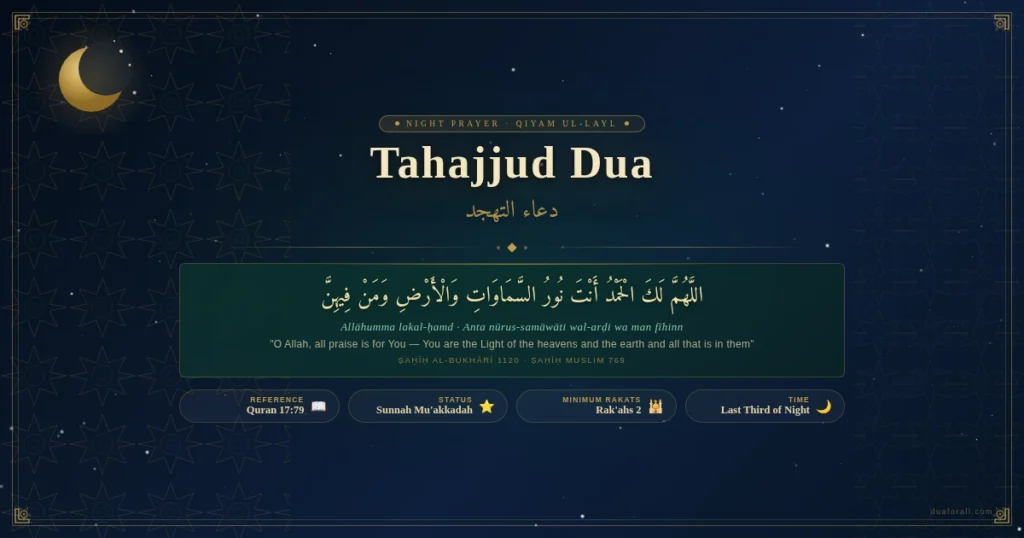
Allahumma lakal-hamd, anta qayyimus-samawati wal-ardi wa man fihinn. Wa lakal-hamd, anta nurus-samawati wal-ardi wa man fihinn.
Translation: “O Allah, all praise is due to You; You are the Sustainer of the heavens and the earth and all that is in them. And all praise is due to You; You are the Light of the heavens and the earth and all that is in them.”
Allahumma laka aslamtu, wa bika aamantu, wa ‘alayka tawakkaltu, wa ilayka anabtu, wa bika khasamtu.
Translation: “O Allah, to You I have submitted, in You I have believed, upon You I have relied, to You I have turned in repentance, and with Your help I have disputed.”
Sahih al-Bukhari 7385 · Sahih Muslim 2717Subhana Rabbiyal-‘Adheem
Translation: “Glory be to my Lord, the Most Great.” — Recite at least 3 times in ruku, and in Tahajjud the Prophet ﷺ used to prolong this remembrance.
Sahih Muslim 772 · Abu Dawud 871Allahummaghfir li dhanbee kullahu, diqqahu wa jillahu, wa awwalahu wa aakhirahu, wa ‘alaniyatahu wa sirrahu.
Translation: “O Allah, forgive all my sins — the minor and the major, the first and the last, the public and the private.”
Rabbana aatina fid-dunya hasanatan wa fil-aakhirati hasanatan wa qina ‘adhaban-nar.
Translation: “Our Lord, grant us good in this world and good in the Hereafter, and protect us from the punishment of the Fire.”
Allahumma aati nafsee taqwaaha, wa zakkiha anta khayru man zakkaaha, anta waliyyuha wa mawlaaha.
Translation: “O Allah, grant my soul its piety, and purify it — You are the best of those who can purify it. You are its Guardian and its Master.”
Sahih Muslim 2722 · Narrated by Zayd ibn Arqam رضي الله عنهAllahumma ihdini feeman hadayt, wa ‘aafini feeman ‘aafayt, wa tawallani feeman tawallayt, wa baarik li feema a’tayt, wa qini sharra ma qadayt, innaka taqdi wa la yuqda ‘alayk.
Translation: “O Allah, guide me among those You have guided; grant me well-being among those You have granted well-being; take me into Your care among those You have taken; bless me in what You have given me; and protect me from the evil of what You have decreed. Verily, You decree and none can decree against You.”
Best Time to Pray Tahajjud & Make Dua
The night is divided into three portions. The last third — when Allah ﷻ descends to the lowest heaven — is the most powerful time for tahajjud dua to be answered. Here is a visual guide:
🌙 The Night: Six Watches from Isha to Fajr
💡 Practical tip: To find the last third, calculate the total hours between Isha’ and Fajr. Divide by 3 — the last portion is your tahajjud window. Many apps like DuaForAll’s Prayer Time Calculator can compute this automatically.
The best prayer after the obligatory prayers is the night prayer (tahajjud).Sahih Muslim 1163 · Narrated by Abu Hurairah رضي الله عنه
Tahajjud Rak’at: What the Sunnah Teaches
Tahajjud has no fixed minimum or maximum of rak’ats — it is a flexible prayer. The Prophet ﷺ most commonly prayed 8 rak’ats in four sets of two, followed by 3 rak’ats of Witr (Sahih al-Bukhari 1138). He also sometimes prayed 11 rak’ats total. Scholars consider any number between 2 and 12 rak’ats to be valid.
Rak’at Options at a Glance
Each circle = 1 rak’a, paired in sets of 2. ⭐ = Prophet ﷺ’s most frequent practice.
(Minimum)
(2 pairs)
Prophetic Sunnah
(Max common)
(Always last)
Always conclude Tahajjud with Witr — making it the last prayer of the night.
Benefits of Tahajjud Dua
The Quran and authentic Sunnah highlight extraordinary rewards for those who make tahajjud a consistent habit. These benefits span both this world and the next.
Du’as Are Answered
Allah ﷻ descends in the last third of the night and personally answers the supplications of those who call on Him (Sahih Bukhari 1145).
Sins Are Forgiven
Consistent night prayer is a means of expiation for sins and a path to Allah’s mercy and forgiveness (Quran 51:17–18).
Elevated Ranks in Jannah
Among the keys to Jannah is spreading salam, feeding others, and praying at night when people sleep (Al-Tirmidhi 2485 — Sahih).
Increased Clarity & Wisdom
The Prophet ﷺ said night prayer improves comprehension of the Quran, sharpens the mind, and strengthens memory (Tabarani — Hasan).
Protection from Evil
Regular tahajjud is described as a shield for the believer against spiritual harm, whispers of Shaytan, and hardship (Ibn Majah 1333).
Honour of the Believer
Jibreel عليه السلام told the Prophet ﷺ that the honour of the believer is in qiyam al-layl (Hakim — Sahih al-Isnad).
Tahajjud Dua — Common Questions
Start Your Tahajjud Journey Tonight
Explore our full collection of authentic duas to enrich every moment of your worship — from the blessed hours of the night to the morning adhkar.
📿 Browse All Duas Masnoon Duas