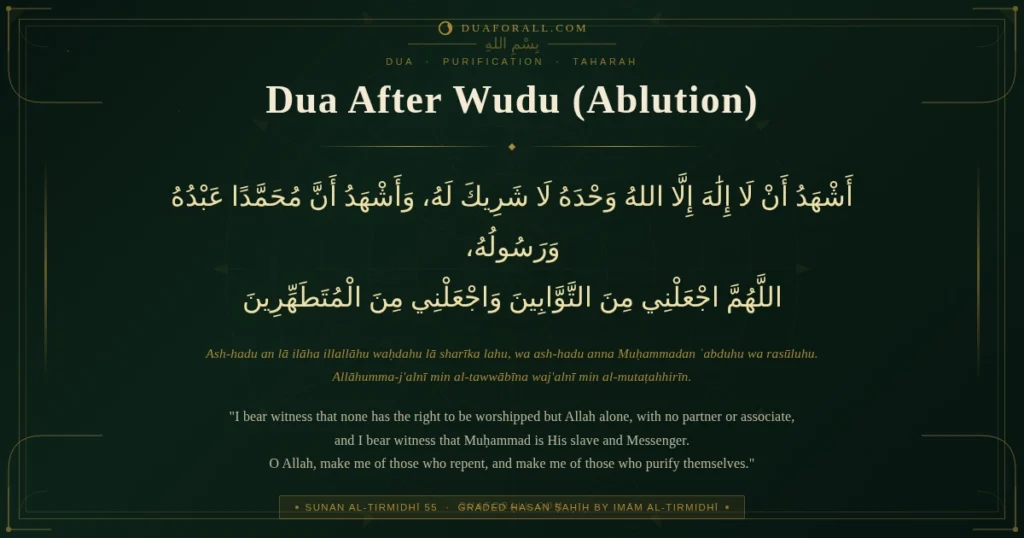
Dua After Wudu
الدعاء بعد الوضوء
The complete supplication after ablution — Arabic text, transliteration, translation, virtues & scholarly guidance.
What Is the Dua After Wudu?
The dua after wudu (ablution) is a short but profound supplication that every Muslim is encouraged to recite immediately after completing wudu. This practice, known as a masnoon dua, is rooted in authentic hadith and carries tremendous spiritual reward — including the opening of all eight gates of Jannah (Paradise) for the believer.
Masnoon duas are those supplications derived directly from the verified Sunnah of Prophet Muhammad ﷺ. Reciting them with understanding transforms everyday actions into acts of worship (ibadah).
Scholarly Verified & Source-Referenced
All duas on this page are drawn from authenticated hadith collections — Sahih Muslim and Jami’ at-Tirmidhi — with full chain references so you can verify every word.
The Dua After Wudu — Arabic & Full Translation
This is the primary and most widely cited dua to be recited after completing wudu, recorded in Sahih Muslim:
وَأَشْهَدُ أَنَّ مُحَمَّدًا عَبْدُهُ وَرَسُولُهُ،
اللَّهُمَّ اجْعَلْنِي مِنَ التَّوَّابِينَ
وَاجْعَلْنِي مِنَ الْمُتَطَهِّرِينَ
Ash-hadu allā ilāha illallāhu waḥdahu lā sharīka lah, wa ashhadu anna Muḥammadan ʿabduhu wa rasūluh. Allāhummaj ʿalnī min at-tawwābīna waj ʿalnī min al-mutaṭahhirīn.
“I bear witness that there is no god worthy of worship except Allah alone, with no partner or associate, and I bear witness that Muhammad is His slave and Messenger. O Allah, make me among those who repent (at-Tawwabeen) and make me among those who purify themselves (al-Mutatahhireen).”
Follow these Fard (obligatory) and Sunnah steps of ablution, then seal it with the supplication.
Second Narration — Extended Dua After Wudu
Some scholars also cite an additional narration reported in Tirmidhi, which begins with praising Allah. Both versions may be recited together.
Subḥānaka Allāhumma wa biḥamdika, ash-hadu allā ilāha illā anta, astaghfiruka wa atūbu ilayk.
“Glory be to You, O Allah, and with Your praise. I bear witness that there is no god but You. I seek Your forgiveness and repent to You.”
📚 Jami’ at-Tirmidhi · Hadith 3433Virtues & Rewards of Reciting the Dua After Wudu
The Prophet ﷺ described immense rewards for those who recite this dua with sincerity. Here is a summary of the major scholarly-cited virtues:
“Whoever performs wudu and does it well, then raises his gaze to the sky and says: Ash-hadu allā ilāha illallāh… — the eight gates of Paradise are opened for him, and he may enter from whichever one he wishes.”
— Narrated by ‘Umar ibn al-Khaṭṭāb رضي الله عنه · Sahih Muslim 234 / Tirmidhi 554 Spiritual Benefits of Saying the Dua After Wudu
Beyond the promised reward of Jannah’s gates, scholars highlight four interconnected benefits of this short supplication:
All Eight Gates of Jannah
The hadith in Sahih Muslim explicitly promises that all eight gates of Paradise are opened for the person who recites this dua correctly after wudu.
Spiritual & Physical Purity
The dua asks Allah to count you among al-Mutatahhireen — those who are truly pure in both outward action and inner state.
Joining the Repentant
By asking to be among at-Tawwabeen, the believer seeks Allah’s continual acceptance of their repentance throughout the day.
Completing the Sunnah
Performing wudu with the accompanying dua fulfils a complete Sunnah act, earning the additional blessings promised for following the Prophet ﷺ.
When & How to Recite the Dua After Wudu
Scholars of fiqh provide clear guidance on the best conditions for reciting this dua to gain its full reward:
🕐 Immediately After Completing Wudu
Recite the dua as soon as you finish washing your feet — the final obligatory step. There is no specific delay required, but it should be done promptly before engaging in other activities.
☁️ Facing the Sky (Mustahabb)
Some narrations mention raising one’s gaze toward the sky while reciting. This is considered a recommended (mustahabb) act according to Imam an-Nawawi’s commentary on Sahih Muslim.
🤲 Raising Both Hands (Optional)
Raising the hands in supplication while reciting this dua is also mentioned in some narrations and is considered a praiseworthy act (mustahabb), though not obligatory.
“Taharah is half of faith (imaan).”
— Prophet Muhammad ﷺ · Sahih Muslim, Hadith 223Frequently Asked Questions About Dua After Wudu
Answers to the most commonly asked questions, based on scholarly consensus:
Related Duas & Islamic Guides
Continue your journey with these carefully selected resources from our collection:
Trusted External Islamic Sources
We always encourage cross-referencing with authoritative Islamic scholarship. The following resources provide deeper verification:
بِسْمِ اللَّهِ الرَّحْمَنِ الرَّحِيمِ
Make This Dua a Lifelong Habit
Every single wudu is an opportunity to have all eight gates of Jannah opened for you. Explore our full library of authentic duas to enrich every moment of your day.