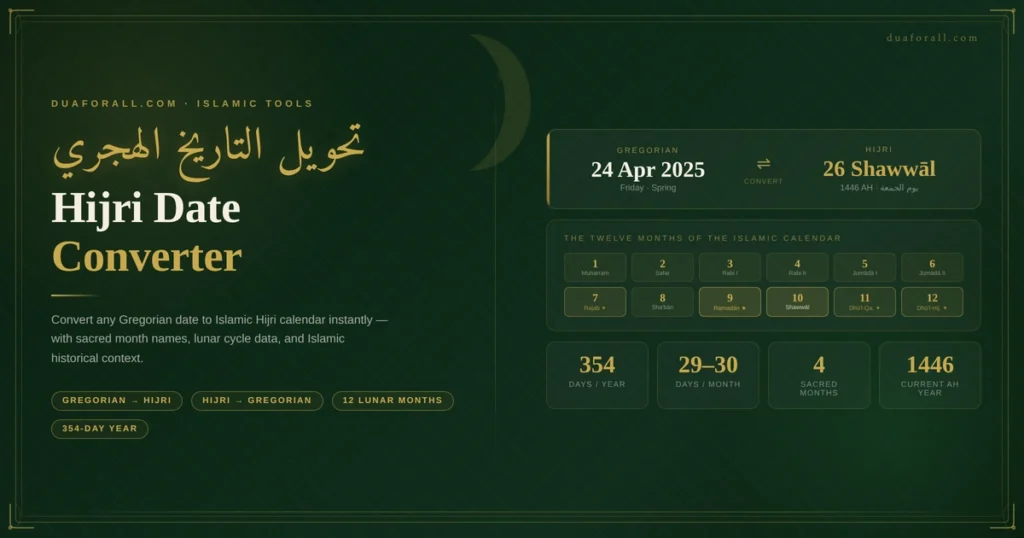
The Hijri Calendar: A Complete Guide & Date Converter
Convert any date between the Gregorian and Hijri (Islamic) calendars instantly. Explore the Islamic Calendar 2026, all 12 Hijri months, key Islamic dates, and the deep spiritual history of the lunar calendar used by 1.8 billion Muslims worldwide.
Free Hijri Date Converter
Instantly convert between Gregorian (CE) and Hijri (AH) dates — both directions
THE 12 HIJRI MONTHS AT A GLANCE
★ Sacred months (Al-Ashhur al-Hurum) | Conversions are calculated (tabular) and may vary ±1–2 days from moon-sighting results.
What Is the Hijri Calendar?
📊 Hijri Calendar — Quick Facts Infographic
The essential numbers behind the Islamic lunar calendar
The Hijri calendar (Arabic: التقويم الهجري, al-taqwīm al-hijrī) — also known as the Islamic calendar or Muslim calendar — is a purely lunar calendar consisting of 12 months in a year of approximately 354 or 355 days. It is the official calendar of Islam and is used by Muslims worldwide to determine the dates of important religious events such as Ramadan, Eid al-Adha, Hajj, and the Islamic New Year.
Unlike the Gregorian calendar — which is solar and follows Earth’s orbit around the sun — the Hijri calendar follows the lunar cycle, with each month beginning at the sighting of the crescent moon (hilal). This means the Hijri year is approximately 10–11 days shorter than the Gregorian year, causing Islamic observances to move backward through the solar year over a cycle of roughly 33 years.
The calendar begins its epoch at the Hijra (هجرة) — the migration of the Prophet Muhammad ﷺ from Mecca to Medina in 622 CE. This momentous event, which marked the founding of the first Islamic community, was chosen by the second Caliph, Umar ibn al-Khattab (رضي الله عنه), as the starting point of the Islamic calendar in the year 17 AH.
Quranic Foundation
The Hijri calendar has a direct Quranic basis. Allah ﷻ states in Surah At-Tawbah (9:36):
إِنَّ عِدَّةَ الشُّهُورِ عِندَ اللَّهِ اثْنَا عَشَرَ شَهْرًا
“Indeed, the number of months with Allah is twelve [lunar] months in the register of Allah [from] the day He created the heavens and the earth…” — Quran 9:36
This verse forms the theological underpinning of the 12-month Islamic calendar. The Quran also specifically mentions the sacred months and the system of lunar reckoning in several other ayat, making the Hijri calendar a deeply spiritual institution beyond its practical timekeeping function.
🌒 How the Lunar Calendar Works — Infographic
Each Hijri month begins with the sighting of the new crescent moon
Islamic Calendar 2026 — Key Dates
The Islamic Calendar 2026 covers two Hijri years: 1447 AH (until mid-2026) and 1448 AH (from mid-2026). Below are the most significant Islamic dates in 2026 (CE), based on calculated (tabular) methods. Actual dates may vary by 1–2 days depending on moon sighting in your region. Always confirm with your local mosque or authority.
| Islamic Date (AH) | Event | Arabic Name | Gregorian Date (2026) | Type |
|---|---|---|---|---|
| 27 Rajab 1447 | Isra’ and Mi’raj (Night Journey) | الإسراء والمعراج | ~26 January 2026 | Sacred |
| 15 Sha’ban 1447 | Shab-e-Barat (Night of Forgiveness) | شب برات / ليلة النصف | ~13 February 2026 | Observance |
| 1 Ramadan 1447 | Start of Ramadan — Holy Month of Fasting | بداية شهر رمضان | ~18 February 2026 | Ramadan |
| 27 Ramadan 1447 | Laylat al-Qadr (Night of Power) | ليلة القدر | ~16 March 2026 | Ramadan |
| 1 Shawwal 1447 | Eid al-Fitr — End of Ramadan | عيد الفطر المبارك | ~20 March 2026 | Eid |
| 9 Dhu al-Hijjah 1447 | Day of Arafah | يوم عرفة | ~27 May 2026 | Hajj |
| 10 Dhu al-Hijjah 1447 | Eid al-Adha — Feast of Sacrifice | عيد الأضحى المبارك | ~28 May 2026 | Eid |
| 1 Muharram 1448 | Islamic New Year 1448 AH | رأس السنة الهجرية | ~17 June 2026 | New Year |
| 10 Muharram 1448 | Ashura — Day of Fasting | يوم عاشوراء | ~26 June 2026 | Sacred |
| 12 Rabi’ al-Awwal 1448 | Mawlid al-Nabi ﷺ (Prophet’s Birthday) | المولد النبوي الشريف | ~28 August 2026 | Observance |
⚠️ Dates are calculated (tabular method) and may vary ±1–2 days based on moon sighting. Always verify with your local Islamic authority. See also: Ramadan Calendar 2026 and Eid al-Adha 2026 on DuaForAll.
The 12 Hijri Months — Meanings & Significance
Each month of the Hijri calendar carries a unique name, rich meaning, and often a special Islamic significance. Here is a complete reference to all 12 months:
★ = Sacred month (Al-Ashhur al-Hurum). See also: Complete Hajj & Umrah Guide →
How the Hijri Lunar Calendar Works
The Hijri calendar is a purely lunar calendar, meaning every month begins and ends based on the actual lunar cycle — the time it takes the Moon to orbit the Earth. Here is how it works:
The Lunar Month (Shahr)
A single synodic month — from one new moon to the next — takes approximately 29 days, 12 hours, 44 minutes, and 3 seconds. Because this is not a whole number, Hijri months alternate between 29 and 30 days. Traditionally, Islamic law requires the physical sighting of the crescent moon (hilal) by reliable witnesses to confirm the start of a new month.
Calculated vs Moon-Sighted Calendars
There are two main approaches to determining Hijri dates globally:
- Moon Sighting (Ru’yah al-Hilal): The traditional method mandated by classical scholars. A qualified Muslim observer must sight the crescent moon with the naked eye. This is still the official method in Saudi Arabia and many Muslim countries.
- Astronomical Calculation (Hisab): Using precise astronomical calculations to predict when the crescent will be visible. Used by many Muslim communities in the West and some Islamic bodies like ISNA for pre-planning.
This is why the same Islamic occasion may be celebrated on different days in different countries — typically 1–2 days apart.
The 10–11 Day Drift
Because a Hijri year (354–355 days) is about 10–11 days shorter than a Gregorian year (365–366 days), Islamic dates “drift” earlier relative to the Gregorian calendar each year. This completes a full cycle through all seasons over approximately 33 years. For example, Ramadan moves through all four seasons within a single lifetime.
The 30-Year Cycle (Intercalation)
In the tabular Hijri calendar (used for calculation purposes), a 30-year cycle is used in which 11 of every 30 years are leap years of 355 days. The leap years in each cycle are: 2, 5, 7, 10, 13, 16, 18, 21, 24, 26, and 29.
Hijri vs Gregorian Calendar: Key Differences
📊 Side-by-Side Comparison Infographic
Understanding the fundamental differences between the two major calendar systems
History & Origin of the Hijri Calendar
Before Islam, the Arabs of the Arabian Peninsula used a lunisolar calendar — adding an intercalary month (nasi’) periodically to keep lunar months aligned with the solar year. This practice was explicitly forbidden by the Quran (Surah At-Tawbah 9:37), and Islam established a purely lunar system.
The Hijri calendar as a formal system was instituted by the second Caliph, Umar ibn al-Khattab رضي الله عنه, in approximately 17 AH (638–639 CE). The challenge arose because letters and documents from different regions of the growing Islamic state were being dated inconsistently. Companions of the Prophet ﷺ debated what year zero should be: the birth of the Prophet, the year of revelation, or the Hijra (migration to Medina).
After consultation, they chose the Hijra of 622 CE as the epoch — the moment when the Prophet ﷺ and his companions left Mecca for Medina. This migration was chosen because it marked the transition from persecution to the establishment of the first Muslim community and Islamic state — a turning point in Islamic history. Thus, the calendar was named al-Hijrī (الهجري), meaning “of the migration.”
Muharram was designated as the first month because the Arabs had already agreed it was the first month of the year. The calendar’s structure — 12 lunar months, no intercalation — was thus formalized and has been used by Muslims for over 14 centuries.
For deeper study of Islamic history, see: Seerah of the Prophet ﷺ →
The Four Sacred Months (Al-Ashhur al-Hurum)
Allah ﷻ designated four months of the Hijri calendar as sacred (حُرُم, Hurum), as mentioned in the Quran (Surah At-Tawbah 9:36). Sins committed in these months are considered more severe, and acts of worship carry greater reward. These months are:
☪️ The Four Sacred Months (Al-Ashhur al-Hurum)
Mentioned in Quran 9:36 — months of heightened spiritual significance
The Prophet Muhammad ﷺ said: “The year is twelve months, of which four are sacred: three consecutive months — Dhu al-Qi’dah, Dhu al-Hijjah and Muharram — and Rajab which comes between Jumada and Sha’ban.” (Bukhari & Muslim)
During these months, Muslims are encouraged to increase acts of worship including dhikr (remembrance of Allah), voluntary fasting, charity, and sincere supplication. For duas for protection and guidance, visit our complete dua collection.
Frequently Asked Questions — Hijri Calendar & Converter
The Hijri (Islamic) date today is displayed live at the top of this page and calculated automatically using our Hijri Date Converter tool above. As of early 2026, we are in the month of Ramadan 1447 AH. Use the converter above to find any specific date. Note that official dates may vary by 1–2 days depending on moon sighting in your region.
Use our free Hijri Date Converter tool at the top of this page. Simply: (1) Select the “Gregorian → Hijri” tab, (2) Enter the day, month, and year in the Gregorian format, (3) Click “Convert to Hijri Date.” The result will show the corresponding Hijri date with the Arabic month name and year in AH (Anno Hegirae). The conversion uses the standard tabular Hijri calendar algorithm and may differ by 1–2 days from moon-sighted dates.
The year 2026 CE corresponds to two Hijri years: 1447 AH (January–mid June 2026) and 1448 AH (mid-June–December 2026). The Islamic New Year 1448 AH begins around June 17, 2026. This crossover happens because the Hijri year is ~11 days shorter than the Gregorian year, so each Gregorian year spans parts of two Hijri years.
Ramadan 1447 AH is expected to begin around February 17–18, 2026 and end around March 18–19, 2026, with Eid al-Fitr falling on approximately March 19–20, 2026. The exact dates depend on moon sighting in your country. See our Ramadan Calendar 2026 for full details including suhoor and iftar times.
The terms Hijri calendar and Islamic calendar are used interchangeably and refer to the same system. “Hijri” comes from the Arabic word for “migration” (hijra — هجرة), referring to the Prophet Muhammad’s ﷺ migration from Mecca to Medina in 622 CE, which serves as the calendar’s epoch (year 1 AH). Some also call it the “Muslim calendar.” The Solar Hijri calendar used in Iran and Afghanistan is a different system.
The Islamic calendar appears to “move backward” relative to the Gregorian calendar because it is a purely lunar calendar with no leap months. A Hijri year has 354–355 days versus the Gregorian year’s 365–366 days — a difference of approximately 10–11 days. Each year, Islamic dates fall earlier in the Gregorian calendar by this amount. Over 33 years, this completes a full cycle, meaning Ramadan passes through all four seasons over the course of a lifetime. This is by divine design — the Quran (9:37) explicitly prohibits adding intercalary months (nasi’) to fix the calendar to seasons.
Eid al-Adha 2026 (10 Dhu al-Hijjah 1447 AH) is expected to fall on approximately May 27–28, 2026. The Day of Arafah (9 Dhu al-Hijjah) falls one day before, around May 26–27, 2026. The exact date depends on moon sighting. For the complete guide to this blessed occasion, visit our Eid al-Adha 2026 page.
Our Hijri Date Converter uses the tabular (arithmetic) Hijri calendar algorithm, which is mathematically consistent and widely used for pre-calculation purposes. It is accurate within ±1–2 days of the actual observational (moon-sighted) Hijri date. For official religious dates (e.g., start of Ramadan, Eid), always verify with your local mosque or national Islamic authority, as these depend on actual moon sighting which can vary by region.
Authoritative External Resources
For further research, official rulings, and complementary Islamic tools, we recommend these trusted external sources:
Explore More on DuaForAll
Continue your Islamic journey with these related guides and tools on DuaForAll: