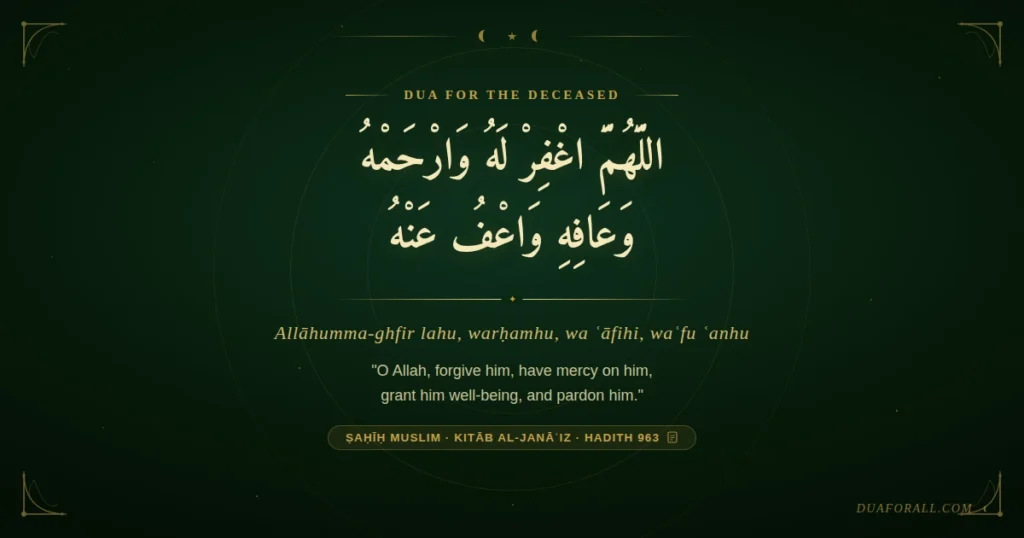
Dua for Deceased
Authentic Islamic supplications for your departed loved ones — with full Arabic text, transliteration, English translation, and verified hadith sources. Offer the greatest gift to those who have passed: your sincere prayer.
Why Dua for the Deceased Matters in Islam
In Islam, death is not the end — it is a transition to the eternal life of the Hereafter. While the deceased can no longer perform deeds of their own, the sincere dua (supplication) of a believer continues to reach them, bringing mercy, light, and ease in their grave.
The Prophet Muhammad ﷺ regularly made dua for those who had passed away, setting an enduring Sunnah for the entire Ummah. Whether you are offering the Janazah (funeral) prayer, standing at the graveside, or simply remembering a loved one in your daily salah — your supplication is a profound act of love that transcends the boundary of this life.
This guide presents the most authentic duas for the deceased as found in Sahih Muslim, Ibn Majah, Abu Dawud, and Hisnul Muslim, ensuring every prayer you recite is traceable back to the Prophet ﷺ himself.
The Spiritual Power of Dua for the Deceased
How your supplication reaches and benefits those who have passed
Mercy & Forgiveness
Your sincere dua calls upon Allah’s infinite mercy to forgive the sins of the deceased and ease their journey in the Hereafter.
Light in the Grave
Specific duas ask Allah to illuminate the grave, shielding the deceased from its darkness and the questioning of Munkar and Nakeer.
A Garden of Paradise
The Prophet ﷺ taught us to ask Allah to make the grave a rawdah — a garden from the gardens of Jannah.
Elevation in Rank
Authentic narrations indicate that sincere dua from the living can elevate the rank of the deceased on the Day of Judgement.
Spiritual Connection
Dua maintains the bond of love between the living and the dead, reminding believers of the temporary nature of this world.
Angels Pray for You Too
As recorded in Sahih Muslim, when you pray for a fellow believer in their absence, the angels say “Āmeen, and for you the same.”
7 Authentic Duas for the Deceased
Arabic text · Transliteration · English meaning · Hadith source
⏳ When to Recite Dua for the Deceased
A timeline of the key moments where your supplication brings the most benefit
🕊️ Upon Hearing the News of Death
Immediately recite Inna lillāhi wa innā ilayhi rājiʿūn (Quran 2:156) — expressing surrender to Allah’s will and acknowledging the soul’s return to its Creator.
🕌 During Salat al-Janazah (Funeral Prayer)
After the third takbeer, recite the extended dua for the deceased — asking Allah for forgiveness, mercy, and admission into Jannah. This is Fard Kifāyah (communal obligation).
🪦 At the Graveside — After Burial
Stand for a moment after the burial and recite duas asking Allah to forgive the deceased and grant them steadfastness during the questioning of the grave by Munkar and Nakeer.
📿 Daily Remembrance — After Salah
Include the deceased in your daily duas, especially after Fajr and Maghrib prayers. Reciting Rabbir-ḥamhumā for parents is strongly recommended in the Quran (17:24).
🌙 On Fridays — Special Virtue
Friday holds exceptional virtue in Islam. Scholars recommend making dua for the deceased on this blessed day, particularly after Jumu’ah or during the final hour before Maghrib.
🌟 During Ramadan & Special Nights
During Ramadan, Laylat al-Qadr, and the first ten days of Dhul-Hijjah, duas carry extraordinary weight. These are ideal moments to make extended supplications for deceased loved ones.
🪦 When Visiting the Graveyard
Begin with the Sunnah greeting, then offer personal duas. The Prophet ﷺ regularly visited graves and taught that visiting the graveyard reminds us of the Hereafter and softens the heart.
Etiquette of Making Dua for the Deceased
Following proper Islamic etiquette enhances the sincerity and spiritual weight of your supplication.
| Practice | Recommended? | Notes |
|---|---|---|
| Being in a state of Wudhū (ablution) | ✔ Recommended | Shows reverence and purification before addressing Allah |
| Facing the Qiblah | ✔ Sunnah | Directing oneself toward the Sacred Mosque in Makkah |
| Raising the hands | ✔ Sunnah | A sign of humility and devotion during supplication |
| Beginning with Hamd & Salawat | ✔ Highly Recommended | Praising Allah and sending blessings on the Prophet ﷺ |
| Mentioning the deceased by name | ✔ Permitted & Encouraged | Personalises the supplication for a specific soul |
| Reciting dua loudly at graveside | ✖ Avoid if disruptive | Silent or soft recitation is more appropriate in a graveyard |
| Reciting Surah Al-Fatiha | ✔ Widely Practised | Many scholars hold this to be permissible and beneficial |
| Giving charity (Sadaqah) on behalf of the deceased | ✔ Strongly Encouraged | Confirmed by the Prophet ﷺ — Sahih Bukhari 2760 |
📌 Pronouns for Male & Female Deceased
In Arabic, gender pronouns are distinct. When making dua for the deceased, it is important to use the correct form. Here is a quick reference:
Explore More Supplications
Related duas and Islamic topics on DuaForAll
Frequently Asked Questions
Common questions about dua for the deceased answered with Islamic evidence
Trusted Sources & Further Reading
🔗 Internal — On DuaForAll
Continue Your Journey of Remembrance
Explore our full collection of authentic duas for every moment of life — from morning adhkar to Quranic supplications from the Prophets ﷺ.