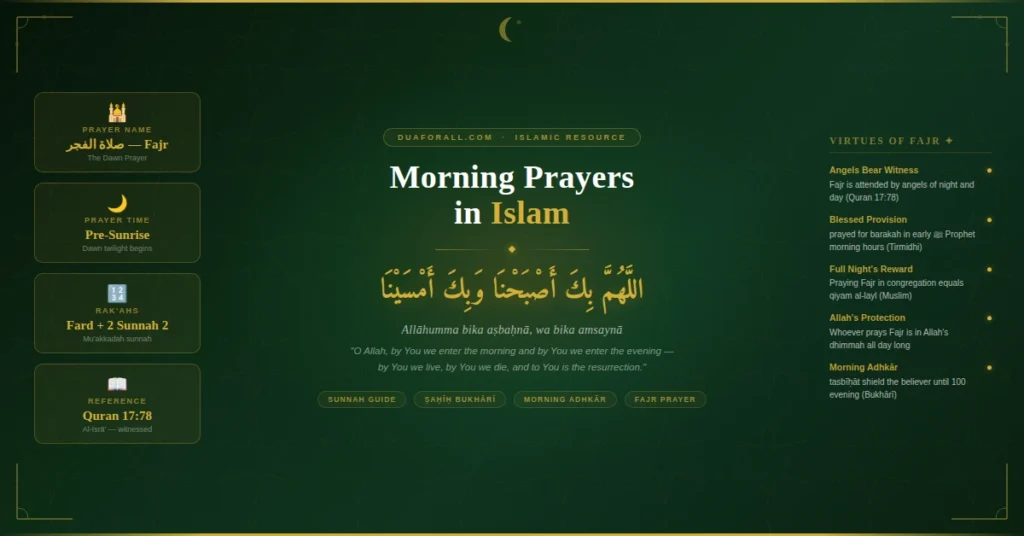
Morning Prayers
in Islam
Complete guide to Fajr Salah & Morning Adhkar — with Arabic text, transliteration, translations and authentic hadith sources for a spiritually nourishing start to your day.
What Are Morning Prayers in Islam?
Morning prayers in Islam encompass two intertwined acts of worship: Salat al-Fajr (the obligatory dawn prayer) and the morning adhkar — a beautiful collection of supplications, remembrances, and praises recommended by the Prophet Muhammad ﷺ to be recited after Fajr, at sunrise, and throughout the early morning hours.
Together, these form the Islamic morning ritual — a practice that spiritually anchors the believer, protects them through the day, and draws them into direct, intimate conversation with Allah ﷻ before the world demands their attention.
The Quran directly commands believers to establish prayer at the decline of the sun and at the darkening of the night, with the scholars of Islam unanimously agreeing that Fajr — the prayer at the very break of dawn — holds a place of singular honour among the five daily prayers.
Fajr Salah — The Dawn Prayer
Fajr is performed before sunrise, once the true dawn (al-fajr al-sadiq) has appeared — a pale white light spreading across the horizon. It consists of 2 obligatory (fard) rak’ahs, preceded by 2 Sunnah rak’ahs which the Prophet ﷺ rarely missed even while travelling.
Performing Fajr on time is one of the most virtuous acts in Islam. It marks the Muslim’s day as one begun in the remembrance of Allah, establishing a spiritual protection that radiates through all that follows.
Time Window for Fajr Prayer
The time for Fajr prayer begins at true dawn (Fajr Sadiq) and ends at sunrise (Shuruq). Praying before sunrise is obligatory; praying the Sunnah beforehand and performing the morning adhkar after is the Prophetic way. Use our Prayer Time Calculator to find your exact Fajr window by location.
The Ideal Islamic Morning Routine
From waking to sunrise — a step-by-step framework based on Prophetic practice.
Morning Adhkar & Duas
Each supplication includes original Arabic text, transliteration, English translation, and authenticated hadith source.
How to Perform Morning Prayers
A detailed walkthrough from true dawn to sunrise.
Morning Adhkar at a Glance
Post-Fajr dhikr recommended by the Prophet ﷺ — with repetition counts and sources.
| # | Dhikr (Arabic) | Meaning | Times | Source |
|---|---|---|---|---|
| 1 | سُبْحَانَ اللَّهِ | Glory be to Allah | ×33 | Muslim 597 |
| 2 | الْحَمْدُ لِلَّهِ | All praise is for Allah | ×33 | Muslim 597 |
| 3 | اللَّهُ أَكْبَرُ | Allah is the Greatest | ×33 | Muslim 597 |
| 4 | أَعُوذُ بِكَلِمَاتِ اللَّهِ التَّامَّاتِ | I seek refuge in Allah’s perfect words | ×3 | Muslim 2709 |
| 5 | لَا إِلَهَ إِلَّا اللَّهُ وَحْدَهُ | None worthy of worship but Allah alone | ×10 | Tirmidhi 3474 |
| 6 | آيَةُ الْكُرْسِيّ | Ayat al-Kursi (Quran 2:255) | ×1 | Quran 2:255 |
| 7 | قُلْ هُوَ اللَّهُ أَحَدٌ + المُعَوِّذَتَان | Al-Ikhlas, Al-Falaq, An-Nas | ×3 each | Abu Dawud 5082 |
| 8 | اللَّهُمَّ صَلِّ عَلَى مُحَمَّدٍ | Salawat upon the Prophet ﷺ | ×10+ | Tirmidhi 484 |
Spiritual Benefits of Morning Prayers
The Quran and Sunnah describe extraordinary rewards for those who guard their Fajr prayer and morning adhkar.
Related Duas & Guides
Continue your journey with our complete collections on DuaForAll.
Frequently Asked Questions
Answers to the most common questions about morning prayers in Islam.
Morning prayers in Islam — specifically Fajr — begin at true dawn (Fajr Sadiq), when a pale white light spreads horizontally across the horizon (not the initial false dawn, Fajr Kadhib). This typically falls 70–90 minutes before sunrise, though the exact time varies by location and season. The prayer window closes at sunrise (Shuruq). Use our Prayer Time Calculator for your precise local Fajr time.
Fajr consists of 4 rak’ahs total: 2 Sunnah Mu’akkadah (highly stressed optional rak’ahs) followed by 2 Fard (obligatory) rak’ahs. The 2 Sunnah rak’ahs are prayed before the fard. The Prophet ﷺ said about the 2 Sunnah rak’ahs: “The two rak’ahs of Fajr are better than the world and all it contains.” (Muslim 725)
Morning prayers (Fajr Salah) refer to the formal ritual prayer — a structured act of worship with standing, bowing, and prostrating, performed facing the Qibla after wudu. Morning adhkar are the dhikr (remembrances), duas (supplications), and recitations recommended for the period after Fajr through the early morning. Both are important: Salah is obligatory; morning adhkar are strongly recommended Sunnah acts with massive spiritual rewards.
The core morning duas from authentic hadith include: (1) the waking dua (Alhamdulillahil-ladhī aḥyānā), (2) Sayyid al-Istighfar (the master dua for forgiveness), (3) “Asbahna wa-asbahal-mulku lillah” (We have entered the morning…), (4) the morning protection dua ×3 (Bismillahil-ladhī lā yaḍurr…), and (5) Surah Al-Ikhlas, Al-Falaq, and An-Nas × 3. All are listed in full with transliteration on this page above.
If Fajr is missed, it must be made up (qadha) immediately upon remembering or waking. The Prophet ﷺ said: “Whoever forgets a prayer, let him pray it when he remembers — there is no expiation for it other than that.” (Muslim 684). Missing Fajr intentionally without a valid excuse is a major sin in Islam. The prayer is still valid as a qadha but does not carry the same merit as praying on time.
Ishraq (Duha al-Sughra) is a voluntary prayer of 2–4 rak’ahs performed approximately 15–20 minutes after sunrise, once the sun has fully risen and its initial glare has subsided. The Prophet ﷺ said that whoever prays Fajr in congregation, then sits in dhikr until sunrise, then prays 2 rak’ahs, earns the reward of a complete Hajj and Umrah. (Tirmidhi 586 — Hasan)
The Prophet ﷺ would recite longer surahs in Fajr compared to other prayers. Commonly recited surahs include: Surah Al-Waqiah, Surah Yasin, Surah Al-Mulk, Surah As-Sajdah, and Surah Al-Insan. On Fridays, he would recite Surah As-Sajdah (32) in the first rak’ah and Surah Al-Insan (76) in the second. Even reciting shorter surahs (Al-Kafirun, Al-Ikhlas) is perfectly valid. Always recite Surah Al-Fatihah in every rak’ah.
Trusted External Resources
Verify all supplications and deepen your knowledge through these authenticated Islamic sources.