Duas for Hajj — A Pilgrim’s Guide to Supplications
Every authenticated dua for every moment of your Hajj journey — from entering Ihram to the Farewell Tawaf — drawn from the Quran and authentic Sunnah, with Arabic text, transliteration, and translation.
The days of Hajj are among the most blessed moments in the entire Islamic calendar. The Prophet ﷺ said: “The best supplication is the supplication on the Day of Arafah.” (Tirmidhi). From the moment you enter Ihram to your final Farewell Tawaf, dua is your constant companion — a direct line to Allah ﷻ at a time when His mercy is especially close.
This guide collects every major supplication for Hajj from the Quran, Sahih Bukhari, Sahih Muslim, Tirmidhi, Abu Dawud, Ibn Majah, and other authentic sources. Each dua is presented with its Arabic text, transliteration, English translation, source, and guidance on how and when to recite it. Use this page alongside the Hajj 2026 complete guide and the official Nusuk Hajj platform.
🕋 The Hajj Journey — Key Dua Moments
Each station of Hajj carries its own supplication — click any stage below to read its duas.
The Dua of Arafah
The Prophet ﷺ said: “The best supplication is the supplication of the Day of Arafah.” — Tirmidhi 3585
“There is no god worthy of worship except Allah, alone, with no partner. His is the dominion, His is all praise, and He is over all things fully capable.”
Source: Tirmidhi 3585 — Declared Hasan by Al-Albani · Recite abundantly between Zuhr and sunset on 9 Dhul-Hijjah
Complete Duas for Every Hajj Ritual
Tap each ritual stage to reveal its authenticated supplications with sources and guidance.
Begin your Hajj journey with intention and supplication. These duas are recited as you leave home and travel toward the Miqat, the designated boundary where Ihram must be entered.
بِسْمِ اللَّهِ، تَوَكَّلْتُ عَلَى اللَّهِ، وَلَا حَوْلَ وَلَا قُوَّةَ إِلَّا بِاللَّهِ
In the name of Allah, I place my trust in Allah, and there is no might or power except with Allah.
Abu Dawud 5095 · Tirmidhi 3426 · Authenticated
اللَّهُمَّ إِنَّا نَسْأَلُكَ فِي سَفَرِنَا هَذَا الْبِرَّ وَالتَّقْوَى، وَمِنَ الْعَمَلِ مَا تَرْضَى، اللَّهُمَّ هَوِّنْ عَلَيْنَا سَفَرَنَا هَذَا وَاطْوِ عَنَّا بُعْدَهُ
O Allah, we ask You in this journey of ours for righteousness and piety, and deeds that please You. O Allah, make this journey easy for us and shorten its distance for us.
Sahih Muslim 1342 — The Prophet ﷺ’s travel supplication
Ihram is the sacred state of consecration entered at your designated Miqat. The Talbiyah — one of Islam’s most powerful proclamations — is recited continuously from this moment until the first stone is thrown at Jamarat al-Aqabah on Eid day.
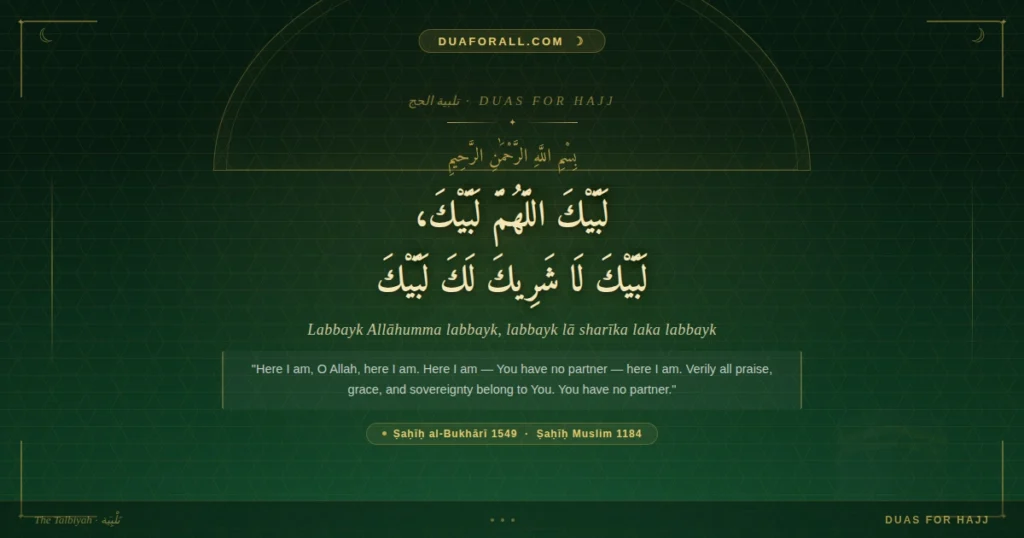
لَبَّيْكَ اللَّهُمَّ لَبَّيْكَ، لَبَّيْكَ لَا شَرِيكَ لَكَ لَبَّيْكَ، إِنَّ الْحَمْدَ وَالنِّعْمَةَ لَكَ وَالْمُلْكَ، لَا شَرِيكَ لَكَ
Here I am, O Allah, here I am. Here I am — You have no partner — here I am. Indeed all praise, blessing, and dominion belong to You. You have no partner.
Bukhari 1549 · Muslim 1184 — The official Talbiyah of Hajj
اللَّهُمَّ إِنِّي أُرِيدُ الْحَجَّ فَيَسِّرْهُ لِي وَتَقَبَّلْهُ مِنِّي
O Allah, I intend to perform Hajj, so make it easy for me and accept it from me.
Authenticated practice from Sunnah — recited silently at heart
Entering the city of Makkah is itself an act of worship. When you first see the Masjid al-Haram and lay eyes on the Kaaba, it is a moment of answered dua — scholars have said that dua at the first sight of the Kaaba is never rejected.
اللَّهُمَّ هَذَا حَرَمُكَ وَأَمْنُكَ، فَحَرِّمْنِي عَلَى النَّارِ، وَأَمِّنِّي مِنْ عَذَابِكَ يَوْمَ تَبْعَثُ عِبَادَكَ
O Allah, this is Your sanctuary and Your place of safety, so forbid me to the Fire and grant me safety from Your punishment on the Day You resurrect Your servants.
Al-Bayhaqi · Al-Hakim — narrated as authentic
اللَّهُمَّ زِدْ هَذَا الْبَيْتَ تَشْرِيفًا وَتَعْظِيمًا وَتَكْرِيمًا وَمَهَابَةً، وَزِدْ مَنْ شَرَّفَهُ وَعَظَّمَهُ مِمَّنْ حَجَّهُ أَوِ اعْتَمَرَهُ تَشْرِيفًا وَتَكْرِيمًا وَتَعْظِيمًا وَبِرًّا
O Allah, increase this House in honour, greatness, nobility, and awe; and increase in honour, nobility, greatness, and righteousness those who honour and revere it by performing Hajj or Umrah.
Al-Shafi’i (RA) recommended this dua · Scholars of all four madhabs
Tawaf involves seven counter-clockwise circuits around the Kaaba. There is no single prescribed dua for each circuit — the Prophet ﷺ made personal supplications throughout. These are the authenticated duas from his Sunnah.
بِسْمِ اللَّهِ، اللَّهُ أَكْبَرُ
In the name of Allah. Allah is the Greatest.
Bukhari · Muslim — recite at the start of each circuit, pointing to the Black Stone.
رَبَّنَا آتِنَا فِي الدُّنْيَا حَسَنَةً وَفِي الْآخِرَةِ حَسَنَةً وَقِنَا عَذَابَ النَّارِ
Our Lord, grant us good in this world and good in the Hereafter, and protect us from the punishment of the Fire.
Quran 2:201 · Bukhari — The Prophet ﷺ recited this between the Yemeni Corner and the Black Stone in every circuit.
اللَّهُمَّ إِنَّ لَكَ عَلَيَّ حُقُوقًا كَثِيرَةً فِيمَا بَيْنِي وَبَيْنَكَ، وَحُقُوقًا كَثِيرَةً فِيمَا بَيْنِي وَبَيْنَ خَلْقِكَ، اللَّهُمَّ مَا كَانَ لَكَ مِنْهَا فَاغْفِرْهُ لِي، وَمَا كَانَ لِخَلْقِكَ فَتَحَمَّلْهُ عَنِّي
O Allah, You have many rights over me between You and me, and many rights between me and Your creation. O Allah, whatever of Your rights I have neglected — forgive me; and whatever is owed to Your creation — take responsibility for it on my behalf.
Reported by Ibn Abi Shaybah · Recommended by Imam Ahmad and scholars of Hanbali fiqh
وَاتَّخِذُوا مِن مَّقَامِ إِبْرَاهِيمَ مُصَلًّى
And take the station of Ibrahim as a place of prayer.
Quran 2:125 — Recite before performing two rak’ahs. In each rak’ah, read Al-Fatihah and Surah Al-Kafiroon (1st) and Surah Al-Ikhlas (2nd).
Sa’i commemorates Hajar (AS), who ran between these two hills searching for water for her infant son Ismail (AS), until the miraculous spring of Zamzam was revealed by Allah ﷻ. Seven back-and-forth walks between Safa and Marwah are performed.
إِنَّ الصَّفَا وَالْمَرْوَةَ مِن شَعَائِرِ اللَّهِ، أَبْدَأُ بِمَا بَدَأَ اللَّهُ بِهِ
Indeed, As-Safa and Al-Marwah are among the symbols of Allah. I begin with what Allah began with.
Sahih Muslim 1218 — The Prophet ﷺ recited this at Safa before ascending.
لَا إِلَٰهَ إِلَّا اللَّهُ وَحْدَهُ لَا شَرِيكَ لَهُ، لَهُ الْمُلْكُ وَلَهُ الْحَمْدُ وَهُوَ عَلَىٰ كُلِّ شَيْءٍ قَدِيرٌ، لَا إِلَٰهَ إِلَّا اللَّهُ وَحْدَهُ، أَنْجَزَ وَعْدَهُ وَنَصَرَ عَبْدَهُ وَهَزَمَ الْأَحْزَابَ وَحْدَهُ
There is no god but Allah alone, with no partner. His is the dominion, His is all praise, and He is over all things capable. There is no god but Allah alone — He fulfilled His promise, gave victory to His servant, and He alone defeated the confederates.
Sahih Muslim 1218 — Recited three times, with personal dua in between each recitation.
اللَّهُمَّ إِنِّي أَسْأَلُكَ عِلْمًا نَافِعًا وَرِزْقًا وَاسِعًا وَشِفَاءً مِنْ كُلِّ دَاءٍ
O Allah, I ask You for beneficial knowledge, abundant provision, and a cure from every disease.
Al-Hakim 1739 · Ibn Majah 3062 — Declared authentic
The Day of Arafah (9 Dhul-Hijjah) is the spiritual pinnacle of Hajj and the most blessed day of the Islamic year. Every sincere supplication made at Arafat — from midday until sunset — carries extraordinary weight. Spend these hours in dua, dhikr, and Quran with complete focus and humility.
لَا إِلَٰهَ إِلَّا اللَّهُ وَحْدَهُ لَا شَرِيكَ لَهُ، لَهُ الْمُلْكُ وَلَهُ الْحَمْدُ، وَهُوَ عَلَىٰ كُلِّ شَيْءٍ قَدِيرٌ
There is no god worthy of worship except Allah, alone, with no partner. His is the dominion, His is all praise, and He is over all things fully capable.
Tirmidhi 3585 — Declared Hasan by Al-Albani
رَبِّ اجْعَلْنِي مُقِيمَ الصَّلَاةِ وَمِن ذُرِّيَّتِي، رَبَّنَا وَتَقَبَّلْ دُعَاءِ، رَبَّنَا اغْفِرْ لِي وَلِوَالِدَيَّ وَلِلْمُؤْمِنِينَ يَوْمَ يَقُومُ الْحِسَابُ
My Lord, make me an establisher of prayer, and from my descendants. Our Lord, accept my dua. Our Lord, forgive me, my parents, and the believers on the Day when the reckoning will be established.
Quran 14:40–41 — The dua of Prophet Ibrahim (AS), especially powerful at Arafat
اللَّهُمَّ اغْفِرْ لِلْمُسْلِمِينَ وَالْمُسْلِمَاتِ، وَالْمُؤْمِنِينَ وَالْمُؤْمِنَاتِ، الأَحْيَاءِ مِنْهُمْ وَالأَمْوَاتِ
O Allah, forgive the Muslim men and women, and the believing men and women — those among them who are alive and those who have passed away.
Established practice of Muslim scholars throughout history
After sunset at Arafat, pilgrims travel to Muzdalifah where they pray Maghrib and Isha combined, sleep under the open sky, and collect 49–70 small pebbles for the Ramy ritual. Fajr is prayed here at its earliest time before departing for Mina.
رَبَّنَا آتِنَا فِي الدُّنْيَا حَسَنَةً وَفِي الْآخِرَةِ حَسَنَةً وَقِنَا عَذَابَ النَّارِ
Our Lord, grant us good in this world and good in the Hereafter, and save us from the torment of the Fire.
Quran 2:201 — The Prophet ﷺ made dua at Al-Mash’ar Al-Haram facing the Qiblah. (Sahih Muslim 1218)
اللَّهُمَّ إِنِّي أَسْأَلُكَ أَنْ تُيَسِّرَ لِي كُلَّ عَسِيرٍ، فَإِنَّ تَيْسِيرَ كُلِّ عَسِيرٍ عَلَيْكَ يَسِيرٌ
O Allah, I ask You to make easy for me every difficulty, for indeed making every difficulty easy is easy for You.
Established from the du’a collections of the Salaf
The symbolic stoning of three pillars representing the places where Shaytaan tried to dissuade Prophet Ibrahim (AS) from obeying Allah. On Eid day, seven pebbles are thrown at the large pillar (Jamarat al-Aqabah). On the days of Tashreeq, all three pillars are stoned.
بِسْمِ اللَّهِ، اللَّهُ أَكْبَرُ
In the name of Allah. Allah is the Greatest.
Bukhari · Muslim — Agreed Upon. Recite with every single pebble (7 times at each pillar).
اللَّهُمَّ اجْعَلْهُ حَجًّا مَبْرُورًا وَذَنْبًا مَغْفُورًا وَسَعْيًا مَشْكُورًا
O Allah, make this an accepted Hajj, a forgiven sin, and a thanked effort.
Narrated in authenticated sources — The Prophet ﷺ would stand facing the Qiblah making dua after the first two pillars.
The Farewell Tawaf is the final act of Hajj before leaving Makkah. The Prophet ﷺ commanded that no pilgrim should depart without performing it. It is a deeply emotional farewell to the House of Allah — many pilgrims weep during these final circuits.
اللَّهُمَّ لَا تَجْعَلْ هَذَا آخِرَ عَهْدِي بِبَيْتِكَ الْحَرَامِ، وَإِنْ جَعَلْتَهُ فَاجْعَلْ ذَلِكَ فِي شَهَادَةٍ فِي سَبِيلِكَ
O Allah, do not make this my last visit to Your Sacred House. And if You make it so, then let it be in martyrdom in Your cause.
Al-Hakim · Al-Bayhaqi — a dua of deep longing and devotion
رَبَّنَا تَقَبَّلْ مِنَّا، إِنَّكَ أَنتَ السَّمِيعُ الْعَلِيمُ
Our Lord, accept from us. Indeed, You are the All-Hearing, the All-Knowing.
Quran 2:127 — The dua of Prophet Ibrahim (AS) and Ismail (AS) as they built the Kaaba.
Peak Dua Acceptance Times During Hajj
The Prophet ﷺ identified specific times when supplications are most powerfully answered. Prioritise these windows during your pilgrimage.
⚠️ Percentages are illustrative of relative blessing and based on scholarly commentary — not a literal measurement. All times carry great virtue.
7 Keys to Accepted Dua in Hajj
These principles, derived from authentic hadith, maximise the power and acceptance of your supplications throughout your pilgrimage.
The Prophet ﷺ said: “Your Lord is Generous and Shy. If His servant raises his hands to Him, He is shy to return them empty.” (Abu Dawud 1488)
The Prophet ﷺ said: “Know that Allah does not answer a dua from a heedless, inattentive heart.” (Tirmidhi 3479). Focus entirely on your words and their meaning.
Tears are a sign of sincerity. On Arafah especially, let your guard down completely. If you cannot weep, adopt the manner of weeping — a humble, broken heart.
Start dua by praising Allah ﷻ and sending salawat upon the Prophet ﷺ. The Prophet said dua is “suspended between heaven and earth” until salawat is sent. (Tirmidhi 486)
The Prophet ﷺ would repeat his supplications three times (Bukhari 240). Repetition is a sign of earnestness and desire — it pleases Allah ﷻ.
Make dua for others — your parents, family, teachers, all Muslims. The Prophet ﷺ said: “No Muslim supplicates for his brother in his absence without the angel saying: and for you the same.” (Muslim 2733)
Ask for specific things with complete certainty of acceptance. The Prophet ﷺ said: “Supplicate to Allah while being certain of being answered.” (Tirmidhi 3401)
وَإِذَا سَأَلَكَ عِبَادِي عَنِّي فَإِنِّي قَرِيبٌ، أُجِيبُ دَعْوَةَ الدَّاعِ إِذَا دَعَانِ
And when My servants ask you about Me — indeed, I am near. I respond to the invocation of the supplicant when he calls upon Me.
— Surah Al-Baqarah, 2:186 · The Promise of Allah ﷻ
Related Guides & Resources
Continue your spiritual preparation with these companion resources from the DuaForAll library.
Verify & Deepen Your Knowledge
All duas on this page are sourced from the following authoritative references. Always verify with qualified scholarship.
Frequently Asked Questions — Duas for Hajj
Answers to the most common questions pilgrims have about supplications during Hajj.
All duas are sourced from authenticated collections. Transliterations and translations are provided for guidance. For fatawa on specific rulings, consult a qualified scholar or IslamQA.info. This page is part of the Hajj 2026 complete guide on DuaForAll.com. Last updated: March 2026.