Jumu’ah Friday
Supplications & Sunnah
The complete, authentic guide to Friday prayers, duas, and Sunnah acts — with Arabic text, transliterations, translations, and scholarly references from the Quran and Hadith.
What Is Jumu’ah (Friday Prayer)?
Jumu’ah (جُمُعَة) — meaning “gathering” or “congregation” in Arabic — is the weekly congregational prayer performed by Muslims every Friday in place of Dhuhr (midday prayer). It is one of the most important obligations in Islam.
“O you who have believed, when the call to prayer is made on the day of Jumu’ah, then proceed to the remembrance of Allah and leave trade. That is better for you, if you only knew.”
📗 Surah Al-Jumu’ah (62:9)This verse makes Jumu’ah prayer obligatory (fard) for every adult Muslim male. The khutbah (sermon) precedes the two rak’ahs of prayer and serves as both spiritual guidance and community connection.
Jumu’ah prayer (2 rak’ahs) replaces the regular Dhuhr prayer of 4 rak’ahs for those who attend. It is performed after the khutbah.
The Prophet ﷺ said: “The best day on which the sun rises is Friday.” (Sahih Muslim 854) — Friday is the sayyid (master) of all days.
Scholars describe Friday as the “weekly Eid” for Muslims — a recurring celebration of faith, community, and remembrance of Allah.
Two khutbahs (sermons) by the imam are delivered before the prayer. Listening attentively is required; even speaking during the khutbah is disliked.
Virtues & Significance of Friday in Islam
Allah ﷻ has honoured Friday above all other days of the week. The Quran and authentic Hadith describe numerous virtues unique to this blessed day.
📊 Scholarly Emphasis on Friday’s Virtues
Based on frequency of mention across major hadith collections (Bukhari, Muslim, Abu Dawud, Tirmidhi, Ibn Majah)
“The best day on which the sun rises is Friday. On it Adam was created, on it he was admitted to Paradise, and on it he was expelled from it. And the Hour will not be established except on Friday.”
📚 Sahih Muslim — Hadith 854 | Narrated by Abu Hurairah (RA)“Whoever misses three consecutive Jumu’ahs out of negligence, Allah will seal his heart.”
📚 Abu Dawud — Hadith 1052 | Classified as Hasan Sahih by Al-Albani“Friday prayer is obligatory on every Muslim who has reached puberty.”
📚 Abu Dawud — Hadith 1067 | Narrated by Tariq ibn Shihab7 Sunnah Acts to Perform Every Friday
The Prophet Muhammad ﷺ established specific acts of worship and preparation for Friday. Performing them brings immense reward and strengthens one’s bond with the Sunnah.
Performing ghusl before Jumu’ah is strongly recommended (some say obligatory). It purifies the body and prepares the soul.
Dress in clean, presentable attire — ideally white — as a mark of honour for the day of Jumu’ah.
Using fragrance (non-alcoholic for those near others) is a Sunnah of the Prophet ﷺ on Fridays.
Cleaning teeth with miswak (or toothbrush) is emphasized on Fridays, as taught by the Prophet ﷺ.
Reading Surah Al-Kahf (Chapter 18) on Friday brings a light that shines from Friday to Friday. (Hakim, Bayhaqi)
Send abundant blessings upon Prophet Muhammad ﷺ — especially after Asr and before the prayer. (Abu Dawud 1047)
Going early to Jumu’ah earns reward equivalent to sacrificing a camel, then a cow, then a sheep, and so on. (Bukhari 881)
The Blessed Hour of Acceptance (Sa’ah Al-Ijabah)
Every Friday contains a hidden hour during which any dua made is immediately accepted by Allah ﷻ. The Prophet ﷺ confirmed this great gift, though its exact timing remains a divine secret — encouraging Muslims to supplicate throughout the day.
When Is the Blessed Hour?
The Prophet ﷺ described it as a concealed hour, encouraging constant supplication. Scholars have identified two most likely periods:
“On Friday there is a time at which no Muslim stands and prays, asking Allah for something, but Allah will grant him that thing.”
📚 Sahih Bukhari — Hadith 935 | Sahih Muslim — Hadith 852 | Narrated by Abu Hurairah (RA)Essential Friday Supplications & Duas
These are the most important duas recommended specifically for Fridays, taken from authentic hadith collections. Recite them throughout the day — especially during the blessed hour.
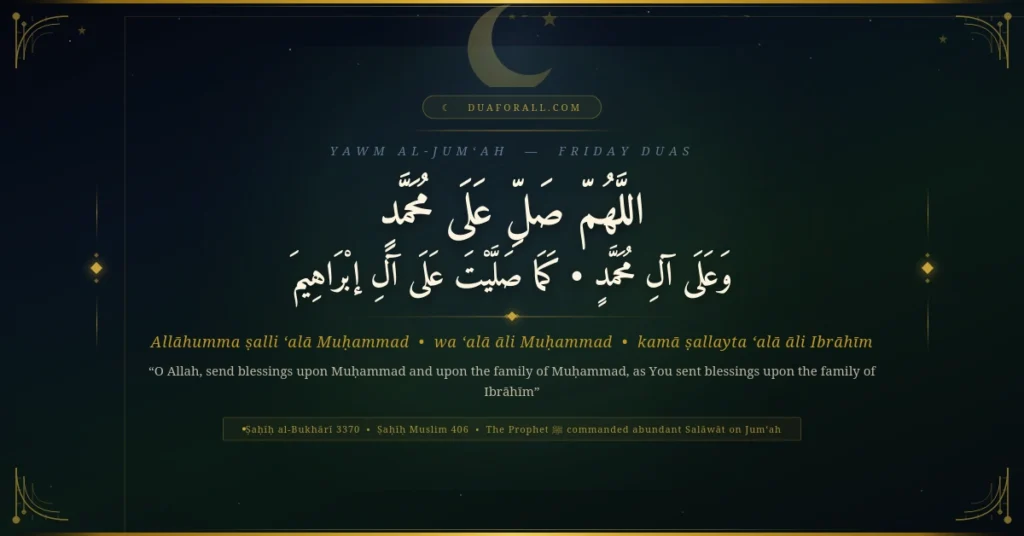
1. The Ibrahimi Salawat (Salawat after Salah)
Allāhumma ṣalli ʿalā Muḥammadin wa ʿalā āli Muḥammadin, kamā ṣallayta ʿalā Ibrāhīma wa ʿalā āli Ibrāhīma, innaka Ḥamīdun Majīd.
“O Allah, send Your mercy upon Muhammad and the family of Muhammad, as You sent Your mercy upon Ibrahim and the family of Ibrahim. Indeed, You are Praiseworthy, Glorious.”
📚 Sahih Bukhari 3370 · Sahih Muslim 4062. Dua During the Blessed Hour
Rabbanā ātinā fī al-dunyā ḥasanatan wa fī al-ākhirati ḥasanatan wa qinā ʿadhāba al-nār.
“Our Lord, grant us good in this world and good in the Hereafter, and save us from the punishment of the Fire.”
📚 Surah Al-Baqarah 2:201 · Most Recited Quranic Dua3. Seeking Forgiveness on Friday
Allāhumma innī asʾaluka al-jannata wa aʿūdhu bika min al-nār.
“O Allah, I ask You for Paradise and I seek refuge in You from the Fire.”
📚 Abu Dawud 792 · Ibn Majah 9104. Dua for Protection (Morning & Evening of Friday)
Allāhumma anta rabbī lā ilāha illā anta, khalaqtanī wa anā ʿabduk, wa anā ʿalā ʿahdika wa waʿdika mā istaṭaʿtu.
“O Allah, You are my Lord. There is no god worthy of worship except You. You created me and I am Your servant. I am upon Your covenant and Your promise as much as I am able.”
📚 Sahih Bukhari 6306 — Sayyid al-Istighfar5. Dua Immediately After Jumu’ah Prayer
Subḥānallāh, walḥamdulillāh, wa lā ilāha illallāh, wallāhu akbar.
“Glory be to Allah. All praise is for Allah. There is no god worthy of worship except Allah. Allah is the Greatest.”
📚 Sahih Muslim 597 — Recite 33× each after prayer6. Dua for the Muslim Ummah (Friday Reflection)
Allāhumma aṣliḥ ummata Muḥammad, Allāhumma farrij ʿan ummati Muḥammad, Allāhumma irḥam ummata Muḥammad.
“O Allah, rectify the Ummah of Muhammad. O Allah, relieve the Ummah of Muhammad. O Allah, have mercy upon the Ummah of Muhammad.”
📚 Musnad Ahmad — Recommended by scholars for FridaySurah Al-Kahf on Friday — Rewards & Method
Among the most emphasized Friday practices is the recitation of Surah Al-Kahf (Chapter 18 of the Quran, comprising 110 verses). Its rewards are staggering, and it serves as protection against the trial of Dajjal.
“Whoever recites Surah Al-Kahf on Friday, a light will shine for him from under his feet to the clouds of the sky, which will shine for him on the Day of Resurrection, and he will be forgiven for whatever sins he committed between the two Fridays.”
📚 Al-Hakim (Mustadrak 2/399) · Al-Bayhaqi · Narrated by Abu Sa’id al-Khudri (RA)The surah illuminates one’s path — spiritually and on the Day of Judgement — extending from this Friday to the next.
Memorizing the first or last 10 verses protects against the trials of the Dajjal (the Anti-Christ). (Muslim 809)
From Thursday evening (after Maghrib) until Friday evening (before Maghrib). Both night and day of Friday are valid.
Even reciting the first 10 verses brings the light of protection. Completing all 110 verses earns the full reward.
Opening of Surah Al-Kahf: “In the name of Allah, the Entirely Merciful, the Especially Merciful. All praise is due to Allah, who has sent down upon His Servant the Book and has not made therein any deviance.”
📗 Surah Al-Kahf (18:1) — Begin recitation hereSending Salawat on the Prophet ﷺ
Sending blessings upon the Prophet Muhammad ﷺ is one of the greatest acts of worship on Fridays. Every salawat is reciprocated by Allah ﷻ with ten-fold blessings upon the sender.
Allāhumma ṣalli wa sallim ʿalā nabiyyinā Muḥammad
“O Allah, send Your prayers and peace upon our Prophet Muhammad.”
“Send abundant blessings upon me on Friday, for it is a witnessed day on which the angels are present, and no one sends blessings upon me except that his blessing will be shown to me.”
📚 Ibn Majah — Hadith 1637 | Narrated by Abu Darda’ (RA)📊 How Often Should You Send Salawat?
of Friday
80 years of sins
(Al-Bayhaqi)
more, the greater
the reward
Special Dua After Asr on Friday
The period between Asr prayer and Maghrib on Friday is considered by many scholars — including Ibn al-Qayyim and Ibn Taymiyyah — to be the most likely time for the blessed hour of acceptance.
📅 A Muslim’s Complete Friday Timeline
Friday begins at Maghrib on Thursday in Islamic tradition. Start the blessed recitation from this evening.
Begin the day with Fajr prayer. The Prophet ﷺ described Friday Fajr as uniquely witnessed by angels (Surah Al-Isra 17:78).
Perform ghusl, wear clean clothes, apply perfume, and head early to the masjid. The earlier you arrive, the greater the reward.
Listen attentively to the khutbah without speaking. Pray two rak’ahs of Jumu’ah with the congregation.
Pray 4 rak’ahs sunnah after Jumu’ah (or 2 at home), recite adhkar, and increase salawat upon the Prophet ﷺ.
This is the most likely time for dua acceptance. Raise your hands, pour out your heart, and ask Allah ﷻ for all your needs — worldly and spiritual.
Finish Surah Al-Kahf if not yet complete, recite evening adhkar, and thank Allah ﷻ for the blessed day of Jumu’ah.
Allāhumma innī aʿūdhu biriḍāka min sakhaṭik, wa bimuʿāfātika min ʿuqūbatik, wa aʿūdhu bika mink, lā uḥṣī thanāʾan ʿalayka, anta kamā athnayta ʿalā nafsik.
“O Allah, I seek refuge in Your pleasure from Your anger, and in Your forgiveness from Your punishment. I seek refuge in You from You. I cannot count Your praise; You are as You have praised Yourself.”
📚 Sahih Muslim 486 — Narrated by Aisha (RA)Jumu’ah for Women: What Islam Teaches
While Jumu’ah attendance is obligatory for Muslim men, women have special rulings and blessings regarding Friday. They are still encouraged to perform the Sunnah acts and duas of Friday.
The majority of scholars (Hanafi, Maliki, Shafi’i, Hanbali) agree that Jumu’ah prayer is not obligatory for women, though they may attend.
Women are permitted and encouraged to attend Jumu’ah if they wish. The Prophet ﷺ said: “Do not prevent the female servants of Allah from the mosques of Allah.” (Muslim 442)
If a woman does not attend Jumu’ah, she prays the regular 4-rak’ah Dhuhr prayer at home. Her Friday still holds all the same blessings.
All Friday Sunnahs — ghusl, Surah Al-Kahf, salawat, dua during the blessed hour — are fully applicable and rewarded for women.
Frequently Asked Questions
Answers to the most common questions about Jumu’ah, Friday prayer, and the special supplications of this blessed day.
Jumu’ah prayer is obligatory (fard) for every adult Muslim male who is sane, free, a resident (not a traveller), and is not excused by illness. Women, travellers, the sick, and children are exempt but may attend and receive full reward. This is based on Surah Al-Jumu’ah 62:9 and numerous authentic ahadith.
Yes. Friday in the Islamic calendar begins at Maghrib on Thursday. Therefore, reciting Surah Al-Kahf after Maghrib on Thursday evening is valid and counts as Friday recitation. The window extends until Maghrib on Friday itself. This is the position of Imam Shafi’i and other scholars.
Friday ghusl is a complete ritual bath performed with the intention of purity for Jumu’ah. It involves washing the entire body, including rinsing the mouth, nose, and ensuring water reaches all parts. The Prophet ﷺ said: “Ghusl on Friday is obligatory on every adult Muslim” — though most scholars classify it as a strongly emphasised Sunnah (wajib or sunnah mu’akkadah) rather than absolute obligation.
No — singling out Friday for fasting without fasting the day before (Thursday) or after (Saturday) is disliked (makruh). The Prophet ﷺ said: “Do not fast on Fridays unless you fast the day before or after.” (Bukhari 1985, Muslim 1144). However, if Friday falls on an established fasting day (e.g., the 13th, 14th, 15th of the month, or Arafah), then it is permitted.
The Jumu’ah prayer itself is 2 rak’ahs (fard), preceded by two khutbahs. Before the prayer, one may pray tahiyyat al-masjid (2 rak’ahs) and optional nafl prayers until the imam begins. After Jumu’ah, it is Sunnah to pray 4 rak’ahs in the masjid, or 2 rak’ahs if praying at home (Muslim 882). Some scholars say 2 + 4 = 6 rak’ahs after Jumu’ah is most rewarded.
If you miss Jumu’ah without a valid excuse (illness, travel, genuine emergency), you should make sincere tawbah (repentance). If you missed it with a valid excuse, or if you arrived after the prayer ended, you should pray Dhuhr (4 rak’ahs). Missing three consecutive Jumu’ahs without excuse is a grave matter — the Prophet ﷺ warned that Allah ﷻ would seal such a person’s heart (Abu Dawud 1052).
Make Every Friday Count
Save this guide and share it with your family and friends. The Prophet ﷺ said: “Whoever guides others to goodness will have the same reward as the one who does it.”
📿 Browse All Duas 📖 Masnoon Duas