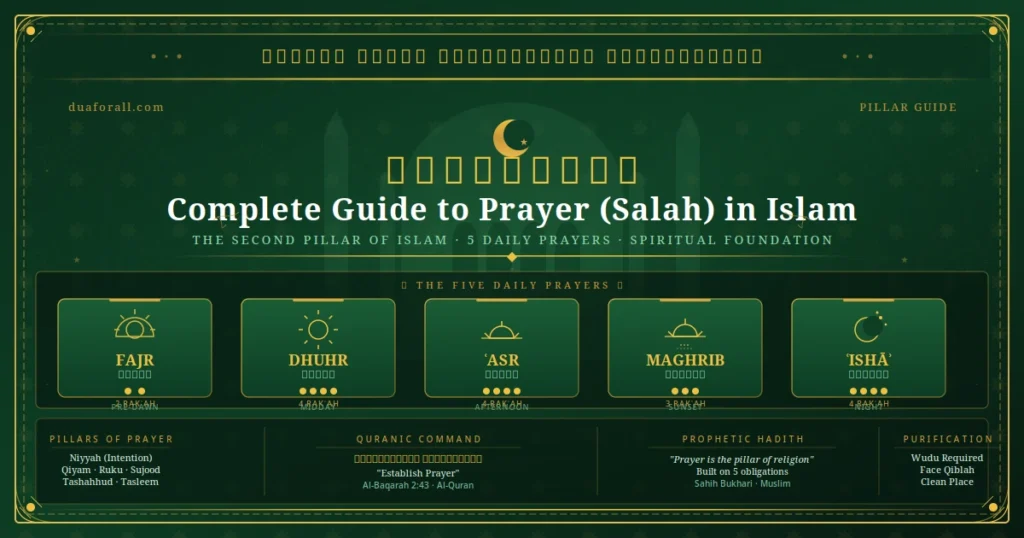
The Complete Guide to
Prayer (Salah) in Islam
Everything you need to know about Islamic prayer — its meaning, method, times, types, and profound spiritual benefits. Authentic references from Quran and Hadith.
📋 Table of Contents
- What is Prayer (Salah) in Islam?
- Prayer in the 5 Pillars of Islam
- The 5 Daily Prayers Explained
- How to Perform Salah — Step by Step
- Spiritual & Scientific Benefits of Prayer
- Types of Prayer in Islam
- Dua vs. Salah — What’s the Difference?
- Conditions & Prerequisites of Prayer
- Prayer Times — Understanding the Schedule
- Special & Occasional Prayers
- Arabic for Prayer — Phrases, Script & Learning
- Frequently Asked Questions
- Authoritative External Resources
What is Prayer (Salah) in Islam?
Salah (Arabic: صَلَاة) is the ritual prayer performed by Muslims five times daily. It is the second of the Five Pillars of Islam and the most important act of worship after the declaration of faith (Shahada). The word “Salah” itself conveys the meanings of connection, communication, and blessing.
Prayer in Islam is not simply a mechanical act. It is a direct conversation between the servant and Allah ﷻ — a structured, mindful, and deeply spiritual practice that encompasses standing, bowing, prostration, and supplication. Every movement and every word carries profound meaning.
The obligation of Salah was established in the Quran and Sunnah, and it was prescribed during the miraculous night journey of Prophet Muhammad ﷺ (Al-Isra’ wal-Mi’raj), making it uniquely direct in its divine origin — it was not revealed through the Angel Jibreel but was given personally in the heavens.
Beyond ritual, Salah serves as a spiritual anchor throughout the day — a reminder of purpose, gratitude, and accountability that prevents the believer from becoming consumed by worldly distractions.
Obligatory on All Muslims
Salah is Fard (obligatory) upon every sane, adult Muslim — male and female. It cannot be delegated, shortened (in normal circumstances), or permanently skipped.
Facing the Qibla
Every prayer is performed facing the Qibla — the direction of the Ka’bah in Makkah. Use our Qibla Finder tool to find your exact direction.
Purification Required (Wudu)
Before prayer, ritual purification (Wudu or Ghusl) is required. This physical act of cleansing also symbolises spiritual readiness to stand before Allah.
Fixed Times Daily
Each of the 5 prayers has a specific window of time determined by the position of the sun. Find your local times with our Prayer Time Calculator.
Performed in Arabic
Salah is performed in the Arabic language, using specific verses from the Quran and prescribed phrases (dhikr) — which connects all Muslims globally in the same words.
Dua: Supplication Beyond Salah
While Salah is structured prayer, Dua is informal personal supplication that can happen anytime. Explore our full Daily Duas collection.
Prayer Within the 5 Pillars of Islam
Islam is built on five essential pillars. Salah is the second — and the most frequently practiced — forming the spiritual spine of a Muslim’s daily life.
The Prophet Muhammad ﷺ said: “The first matter that the servant will be brought to account for on the Day of Judgment is the prayer. If it is sound, then the rest of his deeds will be sound. And if it is bad, then the rest of his deeds will be bad.” — (Al-Tabarani, Authenticated by Al-Albani)
The Five Daily Prayers Explained
Each of the five prayers has a specific time window, a set number of rak’ahs (units), and a distinct spiritual character. Together, they pace the entire day with remembrance of Allah.
⏱️ Total daily Fard rak’ahs: 2 + 4 + 4 + 3 + 4 = 17 rak’ahs. With Sunnah mu’akkadah added: approximately 40 rak’ahs. Use our Prayer Time Calculator to find your exact prayer schedule by location.
How to Perform Salah
A step-by-step breakdown of the key positions and recitations in a single rak’ah (unit) of prayer — the foundational cycle repeated 2–4 times per prayer.
Wudu — Ritual Purification
Before praying, perform Wudu (ablution): wash hands, mouth, nose, face, arms to elbows, wipe head, wash ears and feet. Ensures physical and spiritual cleanliness.
Niyyah — Intention
Make a silent intention in the heart specifying which prayer you are about to perform. The Prophet ﷺ said: “Actions are but by intentions.” (Bukhari & Muslim)
Takbir — Opening Glorification
Raise both hands to shoulder/ear level and say “Allahu Akbar” (Allah is the Greatest). This marks the formal beginning of prayer — the world is now behind you.
Qiyam — Standing Recitation
Stand upright and recite Surah Al-Fatihah (obligatory in every rak’ah), followed by any other Quranic surah. Explore Quranic recitations here.
Ruku’ — Bowing
Bow with your back flat, hands on knees, and say “Subhana Rabbiya al-‘Adheem” (Glory be to my Lord, the Most Great) — at minimum three times.
Sujud — Prostration
Prostrate with 7 body parts touching the ground: forehead+nose, both palms, both knees, both feet. Say “Subhana Rabbiya al-A’la” — your closest position to Allah ﷻ.
Tashahhud & Salam
In the final rak’ah, sit and recite the Tashahhud and Salawat upon the Prophet ﷺ. End with Tasleem: turning right then left saying “As-Salamu Alaykum wa Rahmatullah.”
Spiritual & Scientific Benefits of Prayer
The wisdom behind prayer extends beyond the spiritual — modern research continues to validate what believers have known for 1,400 years.
Mental Clarity
The structured pauses throughout the day reduce cortisol levels and interrupt anxiety cycles, creating mental calm and focus.
Physical Exercise
The movements of Salah — standing, bowing, prostrating — engage multiple muscle groups and improve flexibility and circulation.
Inner Peace
Regular prayer produces a meditative state. The Quran states: “Verily, in the remembrance of Allah do hearts find rest.” (13:28)
Protection from Evil
Allah says prayer prevents immorality and wrongdoing: “Indeed, prayer prohibits immorality and wrongdoing.” (Quran 29:45)
Community & Unity
Praying in congregation (Jama’ah) carries 27 times the reward of solo prayer and strengthens the social fabric of the Muslim community.
Time Management
The five fixed prayer times create a disciplined daily structure that enhances productivity and intentionality across all activities.
Erases Minor Sins
The Prophet ﷺ compared the five daily prayers to bathing five times a day in a river — no trace of impurity remains. (Bukhari & Muslim)
Gratitude Practice
Every Salah begins with Al-Fatihah — a declaration of gratitude, humility, and guidance-seeking that reorients the soul toward thankfulness.
Types of Prayer in Islam
Islamic prayer is classified by obligation level and occasion. Understanding these categories helps you build a complete and rewarding prayer life.
| Type | Arabic | Obligation | Examples | Reward for Missing |
|---|---|---|---|---|
| FardObligatory | فَرْض | Compulsory on every adult Muslim | 5 Daily Prayers (Fajr, Dhuhr, Asr, Maghrib, Isha) + Jumu’ah | Sinful to miss without valid excuse |
| WajibNecessary | وَاجِب | Required, but a degree below Fard | Witr prayer, Eid prayers (Hanafi school) | Sinful to miss intentionally |
| Sunnah Mu’akkadahEmphasized | سُنَّة مُؤَكَّدَة | Strongly emphasized — Prophet rarely skipped | 2 before Fajr, 2+2 around Dhuhr, 2 after Maghrib, 2 after Isha | Blameworthy to regularly omit |
| Sunnah Ghair Mu’akkadahRecommended | سُنَّة غَيْر مُؤَكَّدَة | Recommended but not always practiced by the Prophet ﷺ | 4 before Asr, 4 before Isha | No sin for missing, but reward for performing |
| NaflVoluntary | نَافِلَة | Voluntary, for extra reward | Tahajjud, Duha, Awwabin, Istikhara, Tawbah prayer | No sin; immense reward for performing |
ℹ️ Classifications may vary slightly between the four major Islamic schools of jurisprudence (Hanafi, Maliki, Shafi’i, Hanbali). The above reflects the most widely held scholarly positions.
Dua vs. Salah — What’s the Difference?
Both Salah and Dua are forms of communication with Allah ﷻ — but they differ in structure, obligation, and purpose.
Salah (Ritual Prayer)
A structured, prescribed form of worship with fixed times, specific positions, and set recitations. Obligatory and one of the pillars of Islam.
- Obligatory 5 times daily
- Requires Wudu (purification)
- Facing Qibla is required
- Performed in Arabic only
- Specific times and movements
- Cannot be performed during certain times (e.g. sunrise)
- Contains within it moments ideal for Dua
Dua (Supplication)
Personal, informal communication with Allah — a heartfelt conversation that can happen anytime, anywhere, in any language. Called “the essence of worship.”
- Voluntary — any time, any place
- No Wudu strictly required
- No specific direction needed
- Can be in any language
- No fixed structure required
- Ideal during Sujud, after Salah, last third of night
- Browse 500+ authentic duas →
Conditions & Prerequisites of Prayer
For Salah to be valid, certain conditions must be met both before and during the prayer. Scholars categorize these as Shuroot (conditions).
🌿 Before Prayer
- ✓ Islam — Only valid for Muslims
- ✓ Sanity (Aql) — Prayers not required during insanity
- ✓ Puberty (Bulugh) — Obligatory after puberty
- ✓ Wudu — Ritual purification (or Ghusl if needed)
- ✓ Clean body, clothing, and prayer area
- ✓ Awrah covered — Appropriate modest dress
🕌 During Prayer
- ✓ Prayer time — Must pray within the designated window
- ✓ Qibla direction — Facing toward the Ka’bah
- ✓ Niyyah (Intention) — Formed silently in the heart
- ✓ Khushu’ (Mindfulness) — Presence of heart and focus
- ✓ Correct recitation — Al-Fatihah in every rak’ah
- ✓ Avoid invalidators — Speaking, eating, laughing, major movement
Special & Occasional Prayers in Islam
Beyond the five daily prayers, Islam has a rich tradition of additional prayers for specific occasions, needs, and spiritual seasons.
Jumu’ah (Friday Prayer)
Replaces Dhuhr on Fridays. Obligatory for adult males. Includes a Khutbah (sermon) and 2 rak’ahs. See our Jumu’ah guide.
Eid Prayers
2 rak’ahs performed on Eid al-Fitr and Eid al-Adha. Community prayer with additional Takbeers. See our Eid guide.
Tahajjud (Night Prayer)
Voluntary prayer in the last third of the night — one of the most beloved to Allah. The Prophet ﷺ rarely missed it. Performed in sets of 2 rak’ahs.
Tarawih (Ramadan Prayer)
Extra night prayers performed during Ramadan after Isha. Typically 8 or 20 rak’ahs. Explore our Ramadan guide.
Istikhara Prayer
2 rak’ahs followed by a specific Dua when seeking Allah’s guidance in making an important decision. See Dua for guidance.
Duha (Forenoon Prayer)
Voluntary prayer performed after sunrise until just before Dhuhr. The Prophet ﷺ said it replaces the charity due on every joint of the body.
Related Islamic Topics
Deepen your practice with these closely related guides, duas, and tools from DuaForAll.com.
Arabic for Prayer (Salah) — Phrases, Script & How to Learn
Salah is performed exclusively in Arabic — the language of the Quran. Understanding the Arabic words you recite transforms rote repetition into a living, conscious conversation with Allah ﷻ.
The Arabic word for prayer is صَلَاة (Salah) — pronounced Sa-LAH. It derives from the root ص ل و (Ṣ-L-W), carrying meanings of connection, communication, and blessing. This root beautifully captures the essence of prayer: a live link between the servant and the Divine.
📌 Key insight: Unlike many acts of worship where intention alone suffices in your mother tongue, the verbal recitations of Salah must be in Arabic. Scholars note this creates a universal brotherhood — a Muslim from Pakistan, Nigeria, or Brazil stands in prayer reciting the exact same words as the Prophet Muhammad ﷺ recited 1,400 years ago.
For non-Arabic speakers, the journey to learn Arabic for prayer is one of the most rewarding undertakings in a Muslim’s life. Even learning the phonetics of the phrases — their pronunciation, rhythm, and basic meaning — profoundly deepens Khushu’ (mindfulness) in prayer.
Scholars from all four major madhabs agree: a new Muslim who cannot yet recite Al-Fatihah in Arabic must strive to learn it as quickly as possible. In the meantime, they may recite a transliteration while actively learning the original Arabic pronunciation.
🎯 Arabic in prayer consists of: Quranic recitation (Al-Fatihah + additional surahs), Adhkar (glorifications at each posture), Tashahhud (testimony), Salawat (prayers upon the Prophet ﷺ), and the closing Tasleem.
Essential Arabic Phrases Recited in Salah
Every phrase below is a mandatory or strongly encouraged recitation within prayer — with Arabic script, romanised transliteration, and usage context.
Arabic Vocabulary Glossary for Prayer
Core Arabic terms every Muslim should know — with script, romanisation, and meaning in context of Salah.
| Arabic Script | Romanisation | Meaning | Related Term | Used In |
|---|---|---|---|---|
| صَلَاة | Ṣalāh | Prayer / ritual worship | Plural: Ṣalawāt | General term |
| رَكْعَة | Rakʿah | One unit/cycle of prayer | Plural: Rakʿāt | Structure |
| نِيَّة | Niyyah | Intention (in the heart) | Root: N-W-Y | Before prayer |
| قِيَام | Qiyām | Standing posture | From: qāma (to stand) | Posture |
| رُكُوع | Rukūʿ | Bowing posture | Verb: rakaʿa | Posture |
| سُجُود | Sujūd | Prostration posture | Singular: Sajdah | Posture |
| تَكْبِير | Takbīr | Saying “Allahu Akbar” | Root: K-B-R (greatness) | Transitions |
| تَشَهُّد | Tashahhud | Testimony / sitting recitation | From: shahida (to witness) | Sitting |
| خُشُوع | Khushūʿ | Humility / mindfulness in prayer | Root: Kh-SH-ʿ | Spiritual quality |
| وُضُوء | Wuḍūʾ | Ritual ablution before prayer | From: wadaʾa (to shine) | Prerequisite |
| قِبْلَة | Qiblah | Direction of prayer (toward Makkah) | Root: Q-B-L (to face) | Direction |
| إِمَام | Imām | Leader of congregational prayer | Root: ʾ-M-M (to lead) | Congregation |
| أَذَان | Adhān | The call to prayer | From: ādhana (to announce) | Call to prayer |
| تَسْلِيم | Taslīm | Ending greeting of prayer | Root: S-L-M (peace/Islam) | Closing |
Arabic is written right-to-left and consists of 28 letters. Below are the letters most frequently encountered in Salah recitations — hover to highlight each one.
Key letters in prayer vocabulary: ص (Ṣād — in Ṣalāh) · ل (Lām — in Allāh) · ه (Hāʾ — in Allāh) · ك (Kāf — in Akbar) · ب (Bāʾ — in Bismillah) · ر (Rāʾ — in Raḥmān) · ح (Ḥāʾ — in Al-Ḥamd)
💡 Tajweed note: Arabic for prayer uses Tajweed — the science of correct Quranic pronunciation. Letters like ح (Ḥāʾ), ع (ʿAyn), and ق (Qāf) have no English equivalent and require guidance from a qualified teacher or audio resource.
Learning Arabic for Prayer — A Step-by-Step Roadmap
Whether you are a new Muslim or a lifelong believer wanting to deepen your connection to the words of prayer, this roadmap will guide you forward.
Memorise Al-Fatihah Phonetically First
Start with Surah Al-Fatihah — the 7-verse chapter recited in every rak’ah. Use audio recordings from Quran.com to hear it recited correctly, then use a transliteration to follow along. Focus on pronunciation before meaning. Most new Muslims can memorise it phonetically within 1–2 weeks of daily practice.
Learn the 9 Core Dhikr Phrases of Prayer
Memorise the nine key phrases recited in Salah (Takbir, Ruku dhikr, Sami’allah, Sujud dhikr, Tashahhud, Salawat, and Tasleem). Each is short and rhythmic. Use this page’s phrase cards above as your reference and test yourself after each prayer.
Understand What You Say — Translate Each Phrase
Once you can recite the phrases, learn their word-by-word meanings using resources like IslamiCity or the Understand Quran Academy. Knowing that Subhana Rabbiya al-A’la means “Glory be to my Lord, the Most High” — while your forehead is on the ground — transforms the spiritual experience entirely.
Learn the Arabic Alphabet and Basic Tajweed
Move from transliteration to reading actual Arabic script. Learning the 28 letters takes most dedicated beginners 2–4 weeks. Apps like Iqraa, Noorani Qaida courses, or platforms like Bayyinah Institute offer structured beginner Quranic Arabic courses. Basic Tajweed rules govern elongation (Madd), stopping (Waqf), and merging (Idgham) of letters.
Memorise Short Surahs to Recite After Al-Fatihah
After Al-Fatihah, any portion of the Quran may be recited. Begin with the shortest surahs: Al-Ikhlas (Quran 112 — 4 verses), Al-Falaq (Quran 113 — 5 verses), and An-Nas (Quran 114 — 6 verses). These three surahs together take 5–10 minutes to learn phonetically and a lifetime to appreciate in meaning. Browse them at DuaForAll’s Quranic Duas.
Study Quranic Arabic Grammar (Nahw & Sarf)
For those who wish to understand the Quran in its original language, study Arabic morphology (Sarf) and syntax (Nahw). Courses from SeekersGuidance, Bayyinah TV’s “Dream” programme, or the classical text Madinah Books are widely recommended pathways. Mastering this opens the entire Quran to your direct understanding — with no translator as an intermediary.
Frequently Asked Questions About Prayer
Authoritative External Resources
These trusted scholarly and academic sources provide deeper research on Islamic prayer from authenticated perspectives.
Detailed Rulings on Prayer (Fatawa)
Thousands of scholar-verified Q&A on every aspect of Salah — from Wudu to combined prayers — based on Quran and authentic Hadith.
Visit Resource →Hadith Database — Prayer References
The world’s most comprehensive online Hadith collection. Search every authenticated narration about Salah from Sahih Bukhari, Muslim, Abu Dawud and more.
Search Hadith →Quranic Verses on Prayer (Salah)
Read every Quranic verse related to Salah in Arabic with multiple tafsir commentaries, transliterations, and translations in 50+ languages.
Explore Quran →Free Islamic Courses on Salah
Certified online courses taught by qualified scholars on the fiqh (jurisprudence), spirituality, and proper method of Islamic prayer.
View Courses →Salah Reminders & Lectures
Accessible audio and video lectures on the importance and beauty of Salah by one of the world’s most followed Islamic scholars and speakers.
Listen →Prayer Time Apps
Muslim Pro provides accurate, GPS-based prayer times, Qibla direction, and Adhan notifications used by millions of Muslims worldwide daily.
Get the App →