How to Perform Hajj and Umrah
The Complete Islamic Pilgrimage Guide
Everything you need to know — rituals, duas, preparation checklist, spiritual wisdom, and step-by-step guidance for the journey of a lifetime.
What is Hajj?
The fifth pillar of Islam — a sacred duty incumbent on every able Muslim once in their lifetime.
Hajj (الحَجّ) is the annual Islamic pilgrimage to Makkah al-Mukarramah, Saudi Arabia — the holiest city in Islam. It takes place during the Islamic month of Dhul Hijjah (the 12th month of the lunar calendar) and is one of the Five Pillars of Islam, obligatory for every Muslim who is physically, mentally, and financially capable.
“Islam is built on five pillars: testifying that there is no god but Allah and that Muhammad is His messenger, establishing prayer, paying Zakat, fasting Ramadan, and performing Hajj to the House.”
Conditions of Obligation
- Muslim — must be a believing Muslim
- Adult (Baaligh) — must have reached puberty
- Sane (Aaqil) — must be of sound mind
- Free — not enslaved or imprisoned
- Istita’ah — financially and physically capable
Quranic Command
“And pilgrimage to the House is a duty owed to Allah by people who are able to undertake it.”
Quran 3:97 (Surah Aal Imran)
Hajj vs Umrah — Key Differences
| Feature | 🕋 Hajj | 🌿 Umrah |
|---|---|---|
| Arabic Meaning | The Greater Pilgrimage | The Lesser / Minor Pilgrimage |
| Obligation | Fard (obligatory) once in lifetime | Sunnah Mu’akkadah (strongly recommended) |
| Time | Specific days of Dhul Hijjah only (8–13) | Any time of the year |
| Duration | 5–6 days minimum | Can be completed in a few hours |
| Unique Rituals | Wuquf (Arafat), Muzdalifah, Mina, Rami | Tawaf + Sa’i + Halq/Taqsir only |
| Reward | “No reward except Jannah” (Bukhari) | Equivalent to one Hajj (Ramadan Umrah) |
| Visa Type | Hajj Visa (quota-based by country) | Umrah Visa (available year-round) |
Three Types of Hajj
Hajj al-Tamattu’
Performing Umrah first in the Hajj months, releasing from Ihram, then re-entering Ihram for Hajj on 8th Dhul Hijjah. Requires a Hady sacrifice. Recommended for non-residents of Makkah.
Arabic: التَّمَتُّع — “Enjoying”
Hajj al-Qiran
Combining Hajj and Umrah together in a single Ihram, without releasing it between the two. The pilgrim performs both without a break. Also requires a Hady sacrifice.
Arabic: القِرَان — “Joining”
Hajj al-Ifrad
Performing Hajj only, without combining it with Umrah. The pilgrim enters Ihram with the intention of Hajj alone and does not perform Umrah. No Hady is required.
Arabic: الإِفْرَاد — “Singling Out”
Scholarly Consensus: The majority of scholars consider Hajj al-Tamattu’ to be the most recommended form for pilgrims travelling from outside Saudi Arabia, as it was instructed by the Prophet ﷺ to his companions.
Complete Hajj Rituals — Day by Day
The rites of Hajj span five to six days in Dhul Hijjah, following the exact path of Prophet Ibrahim ﷺ and our beloved Prophet Muhammad ﷺ.
Hijjah
Enter Ihram & Travel to Mina
Pilgrims enter the state of Ihram at their designated Miqat station, make the Niyyah (intention) for Hajj, and recite the Talbiyah continuously. They travel to Mina and spend the night there performing prayers, beginning with Dhuhr. Historically, pilgrims would stock water here for the journey — hence “Day of Quenching.”
Hijjah
Wuquf at Arafat (Standing before Allah)
The most critical rite of Hajj. Pilgrims travel to the Plain of Arafat and stand in prayer and supplication from after Dhuhr until sunset. The Prophet ﷺ said: “Hajj is Arafat” (Ibn Majah). After sunset, they proceed to Muzdalifah for Maghrib and Isha prayers, and collect pebbles for the next day’s stoning ritual, spending the night under the open sky in worship.
Hijjah
Rami, Sacrifice, Halq & Tawaf al-Ifadah
The busiest day of Hajj involves four major acts: (1) Rami — throwing 7 pebbles at Jamarat al-Aqabah; (2) Hady — sacrificing an animal (Qurbani); (3) Halq/Taqsir — shaving or cutting hair, exiting partial Ihram; (4) Tawaf al-Ifadah — circling the Kaaba 7 times, followed by Sa’i between Safa and Marwa (7 laps). This is the day the whole Muslim world celebrates Eid al-Adha.
Hijjah
Rami of All Three Jamarat in Mina
Pilgrims return to Mina and on each of these days throw 7 pebbles at each of the three pillars (Jamarat al-Sughra, Jamarat al-Wusta, and Jamarat al-Aqabah) after midday. These days are spent in prayer, dhikr, and reflection. A pilgrim may hasten and leave after the 12th (Nafr al-Awwal) before sunset, or stay for the 13th (Nafr al-Thani).
Farewell Circumambulation of the Kaaba
Before leaving Makkah, every pilgrim must perform Tawaf al-Wada’ — 7 final circuits around the Kaaba — as a farewell to the House of Allah. This is waajib (obligatory) according to the majority of scholars. Many pilgrims also visit Madinah al-Munawwarah to send salawat upon the Prophet ﷺ at Masjid al-Nabawi, though this is sunnah, not a rite of Hajj.
Hajj Explained: A Complete Visual Guide
Watch a full walkthrough of the Hajj rituals to complement everything you’ve read above — see the sacred sites in real footage.
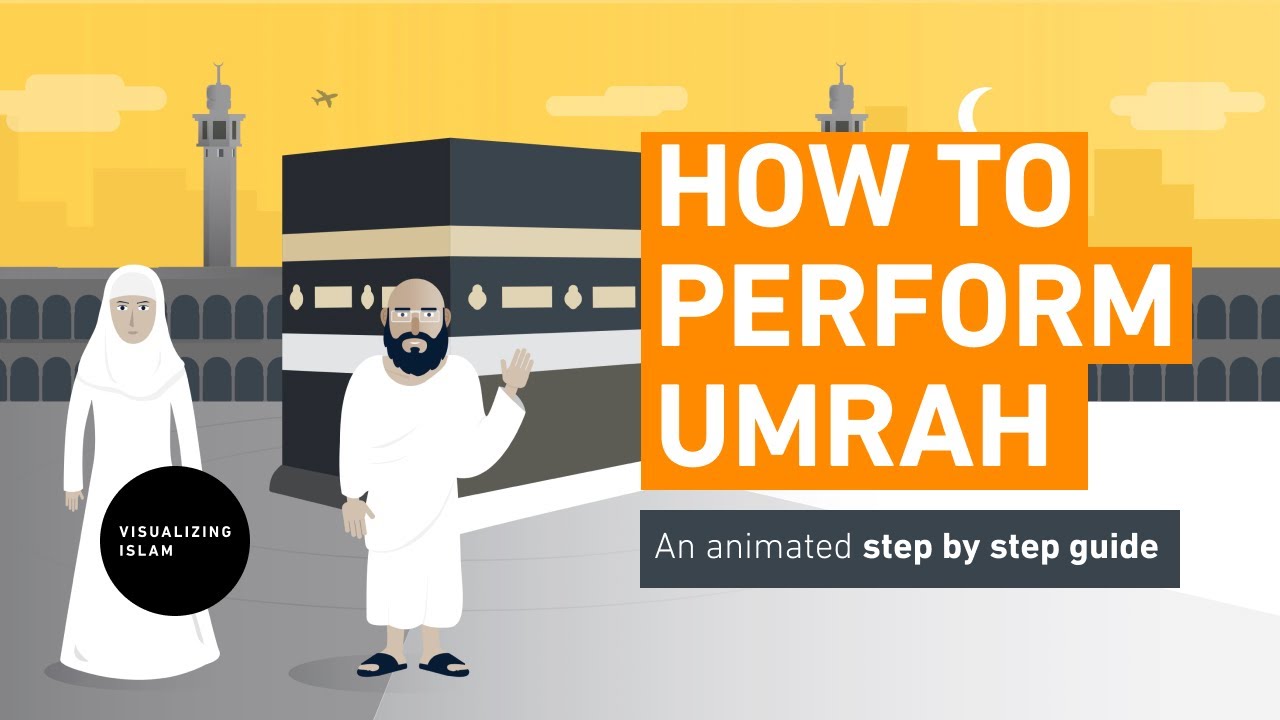

How to Perform Umrah — Step by Step
Umrah can be performed at any time of the year and consists of four essential rites. Here is a complete, simplified walkthrough.
Ihram — The Sacred State
Before reaching Makkah, pilgrims must enter Ihram at the designated Miqat boundary. Men wear two white seamless sheets (Izar and Rida’). Women wear modest regular clothing (no face veil is required). Make Ghusl, perform 2 Rak’ahs, make Niyyah, and begin reciting the Talbiyah. Prohibited acts include cutting hair/nails, wearing perfume, sexual relations, and hunting.
Tawaf al-Umrah — 7 Circuits
Upon entering Masjid al-Haram, begin Tawaf by kissing or gesturing towards the Hajr al-Aswad (Black Stone). Walk 7 complete counter-clockwise circuits around the Kaaba. Men perform Idtiba’ (right shoulder exposed) and Ramal (brisk pace) in the first 3 circuits. Make abundant dua, especially at the Yemeni Corner and in front of the Black Stone: Rabbana atina fid-dunya hasanatah…
Sa’i — Walking Between Safa & Marwa
After Tawaf, perform 2 Rak’ahs of prayer near Maqam Ibrahim, then drink Zamzam water. Proceed to Mount Safa, face the Kaaba, and begin the Sa’i: 7 laps between Safa and Marwa, starting at Safa and ending at Marwa. This commemorates Hajar (عليها السلام) searching for water for baby Ismail. Men jog between the green fluorescent markers. Make dua throughout.
Halq or Taqsir — Exiting Ihram
After completing Sa’i, men either shave the entire head (Halq — more virtuous) or trim at least one centimetre from all parts of the head (Taqsir). Women trim the length of a fingertip from their hair. This act symbolises humility, renewal, and exiting the state of Ihram. Upon completing this, all Ihram restrictions are lifted and Umrah is officially complete. Alhamdulillah!
Ihram: Rules, Miqat & Talbiyah
“Here I am, O Allah, here I am. Here I am, You have no partner, here I am. Verily all praise and blessings are Yours, and all sovereignty — You have no partner.”
✅ What is Permitted in Ihram
- Wearing sandals (for men)
- Using unscented soap and shampoo
- Wearing a watch, glasses, or hearing aid
- Applying henna (women)
- Carrying and using an umbrella for shade
- Eating and drinking normally
🚫 Prohibitions of Ihram
- Cutting hair or nails
- Wearing perfume or fragrance
- Marital relations or engagement
- Hunting land animals
- Men: wearing sewn garments or covering head
- Arguing, swearing, or committing sins
Essential Duas for Hajj & Umrah
Recite these authenticated supplications throughout your pilgrimage for maximum blessing and acceptance.
Complete Hajj & Umrah Preparation Checklist
Spiritual Preparation
- Learn the rituals from a qualified scholar
- Make sincere Tawbah (repentance)
- Settle all debts owed to others
- Seek forgiveness from anyone wronged
- Memorise key duas and the Talbiyah
- Increase Quran recitation and Salah
Administrative & Financial
- Apply through official Hajj Ministry portal
- Obtain valid Hajj or Umrah visa
- Arrange Mahram for women (if required)
- Purchase travel insurance
- Arrange Hady funds (Qurbani for Hajj)
- Notify family of travel itinerary
What to Pack
- Ihram garments (men: 2 sets minimum)
- Unscented soap, shampoo, and toiletries
- Comfortable slip-on sandals
- Pocket dua booklet or phone app
- Medications, sunscreen, and lip balm
- Zamzam-approved water bottle
Official Resources: Always book through your country’s official Hajj authority. For Saudi Arabia’s official Hajj ministry information, visit haj.gov.sa. UK pilgrims may refer to the Muslim Council of Britain. For in-depth scholarly guidance, refer to IslamQA — Hajj & Umrah.
History & Spiritual Significance of Hajj
The Kaaba — Bayt al-Atiq
The Kaaba (الكعبة) — also called Bayt Allah (House of Allah) — was originally built by Prophet Adam عليه السلام and later reconstructed by Prophet Ibrahim and his son Ismail عليهما السلام. Allah ﷻ commanded Ibrahim to call humanity to pilgrimage: “And proclaim the Hajj among the people; they will come to you on foot and on every lean camel, coming from every distant pass.” (Quran 22:27).
The Story of Hajar & Zamzam
The rite of Sa’i commemorates Hajar’s (عليها السلام) desperate search for water for baby Ismail in the valley of Makkah. Allah answered her prayer by causing the Zamzam Well to spring forth — a miracle that has flowed for over 4,000 years and continues to provide blessed water to millions of pilgrims today. The Prophet ﷺ said: “Zamzam is for whatever it is drunk for.” (Ibn Majah 3062).
Ibrahim’s Supreme Sacrifice & Eid al-Adha
The Hady sacrifice during Hajj and the global celebration of Eid al-Adha commemorate Ibrahim’s willingness to sacrifice his son Ismail in obedience to Allah. Allah replaced Ismail with a ram at the last moment, establishing the tradition of Qurbani (sacrifice) for all Muslims. The Rami (stoning of pillars at Jamarat) re-enacts Ibrahim rejecting Shaytan’s whispers at that same location.
The Farewell Hajj of the Prophet ﷺ
The Prophet Muhammad ﷺ performed Hajj only once in his lifetime — in 10 AH, just months before his passing. During his Khutbat al-Wada’ (Farewell Sermon) at Arafat, he declared: “O people! No prophet will come after me and no new nation will be born after you.” Over 100,000 companions were present. This Hajj established the definitive rituals followed by 1.8 billion Muslims to this day.
“Whoever performs Hajj for the sake of Allah and does not commit any obscenity or sin will return as sinless as the day his mother bore him.”
Trusted External Resources
Frequently Asked Questions
More from DuaForAll
Eid al-Adha 2026
Complete guide to Eid ul-Adha — dates, prayers, Takbeer, and how to celebrate this blessed day linked to Hajj.
Quranic Duas
The most powerful supplications from the Noble Quran, perfect to recite during Tawaf and throughout your pilgrimage.
Ramadan Calendar 2026
Ramadan Umrah earns the reward of a complete Hajj. Plan your blessed journey with our Ramadan calendar and guide.