“And whoever fears Allah — He will make for him a way out, and provide for him from where he does not expect.” — Quran 65:2–3
Dua for Rizq & Success
in Islam
Discover the most powerful, Quran-and-Sunnah-verified duas to increase your provision, open doors of barakah, and achieve worldly and spiritual success — with Arabic, transliteration, and scholarly references.
📖 Islamic Foundation
What is Rizq in Islam?
Rizq (الرِّزْق) is an Arabic term that encompasses far more than money or material wealth. In Islamic theology, Rizq is everything that Allah bestows upon His creation — sustenance, livelihood, health, knowledge, righteous children, time, peace of heart, and divine guidance itself.
The Quran mentions Rizq over 120 times, consistently affirming that Allah alone is the Razzaq — the All-Provider (الرَّزَّاق). This is one of the 99 beautiful names of Allah. Every creature on Earth, from the smallest ant to the mightiest whale, receives its Rizq from Allah alone. No one can withhold what Allah has decreed for you, and no one can give you what Allah has withheld.
Why Make Dua for Rizq?
The Prophet Muhammad ﷺ taught that dua is the weapon of the believer and the very essence of worship. Making sincere dua for Rizq is not a sign of worldliness — it is an act of complete dependence on Allah (tawakkul) and an acknowledgment of His sovereignty. Allah Himself commands: “Ask Me, and I will respond to you” (Quran 40:60).
Our scholars have noted that combining dua with righteous action, seeking halal income, giving in charity (sadaqah), and maintaining family ties (silat al-rahim) are among the greatest causes of barakah and increase in Rizq — as explicitly mentioned in authentic ahadith.
“Indeed, it is Allah who is the continual Provider, the firm possessor of strength.”
📖 Quran · Surah Adh-Dhariyat 51:58
“And when My servants ask you concerning Me — indeed I am near. I respond to the invocation of the supplicant when he calls upon Me.”
📖 Quran · Surah Al-Baqarah 2:186
🌿 Islamic Understanding
The 6 Types of Rizq in Islam
Islamic scholars identify multiple dimensions of Rizq — provision that extends well beyond financial wealth into every blessing Allah grants to a human being.
Maal — Wealth & Food
Material provision: money, food, clothing, shelter. The most commonly thought-of Rizq, but only one dimension.
Sihha — Health
A healthy body and sound mind are among the greatest gifts of Allah. The Prophet ﷺ called health one of two blessings most people neglect.
Ilm — Knowledge
Sacred knowledge and wisdom. Allah elevates those who are given knowledge in this life and the next (Quran 58:11).
Dhurriyah — Family
Righteous children, a supportive spouse, and loving family bonds are forms of Rizq that bring lasting happiness.
Tuma’ninah — Peace
Tranquility and contentment of the heart. True inner peace is one of the rarest and most precious forms of Rizq.
Waqt — Blessed Time
A long life filled with good deeds and barakah in time. Some people accomplish in one hour what others cannot in a day.
📿 Authentic Supplications
12 Most Powerful Duas for Rizq & Success
Carefully verified from the Quran, Sahih Bukhari, Sahih Muslim, and major hadith collections. Each dua includes its original Arabic, transliteration, full translation, and authentic source.
Rabbi innī limā anzalta ilayya min khayrin faqīr
“My Lord, indeed I am, for whatever good You would send down to me, in need.”
This was the dua of Prophet Musa ﷺ when he was in a state of desperate need, having fled Pharaoh and arriving in Madyan. Within hours of making this dua, his situation transformed completely.
Allāhumma innī as’aluka ‘ilman nāfi’an, wa rizqan tayyiban, wa ‘amalan mutaqabbalan
“O Allah, I ask You for beneficial knowledge, pure provision, and accepted deeds.”
One of the most comprehensive morning duas, combining all three pillars of a successful life: knowledge, halal provision, and righteous action.
Rabbanā ātinā fid-dunyā hasanatan wa fil-ākhirati hasanatan wa qinā ‘adhāban-nār
“Our Lord, give us in this world good and in the Hereafter good, and protect us from the punishment of the Fire.”
The Prophet ﷺ recited this dua more than any other. It encompasses every good of this world — including Rizq, health, and happiness — as well as the Hereafter.
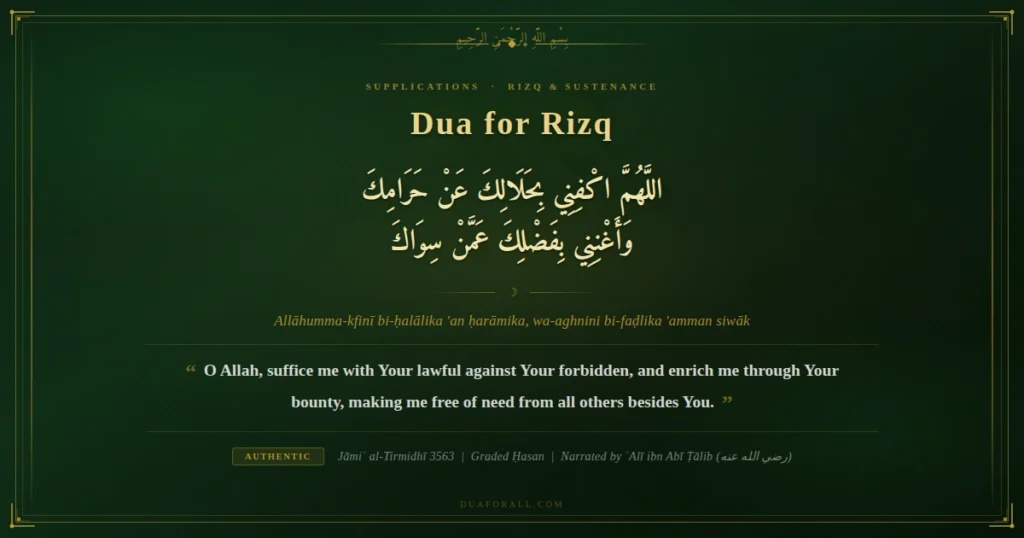
Allāhumma ikfinī bi-ḥalālika ‘an ḥarāmik, wa aghnini bi-faḍlika ‘amman siwāk
“O Allah, suffice me with what You have made lawful against what You have made forbidden, and enrich me by Your bounty — making me independent of all others besides You.”
A deeply meaningful dua — asking not just for wealth, but for contentment with halal provision and freedom from dependence on people.
Allāhumma innī a’ūdhu bika minal-hammi wal-ḥazan, wal-‘ajzi wal-kasal, wal-bukhli wal-jubn, wa ḍala’id-dayni wa ghalabatir-rijāl
“O Allah, I take refuge in You from worry and grief, from incapacity and laziness, from miserliness and cowardice, and from the burden of debt and the overpowering of men.”
The Prophet ﷺ recited this dua every morning. It removes the spiritual and psychological barriers that prevent Rizq — laziness, fear, miserliness, and debt.
Rabbi anzilnī munzalan mubārakan wa anta khayrul munzilīn
“My Lord, cause me to land at a blessed landing place, and You are the best to accommodate.”
This dua of Prophet Nuh ﷺ is recommended to read when entering a new home, new city, starting a new job, or beginning any new phase of life — to invite barakah into the new place.
Allāhumma rabbas-samāwāti wa rabbal-arḍi wa rabbal-‘arshil-‘aẓīm, iqḍi ‘anid-dayna wa aghnini minal-faqr
“O Allah, Lord of the heavens, Lord of the earth, and Lord of the Mighty Throne — settle my debt for me and enrich me from poverty.”
Particularly powerful for those burdened by debt. The Prophet ﷺ taught this dua to a companion who was overwhelmed with financial difficulties.
Allāhumma bārik lanā fīmā razaqtanā wa qinā ‘adhāban-nār
“O Allah, bless for us what You have provided us and protect us from the punishment of the Fire.”
A short, powerful dua to be recited at mealtimes or when receiving income. Asking for barakah in existing provision is as important as asking for increase.
Lā ilāha illā anta subḥānaka innī kuntu minaẓ-ẓālimīn
“There is no deity except You; exalted are You. Indeed, I have been of the wrongdoers.”
Called Dua Yunus, the Prophet ﷺ said: “No Muslim ever supplicates with it about any matter, but Allah will answer for him.” Unparalleled in its power to remove hardship and open Rizq.
Allāhumma innī as’alukal-‘āfiyata fid-dunyā wal-ākhirah
“O Allah, I ask You for well-being (‘afiyah) in this world and the Hereafter.”
The Prophet ﷺ said that after certainty in faith, no one has been given anything better than ‘afiyah — a word that encompasses health, safety, prosperity, and all-encompassing goodness.
Astaghfirullāhal-‘aẓīmal-ladhī lā ilāha illā huwal-ḥayyul-qayyūmu wa atūbu ilayh
“I seek forgiveness from Allah the Magnificent, besides Whom there is none worthy of worship, the Ever-Living, the Self-Sustaining, and I turn to Him in repentance.”
According to the Quran (71:10–12), seeking forgiveness abundantly is one of the primary causes of increase in Rizq, rain, wealth, and progeny. Repeat 100× daily for maximum barakah.
Ḥasbunallāhu wa ni’mal-wakīl, ni’mal-mawlā wa ni’man-naṣīr
“Allah is sufficient for us, and He is the best disposer of affairs. How excellent a Protector, and how excellent a Helper.”
When Ibrahim ﷺ was thrown into the fire, he said “Hasbunallah wa ni’mal wakeel” — and Allah made the fire cool and safe. The Prophet ﷺ recommended this when facing any fear or difficulty.
📿 Explore the full collection of Rizq & Success Duas on DuaForAll →
⏰ Dua Acceptance
9 Best Times When Dua for Rizq is Most Accepted
The Prophet ﷺ identified specific times when the doors of acceptance are wide open. Make your duas for Rizq during these blessed windows.
Last Third of Night
Allah descends to the lowest heaven asking “Who is calling Me?” — the most powerful time for Rizq duas. (Sahih Bukhari 1145)
In Sujood (Prostration)
The closest a servant is to Allah. The Prophet ﷺ said to make many duas during sujood. (Sahih Muslim 482)
Friday Blessed Hour
One hour on Friday when every dua is accepted. Scholars say it is the last hour before Maghrib. (Sahih Bukhari 935)
Between Adhan & Iqamah
The Prophet ﷺ said: “A dua made between adhan and iqamah is never rejected.” (Tirmidhi 212)
After Obligatory Prayer
Dua after completing the Fard salah, while still facing the Qibla, is among the most accepted. (Tirmidhi 3499)
During Rain
The Prophet ﷺ said duas are accepted when it rains — go outside, raise your hands, and call on Allah. (Abu Dawud 2540)
Night of Qadr (Laylatul Qadr)
Better than 1000 months. Duas made on this night include all Rizq for the entire coming year. (Quran 97:1–5)
After Fajr Prayer
The early morning hours are blessed and carry special barakah for seeking provision. (Tirmidhi 1212)
Night of ‘Arafah (9 Dhul Hijjah)
The greatest single day and night of the year for dua. Allah boasts about those supplicating on this night. (Sahih Muslim)
✨ Practical Guide
7 Quranic & Sunnah Actions That Increase Rizq
Beyond dua, Islam identifies specific amaal (deeds) that are directly linked to increase in Rizq — each with explicit Quranic or prophetic evidence.
🛡️ Taqwa — Consciousness of Allah
The single most powerful cause of Rizq. Allah promises in Quran 65:2–3: “Whoever fears Allah, He will make for him a way out and provide for him from where he does not expect.”
📖 Quran 65:2–3 · Direct divine promise
💝 Sadaqah — Giving in Charity
The Prophet ﷺ said: “Charity does not decrease wealth.” (Sahih Muslim 2588). Spending in the way of Allah multiplies Rizq manifold. Quran 2:261 compares it to a grain producing 700 grains.
📚 Sahih Muslim 2588 · Quran 2:261
🙏 Shukr — Gratitude to Allah
Quran 14:7 states: “If you are grateful, I will surely increase you.” Consistent gratitude for existing Rizq is among the most powerful means of multiplying it.
📖 Quran 14:7 · Divine covenant
👨👩👧 Silat al-Rahim — Maintaining Family Ties
The Prophet ﷺ said: “Whoever wishes that his Rizq be expanded and his life prolonged should maintain ties of kinship.” (Sahih Bukhari 5986). This is one of the most cited hadith on Rizq.
📚 Sahih Bukhari 5986 · Explicit link
🔄 Istighfar — Seeking Forgiveness
Prophet Nuh ﷺ told his people: “Ask forgiveness of your Lord — He will send rain upon you in abundance, and give you increase in wealth and children.” (Quran 71:10–12). Sins block Rizq; istighfar removes those blocks.
📖 Quran 71:10–12 · Causal relationship
⚓ Tawakkul — Complete Trust in Allah
The Prophet ﷺ said: “If you relied on Allah with true tawakkul, He would provide for you as He provides for the birds — they go out in the morning hungry and return full.” (Tirmidhi 2344).
📚 Tirmidhi 2344 · Graded Sahih
🕋 Hajj & Umrah — Pilgrimage
The Prophet ﷺ said: “Perform Hajj and Umrah consecutively, for they remove poverty and sins as a bellows removes impurities from iron.” (Tirmidhi 810). Consistent Umrah is a proven Sunnah remedy for financial hardship.
📚 Tirmidhi 810 · Ibn Khuzaymah 2512
✅ Dua Guidance
Conditions for Dua Acceptance & What Blocks It
Understanding what makes a dua accepted — and what prevents it — is as important as knowing the words themselves.
✅ Conditions for Acceptance
Sincerity of Intention (Ikhlas)
Your dua must be made sincerely for Allah alone, not for show. Ask with full awareness that only He can answer.
Certainty of Answer (Yaqeen)
The Prophet ﷺ said: “Call upon Allah while being certain of being answered.” Half-hearted duas risk rejection.
Proper Etiquette (Adab)
Face the Qibla, be in a state of wudu if possible, raise your hands, begin with Hamd and Salawat on the Prophet ﷺ.
Persistence & Repetition (Ilhah)
Repeat your dua three times and continue asking. The Prophet ﷺ repeated each dua three times.
Halal Income & Food
The Prophet ﷺ mentioned a man calling on Allah while his food and clothing were haram and asked: “How can his dua be answered?” (Sahih Muslim 1015).
Choosing the Best Times
Make dua during the 9 accepted times above — especially the last third of the night, sujood, and after obligatory prayers.
“And your Lord says: ‘Call upon Me; I will respond to you.'”
📖 Quran · Surah Ghafir 40:60
The Quran on Rizq — Allah’s Promise of Provision
Among the most comforting themes in the entire Quran is Allah’s repeated, categorical guarantee that He has taken upon Himself the responsibility of providing for every living creature. In Surah Hud, Allah declares: “There is no creature on earth but that upon Allah is its provision” (11:6). This is not merely a statement of comfort — it is a theological cornerstone of Islamic belief: Rizq is from Allah alone, and your portion has already been decreed.
The Prophet Muhammad ﷺ elaborated on this divine decree, stating in a famous hadith: “The Angel of the Womb is ordered to write four things: the provision (rizq), the lifespan, the deeds, and whether he will be miserable or happy.” (Sahih Bukhari 3208). This means your Rizq was written before you were even born — in the 40th day of your existence in the womb. This belief, when properly understood, brings immense peace: your Rizq cannot pass you by, and none of it can be taken away.
Does This Mean We Should Not Work?
Absolutely not. The same Prophet ﷺ who taught that Rizq is decreed also said: “No one eats anything better than what he eats from the work of his own hand.” (Sahih Bukhari 2072). Tying your camel and trusting in Allah is the Islamic model — not passive fatalism. Dua, work, and tawakkul work together as a three-strand rope.
Learn more about the Islamic concept of provision and halal income on our Rizq & Success Duas collection and our Islamic Knowledge articles.
Surah Al-Waqiah — The Surah of Rizq
Among all the surahs of the Quran, Surah Al-Waqiah (Chapter 56) holds a special status in Islamic tradition for its connection to Rizq and the prevention of poverty. The Prophet ﷺ reportedly said: “Whoever recites Surah Al-Waqiah every night will never be afflicted by poverty.” While some scholars debate the grading of this specific narration, the surah’s thematic focus on the distribution of blessings in the Hereafter — and its call to reflection on Allah’s power to provide — makes it a beloved recitation for barakah in Rizq.
Many Islamic scholars, including Ibn Masud (RA), who reportedly asked his family to recite this surah regularly, and contemporary scholars like IslamQA, have affirmed its value as a regular recitation for those seeking increase in provision.
Rizq & Mental Health — The Islamic Perspective on Contentment
One of the most profound Islamic teachings on Rizq is that true contentment (qana’ah) is itself a form of the richest Rizq. The Prophet ﷺ said: “Richness is not having many possessions. Rather, true richness is the contentment of the soul.” (Sahih Bukhari 6446).
This teaching has profound implications for how we approach dua for Rizq: we should ask for halal, sufficient, and blessed provision — not necessarily for maximized wealth. The concept of barakah (blessing in what you have) is far more valuable than accumulation. A small income with barakah can go further than a large income without it. This is why so many of the duas above ask for rizqan tayyiban — “pure, wholesome provision” — rather than simply “more.”
Scholarly Opinions on Dua for Rizq
All four major madhabs (Hanafi, Maliki, Shafi’i, Hanbali) emphasize the legitimacy and encouragement of making dua for worldly provision. Unlike some spiritual traditions that view material concerns as incompatible with religion, Islam explicitly encourages asking Allah for this-world needs, as long as this does not override attention to the Hereafter.
Prominent contemporary scholars including Nouman Ali Khan, Shaykh Muhammad Saalih al-Munajjid, and various scholars at IslamWeb’s Fatwa Center have all addressed the topic of dua for Rizq extensively, confirming that:
- Making dua for increase in Rizq is permissible and encouraged (mustahabb)
- Combining dua with halal means is obligatory — dua alone without effort is not tawakkul
- Gratitude for existing Rizq is a prerequisite for receiving more
- Dua for Rizq should include asking for barakah, not just quantity
- The spiritually mature Muslim asks for sufficiency (kifayah) and barakah more than raw accumulation
❓ Frequently Asked
Common Questions About Dua for Rizq
📚 Scholarly References
Authoritative Islamic Sources
Comprehensive scholarly fatwas on dua for Rizq, halal income, and barakah.
islamqa.info →In-depth Islamic rulings on sadaqah, tawakkul, and dua acceptance conditions.
islamweb.net →Full authentic hadith text and grading for all sourced prophetic narrations on Rizq.
sunnah.com →Verified Arabic text and translations for all Quranic verses referenced on this page.
quran.com →Egypt’s supreme fatwa authority on Islamic supplications and dua etiquette.
dar-alifta.org →North American Islamic scholarly resources on dua and provision in Islam.
isna.net →وَاللَّهُ يَرْزُقُ مَن يَشَاءُ بِغَيْرِ حِسَابٍ
May Allah Open the Doors of Rizq for You
“And Allah provides for whom He wills without account.” — Quran 3:37 | Explore 500+ verified duas and Islamic resources, free on DuaForAll.
All hadith gradings sourced from Sunnah.com and authenticated collections. Quranic references verified via Quran.com. Last updated March 2026.