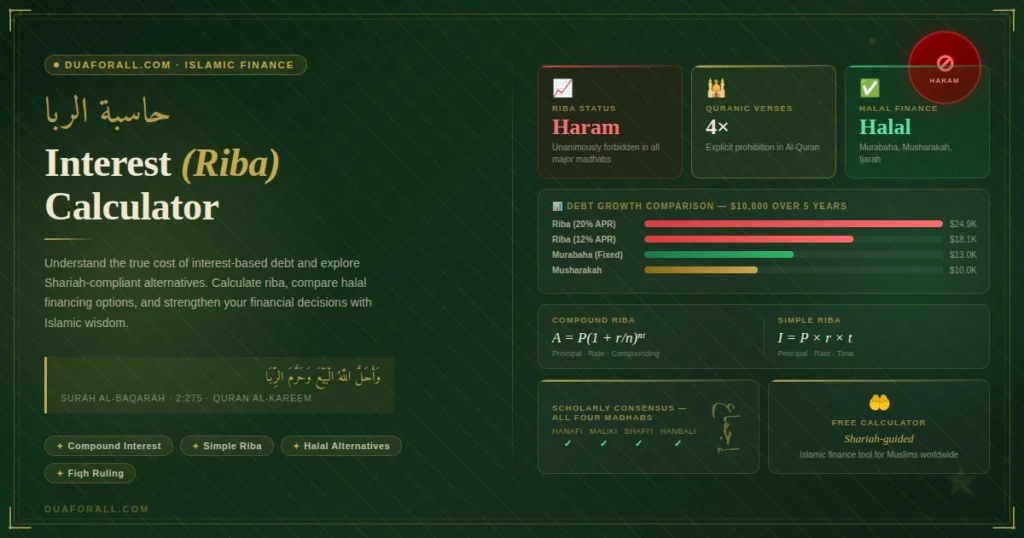
Interest (Riba) Calculator
حاسبة الربا — اعرف كم تدفع من فائدةCalculate simple interest, compound interest, and loan amortization — and understand the true cost of Riba (interest) from an Islamic finance perspective. Trusted by Muslims worldwide.
Advanced Interest (Riba) Calculator
Select a calculator mode below. All calculations are instant and show both financial totals and the hidden cost of interest over time.
What is Riba (ربا)? A Comprehensive Guide
Understanding the Islamic concept of interest and why Allah ﷻ prohibited it for the benefit of all mankind.
Definition of Riba in Islam
Riba (ربا) is an Arabic word literally meaning “increase,” “addition,” or “growth.” In Islamic jurisprudence (fiqh), it refers to any predetermined, guaranteed surplus charged on a loan or debt transaction — what modern economies call interest or usury.
The prohibition of Riba is one of the most emphatic commandments in the Quran, mentioned in no fewer than four separate Surahs (2, 3, 4, and 30), and was universally confirmed by the Prophet Muhammad ﷺ in multiple authentic Hadith.
Unlike modern secular economists who distinguish between “acceptable” and “excessive” interest, Islamic scholars hold that any amount of Riba — no matter how small — is forbidden. The distinguishing factor is that the lender bears no risk; profit without risk is the hallmark of Riba.
Key Characteristics of Riba
- ✦ Predetermined, fixed return regardless of outcome
- ✦ Lender bears no commercial risk
- ✦ Money generates money without productive activity
- ✦ Exploitative when borrower is in need
- ✦ Creates wealth concentration without value creation
Types of Riba in Islamic Law
Islamic scholars have categorised Riba into two major types, each with distinct rulings and subcategories.
Riba al-Nasi’ah (ربا النسيئة)
Also called Riba al-Quran (the Riba forbidden by the Quran), this is the most common form — interest charged for the deferral of repayment. Any surplus amount stipulated over and above the principal as a condition of giving time for repayment.
Modern equivalents: Bank loans, credit card interest, personal finance charges, conventional mortgages, overdraft fees, and any fixed-rate lending.
⚠️ Consensus: Categorically Haram by all four major madhabs
Riba al-Fadl (ربا الفضل)
Also called Riba al-Hadith (the Riba forbidden by Hadith), this refers to the unequal exchange of the same commodity — e.g., trading 1kg of gold for 1.2kg of gold, or $100 for $110 cash. The surplus constitutes Riba even in spot transactions.
Modern equivalents: Currency trading with unequal exchange, certain commodity futures, premium note exchanges, and discount rate arbitrage in some currency swaps.
⚠️ Consensus: Haram — Prophet ﷺ explicitly prohibited in Sahih Muslim 1587
“The prohibition of Riba in Islam is not merely a financial regulation — it is a comprehensive moral, social, and economic framework designed to prevent exploitation, ensure equitable distribution of wealth, and align economic activity with productive, real-economy outcomes.”
Riba vs Halal Finance — Infographic
A visual comparison of how interest-based finance and Islamic finance differ in structure and outcome.
🔄 How Riba Compounds: The Debt Cycle
⚖️ Conventional Banking vs Islamic Finance — Side by Side
Halal Alternatives to Interest-Based Finance
Islam does not prohibit commerce or profit — only guaranteed, risk-free returns. These Sharia-compliant instruments replace Riba with equitable arrangements.
Murabaha
The bank purchases an asset and sells it to the customer at a declared mark-up, paid in instalments. No interest — the profit is on the trade. Common for home, car, and equipment financing.
Diminishing Musharakah
The bank and customer jointly own a property. The customer buys the bank’s share gradually while paying rent for the bank’s portion. Used by major Islamic home finance providers globally.
Sukuk (Islamic Bonds)
Asset-backed certificates representing ownership in a tangible asset or business venture. Returns come from asset profits, not predetermined interest. A $4.5 trillion global market.
Mudarabah
A profit-sharing contract: one party provides capital, the other provides expertise and management. Profits are shared at an agreed ratio; losses fall on the capital provider only.
Ijara (Islamic Leasing)
Similar to leasing — the bank buys an asset and leases it to the customer. The customer pays rent, not interest. Ownership may transfer at the end of the lease term.
Takaful (Islamic Insurance)
Mutual risk-sharing arrangement where participants contribute to a pool. Surplus is redistributed to participants — replacing conventional interest-earning insurance.
| Feature | Conventional Loan | Murabaha | Diminishing Musharakah |
|---|---|---|---|
| Return Basis | Fixed Interest (Riba) | Trade Markup (Profit) | Rent + Equity Purchase |
| Sharia Compliant | ✗ Haram | ✓ Halal | ✓ Halal |
| Risk Sharing | ✗ None | ✓ Partial | ✓ Full |
| Asset Required | ✗ No | ✓ Yes | ✓ Yes |
| Global Availability | Universal | 70+ countries | 40+ countries |
| Common Use Case | Mortgage, Car, Personal | Home, Vehicle, Equipment | Home Purchase |
Evidence from Quran, Sunnah & Islamic Scholarship
The prohibition of Riba is among the most thoroughly documented rulings in Islamic law, confirmed by Quran, authentic Hadith, and unanimous scholarly consensus (Ijma’).
Unanimous Scholarly Position (Ijma’)
All four major Sunni schools of jurisprudence — Hanafi, Maliki, Shafi’i, and Hanbali — are in complete agreement that Riba al-Nasi’ah (interest on loans) is absolutely forbidden. This unanimity is one of the strongest possible legal certifications in Islamic law, known as Ijma’ al-Ummah.
Modern Islamic Finance institutions including the AAOIFI (Accounting and Auditing Organisation for Islamic Financial Institutions), the Islamic Fiqh Academy (OIC), and the Sharia boards of HSBC Amanah, Standard Chartered Saadiq, and Dubai Islamic Bank all reaffirm this prohibition in their contemporary fatawa.
Notable scholars including Sheikh Yusuf al-Qaradawi, Dr. Wahbah al-Zuhayli, Mufti Taqi Usmani, and Dr. Muhammad Imran Usmani have written extensively confirming that conventional bank interest in all its forms constitutes Riba.
“The prohibition of Riba is absolute, and there is no distinction in the Sharia between a small and a large rate of interest. What the Quran has prohibited is the very concept of a guaranteed, predetermined excess over the principal, regardless of the commercial context in which it arises.”
More Free Islamic Finance Tools
Zakat Calculator
Calculate your annual Zakat on gold, savings, trade goods, and investments.
Inheritance Calculator
Distribute estate assets according to Quranic Mirath (inheritance) rules.
Prayer Times
Accurate Salah times for any city in the world using astronomical calculations.
Hijri Converter
Convert between Gregorian and Islamic Hijri calendar dates instantly.
Riba FAQs — Answered by Islamic Scholarship
Common questions Muslims ask about interest, banking, and Sharia-compliant finance.
Yes. The overwhelming scholarly consensus — including the Islamic Fiqh Academy (OIC), AAOIFI, and major Islamic universities — is that conventional bank interest in all its forms constitutes Riba and is therefore forbidden. Some contemporary scholars debated this in the early 20th century, but this minority position has been largely superseded. Whether the rate is 1% or 20%, fixed or variable, the legal ruling remains the same: it is Riba and therefore Haram.
Islamic scholars apply the principle of Darura (necessity) — that in cases of genuine unavoidable hardship, one may be temporarily permitted what is otherwise forbidden. However, scholars are strict in defining what constitutes real necessity. Most contemporary scholars do not consider buying a home through conventional mortgage a necessity when halal alternatives exist (Guidance Residential, UIF, Devon Bank in the USA; Al Rayan Bank in the UK, etc.). One should exhaust all halal options, seek formal Islamic finance, and if genuinely no alternative exists, consult a qualified Islamic scholar for a ruling specific to their situation.
Yes — receiving Riba is as forbidden as paying it. The Hadith in Sahih Muslim (1598) explicitly states that the Prophet ﷺ cursed both “the one who consumes Riba AND the one who pays it.” Muslims with conventional savings accounts should either move to an Islamic savings account (available at many banks globally) or, if they receive interest, donate it to charity (without expecting any spiritual reward from the donation, as it is tainted wealth). Simply spending the interest or keeping it is not permissible.
The difference lies in the legal structure and economic principle, not necessarily the final number. In Islamic finance, you are buying an asset at a disclosed price (Murabaha) or co-owning it (Musharakah) — not borrowing money at interest. The prohibition of Riba is about the nature of the contract, not the amount. Additionally, Islamic finance structures share risk between parties, link returns to real economic activity, prohibit speculation (Gharar), and forbid financing Haram industries — creating a fundamentally different economic ecosystem regardless of comparable pricing.
Scholars differ on this. The dominant opinion is that using a credit card is permissible if one pays the full balance before any interest is charged, as no Riba is actually incurred. However, one must be extremely disciplined, as missing a payment results in Riba. Some scholars dislike it due to the risk involved and because signing the credit agreement involves agreeing to pay Riba in case of default — a contractual condition that itself may be problematic. Many recommend Islamic credit alternatives like debit cards, prepaid cards, or Islamic charge cards where available.
Leading Islamic finance institutions include: Al Rajhi Bank (Saudi Arabia — world’s largest Islamic bank), Dubai Islamic Bank (UAE), Meezan Bank (Pakistan), Kuwait Finance House (Kuwait), Bank Islam Malaysia (Malaysia), Al Rayan Bank (UK — FSA-regulated), Guidance Residential & UIF Corporation (USA — home finance), Abu Dhabi Islamic Bank (ADIB) (UAE), and Ameen Housing (USA). For a comprehensive list, consult the AAOIFI directory or the Islamic Financial Services Board.
Further Reading & Official References
AAOIFI — Accounting & Auditing Organisation for Islamic Financial Institutions
The global standard-setter for Islamic financial institutions. Home of Sharia standards governing Murabaha, Sukuk, and Islamic banking globally.
Regulatory BodyIFSB — Islamic Financial Services Board
Promotes and enhances the soundness and stability of Islamic financial institutions across banking, capital markets, and Takaful.
Academic ResearchIslamic Economics Research — Al-Kantakji Centre
A leading academic centre publishing research on Islamic economics, Riba prohibition, and Sharia-compliant finance alternatives.
Disclaimer: This calculator is for educational and informational purposes only. It does not constitute a fatwa or formal Islamic legal ruling. For binding Islamic legal opinions regarding your specific financial situation, please consult a qualified Islamic scholar or an accredited Sharia advisory board. All calculations assume standard mathematical formulas. | Privacy Policy | About Us