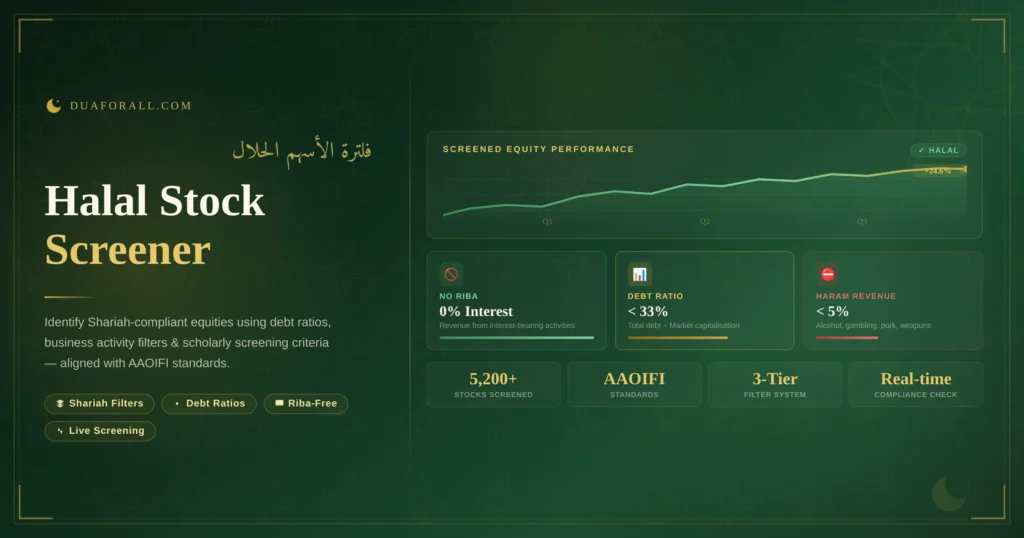
Free Halal Stock Screener
for Muslim Investors
Screen thousands of equities against Islamic Shariah principles. Filter by debt ratios, haram income thresholds, business activity, and sector — powered by AAOIFI and Dow Jones Islamic Market Index standards.
Advanced Halal Stock Screener
Apply Shariah-compliant filters and instantly see which stocks pass Islamic finance screening criteria based on globally recognized standards.
Stock Screener
🕌 Shariah Screening Active| Company | Sector | Price | Debt Ratio | Haram Inc. | Score | Status |
|---|
⚠️ Investment Disclaimer
This Halal Stock Screener is provided for informational and educational purposes only. It does not constitute financial or religious advice. Shariah compliance status may change as company financials are updated. Always verify compliance with a qualified Islamic finance scholar or a certified Shariah supervisory board before investing. Past performance is not indicative of future results.
Understanding Halal Investing
Comprehensive infographics explaining Shariah screening standards, sector classifications, and financial ratio thresholds used by major Islamic finance indices.
The 4 Pillars of Shariah Stock Screening
Islamic equity screening follows a two-tier approach: business activity screening (qualitative) followed by financial ratio screening (quantitative).
Business Activity Screen
Companies must derive no significant revenue from alcohol, tobacco, pork, gambling, adult entertainment, conventional banking, insurance, or weapons manufacturing.
Haram Revenue < 5% of TotalDebt Ratio Screen
Total interest-bearing debt must not exceed a defined percentage of the company's total assets or market capitalization to avoid excessive leverage (riba).
Total Debt / Assets < 33%Cash & Liquid Assets
The sum of cash and interest-bearing securities held by the company should not dominate its asset base, limiting exposure to riba-based instruments.
Cash + Securities / Assets < 33%Accounts Receivable
Accounts receivable and trade notes should not form the majority of a company's total assets, preventing valuation concerns in secondary market trading.
Receivables / Assets < 49%Sector Halal Classification Guide
Sector-level Shariah compliance overview. Mixed sectors require deeper stock-level screening. Always verify individual company financials.
Financial Ratio Thresholds by Standard
Different Islamic finance standards use slightly different thresholds. The AAOIFI standard is the strictest and most globally accepted by Shariah scholars.
Our Screening Methodology
A transparent, scholar-reviewed 5-step process aligned with international Islamic finance standards.
Universe Definition & Data Collection
We begin with the full universe of publicly traded equities across major global exchanges (NYSE, NASDAQ, LSE, TSX, ASX). Financial data — including total assets, total debt, cash holdings, accounts receivable, and revenue segments — is sourced from audited annual reports and verified financial data providers.
Business Activity (Qualitative) Screen
Each company's primary and secondary revenue streams are analyzed. Stocks are excluded if they derive more than 5% of total revenue from impermissible (haram) activities: alcohol, tobacco, pork products, adult entertainment, gambling/gaming, conventional banking & insurance, and weapons manufacturing — as defined by AAOIFI Shariah Standard No. 21.
Financial Ratio (Quantitative) Screen
Stocks passing the activity screen are then subjected to three financial ratio tests: (1) Total debt-to-total assets must not exceed 33%, (2) Total cash plus interest-bearing securities-to-total assets must not exceed 33%, and (3) Accounts receivable-to-total assets must not exceed 49%. These thresholds align with AAOIFI, MSCI, and S&P Shariah standards.
Compliance Scoring & Rating Assignment
Stocks are assigned a proprietary Shariah Compliance Score (0–100) based on how comfortably they meet each criterion — not merely whether they pass or fail. Stocks are then labeled Compliant (score ≥ 70), Monitor (score 40–69 — borderline ratios requiring quarterly review), or Non-Compliant (score < 40).
Purification Calculation (Tazkiyah)
For compliant stocks that have minor incidental non-permissible income, we calculate a purification ratio — the percentage of dividends or profits that should be donated to charity (sadaqah) to cleanse the investment. This is consistent with the scholarly consensus on tazkiyah al-maal as described by contemporary Islamic finance jurists.
Halal Investing: A Comprehensive Guide for Muslim Investors
Halal investing — also referred to as Islamic finance investing, Shariah-compliant investing, or ethical Muslim investing — is the practice of building an investment portfolio that adheres to the principles of Islamic law (Shariah). For Muslims worldwide, aligning one's financial life with Islamic values is not a cultural preference but a spiritual obligation.
The global Islamic finance industry has grown to over $4 trillion in assets as of 2024 (Islamic Financial Services Board, 2024), reflecting the massive and underserved demand among the world's 1.9 billion Muslim population for Shariah-compliant financial products.
"O you who have believed, do not consume usury, doubled and multiplied, but fear Allah that you may be successful."
— Quran 3:130 | The prohibition of riba (interest) is the foundational principle of Islamic finance.What Makes a Stock Halal?
A stock is considered halal when the underlying company's business operations, revenue sources, and financial structure comply with Shariah principles. The key conditions for halal stock investing include:
- Permissible business activity: The company must not be primarily engaged in industries classified as haram (forbidden) under Islamic law, including conventional interest-based banking, alcohol, pork, gambling, adult entertainment, tobacco, and weapons.
- Acceptable financial leverage: The company's interest-bearing debt should not constitute an excessive portion of its asset base, limiting riba-based obligations.
- Limited interest income: Any incidental interest income (e.g., from cash held in conventional bank accounts) must be minimal and below defined thresholds.
- Purification of impure income: When a compliant stock has minor non-permissible income, the investor must purify (tazkiyah) that portion of their returns through charitable donation (sadaqah).
The Academic Foundation of Shariah Screening
Contemporary Islamic equity screening is grounded in centuries of Islamic jurisprudence (fiqh), particularly the scholarship of Imam Ibn Taymiyyah, Imam Ibn al-Qayyim, and modern-day jurists such as Sheikh Yusuf al-Qaradawi and Dr. Muhammad Imran Ashraf Usmani. The formal systematization of Shariah stock screening for modern capital markets began with the establishment of the Accounting and Auditing Organization for Islamic Financial Institutions (AAOIFI) in 1991.
Key academic milestones include the 1990 ruling by the Fiqh Council of the Organisation of Islamic Cooperation (OIC) permitting stock ownership under conditions, and the subsequent development of Shariah screening indices by Dow Jones in 1999 (Dow Jones Islamic Market Index), followed by the FTSE Shariah index and MSCI Islamic indices.
Why Halal Investing Is Not Just for Muslims
Shariah-compliant investing shares significant overlap with ESG (Environmental, Social, and Governance) investing and socially responsible investing (SRI). Research published in the Journal of Banking & Finance (Renneboog et al., 2008) demonstrates that screens excluding harmful industries and excessive leverage often result in portfolios with lower volatility and comparable long-term returns.
A landmark study by the Islamic Financial Services Board (IFSB) found that Islamic equity indices demonstrated greater resilience during the 2008 global financial crisis, largely due to their exclusion of heavily leveraged financial sector stocks.
Halal Alternatives to Common Investment Types
Islamic REITs (Real Estate Investment Trusts)
Shariah-compliant REITs invest in permissible real estate (excluding liquor stores, casinos, hotels with alcohol, etc.) and must not use excessive debt financing. They represent an excellent halal alternative for real estate exposure.
Sukuk (Islamic Bonds)
Unlike conventional bonds, sukuk are asset-backed certificates representing ownership in a tangible asset or project, generating returns from asset performance rather than interest. The global sukuk market exceeded $800 billion in 2023.
Halal ETFs and Index Funds
Several asset managers now offer Shariah-compliant ETFs, including the Wahed FTSE USA Shariah ETF (HLAL), SP Funds S&P 500 Sharia Industry Exclusions ETF (SPUS), and iShares MSCI World Islamic ETF. These provide diversified halal exposure with lower individual stock selection risk.
The Role of Purification (Tazkiyah al-Maal)
Even when a company passes Shariah screening, it may have a small percentage of impermissible income (e.g., incidental interest on cash deposits). Islamic scholars have agreed that investors must calculate and donate (as sadaqah) a proportional amount of their income or profits — this is known as tazkiyah or purification. Most major Shariah supervisory boards publish annual purification ratios for listed equities.
📚 Academic References & Authoritative Sources
- AAOIFI (2021). Shariah Standards for Islamic Financial Institutions. Standard No. 21: Financial Papers (Shares and Bonds). aaoifi.com
- Islamic Financial Services Board (2024). Islamic Financial Services Industry Stability Report. ifsb.org
- Renneboog, L., Ter Horst, J., & Zhang, C. (2008). Socially responsible investments: Institutional aspects, performance, and investor behavior. Journal of Banking & Finance, 32(9), 1723–1742.
- Derigs, U., & Marzban, S. (2008). Review and analysis of current Shariah-compliant equity screening practices. International Journal of Islamic and Middle Eastern Finance and Management, 1(4), 285–303.
- S&P Dow Jones Indices (2023). S&P Shariah Indices Methodology. spglobal.com
- MSCI (2023). MSCI Islamic Index Series Methodology. msci.com
Islamic Finance Authority & Scholarship
Our screening criteria are grounded in the scholarly opinions of leading contemporary Islamic finance jurists and global Shariah supervisory boards.
Dr. Muhammad Imran Ashraf Usmani
Author of foundational works on Islamic finance & equity investment permissibility.
Sheikh Yusuf al-Qaradawi
Instrumental in establishing the permissibility of stock market investment under Shariah conditions.
Sheikh Nizam Yaquby
Member of numerous global Shariah supervisory boards; contributor to MSCI Islamic index methodology.
Dr. Mohammed Obaidullah
Author of Islamic Financial Services; key researcher on Shariah equity screening quantitative standards.
Frequently Asked Questions
Answers to the most common questions about halal stock screening, Shariah-compliant investing, and how to use this tool.
Invest With Confidence & Conscience
Our Halal Stock Screener is completely free to use. Bookmark this page, share it with your Muslim community, and make your investments count — both financially and spiritually.