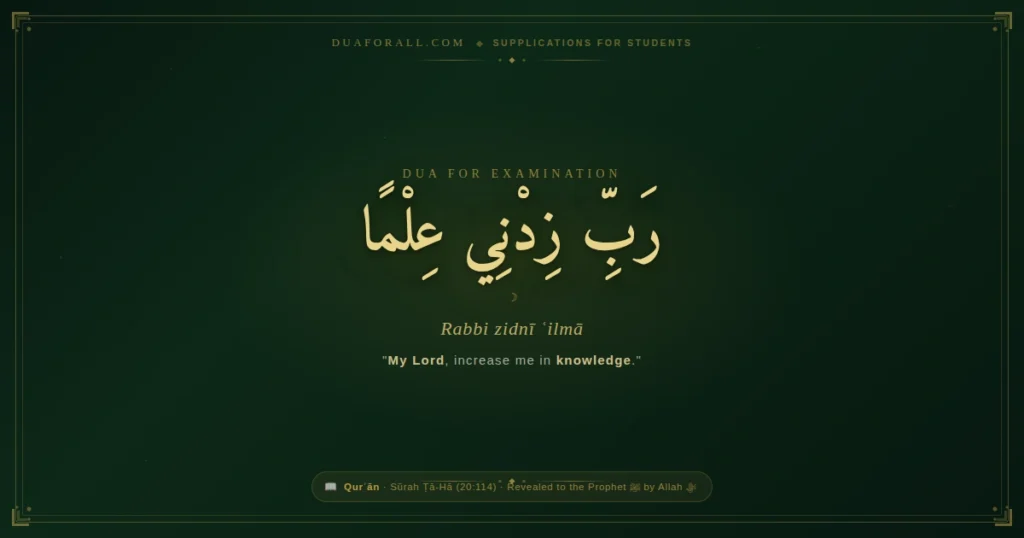
Dua for Examination
Success & Knowledge
Authentic duas from the Quran and Sunnah to ease exam anxiety, sharpen your memory, and seek Allah’s guidance before, during, and after every test.
رَبِّ زِدْنِي عِلْمًا“My Lord, increase me in knowledge.” — Quran 20:114
Why Muslims Make Dua Before Examinations
In Islam, knowledge (ʻilm) is one of the greatest gifts Allah has bestowed upon humanity. The very first word revealed in the Quran was Iqra — “Read.” Seeking knowledge is an act of worship, and turning to Allah in dua before and during your examinations is a sign of tawakkul (reliance on Allah) — not weakness, but profound wisdom.
Exams can bring stress, sleeplessness, and self-doubt. Islam’s prescription is beautiful in its completeness: pair your sincere study effort (asbāb) with heartfelt supplication (dua). The Prophet ﷺ said: “Tie your camel, then put your trust in Allah” — meaning: do your part, then rely on Allah for the rest.
The duas on this page are sourced directly from the Quran and authenticated hadiths. They ask Allah to expand your chest (open your heart and mind), ease difficulty, increase knowledge, and grant you clarity — exactly what every student needs.
Hadith on Seeking Knowledge
The Prophet Muhammad ﷺ said: “Seeking knowledge is an obligation upon every Muslim.” (Sunan Ibn Majah, 224) — Your examination is part of your greater journey of learning. Every dua you make honours this obligation.
6 Authentic Duas for Examination Success
Each dua below comes with its full Arabic text, transliteration, English translation, and verified hadith or Quranic source.
Dua for Increase in Knowledge
Quranic Dua — Most Essential for StudentsTransliteration
Rabbi zidnī ʻilmā
Translation
“My Lord, increase me in knowledge.”
📖 Quran · Surah Ta-Ha 20:114Dua of Musa (AS) — For Clarity & Eloquence
Quranic Dua — Perfect Before Exams & PresentationsTransliteration
Rabbi ish-raḥ lī ṣadrī, wa yassir lī amrī, waḥ-lul ʻuqdatan min lisānī yafqahū qawlī
Translation
“My Lord, expand for me my chest [with assurance], ease for me my task, and untie the knot from my tongue so that they may understand my speech.”
📖 Quran · Surah Ta-Ha 20:25–28Dua to Make Difficult Things Easy
Ibn Hibban · Hadith 974Transliteration
Allāhumma lā sahla illā mā jaʻaltahu sahlā, wa anta tajʻalul ḥazna idhā shiʼta sahlā
Translation
“O Allah, there is no ease except in that which You have made easy, and You make the difficulty, if You wish, easy.”
📚 Ibn Hibban · Hadith 974Dua Before Studying — For Beneficial Knowledge
Sunan Ibn Majah · Hadith 251Transliteration
Allāhumma infaʻnī bimā ʻallamtanī, wa ʻallimnī mā yanfaʻunī, wa zidnī ʻilmā
Translation
“O Allah, benefit me with what You have taught me, teach me what will benefit me, and increase me in knowledge.”
📚 Sunan Ibn Majah · Hadith 251Dua to Relieve Anxiety & Exam Stress
Sahih Bukhari · Hadith 6369Transliteration
Allāhumma innī aʻūdhu bika minal-hammi wal-ḥazan, wal-ʻajzi wal-kasal, wal-bukhlī wal-jubn, wa ḍalaʻid-dayn, wa ghalabatr-rijāl
Translation
“O Allah, I seek refuge in You from worry and grief, from incapacity and laziness, from cowardice and miserliness, from being heavily in debt and from being overpowered by men.”
📚 Sahih Bukhari · Hadith 6369Dua of Tawakkul — After Completing the Exam
Quran · Surah At-Tawbah 9:129Transliteration
Ḥasbiyallāhu lā ilāha illā huwa, ʻalayhi tawakkaltu, wa huwa rabbul-ʻarshil-ʻaẓīm
Translation
“Allah is sufficient for me; there is no deity except Him. On Him I have relied, and He is the Lord of the Great Throne.”
📖 Quran · Surah At-Tawbah 9:129Best Times to Make Dua for Examination
Certain moments carry elevated acceptance for duas. Plan your supplications around these blessed windows for maximum spiritual impact.
⭐ The Blessed Hours — When Duas Are Most Accepted
Schedule your exam duas during these powerful windows of divine acceptance
Complete Islamic Examination Preparation Guide
A holistic approach combining spiritual practice with effective study habits — the way of the students of knowledge throughout Islamic history.
The Night Before — Tahajjud & Rest
Pray Tahajjud (night prayer) if you are able — the last third of the night is when Allah is most near to His servants. Make extended dua, asking for ease and clarity. Then sleep early; rest is a Sunnah of the Prophet ﷺ. Avoid all-night cramming sessions, as they cloud the mind and weaken focus.
Exam Morning — Fajr, Dhikr & Dua
Begin with Fajr salah. After salah, recite your morning adhkar and the duas on this page. Have a halal breakfast and leave early — punctuality is part of your preparation. On your way, continue making dua quietly in your heart.
Entering the Exam Hall — Bismillah & Dua of Musa
Say Bismillah as you enter. Silently recite Dua #2 (the Dua of Musa AS) asking Allah to expand your chest, ease your task, and clarify your speech. Place your trust in Allah, breathe, and begin with calm focus.
During Difficult Questions — Dua #3
When you encounter a hard question, pause briefly and silently recite Dua #3 — “O Allah, there is no ease except what You make easy.” Then attempt the question with full effort. If you still struggle, move on and return later — this too is a Sunnah of wisdom.
After Submitting — Tawakkul & Gratitude
Once you submit, recite Dua #6 (the Tawakkul dua) and thank Allah for the ability to have studied and sat the exam. Make shukr (gratitude). Whatever the outcome, it is Allah’s decree — and the believer’s attitude towards both success and difficulty is one of profound beauty.
Adab (Etiquettes) of Making Dua for Exams
The Prophet ﷺ taught us that dua has conditions that increase its likelihood of acceptance. Here are the key etiquettes to observe.
✨ 7 Keys to an Accepted Dua
Follow the prophetic etiquettes to strengthen your supplications
Important Note on Effort & Dua
Islam teaches us to combine effort (asbāb) with supplication (dua). Making dua while neglecting to study is not tawakkul — it is wishful thinking. The Prophet ﷺ told a man who left his camel without tying it: “First tie it, then put your trust in Allah.” Study diligently, then supplement your preparation with sincere dua.
🔗 DuaForAll Library
Explore More Duas & Islamic Guides
Deepen your spiritual practice with our comprehensive collection of verified duas and Islamic resources.
Frequently Asked Questions
Answers to the most common questions Muslims have about making dua for examinations.
The most recommended dua for exams is Rabbi zidnī ʻilmā (Quran 20:114) — “My Lord, increase me in knowledge.” It is directly Quranic and concise enough to recite repeatedly. Combine it with the Dua of Musa (AS) from Surah Ta-Ha for a powerful combination of requesting knowledge and mental clarity.
Yes, absolutely. You can silently make dua to Allah in your heart at any time — there is no restriction on the language, location, or time of dua. During your exam, quietly repeat Dua #3 (“O Allah, there is no ease except what You make easy”) when facing a difficult question, and Dua #1 (Rabbi zidni ilma) throughout. Visit our Masnoon Duas collection for more.
While there is no single hadith specifying a dua exclusively for memory, scholars recommend: (1) Recite Dua #4 above (Allāhumma infaʻnī bimā ʻallamtanī) regularly; (2) Recite Ayat al-Kursi each morning; (3) Avoid sins, as Imam Shafiʻi noted sins harm memory; (4) Maintain wudu during study. Visit our Prayers for Wisdom & Knowledge page for a complete guide.
There is no fixed number required for most of these duas — you may recite them as often as you feel the need. The Tawakkul dua (Dua #6) is recommended to be recited 7 times in the morning and evening. The best approach is to recite each dua with presence of heart (khushuʻ) rather than rapidly for a high count without reflection. Quality of supplication outweighs quantity.
This is a profound question. Islamic theology teaches that every sincere dua is accepted by Allah, but in one of three ways: (1) What you asked for is granted; (2) A harm that would have befallen you is averted instead; (3) The reward is stored for you in the Hereafter. A difficult exam result may hold wisdom you don’t yet see. Trust Allah’s decree with patience. See our Duas for Success page for more on this topic.
Absolutely — the dua of a parent for their child is among the most powerful supplications in Islam. The Prophet ﷺ said that three supplications are answered without doubt: the dua of the oppressed, the dua of the traveller, and the dua of the parent for their child (Sunan Ibn Majah, 3862). Parents should use all the duas on this page when supplicating for their children. See our dedicated Duas for Children collection.
External Scholarly Resources
Verified references from leading Islamic scholarship to deepen your understanding of dua and the Islamic approach to seeking knowledge.
- Sunan Ibn Majah — Hadith on Seeking Knowledge (Sunnah.com)
- Surah Ta-Ha 20:114 — “Rabbi Zidni Ilma” (Quran.com)
- Sahih Bukhari 6369 — Dua for Relief from Anxiety (Sunnah.com)
- IslamQA — Duas and Etiquettes for Studying (IslamQA.info)
- SeekersGuidance — The Complete Etiquette of Dua
- Yaqeen Institute — Research on the Power of Dua
- IslamWeb — Scholarly Fatawa on Dua for Students
Explore Our Full Dua Collection
500+ verified duas for every situation in a Muslim’s life — all with Arabic, transliteration, translation, and sources.