Dua for Waswasa — Remove Bad & Intrusive Thoughts Islamically
If you’re looking for a dua for waswasa — the unsettling whispers Shaytan plants in the heart — you’ve come to the right place. This comprehensive guide brings together every authentic waswasa dua and bad thoughts dua prescribed by the Prophet ﷺ, drawn directly from the Quran and verified hadith collections. Whether you need a dua to get rid of bad thoughts, a dua to stop bad thoughts in their tracks, a dua for OCD and intrusive thought cycles, a dua for waswasa and overthinking, or the waswasa ki dua you may have heard from family elders — all of it is here. Looking for a dua to protect from bad thoughts, a dua to remove negative thoughts, or even a dua to stop watching bad things? This guide covers every angle, with Arabic text, transliteration, full translation, and source reference, so you can recite with confidence and sincerity.
What Is Waswasa (وَسْوَسَة) in Islam?
Every Muslim — at some point — experiences what the Quran calls waswasa (وَسْوَسَة): unsettling, intrusive thoughts that whisper doubts, fears, or temptations into the heart. These are not a sign of weak faith. Quite the opposite — the Prophet Muhammad ﷺ told his Companions that experiencing waswasa is itself proof of iman (faith), because Shaytan does not trouble hearts that are already far from Allah.
Islam provides a complete framework for understanding and eliminating these thoughts — not through suppression or anxiety, but through the powerful weapon of dua, dhikr, and turning to Allah with trust and sincerity. Many Muslims search for a dua for intrusive thoughts without realising that Islam has already addressed this with profound specificity — and that simply knowing the right dua to remove bad thoughts can transform your entire relationship with these whispers. Others come looking for a dua to remove dirty thoughts from mind or a dua for evil thoughts that feel shameful and difficult to speak of. Know that the Prophet ﷺ himself was asked about exactly this — and his answer was one of mercy and reassurance.
Whether you are searching for a dua to protect from bad thoughts, a dua against bad thoughts, a dua to get rid of negative thoughts, or a dua to remove evil thoughts that have taken hold — this guide has you covered with authentic Prophetic prescriptions for every situation. The Arabic term waswas (وَسْوَاس) refers to the whispering entity itself, while waswasa describes the whisper — both are addressed here, so whether you are looking for a waswas dua or a dua for waswasa, the Prophetic remedy is one and the same.
“Some of the Companions came to the Prophet ﷺ and said: We find in ourselves thoughts that are too grave to speak of. He said: Do you really experience that? They said: Yes. He said: That is clear faith.”
Key Insight: Waswasa Is Not Sin
Islamic scholars unanimously agree that a thought which crosses the mind — without being acted upon or entertained — carries no sin. The Prophet ﷺ said: “Allah has pardoned for my Ummah what is whispered in their hearts, as long as they do not act upon it or speak of it.” (Bukhari 5269, Muslim 127) The dua below helps you actively repel these whispers before they take hold.
3 Types of Bad Thoughts in Islamic Understanding
Not all intrusive thoughts are the same. Scholars of Islam categorise waswasa into three primary types, each requiring a slightly different approach. Identifying which source your waswasa comes from is the first step toward choosing the right dua to get rid of unwanted thoughts — and reclaiming your peace of heart. For every type, the goal is the same: to make those bad thoughts go away with the dua the Prophet ﷺ prescribed, and to return the heart to its natural state of clarity and trust in Allah.
From Shaytan
Doubts about faith, Allah’s existence, or the permissibility of acts. Repelled by Ta’awwudh and turning to Allah.
From the Nafs
Desires, ego-driven whispers, and anger. Repelled through fasting, reflection, and purifying the heart.
From the World
Anxious thoughts about wealth, status, and dunya matters. Repelled by tawakkul (reliance on Allah).
Essential Duas for Removing Bad Thoughts
These supplications are sourced directly from the Quran and authentic hadith collections — representing the most powerful dua for waswasa that Islamic tradition has prescribed across fourteen centuries. Recite them with presence of heart and sincere reliance upon Allah ﷻ.
Ta’awwudh — The Primary Refuge from Shaytan
A’ūdhu billāhi min ash-shayṭāni ar-rajīm
“I seek refuge in Allah from the accursed Shaytan.”
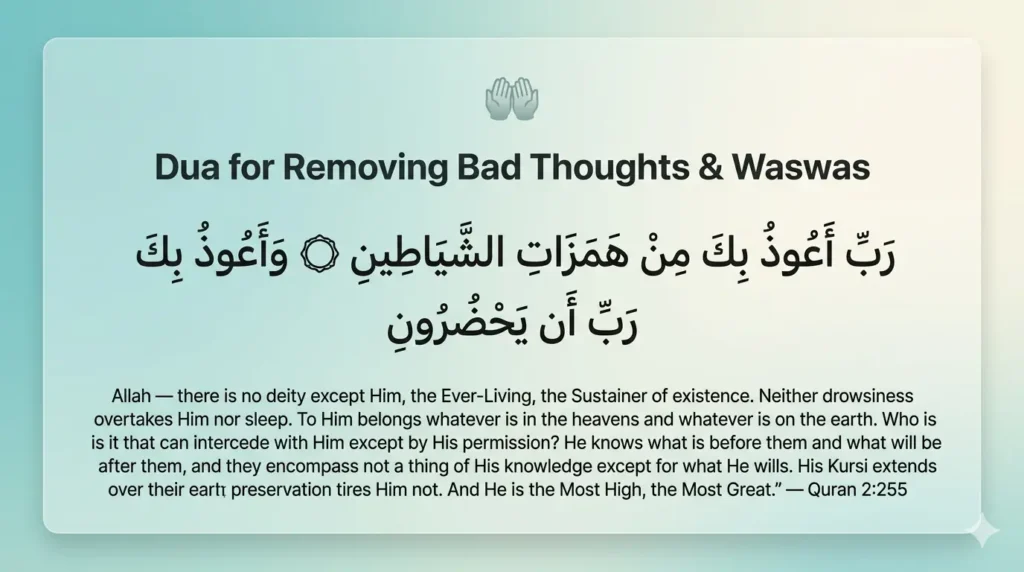
Dua of the Prophets — Seeking Refuge from Shaytan’s Whispers
Rabbi a’ūdhu bika min hamazātish-shayāṭīn · wa a’ūdhu bika rabbi an yaḥḍurūn
“My Lord, I seek refuge with You from the prompting of the devils. And I seek refuge with You, my Lord, lest they come to me.”
Surah An-Nas — The Complete Shield Against Whispers
Qul a’ūdhu bi-rabbin-nāsi · Malikin-nāsi · Ilāhin-nāsi · Min sharril-waswāsil-khannās · Alladhī yuwaswisu fī ṣudūrin-nāsi · Minal-jinnati wan-nās
“Say: I seek refuge in the Lord of mankind, the King of mankind, the God of mankind — from the evil of the retreating whisperer, who whispers into the hearts of mankind — from the jinn and mankind.”
Dua to Remove Negative Thoughts During Salah & Intrusive Thoughts in Prayer
Intrusive thoughts during salah are one of Shaytan’s primary tactics to distract believers. This section provides the authentic dua to remove negative thoughts during salah — the exact Prophetic method for silencing distractions in prayer instantly. For those experiencing a dua for OCD thoughts — particularly repetitive, distressing doubts that cycle during worship — the Prophet ﷺ gave direct and practical guidance on how to silence this immediately with a single supplication and a specific physical action.
Dua When Distracted in Salah — Spit Left & Seek Refuge
A’ūdhu billāhi min ash-shayṭāni ar-rajīm
“I seek refuge in Allah from the accursed Shaytan.” — The Prophet ﷺ instructed: when distracted in prayer, turn slightly to the left and spit (a dry spit, no saliva) three times, then recite this phrase, and Shaytan will be driven away. (Sahih Muslim 2203)
Imam Ahmad’s Advice on Waswas in Prayer
Imam Ahmad ibn Hanbal — when asked about persistent distraction in salah — said: “Ignore the thought entirely. Do not fight it — the fight itself distracts you further. Simply focus on the words of the prayer and the meaning will follow your intention.” Scholars have emphasised that deliberately engaging with waswasa, rather than dismissing it, only strengthens it.
Ayat al-Kursi — The Mightiest Protective Verse
Ayat al-Kursi (Quran 2:255) is the greatest verse in the Quran and the most powerful single shield against Shaytan and his whispers.
Ayat al-Kursi — The Throne Verse
“Allah — there is no deity except Him, the Ever-Living, the Sustainer of existence. Neither drowsiness overtakes Him nor sleep. To Him belongs whatever is in the heavens and whatever is on the earth. Who is it that can intercede with Him except by His permission? He knows what is before them and what will be after them, and they encompass not a thing of His knowledge except for what He wills. His Kursi extends over the heavens and the earth, and their preservation tires Him not. And He is the Most High, the Most Great.” — Quran 2:255
“Whoever recites Ayat al-Kursi when he goes to sleep, Allah will appoint a guardian over him and Shaytan will not come near him until morning.”
Daily Adhkar for Mental Clarity, Negative Thoughts & Protection
Beyond individual duas, the Prophet ﷺ prescribed a complete daily routine of dhikr and supplication that forms a protective barrier against waswasa and negative thoughts throughout the day. This daily practice is your most reliable dua for protection from bad thoughts — not just reactive, but preventative — building the spiritual shield before the whispers even arrive. Those looking for a dua to get rid of negative thoughts should begin here, because consistent daily adhkar treats the root, not just the symptom.
La Hawla wa La Quwwata — Dispelling Anxiety & Whispers
Lā ḥawla wa lā quwwata illā billāh
“There is no power and no strength except with Allah.” — This profound phrase acknowledges complete dependence on Allah and is described in hadith as a treasure of Paradise. It breaks the cycle of anxious, repetitive thoughts by redirecting the heart to its source of strength.
Morning Dua for Heart Purification & Guidance
Allāhumma innī a’ūdhu bika minal-hammi wal-ḥazan, wa a’ūdhu bika minal-‘ajzi wal-kasal
“O Allah, I seek refuge in You from anxiety and sorrow, and I seek refuge in You from incapacity and laziness.” — The Prophet ﷺ recited this supplication regularly. It directly addresses the anxious thought-cycles (hamm and hazan) that underlie persistent bad thoughts.
Hasbi Allah — Complete Trust in Allah
Ḥasbiyallāhu lā ilāha illā huwa, ‘alayhi tawakkaltu, wa huwa rabbul-‘arshil-‘aẓīm
“Sufficient for me is Allah; there is no deity except Him. Upon Him I have relied, and He is the Lord of the Great Throne.” — The Prophet ﷺ taught that whoever recites this seven times morning and evening, Allah will suffice him from whatever concerns him — including the overwhelming burden of bad thoughts. (Abu Dawud 5081)
Dua for OCD & Waswasa al-Qahri (Compulsive Overthinking)
In Islamic scholarship, waswasa al-qahri — compulsive, intrusive thought cycles that a person cannot stop — closely mirrors what modern psychology calls OCD (Obsessive Compulsive Disorder). If you are searching for a dua for OCD or a dua for waswasa and overthinking, know that Islamic tradition addresses this condition with specific Prophetic instruction that is both spiritually grounding and practically effective. The key distinction scholars make: waswasa of this type is not sin, and the person experiencing it bears no blame. The prescription, however, is clear and consistent.
“The Companions came to the Prophet ﷺ and said: We find in ourselves thoughts too grave to speak of. He said: Do you really experience that? They said: Yes. He said: That is clear faith — that you are troubled by them proves you reject them.”
The Prophetic Remedy for OCD-Style Waswasa
For intrusive, cycling thoughts that keep returning despite effort, the Prophet ﷺ prescribed a two-step response: (1) Declare “Āmantū billāh” (I believe in Allah) and immediately stop engaging with the thought — do not analyse, argue, or rationalise it. (Muslim 134) (2) Recite Ta’awwudh and move your attention to dhikr. Scholars stress that analysing or trying to “solve” an OCD-like thought is exactly what Shaytan wants — the dua for OCD works by disengagement, not debate.
Stop Engaging
The prophetic instruction is to stop entertaining the thought entirely. Engagement — even to refute it — feeds the cycle. This is the core of the dua for OCD method.
Say “Āmantū billāh”
Declare belief in Allah and end the internal dialogue. This single phrase, taught by the Prophet ﷺ, is the primary verbal response to OCD-like intrusive thoughts. (Muslim 134)
Replace With Dhikr
The mind cannot hold two competing thoughts simultaneously. Replacing the intrusive thought immediately with SubhanAllah or Alhamdulillah is the Islamic solution to overthinking spirals.
Don’t Fight — Float
Ibn al-Qayyim taught that fighting waswasa al-qahri only strengthens it. The Prophetic method is surrender to Allah — tawakkul — not mental combat. Your dua for waswasa and overthinking is this: trust Allah with the outcome and move on.
Seek Dual Support
If OCD thoughts are severe, persistent, or impair daily life, combining Islamic spiritual practice with professional Muslim counselling is the scholarly-endorsed approach. Dua and therapy work together.
Learn the Fiqh
Much OCD-like waswasa in worship (am I in wudu? did I say the right words?) is fuelled by uncertainty about Islamic rulings. Learning the basics of fiqh removes the soil in which these doubts grow.
Further Reading on OCD & Waswasa
SeekersGuidance — Scholarly guidance on obsessive waswasa ↗ | IslamQA — Compulsive waswasa in worship ↗
Dua to Stop Watching Bad Things — Guarding the Eyes from Haram
Many Muslims recognise that their bad thoughts are fuelled by what they consume visually — haram content, immodest imagery, or digital environments that weaken the heart. The Prophet ﷺ directly addressed the need to guard the senses, calling the eyes one of the arrows of Shaytan. If you are searching for a dua to stop watching bad things or a dua for protection from bad thoughts driven by visual fitnah, the following authentic supplication — combined with the spiritual discipline of lowering the gaze — is your Prophetically-prescribed starting point.
Dua for ‘Afaf — Chastity, Purity & Guarding the Senses
Allāhumma innī as’aluka al-hudā wat-tuqā wal-‘afāfa wal-ghinā
“O Allah, I ask You for guidance, God-consciousness, chastity (of the eyes and heart), and contentment.” — The word ‘afāf (عَفَاف) encompasses purity of the eyes, guarding the gaze, and freedom from immodesty and filth. This dua is the core Prophetic prayer for those who wish to stop watching bad things and protect their hearts from visual fitnah. Recite it morning and evening as part of your daily adhkar.
Why Visual Fitnah Fuels Waswasa
The Prophet ﷺ said: “The eyes commit zina and their zina is the forbidden look.” (Bukhari 6243) What we see enters the heart — and haram visual content directly feeds the cycle of intrusive, dirty thoughts. The dua to stop watching bad things works best when paired with practical action: lowering the gaze, adding website blockers, and filling idle time with Quran or dhikr. Ask Allah for ‘afaf daily, and He will make it easy. (Muslim 2721)
Step-by-Step: How to Get Bad Thoughts Out of Your Head Islamically
Follow this Prophetically-guided sequence whenever waswasa or intrusive thoughts arise — in or out of prayer. This is your complete, step-by-step dua to get bad thoughts out of head and dua for protection from bad thoughts, grounded entirely in the Sunnah of the Prophet ﷺ. Think of it as the definitive dua to get rid of waswasa: practised consistently, this sequence also becomes a preventative dua for avoiding bad thoughts and temptation before they even fully form — training the heart to avoid bad thoughts through reflex and remembrance rather than willpower alone.
Prophetic Guidance on Waswasa & Bad Thoughts
The Prophet Muhammad ﷺ addressed the issue of intrusive thoughts with profound wisdom and compassionate practical guidance. His teachings give us the most authentic dua to remove waswasa and the most reliable dua to protect from bad thoughts — not merely as words to recite, but as a complete and tested way of life. Each piece of Prophetic advice below also serves as a practical dua against bad thoughts: catch the whisper early, respond with remembrance, and trust Allah to drive it away before it takes hold.
Say “Āmantū billāh”
When doubts or shocking thoughts arise, the Prophet ﷺ instructed believers to declare “I believe in Allah” and stop engaging. (Muslim 134)
Make Wudu
Ritual purification refreshes the body and spiritual state, creating a physical break from the loop of intrusive thinking.
Recite Quran
The Prophet ﷺ said that Shaytan flees from the house in which Surah Al-Baqarah is recited. (Muslim 780)
Change Position
The Prophet ﷺ advised: “If one of you feels anger or waswasa, let him change his position — sit if standing, or lie down if sitting.” (Abu Dawud 4782)
Night Adhkar
Consistently reciting the three Quls and Ayat al-Kursi before sleep protects the heart through the night. (Bukhari 5017)
Seek Knowledge
Many types of waswasa arise from ignorance about halal/haram. Increasing Islamic knowledge removes the soil in which doubts grow.
Best Times to Recite These Duas
While your dua for waswasa can be recited at any time — even mid-thought, mid-step, or mid-prayer — certain blessed moments carry extra spiritual weight and efficacy, making them especially powerful for breaking the cycle of bad thoughts.
After Fajr Prayer
The morning is the most spiritually charged part of the day. Morning adhkar form a protective dome for the coming hours.
After Asr Prayer
Evening adhkar (after Asr until Maghrib) complete the day’s shield. This is the second great adhkar session.
Before Sleeping
Recite Ayat al-Kursi, the three Quls, and blow into your palms. This protects the heart and mind through the night.
During Sujood
The Prophet ﷺ said the believer is closest to Allah in sujood. This is the most powerful moment for personal dua.
Immediately When Waswasa Arrives
Do not wait — the moment you notice a bad thought, immediately seek refuge. Speed is key to preventing the thought from taking hold.
During Rain
Duas made while it rains are among those reported to be especially accepted. Intensify your supplications during rainfall.
Tips for Making Your Dua Most Effective
These practical principles, drawn from the Sunnah and scholarship, maximise the impact of your supplications against bad thoughts.
Memorise the Arabic
The Prophet ﷺ taught these duas in Arabic. Reciting them in their original form carries unique spiritual weight. Start with Ta’awwudh and build from there.
Maintain Wudu Throughout the Day
Constant wudu is a fortress. Shaytan finds it significantly harder to create persistent waswasa in a person who is continuously in a state of ritual purity.
Never Entertain the Thought
Do not debate with, analyse, or argue against the thought. The Prophet ﷺ taught: seek refuge and stop — engagement is the trap Shaytan wants you to fall into.
Guard Your Senses
Bad thoughts are often fuelled by what we see, hear, and consume. Limiting haram content dramatically reduces the frequency and intensity of waswasa.
Recite the Three Quls Daily
Al-Ikhlas, Al-Falaq, and An-Nas — three times each morning and evening, and once before sleep. This was a consistent Prophetic practice.
Seek Ruqyah If Persistent
If waswasa is severe, persistent, or causes significant distress, seeking Islamic spiritual healing (ruqyah) from a qualified person is a valid Sunnah option.
Explore More Protective Duas on DuaForAll
Our full collection of duas for protection, anxiety, and spiritual purification — all verified, all free.
Frequently Asked Questions
Waswasa is not your fault — and it is not your identity. It is a whisper, fleeting and external, ultimately powerless against a heart that turns sincerely to Allah. Every time you reach for a dua to remove waswasa, you are doing exactly what the Prophet ﷺ taught: choosing remembrance over reaction, and trust over fear. If you came to this page hoping for a dua for bad thoughts to go away — know that they will, with consistency and sincerity. Use this guide as your dua to get rid of bad thoughts whenever the whispers grow loud, your dua to remove bad thoughts from mind when the cycle feels overwhelming, and your dua against bad thoughts when you need an immediate shield. Whether you need a dua to get rid of negative thoughts, a dua to remove evil thoughts, a waswas dua for a specific situation, or a dua to protect from bad thoughts and dua from protection of evil generally — the Prophetic tools are all here. Build your daily adhkar as a habit rather than a last resort, and know that the most powerful dua for waswas is always the one recited with a surrendered and sincere heart. May Allah grant you clarity, steadiness, and lasting peace. Āmīn.