إِنَّ الصَّلَاةَ كَانَتْ عَلَى الْمُؤْمِنِينَ كِتَابًا مَوْقُوتًا
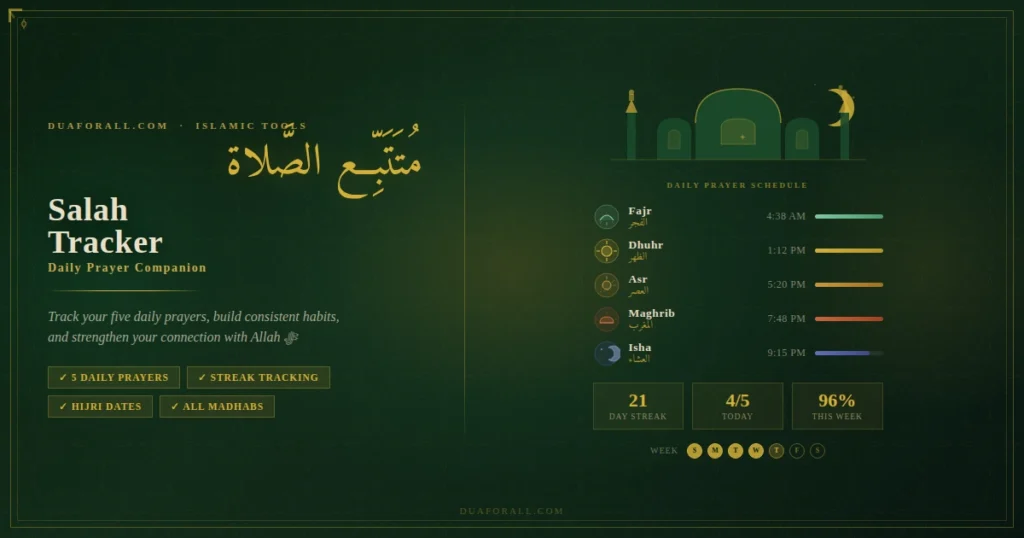
Salah Tracker Build Daily Prayer Consistency, One Salah at a Time
A free, private daily prayer tracker for the five fard prayers — log Fajr to Isha, mark jama‘ah, track qada, build a streak, and see your 30-day consistency at a glance. Nothing leaves your device.
Daily Salah Tracker
Last 30 Days
0 5
Privacy: your log is saved only in this browser’s local storage. We never see it, and it is not sent to any server.
Clearing your browser data or switching device will clear the log — use Export CSV to keep a backup.
Note: this tracker records what you log; it does not calculate prayer times. Always follow your local masjid or a reliable timetable.
Why Track Your Salah?
Salah is not a habit we are asked to feel our way through — it is an appointment with fixed times. Tracking is simply a way of taking that appointment seriously.
إِنَّ الصَّلَاةَ كَانَتْ عَلَى الْمُؤْمِنِينَ كِتَابًا مَوْقُوتًا
“Indeed, prayer has been decreed upon the believers a decree of specified times.”
Qur’an 4:103 — An-Nisa 103 on Quran.comThe word mawqūtā (مَوْقُوتًا) means fixed by time. That single word is the entire argument for tracking: an obligation with a window has a beginning and an end, which means it can be met early, met late, or missed altogether. A tracker makes that visible instead of vague.
“The first thing for which a servant will be brought to account on the Day of Resurrection will be his prayer. If it is sound, he will have succeeded; and if it is corrupt, he will have failed.” Sahih / Authentic
Jami‘ at-Tirmidhi 413 — Sunnah.com. Graded sahih by al-Albani.The Prophet ﷺ was asked which deed is most beloved to Allah, and he said: “The prayer at its proper time.” Sahih
Sahih al-Bukhari 527 · Sahih Muslim 85 — Sunnah.comWhat tracking actually changes
It removes self-deception
Most people who feel “mostly consistent” are surprised by their real 30-day rate. Data beats memory.
It exposes the weak prayer
Almost everyone has one habitual gap — usually Fajr or ‘Asr. Naming it lets you build a fix around that one slot.
It makes qada finite
“I’ve missed a lot” is paralysing. “I owe 6 ‘Asr prayers” is a task you can finish.
An important caution: a streak is a diagnostic tool, not a measure of your worth before Allah. Sincerity (ikhlas) and khushū‘ are the substance of prayer; a number on a screen is only a mirror. If a streak begins to make you pray for the streak, close the tool and keep the prayer. Never delay a prayer to preserve a tidy log, and never let a broken streak become a reason to stop.
The Five Daily Prayers at a Glance
Each prayer has a window that opens and closes. This is why “I’ll pray it later” is a fiqh question, not just a scheduling one.
Rak‘ah Count for Each Prayer
The fard column is the obligation your tracker logs. The Sunnah columns are the confirmed voluntary prayers (sunan ar-rawātib) attached to each — highly rewarded, but not what you are held accountable for.
| Prayer | Arabic | Sunnah before | Fard | Sunnah after | Witr / extra |
|---|---|---|---|---|---|
| Fajr | الفجر | 2 (strongly emphasised) | 2 | — | — |
| Dhuhr | الظهر | 4 (Hanafi) / 2–4 | 4 | 2 | 2 optional (nafl) |
| ‘Asr | العصر | 4 (ghayr mu’akkadah) | 4 | — | — |
| Maghrib | المغرب | — | 3 | 2 | 2 optional (nafl) |
| Isha | العشاء | 4 (ghayr mu’akkadah) | 4 | 2 | 3 Witr (wājib — Hanafi) |
| Total | — | — | 17 fard | — | — |
Madhab note — where the schools differ
The 17 fard rak‘ahs are agreed upon by all four schools. The differences sit in the voluntary layer:
- Hanafi: 4 sunnah before Dhuhr; Witr is classified as wājib (near-obligatory), not sunnah.
- Shafi‘i & Hanbali: commonly 2 (or 4) before Dhuhr; Witr is a strongly emphasised sunnah, not wājib.
- Maliki: counts the rawātib more loosely as nawāfil; Witr is sunnah mu’akkadah.
Follow the school your local scholars teach. For a detailed breakdown of Witr and its supplication, see our guide to Dua Qunoot.
The Consistency Loop
Istiqāmah is not built by intensity. It is built by making the next prayer easier than the last one was.
How to Build Salah Consistency in 7 Steps
This is the method we recommend to readers who write to us saying they “keep starting over.” Work it in order; do not skip to step 5.
Fix the intention before the system
Any tool — including this one — can quietly become the goal. Before you log anything, be clear that you are praying for Allah, and the tracker is only a mirror. The Prophet ﷺ said: “Actions are but by intentions.” (Sahih al-Bukhari 1)
Start with your weakest prayer, not all five
Log honestly for one week without trying to change anything. Your 30-day rate will show one prayer that is clearly worse — for most people it is Fajr or ‘Asr. Fix that one prayer for a month before touching the others. Five simultaneous changes fail; one change holds.
Anchor each prayer to an event, not a feeling
“I’ll pray when I get a moment” fails because there is no trigger. “I pray Dhuhr the minute I close my laptop for lunch” succeeds because the cue already happens daily. Tie every prayer to something that occurs whether or not you are motivated — the adhan, a commute, a meal, the school run.
Remove the friction before it starts
Keep a prayer mat unrolled in a clean corner. Renew wudu after ‘Asr so Maghrib costs you thirty seconds, not five minutes. If the barrier is remembering the method itself, review our step-by-step Wudhu guide and the dua after wudu.
Pray at the start of the window
This single rule fixes most missed prayers, because a prayer delayed to the last ten minutes is a prayer competing with everything else in your day. The most beloved deed to Allah is “the prayer at its proper time” (Sahih al-Bukhari 527).
Solve Fajr the night before
Fajr is not a morning problem — it is a bedtime problem. A prayer you sleep through was usually lost around 1am. Fix the sleep window first with our Sunnah-based Sleep Calculator, recite the duas before sleep, and keep the dua to wake up for Fajr nearby. Then follow it with the morning adhkar so the prayer opens the day rather than ending the night.
Review weekly, not hourly
Check your heatmap once a week — Friday is a natural point. Look for the pattern, not the streak. Then ask one question: which single slot cost me the most this week, and what will I change for the next seven days? If you want to formalise that review, our Islamic Goal Tracker pairs well with this page.
Missed Prayers (Qada): What the Scholars Say
The Qada option in the tracker exists because most people rebuilding consistency have a backlog. Here is the honest position — including where the schools genuinely disagree.
If you missed a prayer by oversleeping or forgetting
There is complete agreement here. The prayer is made up as soon as you remember, and there is no sin attached.
“Whoever forgets a prayer or sleeps through it, its expiation is that he prays it when he remembers it.” Sahih
Sahih Muslim 684 · Sahih al-Bukhari 597 — Sunnah.comIf you deliberately abandoned prayers for a period
This is where the schools part company, and you should know that before someone tells you there is only one answer:
The majority (all four schools)
Deliberately missed prayers must be made up (qada) alongside sincere repentance. The number is estimated as carefully as possible, and made up gradually — commonly by praying one missed prayer alongside each current one, without ever delaying a current prayer to do so.
A minority (Ibn Hazm, Ibn Taymiyyah)
Deliberately abandoned prayers cannot be “made up” at all, because the appointed time was a condition of the act. What is required instead is sincere tawbah plus an abundance of voluntary (nafl) prayer. This is a real scholarly position, but it is the minority one.
In practice, both positions converge on the same advice: repent sincerely, pray consistently from today, and add extra prayer. The dispute is over accounting, not over what you should do tomorrow morning.
This page is educational, not a fatwa. Rulings on a large backlog — how to estimate it, how quickly to discharge it, and what applies in cases of long-term abandonment — depend on your circumstances and your school. Please put your specific situation to a qualified local scholar or a reputable fatwa body such as IslamQA or SeekersGuidance. See our Editorial Standards for how we source and verify this material.
Where to start if the backlog feels impossible
Do not calculate years of missed prayers on day one. That number will stop you before you begin. Start by not adding to it: log the five prayers of today, and only today. When a week of consistency is genuinely stable, then — and only then — begin the estimate and the repayment. And turn to Allah as you do: the duas for forgiveness are the other half of this work.
قُلْ يَا عِبَادِيَ الَّذِينَ أَسْرَفُوا عَلَىٰ أَنفُسِهِمْ لَا تَقْنَطُوا مِن رَّحْمَةِ اللَّهِ
“Say: O My servants who have transgressed against themselves, do not despair of the mercy of Allah.”
Qur’an 39:53 — Az-Zumar 53 on Quran.comWhy the Tracker Has a Separate “Jama‘ah” Marker
Once the five prayers are stable, congregational prayer is the next rung — which is why it is logged separately rather than folded into a single checkbox.
“Prayer in congregation is twenty-seven degrees superior to prayer offered by a person alone.” Sahih
Sahih al-Bukhari 645 · Sahih Muslim 650 — Sunnah.comA practical target: rather than aiming for “all five in the masjid” immediately, pick the one prayer that is realistically attendable — often Maghrib or Isha — and hold it for a month. Then add a second. Before you go, the dua for entering the masjid is worth memorising.
On the fiqh: the Hanbali school holds congregational prayer to be individually obligatory (fard ‘ayn) on able men; the Hanafi school calls it sunnah mu’akkadah; the Shafi‘i and Maliki schools have positions ranging between fard kifāyah and strongly emphasised sunnah. All four regard abandoning it habitually without excuse as blameworthy. Women may pray at home with full reward, and attendance at the masjid is permitted.
Strengthen Each Prayer
Tracking tells you whether you prayed. These guides deepen how you pray.
Before the prayer
Wudhu Steps Dua After Wudu Entering the Masjid Taharah & Cleanliness
Around Fajr & the night
Waking for Fajr Morning Prayers & Adhkar Evening Adhkar Duas Before Sleep Sunnah Sleep Calculator
Beyond the fard
Tahajjud Dua Dua Qunoot & Witr Salat al-Istikhara The Three Quls
Frequently Asked Questions
Is it permissible to use an app or tracker for Salah?
Yes. A tracker is a neutral organisational aid, in the same category as a wall calendar, a tasbih counter, or a masjid timetable. It adds nothing to the religion and claims no reward of its own. The only caution scholars raise is the one we raise on this page: the record must never become the motive, and it must never cause you to delay a prayer.
Where is my data stored, and can DuaForAll see it?
No, we cannot see it. The tracker writes to your browser’s local storage on your own device. Nothing is transmitted to us or to any third party, and no account is required. The trade-off is that your log will not follow you to another browser or device, and clearing your browser data erases it — so use the Export CSV button if you want a backup.
Does the tracker show prayer times for my city?
No, and that is deliberate. Prayer times depend on latitude, calculation method, and local scholarly convention, and a wrong time is worse than no time. This tool records what you tell it you prayed. Take your timings from your local masjid or an established timetable for your city.
What is the difference between “Jama‘ah,” “Alone,” and “Qada”?
Jama‘ah means you prayed it in congregation — reported as twenty-seven times superior (Sahih al-Bukhari 645). Alone means you prayed it on time individually. Qada means you prayed it, but after its window had closed. All three count as prayed for your streak — the distinction exists so you can see the quality trend, not just the tally.
I broke a long streak. Should I start over?
The streak resets; your standing with Allah does not. This is a counter, not a judgement, and treating a broken streak as a reason to quit is the single most common failure mode we see. The Prophet ﷺ taught that the deeds most beloved to Allah are the consistent ones, even if small (Sahih al-Bukhari 6464). Pray the next prayer. That is the whole recovery.
How do I track prayers when travelling?
A traveller may shorten (qasr) the four-rak‘ah prayers to two, and the majority of scholars permit combining Dhuhr with ‘Asr and Maghrib with Isha. Log each prayer normally — combining or shortening does not make a prayer late or missed. Our guide to journey prayer in Islam covers the four conditions for qasr in detail.
Should women log prayers during menstruation?
No. There is scholarly consensus that prayers are not obligatory during menstruation or post-natal bleeding, and — unlike fasting — they are not made up afterwards. This is a mercy, not a deficiency. Simply leave those days unlogged; they are not missed prayers and should not be recorded as qada.
What if I don’t know how many prayers I’ve missed over the years?
Make a careful, honest estimate rather than an exhausting audit — the majority position accepts a reasonable estimate. Then discharge it gradually, commonly one missed prayer alongside each current prayer, and never at the expense of a current one. If your backlog spans years, put your specific case to a qualified scholar rather than a website.
Can I use this tracker offline?
Once the page has loaded, the tracker itself runs entirely in your browser and will keep working without a connection for that session. Adding the page to your phone’s home screen makes it a one-tap daily habit.
About This Page
Founder and Islamic Content Editor at DuaForAll. BA in Islamic Studies with over a decade of hadith research; leads the site’s sourcing and verification methodology.
Sharia Advisor at DuaForAll. BA and MA from Al-Azhar University and IIUM, with an Ijazah in hadith narration. Verifies all fiqh-sensitive content prior to publication.
Sourcing: every hadith on this page is cited with its collection and number and linked to Sunnah.com; Qur’anic references link to Quran.com. Authenticity grades are stated explicitly, and points of madhab disagreement are presented as disagreements rather than collapsed into a single view. Read our full Editorial Standards.
Not a fatwa. This page is educational. For rulings specific to your circumstances — particularly regarding a backlog of missed prayers — consult a qualified scholar in your community or a recognised fatwa body.