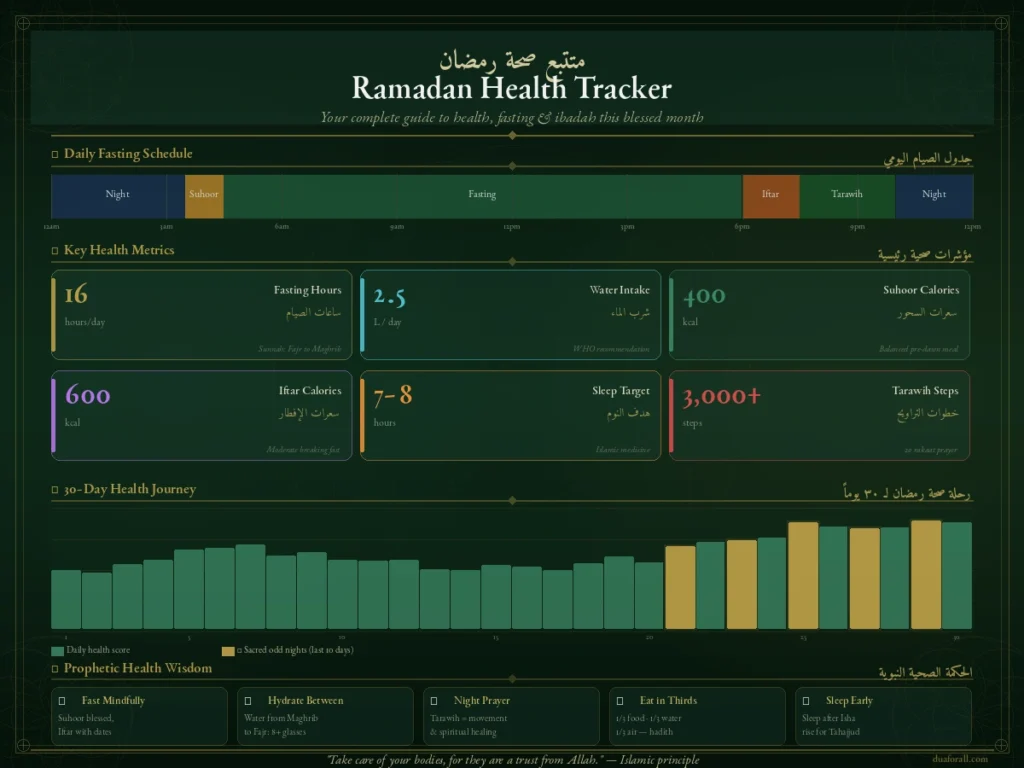
Ramadan Health Tracker 2026
Track your fasting, prayers, hydration & Quran recitation day-by-day — with Islamic wellness guidance backed by Sunnah and modern science.
Science-backed milestones of the Ramadan fast — from Suhoor to Iftar and beyond.
The Prophet ﷺ said: “Eat Suhoor, for indeed in Suhoor there is blessing.” (Sahih Bukhari 1923)
🌅 Suhoor Foods
- Oats & whole grains — slow-digesting, sustain energy for 8–10 hours
- Eggs & Greek yoghurt — quality protein reduces muscle loss during fasting
- Dates (Sunnah) — natural energy, fibre, and electrolytes
- Avocado & nuts — healthy fats delay hunger signals
- Cucumber & watermelon — 90%+ water content hydrates slowly
- 8–10 glasses water — distributed from Iftar to Suhoor
🌙 Iftar Sunnah
- 3 dates + water — Sunnah of breaking fast (Abu Dawud 2356)
- Light soup or broth — gently awakens the digestive system
- Lentils & legumes — fibre-rich, slow glucose release
- Grilled protein — replenishes amino acids without heavy fats
- Fresh salad — vitamins and minerals lost during the day
- Avoid overeating — the Prophet ﷺ taught: fill ⅓ food, ⅓ water, ⅓ air
⚠️ Avoid / Limit
- Fried foods — cause sluggishness and acid reflux when fasting
- Excessive caffeine — acts as a diuretic, accelerating dehydration
- Salty foods at Suhoor — trigger intense thirst within hours
- Sugary drinks & sweets — rapid blood sugar spike then crash
- Heavy red meats — hard to digest on an empty stomach
- Skipping Suhoor — the biggest Ramadan health mistake
You have 8–12 hours between Iftar and Suhoor to drink your daily water. Here’s how to do it smartly.
Smart Hydration Schedule
- 🌙At Iftar (0h): 2 glasses of water + dates. Start slow to avoid stomach cramps.
- 🍽️During Iftar meal: 1 glass. Avoid excessive drinking while eating — it dilutes digestive enzymes.
- 🕌After Maghrib prayer: 2 glasses. The best time to hydrate steadily.
- ⭐During Tarawih & late night: 2–3 glasses spread over 2–3 hours.
- 🌅At Suhoor: 2 glasses minimum. Never skip — it’s your last chance until Iftar.
- 🚫Avoid: Carbonated drinks, excessive tea/coffee, and salty Suhoor foods that cause thirst.
Ramadan is the ninth month of the Islamic Hijri calendar — a sacred month of fasting (Sawm), prayer, reflection, and community. For approximately 1.9 billion Muslims worldwide, it represents the holiest period of the year. The Ramadan health tracker above is designed to help you honour this month not only spiritually but physically — because caring for the body Allah ﷻ has entrusted to you is itself an act of worship.
The Science Behind Ramadan Fasting and Health
Modern research continues to validate what the Prophet Muhammad ﷺ taught 1,400 years ago. Ramadan fasting — typically lasting 12–20 hours depending on geographic location and season — represents one of the most studied forms of intermittent fasting in the world. Studies published in journals including Obesity Reviews, Nutrients, and the World Health Organization‘s clinical resources have documented wide-ranging benefits when Ramadan fasting is approached with sound nutritional strategy.
Key Health Benefits of Islamic Fasting
Research consistently highlights improvements in lipid profiles (reduction of LDL “bad” cholesterol), enhanced insulin sensitivity, lowered inflammatory markers (including C-reactive protein), and the activation of autophagy — the body’s cellular self-cleaning mechanism identified in the Nobel Prize-winning research of Yoshinori Ohsumi (2016). A landmark 2019 study in Cell found that even 12–16 hours of daily fasting can produce measurable cardiometabolic improvements — precisely the duration of a typical Ramadan fast.
How to Use This Ramadan Health Tracker
Our free Islamic fasting tracker is built around three core pillars of a healthy Ramadan:
1. Physical wellness: Daily logs for hydration (glasses of water), sleep hours, and a subjective energy and mood rating help you spot patterns. Research from the National Institutes of Health (PubMed) shows that dehydration as little as 1–2% of body weight impairs cognitive performance — crucial awareness for Ramadan fasters.
2. Spiritual milestones: The five daily prayers (Salah) form the backbone of Ramadan observance. Our prayer tracker keeps you accountable for Fajr, Dhuhr, Asr, Maghrib, and Isha — as well as the voluntary Tarawih prayers that distinguish Ramadan nights. Scholars agree that maintaining Salah is the greatest single marker of a spiritually successful Ramadan.
3. Quranic recitation: The Quran was first revealed in Ramadan. The Prophet ﷺ would review the entire Quran with Angel Jibreel (AS) each Ramadan. Our 30-Juz Quran Khatam tracker makes it simple to plan and record your recitation progress toward completing the full Quran before Eid.
Suhoor: The Blessed Pre-Dawn Meal
The Prophet ﷺ explicitly encouraged eating Suhoor — the pre-dawn meal taken before Fajr prayer. This is not merely a practical recommendation but a spiritual one:
From a health perspective, skipping Suhoor is the single greatest nutritional mistake a Ramadan faster can make. A well-constructed Suhoor delays hunger, maintains muscle mass, prevents blood sugar crashes, and sustains mental focus for Fajr prayer and the working morning ahead. Prioritise complex carbohydrates (oats, wholemeal bread), proteins (eggs, legumes), and foods with high water content (cucumber, watermelon).
Iftar: Breaking the Fast with Sunnah
The Islamic tradition of breaking fast with dates and water before Maghrib prayer is backed by sound nutritional science. Dates provide rapid glucose to replenish glycogen stores, while their fibre content prevents the digestive shock of eating a large meal on an empty stomach. The Prophet ﷺ also warned against overeating at Iftar:
Ramadan Sleep and Mental Wellness
Many Muslims experience disrupted sleep during Ramadan due to late Tarawih prayers, Suhoor preparation, and altered eating schedules. Research shows that chronic sleep restriction (below 6 hours) impairs immune function, increases hunger hormones (ghrelin), and reduces cognitive performance. Use the sleep tracker above to monitor your rest, and aim for 7–8 hours distributed between nighttime sleep and an optional mid-afternoon nap (qaylulah — itself a Sunnah).
Exercise During Ramadan
Light to moderate exercise remains beneficial during Ramadan. The best timing is either 1–2 hours before Iftar (when the body can immediately replenish nutrients) or after Tarawih prayer. Avoid intense workouts during peak daytime heat. Walking to the mosque for Tarawih, gentle stretching, and yoga-style movements are all excellent options. For dedicated fitness guidance, refer to resources from sports medicine bodies including those cited on PubMed.
The Last Ten Nights — Laylat al-Qadr
The spiritual intensity of Ramadan peaks in its final ten nights (Ashr al-Akhir). The Prophet ﷺ used to make i’tikaf (seclusion in the mosque) during this period, intensifying worship in search of Laylat al-Qadr — the Night of Power — which the Quran describes as “better than a thousand months” (Surah Al-Qadr, 97:3). Maximise worship in the odd nights: 21st, 23rd, 25th, 27th, and 29th of Ramadan. The recommended dua for Laylat al-Qadr is:
Medical Exemptions and Fidyah
Islamic jurisprudence across all four Sunni madhabs (Ḥanafī, Mālikī, Shāfi’ī, Ḥanbalī) provides exemptions from obligatory fasting for those who are chronically ill, pregnant, breastfeeding, elderly, or travelling. Those who cannot fast and cannot make up missed days must pay Fidyah — feeding a poor person for each missed day of fasting. Visit our Fidyah Calculator for madhab-specific rulings and current food values. For voluntary fasting (Sunnah fasts) such as the six days of Shawwal, Mondays and Thursdays, and the White Days (13th–15th of each Hijri month), explore guidance at Islam QA and IslamWeb.
Zakat and Charity in Ramadan
Ramadan is the prime time for giving Zakat (obligatory almsgiving) and Sadaqah (voluntary charity). The reward of any good deed in Ramadan is multiplied manifold. Many Muslims use this month to calculate and distribute their annual Zakat. Use our Zakat Calculator to determine exactly what you owe. Additionally, Zakat al-Fitr — a mandatory charity due before Eid al-Fitr prayer — must be paid on behalf of every member of the household. See our Kaffarah Calculator for related expiation rulings.