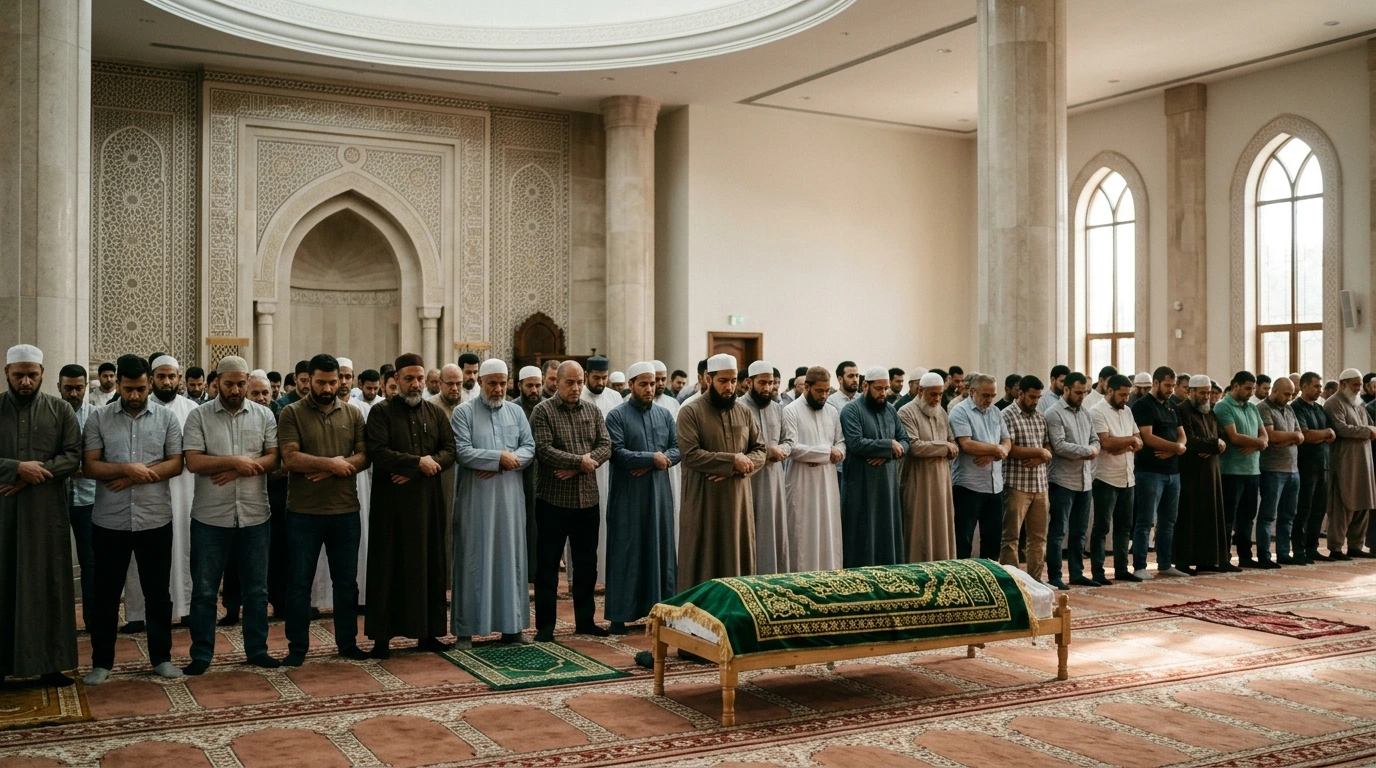
Janazah Prayer (Salat al-Janazah): Complete Step-by-Step Guide
A hadith-graded walkthrough of the funeral prayer, with sources cited — the four takbeers, the exact duas to recite, madhab differences, and the etiquette every Muslim should know before standing in the row.
What Is Salat al-Janazah?
Salat al-Janazah (صلاة الجنازة), the funeral prayer, is the collective supplication Muslims offer on behalf of a deceased believer before burial. Unlike the five daily prayers, it has no bowing (ruku’) or prostration (sujud) — it consists entirely of four takbeers (raised-hand declarations of “Allahu Akbar”) interspersed with specific supplications, performed standing.
The prayer is a communal act of mercy: it does not benefit the reciter’s personal record of obligatory worship in the way daily salah does, but it is one of the greatest rights a Muslim owes another. The Prophet ﷺ said that whoever attends a funeral until the prayer is offered earns one qirat of reward, and whoever stays until burial earns two — “the smaller of which is like Mount Uhud.”Sahih
Ruling: Is Janazah Prayer Obligatory?
Because it is fard kifayah rather than fard ‘ayn (individually obligatory), a Muslim who is unable to attend — due to distance, illness, or timing — bears no sin as long as others fulfill it. Many scholars nonetheless encourage attending whenever possible, given the reward mentioned above.
Prerequisites Before You Begin
Before the prayer itself, several conditions and preparations must be in place:
- Wudu (ablution) must be completed by every participant
- The body must be washed (ghusl) and shrouded (kafan)
- The body is placed facing the qibla direction
- The imam stands level with the chest of the deceased
- Rows (saff) are formed behind the imam, ideally in odd numbers
- No adhan or iqamah is called for this prayer
If you need a refresher on ritual purification first, see our full Wudu guide and dua after wudu.
Step-by-Step Procedure
Make the Intention (Niyyah) & First Takbeer
Silently intend to pray Salat al-Janazah for this specific deceased person. Raise your hands to your ears and say “Allahu Akbar.” Then place your hands on your chest, right over left, as in regular prayer, and recite Surah al-Fatiha silently.
Second Takbeer — Send Blessings on the Prophet ﷺ
Without raising the hands again, say “Allahu Akbar” and recite Durood Ibrahim (the same blessings said in the final sitting of daily prayer):
اللَّهُمَّ صَلِّ عَلَى مُحَمَّدٍ وَعَلَى آلِ مُحَمَّدٍ، كَمَا صَلَّيْتَ عَلَى إِبْرَاهِيمَ وَعَلَى آلِ إِبْرَاهِيمَ، إِنَّكَ حَمِيدٌ مَجِيدٌ
Allahumma salli ‘ala Muhammadin wa ‘ala aali Muhammad, kama sallayta ‘ala Ibrahima wa ‘ala aali Ibrahim, innaka Hamidun Majid.
Translation: “O Allah, send blessings upon Muhammad and the family of Muhammad, as You sent blessings upon Ibrahim and the family of Ibrahim. Indeed, You are Praiseworthy, Glorious.”Sahih
Third Takbeer — The Core Dua for the Deceased
Say “Allahu Akbar” a third time, then recite a sincere dua for the deceased. The most authentically narrated version is:
اللَّهُمَّ اغْفِرْ لِحَيِّنَا وَمَيِّتِنَا، وَشَاهِدِنَا وَغَائِبِنَا، وَصَغِيرِنَا وَكَبِيرِنَا، وَذَكَرِنَا وَأُنْثَانَا
Allahumm-aghfir li hayyina wa mayyitina, wa shahidina wa gha’ibina, wa saghirina wa kabirina, wa dhakarina wa unthana.
Translation: “O Allah, forgive our living and our dead, those present and those absent, our young and our old, our males and our females.”Sahih
If the deceased is a child, scholars note a shorter dua asking Allah to make the child an intercessor and means of reward for the parents is reported instead.
Fourth Takbeer & Concluding Dua
Say “Allahu Akbar” a fourth time. A brief dua may optionally be added here, such as asking Allah not to deprive the reciter of the reward and not to test them after the deceased. Then conclude the prayer by turning the head to the right and reciting the tasleem:
السَّلَامُ عَلَيْكُمْ وَرَحْمَةُ اللَّهِ
As-salamu ‘alaykum wa rahmatullah.
Some scholars also recommend a second tasleem to the left, though a single tasleem to the right is sufficient and is the position most widely practiced.
Visual Infographic: The 4 Takbeers at a Glance
Infographic summary based on the step-by-step procedure above; see full hadith citations in each step.
Differences Between the Four Madhabs
The core structure of four takbeers is agreed upon by all four Sunni schools. Minor differences exist in secondary details:
Hands are raised only for the first takbeer; for the remaining three, hands stay folded. Raising the hands with each takbeer is considered permissible but not the preferred practice in this school.
Hands are raised only for the first takbeer, similar to the Hanafi position. Only one tasleem is given, quietly, to the right side.
Hands are raised with every one of the four takbeers. Two tasleems are typically given — one to the right and one to the left — mirroring the daily prayers.
Hands are raised with every takbeer, similar to the Shafi’i view. A single tasleem to the right is generally sufficient, though a second is also reported as permissible.
Common Mistakes to Avoid
Standing in the wrong position
The imam should align with the chest of the deceased (some scholars say the head for a woman), not the feet.
Adding ruku’ or sujud
Janazah prayer has no bowing or prostration — this is a defining feature that distinguishes it from all other prayers.
Reciting Al-Fatiha aloud
All recitation in Janazah prayer is silent, whether prayed individually or in congregation, day or night.
Skipping the funeral for minor reasons
While fard kifayah, unnecessarily avoiding attendance forfeits significant reward and weakens communal bonds.
Frequently Asked Questions
Most scholars discourage performing Janazah prayer during the three specifically prohibited times: right after sunrise until it fully rises, at the sun’s zenith before it declines, and right before sunset — except in cases of necessity, such as risk of the body decomposing.
Yes. Women may participate in Salat al-Janazah, typically forming their own row(s) behind the men, though practices around women attending the burial itself vary by scholarly opinion and local custom.
Join the imam immediately in whichever takbeer he is on. After the imam completes the tasleem, catch up on any missed takbeers on your own (without additional recitation between them) before giving your own tasleem.
Scholars differ based on signs of life and gestational stage; many hold that a child who showed any sign of life after birth should be prayed for, while views vary for a stillbirth. Consult a local scholar for the specific ruling relevant to your situation, as this is a sensitive, case-by-case matter.
Those who missed the original prayer may still pray it individually at the grave afterward. Repeating it in congregation multiple times for the same person is generally discouraged once it has already been fulfilled.