Kaffarah Calculator
Islamic Expiation (كفارة) Guide & Tool
An advanced, scholar-verified Kaffarah calculator — your complete guide to Islamic expiation (كفارة) and atonement. Instantly calculate Kaffarah for breaking an oath, intentional Ramadan iftar, Zihar & more, according to the Quran, authenticated Hadith, and the scholarly consensus of all four major Madhabs.
Calculate Your Kaffarah
Answer the questions below to receive your personalised expiation guidance based on your situation and school of thought.
Your Kaffarah Result
Based on your selected type and school of thought
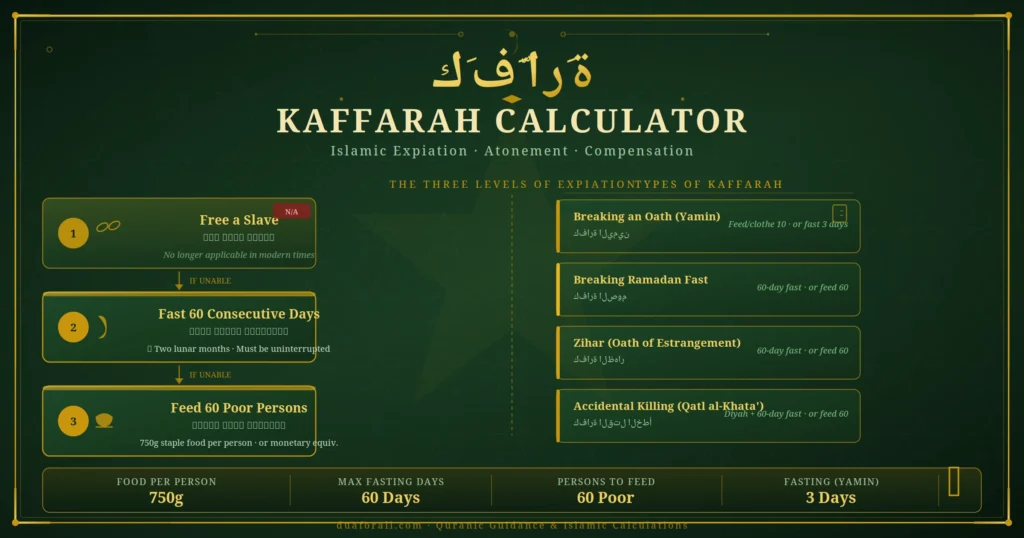
Types of Kaffarah at a Glance
A visual overview of all major forms of Islamic expiation, their triggers, and the prescribed remedies.
🔄 Kaffarah Decision Flowchart
📊 Comprehensive Kaffarah Reference Table
| Type of Kaffarah | Arabic Term | Quranic Basis | Options (in order) | Madhab Note |
|---|---|---|---|---|
| Broken Oath | كفارة اليمين | Quran 5:89 | Feed 10 poor Clothe 10 poor Fast 3 days* | *Only if unable to feed/clothe |
| Intentional Iftar in Ramadan | كفارة الإفطار | Hadith (Bukhari 1936) | Free slave Fast 60 days Feed 60 poor | Strict hierarchical order (Ḥanafī, Mālikī, Shāfi’ī). Ḥanbalī allows choice. |
| Ẓihār | كفارة الظهار | Quran 58:3–4 | Free slave Fast 60 days Feed 60 poor | Must be completed before resuming marital relations |
| Accidental Killing | كفارة القتل الخطأ | Quran 4:92 | Free slave Fast 60 days Diya also required | Feeding is NOT an option for killing; diya paid separately |
| Iḥrām Violation (Hunting) | جزاء الصيد | Quran 5:95 | Equivalent livestock Feed poor (value) Fast per portion | Value of hunted animal estimated by two just Muslims |
| Broken Vow (Nadhr) | كفارة النذر | Quran 5:89 (majority view) | Feed 10 poor Clothe 10 poor Fast 3 days | If the vow was possible to fulfill; otherwise no kaffarah |
📐 Understanding the Mudd — The Unit of Kaffarah Food
Kaffarah Across the Four Madhabs
Scholarly differences in Kaffarah rulings — all valid and rooted in authentic textual evidence.
Follows strict sequential order for Ramadan Kaffarah. Considers monetary payment (cash equivalent of food) as valid for feeding the poor. Widely followed in South Asia, Turkey & Central Asia.
Requires sequential order (free slave → fast → feed). Only actual food is valid — not cash. Dominant in North & West Africa. Follows the practice of the people of Madinah.
Sequential order strictly maintained. Cash is not valid — must give food itself (a Mudd per person). Predominant in Southeast Asia, East Africa & parts of Arabia.
Allows the person to choose from the three options without a strict hierarchy — greatest flexibility. Prevalent in Saudi Arabia and Gulf states. Basis of many contemporary fatāwā.
Complete Guide to Kaffarah (كفارة) — Islamic Expiation & Atonement
What is Kaffarah in Islam?
Kaffarah (كفارة), derived from the Arabic root kafara (كفر) meaning “to cover” or “to conceal,” refers to the acts of expiation and atonement prescribed by Allah ﷻ in the Quran and Sunnah. Unlike tawbah (repentance), which addresses the spiritual dimension of sin, Kaffarah is a tangible, prescriptive act of worship that fulfils a legal obligation — a debt owed to Allah ﷻ and, in some cases, to fellow human beings.
The concept is rooted in divine mercy: Allah ﷻ, recognising human fallibility, provided concrete pathways for sincere believers to expiate certain transgressions, maintain their covenant with Him, and purify their souls. Kaffarah is not a punishment but a rahma (mercy) — a structured mechanism of forgiveness.
Kaffarah Meaning in English — Etymology & Pronunciation
The word kaffarah (كفارة) — pronounced kaf-fāh-rah — derives from the Arabic root k-f-r (كفر), meaning “to cover,” “to conceal,” or “to expiate.” In Islamic jurisprudence its full kaffarah definition is: a prescribed act of worship that legally expiates a specific sin or broken obligation. The closest English equivalents are “expiation,” “atonement,” or “penance.” Kaffarah meaning in Islam carries an additional spiritual weight — it is an act commanded by Allah ﷻ Himself as a mercy upon the believer.
Kaffarah meaning in Urdu is کفارہ (same pronunciation), widely understood across South Asian Muslim communities, where it is also written as kufara or kfara in informal transliteration. Kaffarah meaning in Hindi is transliterated as कफ़ारा. The word also appears in Malay/Indonesian as kaffarah or kifarah — both valid transliterations of the same Arabic term. The plural form in classical Arabic is kaffārāt (كفّارات). In some communities you may see it written as al-kaffarah, al-kifarah, or simply kafarah — all refer to the same concept. Kaffarah in Arabic is كفارة.
The Scholarly Consensus (Ijmāʿ) on Kaffarah
Muslim scholars across all four major Sunni schools of jurisprudence — the Ḥanafī, Mālikī, Shāfi’ī, and Ḥanbalī — are in consensus (ijmāʿ) that Kaffarah is a binding obligation when its triggering conditions are met. This is supported by extensive primary textual evidence in the Quran and authenticated collections of Hadith, including Ṣaḥīḥ al-Bukhārī and Ṣaḥīḥ Muslim.
“Kaffarah occupies a unique position in Islamic law: it bridges the punitive and the penitential. While some sins attract ḥudūd or ta’zīr, Kaffarah purifies the soul through acts of charity and worship, affirming the Islamic principle that virtue and expiation are inseparable.”
Kaffarah for Breaking an Oath (كفارة اليمين)
This is the most commonly encountered Kaffarah. When a Muslim takes an oath in the name of Allah ﷻ and subsequently fails to fulfil it, Kaffarah al-Yamīn becomes obligatory. The Quran prescribes three options, with a fourth available for those unable to perform the first three:
- Feed ten poor persons — each receiving a full meal (approximately 510g–750g of the staple food of your region)
- Clothe ten poor persons — a complete outfit that covers the awrah
- Free a believing slave — this option is no longer applicable in the modern context
- Fast for three consecutive days — only permitted if one is unable to perform any of the above (Ḥanafī: may be non-consecutive)
Kaffarah al-Yameen (كفارة اليمين) — Oaths, Promises & the Kaffarah for Lying
Kaffarah yameen — also written kaffarah al yameen or kaffarah yamin — applies when a Muslim takes a deliberate oath in the name of Allah ﷻ and then breaks it. This includes: swearing to give up a habit, making a kasam (sworn promise), or taking any oath in Allah’s name that you subsequently fail to fulfil. Kaffarah for breaking a promise in Islam specifically refers to this category when the promise was accompanied by a formal oath in Allah’s name — casual promises without an explicit oath do not trigger Kaffarah al-Yameen.
Kaffarah for breaking oath on the Quran falls under the same ruling — if you swore by the Quran with Allah’s name and broke that oath, Kaffarah al-Yameen applies. Similarly, kaffarah for lying is triggered when the lie was accompanied by a sworn oath (e.g., saying “by Allah, I did not do this” when you did). Paying kaffarah for breaking an oath can be done directly by feeding ten people or through a reputable Kaffarah oath charity. Multiple broken oaths require separate Kaffarah for each.
Kaffarah for Intentionally Breaking the Ramadan Fast
This is among the most severe forms of Kaffarah due to the sanctity of Ramadan. The basis comes from the famous Hadith in which a man confessed to the Prophet ﷺ that he had intentionally broken his fast through conjugal relations. The Prophet ﷺ prescribed a hierarchical expiation:
- Free a believing slave (not applicable today)
- Fast for sixty (60) consecutive days — if a single day is missed (except for a valid excuse on which fasting is Haraam, such as Eid), the count restarts from Day 1
- Feed sixty (60) poor people — one full meal each, or the equivalent food value
Kaffarah for Ẓihār (كفارة الظهار)
Ẓihār was a pre-Islamic form of divorce where a man would liken his wife’s back to his mother’s. Islam prohibited this practice and prescribed the same Kaffarah as intentional Iftar (free slave → fast 60 days → feed 60 poor). Crucially, the Kaffarah must be completed before marital relations resume, as specified in Quran 58:3–4. This is one of the clearest examples of Kaffarah functioning as a deterrent.
Kaffarah for Accidental Killing (كفارة القتل الخطأ)
The Quran (4:92) prescribes that one who kills a believer accidentally must both pay diya (blood money) to the deceased’s family and perform Kaffarah (free a slave or fast 60 days). Unlike other types, feeding is not offered as an alternative for this Kaffarah, underscoring the gravity of the taking of human life even unintentionally.
Types of Kaffarah in Islam — A Complete Overview
Classical Islamic jurisprudence recognises five primary types of Kaffarah:
- Kaffarah al-Yameen (كفارة اليمين) — for breaking a sworn oath; feed/clothe 10 poor or fast 3 days (Quran 5:89)
- Kaffarah al-Iftar (كفارة الإفطار) — for intentionally breaking the Ramadan fast; free a slave / fast 60 days / feed 60 poor (Hadith, Bukhari 1936)
- Kaffarah al-Zihar (كفارة الظهار) — for the pre-Islamic divorce formula Zihar; same hierarchy as al-Iftar, must precede resumption of marital relations (Quran 58:3–4)
- Kaffarah al-Qatl al-Khata (كفارة القتل الخطأ) — for accidental killing; free a slave or fast 60 days, plus Diya blood money (Quran 4:92)
- Kaffarah al-Nadhr (كفارة النذر) — for breaking a religious vow; same as Yameen by scholarly consensus
- Jaza’ al-Sayd (جزاء الصيد) — for hunting during Iḥrām; livestock / food / fasting equivalent (Quran 5:95)
Kaffarah Hadith — Primary Textual Evidence
The most frequently cited kaffarah hadith is the account in Ṣaḥīḥ al-Bukhārī (no. 1936) in which a man came to the Prophet ﷺ confessing he had broken his Ramadan fast through conjugal relations. The Prophet ﷺ prescribed the hierarchical expiation: free a slave, then fast 60 consecutive days, then feed 60 poor. The man’s subsequent inability to afford any of these led the Prophet ﷺ to give him dates to distribute, illustrating the mercy embedded in Islamic jurisprudence. This Hadith — graded Ṣaḥīḥ (authentic) in both Bukhārī and Muslim — forms the primary textual basis for Kaffarah al-Iftar. For Kaffarah al-Yameen, the primary evidence is Quran 5:89 supported by numerous authenticated narrations in the Sunan collections. See all references at ↗ Sunnah.com: Bukhari 1936.
Who Must Pay Kaffarah?
Kaffarah is obligatory upon a Muslim who is:
- Legally adult (bāligh) and mentally sound (‘āqil)
- The one directly responsible for the triggering action
- Under no duress (ikrāh) at the time of the act (in the case of oaths)
Can Kaffarah Be Paid in Cash?
This is a notable jurisprudential difference among the schools. The Ḥanafī school permits the monetary equivalent to be given directly to poor individuals, making it highly practical in modern economies. The Mālikī, Shāfi’ī, and Ḥanbalī schools generally require the actual food to be given, not its cash value. In contemporary practice, many Muslim charities and Kaffarah organisations operate with scholarly authorisation to distribute food on your behalf, often making the Ḥanbalī or Ḥanafī provisions the most widely used.
Kaffarah vs. Fidyah vs. Sadaqah — The Differences Explained
These terms are often confused. Fidyah (فدية) is the compensation paid by those who cannot fast in Ramadan due to a chronic permanent illness or extreme old age — it is not a punishment but a substitution (one person fed per missed fast). Kaffarah (كفارة) is expiation for a deliberate violation (60 people for Ramadan, 10 for oath). Sadaqah is voluntary charity that earns reward but does not fulfil a legal obligation.
- Fidyah → Cannot fast (chronic illness / old age) → Feed 1 person per missed day → No sin involved
- Kaffarah → Deliberately broke a fast or oath → Feed 60 people (fast) or 10 people (oath) → Expiation of a transgression
- Qada (قضاء) → Missed a fast with a valid excuse → Make it up later, no extra payment
Fidya or Kaffarah? — If your inability to fast is chronic and permanent, Fidyah applies. If you deliberately broke a valid Ramadan fast without an excuse, Kaffarah is required. Both fidyah and kaffarah donations can be made through reputable Islamic charities. The difference between fidya and kaffarah also extends to eligibility: Fidyah is paid for each individual missed fast, while Kaffarah for Ramadan fasting is a single heavy expiation per deliberate violation. For more, see the Fidyah Calculator →.
How Much is Kaffarah? — 2026 Country Guide
Kaffarah amount is calculated based on the local price of a basic staple meal (one mudd). How much you pay depends on the type of Kaffarah and your country. The figures below are 2026 estimates under the Ḥanafī position (cash equivalent per person per meal):
- Kaffarah UK: £3–4 per person → Oath Kaffarah: ~£30–40 total; Ramadan Kaffarah: ~£180–240
- Kaffarah USA: $3.50–5 per person → Oath: ~$35–50; Ramadan: ~$210–300
- Kaffarah Pakistan: ₨150–260 per person → Oath: ~₨1,500–2,600; Ramadan: ~₨9,000–15,600
- Kaffarah India: ₹25–40 per person → Oath: ~₹250–400; Ramadan: ~₹1,500–2,400
- Kaffarah Saudi Arabia: SAR 6–10 per person → Oath: ~SAR 60–100; Ramadan: ~SAR 360–600
- Kaffarah UAE: AED 6.50–10 per person → Oath: ~AED 65–100; Ramadan: ~AED 390–600
- Kaffarah Bangladesh: ৳40–60 per person → Oath: ~৳400–600; Ramadan: ~৳2,400–3,600
These are general estimates. How much kaffarah to pay precisely may vary by local food prices, madhab, and the type of violation. Always confirm with a local scholar or your chosen charity for the most current kaffarah price in your region. Our Kaffarah Calculator ↑ above calculates personalised amounts by currency and school of thought.
How to Pay Kaffarah — Online Kaffarah Donation Options
Wondering how to give kaffarah? You have two main routes for how to pay kaffarah in Islam:
- Directly — purchase food (or its cash equivalent under the Ḥanafī position) and distribute it personally to eligible poor Muslims. Each recipient must receive a full, satisfying meal equal to approximately 510g–750g of your region’s staple food.
- Through an Islamic charity — pay kaffarah online via a reputable organisation with a dedicated, scholar-supervised Kaffarah programme. Leading options include Islamic Relief Kaffarah, Human Appeal Kaffarah, Penny Appeal Kaffarah, MATW Kaffarah, Muslim Aid Kaffarah, Ummah Welfare Trust Kaffarah, and Muslim Hands Kaffarah.
When paying kaffarah through a charity, verify that: (a) funds go toward actual food distribution; (b) the correct number of recipients are fed; and (c) the organisation has scholarly oversight. Can I pay kaffarah in another country? Yes — the majority scholarly position permits Kaffarah distribution in a different country to where you reside, provided it reaches genuinely eligible poor recipients.
Can I pay Kaffarah in installments? This is nuanced. For Oath Kaffarah, most scholars require all 10 people to be fed in the same distribution event. For Ramadan Kaffarah, the Ḥanafī school permits feeding 60 people across multiple sittings provided the obligation is eventually completed. Paying online through a charity automatically handles distribution on your behalf. If you genuinely cannot afford Kaffarah, consult a qualified scholar — Islamic jurisprudence has mercy provisions for those in genuine financial hardship (i’sar).
For further reading, see the authoritative sources: ↗ Islam QA: Breaking Oaths ↗ IslamWeb: Zihar Kaffarah ↗ Sunnah.com: Hadith on Kaffarah
Kaffarah — Key Numbers
Essential figures every Muslim should know about expiation obligations
Frequently Asked Questions
Scholar-referenced answers to the most common Kaffarah questions
Tawbah (توبة) is the sincere, internal act of repentance — turning to Allah ﷻ with remorse, resolving not to repeat the sin. Kaffarah (كفارة) is an external, legally prescribed act of worship that fulfils a specific obligation. Both are required together; Kaffarah alone without tawbah is incomplete, and tawbah alone does not remove the legal obligation of Kaffarah once it has become due. Think of tawbah as addressing the spiritual debt to Allah and Kaffarah as addressing the legal debt.
No. The scholars are in agreement that Kaffarah is only obligatory for intentional violation of the Ramadan fast without a valid excuse. If you accidentally ate or drank while forgetting you were fasting, your fast remains valid and no Kaffarah is due — as confirmed by the Prophet ﷺ (Hadith narrated by Abu Hurayrah, Bukhari 1933). However, you should complete the rest of that day’s fast. You would only need to make up (qadha) the day if the fast was invalidated for another reason.
Yes, provided the charity operates a legitimate Kaffarah programme where the food (or its value, in the Ḥanafī position) actually reaches the intended recipients. Many reputable Islamic charities — such as Islamic Relief, Human Appeal, and Penny Appeal — offer Kaffarah payment services and distribute on behalf of donors with scholarly oversight. Ensure the charity you use is transparent about how Kaffarah funds are distributed, and that the food reaches the required number of individuals.
If a person is genuinely medically unable to fast — due to a chronic illness, permanent disability, or a condition that would be significantly worsened by fasting — they may proceed to the next option in the Kaffarah hierarchy: feeding 60 people. A doctor’s confirmation is prudent. Notably, this only applies if the incapacity is genuine and not merely inconvenient. If the incapacity is temporary, one should wait until able to fast — the obligation does not expire with time.
Yes — consecutiveness is a condition of the 60-day fast. If you break the fast on Day 35 without a legitimate excuse (e.g. illness that makes fasting ḥarām, like Eid al-Fitr), the count resets to Day 1. Days on which fasting is forbidden by Shariah — such as the two Eids and the days of Tashrīq — do not break the sequence and are simply skipped; you continue on the following day. This makes the 60-day fast a significant undertaking that requires planning and commitment.
Kaffarah al-Yamīn applies to intentional oaths taken in the name of Allah ﷻ that are subsequently broken. The Quran (5:89) specifically excludes lagw — meaningless or inadvertent speech (like saying “by Allah” habitually without real intent). Kaffarah is also due when you choose to break an oath you could have kept. If you took an oath to do something sinful and then chose not to (the correct moral choice), you still owe Kaffarah but receive no sin for breaking it — as keeping the oath would have been worse.
The cost varies significantly by country and is based on the local price of a staple meal. In 2026 approximate estimates (Ḥanafī position — cash equivalent per person): UK: £3–4; USA: $3.50–5; Pakistan: ₨150–260; India: ₹25–40; Saudi Arabia: SAR 6–10; UAE: AED 6.50–10; Bangladesh: ৳40–60; Malaysia: RM 8–12; Indonesia: Rp 20,000–30,000; Egypt: E£ 45–70. For Oath Kaffarah (10 people): approximately £30–40 (UK) or $35–50 (USA). For Ramadan/Zihar Kaffarah (60 people), multiply by 60. Always confirm the current kaffarah amount with a local scholar or your chosen charity. Use the Kaffarah Calculator above for personalised figures by currency and madhab.
Fidyah and Kaffarah are both forms of Islamic financial worship but serve very different purposes. Fidyah (فدية) applies to a person who cannot fast in Ramadan due to a chronic permanent illness or extreme old age — it is a substitution, not a penalty. The fidyah amount is one person fed per missed fast day. Kaffarah is a far heavier expiation for deliberate transgressions: intentionally breaking a Ramadan fast requires feeding 60 poor people (or fasting 60 consecutive days), while breaking a sworn oath (Kaffarah al-Yameen) requires feeding or clothing 10 people. In summary: fidyah or kaffarah — if the inability to fast is chronic and permanent, fidyah; if the fast was deliberately broken without excuse, kaffarah. Both fidya and kaffarah donations can be made through reputable Islamic charities.
This depends on the type of Kaffarah. For Oath Kaffarah (feeding 10 people), most scholars require all 10 to be fed in the same distribution event — splitting across separate days is generally not valid under the majority opinion. For Ramadan Kaffarah (feeding 60 people), the Ḥanafī school permits feeding them across multiple sittings provided all 60 are eventually fed. Mālikī and Shāfi’ī schools prefer a single distribution where possible. Paying through a charity effectively handles distribution on your behalf in a single operation. What if you can’t afford Kaffarah? If financial hardship is genuine, consult a qualified Islamic scholar — jurisprudence has provisions (i’sar) for those in documented financial inability.
You can pay Kaffarah online through several reputable Islamic charities operating scholar-supervised Kaffarah donation programmes. Leading organisations include Islamic Relief Kaffarah, Human Appeal Kaffarah, Penny Appeal Kaffarah, MATW Kaffarah, Muslim Aid Kaffarah, Ummah Welfare Trust Kaffarah, Muslim Hands Kaffarah, and Al-Ayn Kaffarah. When selecting a charity to pay kaffarah, verify: (1) how many people will be fed per donation; (2) that the charity distributes actual food, not only cash (required by Mālikī/Shāfi’ī schools); and (3) that they have scholarly oversight for their Kaffarah programme. Most UK-registered charities operate globally, allowing you to pay kaffarah oath or Ramadan kaffarah from any country. Always confirm current kaffarah cost and eligibility criteria on the charity’s website.
Kaffarah al-Yameen (كفارة اليمين) — literally “expiation of the oath” — is the Kaffarah required when a Muslim deliberately takes a sworn oath in Allah’s name and then breaks it. It becomes obligatory when: (1) a Muslim takes an intentional oath explicitly in Allah’s name; (2) the oath was for a lawful or neutral act; and (3) the oath is subsequently broken. It is also due when a Muslim swears to commit a sin and then correctly chooses not to — they still owe Kaffarah. Kaffarah for breaking a promise in Islam (kasam) refers to this type. It is NOT required for casual speech like habitually saying “by Allah” without real intent (lagw — Quran 5:89). For kaffarah for breaking oath on the Quran, the same ruling applies. How to do Kaffarah for breaking an oath: feed 10 poor people, clothe 10 poor people, or (if unable) fast 3 days.
Yes — Kaffarah is explicitly mentioned in the Quran in multiple places. Quran 5:89 prescribes Kaffarah for breaking oaths (feeding/clothing 10 poor, or fasting 3 days). Quran 58:3–4 prescribes Kaffarah for Ẓihār (freeing a slave → fasting 60 days → feeding 60 poor). Quran 4:92 prescribes it for accidental killing (freeing a slave or fasting 60 days, plus Diya). Quran 5:95 prescribes Kaffarah for hunting during Iḥrām. The Kaffarah for intentionally breaking the Ramadan fast is established through the Sunnah — the famous Hadith in Ṣaḥīḥ al-Bukhārī (no. 1936) where the Prophet ﷺ prescribed expiation to a man who had broken his Ramadan fast. Together, these Quranic verses and authenticated Ahadith form the complete dalil (evidential foundation) for all types of Kaffarah in Islamic law.
Related Islamic Tools & Resources
Zakat Calculator
Calculate your annual Zakat obligation on savings, gold, investments and livestock.
Calculate Zakat →Fidyah Calculator
Determine the Fidyah amount for missed Ramadan fasts due to chronic illness.
Calculate Fidyah →Qurbani Calculator
Find out who is obligated to perform Qurbani and how many shares are required.
Calculate Qurbani →Dua Library
Authentic duas for forgiveness, expiation and seeking Allah’s mercy with Arabic text.
Browse Duas →
Disclaimer: This tool provides general educational information based on classical Islamic jurisprudence and is not a substitute for a formal fatwa from a qualified scholar. For personal rulings, please consult a qualified Islamic scholar or mufti familiar with your specific circumstances and local customs.
External references: Islam QA · Sunnah.com · Quran.com · IslamWeb