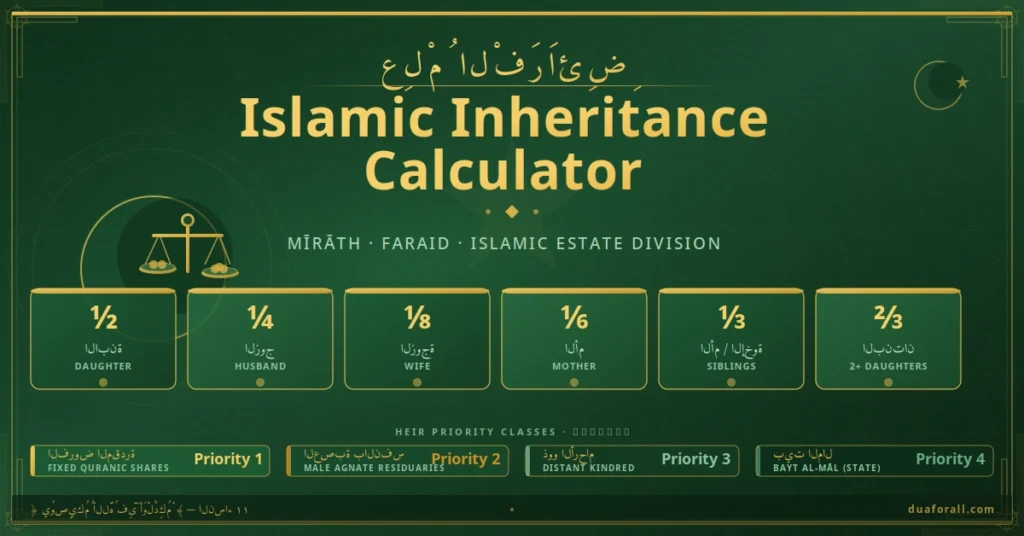
This free Islamic inheritance calculator — also known as a Faraid calculator, Mirath calculator, or Sharia inheritance calculator — lets any Muslim family calculate inheritance in Islam accurately and instantly. Whether you are a widower determining your exact share, an executor distributing a large estate, or a family member seeking clarity before approaching a Syariah court, this Islamic calculator for inheritance covers every standard scenario. It applies the precise Islamic inheritance calculation formula derived from Surah An-Nisa (4:11–12), supports the Hanafi and all other major Sunni legal schools, and outputs both the fractional Faraid share and the exact monetary amount for each heir. For families in Malaysia, Singapore, or any jurisdiction where the Syariah court oversees estate distribution, the shares displayed here align with standard Faraid inheritance principles as applied in Muslim-majority legal systems worldwide.
What Is Islamic Inheritance Law (Faraid / Mirath)?
Faraid (فرائض), also called Mirath or Tirkah, is the divine system of estate distribution prescribed in the Quran and Sunnah for every Muslim. The word Faraid derives from Fardh, meaning “obligatory,” reflecting its binding nature in Islamic law. Unlike secular inheritance systems, Islamic inheritance law assigns precise, God-ordained fractions to each class of heir — leaving no room for personal preference over the mandatory shares.
The primary Quranic source for Islamic inheritance rules is Surah An-Nisa (Chapter 4), specifically verses 11, 12, and 176. These verses detail the shares of daughters, sons, parents, spouses, and siblings with remarkable precision. The Prophet Muhammad (صلى الله عليه وسلم) further elaborated these rules through authentic Hadith, stating: “Learn the rules of inheritance and teach them to people, for they are half of knowledge” (Ibn Majah).
Before any Faraid distribution, Islam mandates three obligations be fulfilled in strict order:
(1) Funeral and burial expenses — (2) Repayment of all debts, including deferred Mahr owed to the wife — (3) Execution of any valid Wasiyyah (Islamic will / bequest), which cannot exceed one-third of the net estate and cannot benefit an existing heir. Only the remaining estate enters the Faraid distribution. If you also need to calculate your annual Zakat obligation, our dedicated Zakat Calculator handles gold, silver, cash, and business assets.
The Three Categories of Heirs in Islamic Inheritance
Islamic jurisprudence classifies every potential heir into one of three categories, determining how — and whether — they receive a share of the estate. This Islamic share calculator automatically places every heir you select into the correct category:
1. Ashaab al-Furudh — Fixed-Share Heirs
These are the heirs whose shares are explicitly mentioned in the Quran or authentic Hadith. They receive a fixed fraction — either 1/2, 1/4, 1/8, 1/3, 2/3, or 1/6 — regardless of who else is present. Fixed-share heirs include the husband, wife/wives, daughter(s), father (with children present), mother, paternal grandfather, paternal and maternal grandmothers, full sisters, paternal half-sisters, and uterine siblings.
2. Asaba — Residuary Heirs
Asaba (عصبة) heirs inherit whatever remains after all fixed shares have been distributed. Sons are the primary Asaba; they inherit the residue individually or share it with daughters on a 2:1 ratio. The father becomes Asaba when there are no children. Full brothers, paternal half-brothers, and their descendants form subsequent levels of Asaba. A daughter also becomes Asaba when she inherits alongside a son — known as the “with-a-son Asaba” — receiving half his share per Surah An-Nisa (4:11).
3. Mahjub — Blocked Heirs
A Mahjub (محجوب) heir is completely excluded from inheriting due to the presence of a closer relative. For example, the paternal grandfather is blocked by the father; full brothers are blocked by a son or the father. This Muslim inheritance calculator automatically identifies and displays all blocked heirs so you can verify every calculation transparently.
Faraid Inheritance Chart — Quranic Shares Quick Reference
The Faraid inheritance chart below summarises the six fixed Quranic fractions (Furudh al-Muqaddarah) — the foundation of every Islamic inheritance calculation formula — along with the exact conditions under which each heir receives them:
| Heir | Condition | Share | Reference |
|---|---|---|---|
| Husband | Deceased has no children | 1/2 | An-Nisa 4:12 |
| Husband | Deceased has children | 1/4 | An-Nisa 4:12 |
| Wife / Wives | Deceased has no children | 1/4 (shared) | An-Nisa 4:12 |
| Wife / Wives | Deceased has children | 1/8 (shared) | An-Nisa 4:12 |
| One Daughter | No son present | 1/2 | An-Nisa 4:11 |
| Two+ Daughters | No son present | 2/3 (shared) | An-Nisa 4:11 |
| Son(s) + Daughter(s) | Together as Asaba | Residue (2:1) | An-Nisa 4:11 |
| Mother | With children or 2+ siblings of deceased | 1/6 | An-Nisa 4:11 |
| Mother | No children, fewer than 2 siblings | 1/3 | An-Nisa 4:11 |
| Father | Deceased has children | 1/6 + residue | An-Nisa 4:11 |
| Father | No children (becomes Asaba) | Residue | An-Nisa 4:11 |
| Uterine Sibling (1) | No children or father of deceased | 1/6 | An-Nisa 4:12 |
| Uterine Siblings (2+) | No children or father of deceased | 1/3 (shared) | An-Nisa 4:12 |
Islamic Inheritance Calculation Formula — 6-Step Method
The Islamic inheritance calculation formula follows a fixed, logical sequence that every estate must go through before shares are distributed. Unlike civil law — which leaves considerable discretion to the deceased — Faraid prescribes an exact mathematical method rooted in Quranic fractions. Here is how every inheritance calculation in Islam works:
Clear All Pre-Distribution Obligations
From the gross estate deduct in strict order: (i) funeral and burial costs, (ii) all outstanding debts including any deferred Mahr owed to the wife, and (iii) any valid Wasiyyah (bequest) up to a maximum of 1/3 of the remaining estate — exclusively to non-heirs. The result is the Net Distributable Estate — the only figure that enters the Faraid formula and the figure you enter into this calculator.
Identify Surviving Heirs & Their Categories
Classify each heir as (a) Ashaab al-Furudh (fixed-share), (b) Asaba (residuary), or (c) Mahjub (blocked). The presence of a closer heir can eliminate more distant heirs from inheriting entirely — for example, the presence of a son blocks the paternal grandfather from the Asaba share.
Assign Quranic Fractions — Find the Common Denominator
Assign each fixed-share heir their Quranic fraction from the Faraid inheritance chart above. The denominator used in classical Faraid is the Lowest Common Multiple (LCM) of all individual share denominators. For example, shares of 1/4, 1/6, and 1/6 yield an LCM denominator of 12, giving 3/12, 2/12, and 2/12 respectively.
Apply Awl if Shares Exceed 100%
If the sum of all fractions exceeds 1 (total > 100% of the estate), apply Awl — increase the denominator proportionally so every heir’s share is reduced by the same ratio. All four major Sunni schools agree on Awl. This calculator automatically detects and applies it, notifying you when it occurs.
Apply Radd or Distribute Residue to Asaba
If shares sum to less than 1 and no Asaba heirs exist, apply Radd — return the surplus proportionally to eligible fixed-share heirs. Under Hanafi rules, Radd also applies to the spouse; under Shafi’i/Maliki/Hanbali, it does not (surplus goes to Bayt al-Mal). If Asaba heirs exist, the residue passes to them in priority order: sons (and daughters alongside them at 2:1), then father, then full brothers, and so on.
Convert Fractions to Exact Monetary Amounts
Multiply each heir’s adjusted fractional share by the net distributable estate to arrive at the exact monetary amount. This is the final output of this Islamic inheritance calculator with amount:
Formula: Heir’s Amount = Net Estate × Heir’s Adjusted Fardh Fraction
Understanding Awl and Radd in Islamic Inheritance
Awl — عول Proportional Reduction
Awl (“increase”) occurs when the sum of all fixed Fardh shares exceeds 100% of the estate. For example, a husband (1/4), two daughters (2/3), and a mother (1/6) together would claim 13/12 of the estate — mathematically impossible. The solution, adopted unanimously by the Companions (Sahabah) and agreed upon by all four Sunni schools, is to proportionally increase the denominator, reducing every heir’s share by the same ratio. This calculator detects and applies Awl automatically.
Radd — رد Return of Surplus
Radd (“return”) is the opposite: fixed shares do not consume the entire estate and no Asaba heir exists to take the residue. The surplus is returned proportionally to the fixed-share heirs. The Hanafi school allows Radd to all eligible heirs including the spouse. The Shafiʿī, Mālikī, and Hanbali schools exclude the spouse from Radd — that portion goes instead to the Bayt al-Mal. Select your legal school in Step 1 of the calculator for the correct result.
How to Use This Islamic Inheritance Calculator
This free online Faraid calculator covers all four major Sunni schools. Get your results in three steps:
Enter the Net Estate Value
Deduct funeral expenses, all debts, and any valid Wasiyyah (max 1/3 to non-heirs) from the gross estate first. Enter only the distributable net amount. Select your currency — PKR, USD, GBP, EUR, SAR, AED, MYR, BDT, IDR, and more — and the applicable legal school (Hanafi or other Sunni schools).
Select All Surviving Heirs
Click each heir card that applies. For heirs with variable counts (wives up to 4, multiple sons, daughters, brothers, sisters), use the + and − buttons to set the exact number. Husband and wife are mutually exclusive — selecting one automatically deselects the other.
View Results — Fractions & Exact Monetary Amounts
Click “Calculate Shares” to see each heir’s Quranic fraction, exact monetary amount in your chosen currency, and percentage of the total estate. Any Awl reduction, Radd surplus, or blocked (Mahjub) heirs are clearly labelled. Modify heirs and recalculate as many times as needed — this is a true Islamic inheritance calculator with amount output.
Spouse & Widower Inheritance in Islam — What Is Your Share?
One of the most-searched questions in Islamic inheritance calculation is what a surviving spouse — a widower (husband) or widow (wife) — is entitled to receive. The Quran addresses this directly in Surah An-Nisa (4:12), making the spouse’s share among the clearest and most protected rights in Faraid law.
Widower (Surviving Husband) — Detailed Rules
A widower’s share under Sharia law inheritance depends on whether his deceased wife left children:
- No children from any marriage: The widower inherits 1/2 of the net estate.
- With children: The widower inherits 1/4 of the net estate — the minimum Fardh, regardless of how many children exist.
After receiving his fixed Fardh share, the widower does not participate in the Asaba (residuary) distribution. However, under the Hanafi school, if there is a surplus after all Fardh shares and no Asaba exists, that surplus (Radd) is returned to the widower proportionally — potentially increasing his final amount beyond the base Fardh fraction.
Widow / Wives (Surviving Wife or Wives) — Detailed Rules
If a man dies leaving one or more wives:
- No children: The wife (or all wives collectively) inherits 1/4 of the net estate, shared equally between them if more than one.
- With children: The wife (or all wives collectively) inherits 1/8 of the net estate, shared equally. A man may have up to four wives; their collective Fardh share remains 1/8 regardless.
To calculate your exact share as a widower or widow, scroll to the calculator above, enter the net estate value, set your Legal School, and select “Husband” or “Wife / Wives” along with all other surviving heirs. The calculator displays the precise monetary amount for each heir instantly.
Differences Between the Four Sunni Madhabs on Inheritance
While the core Quranic shares are unanimously agreed upon by all four Sunni schools, notable differences exist in specific edge cases. The Hanafi inheritance calculator mode applies the following positions — which differ from the other three schools — in the two most common edge cases:
Radd & the Spouse
Hanafi: Returns surplus (Radd) to all eligible heirs including the spouse.
Shafi’i, Maliki, Hanbali: Spouse excluded from Radd — the residual portion is directed to Bayt al-Mal.
Paternal Grandfather with Brothers
Hanafi (following ʿAli ibn Abi Talib): Grandfather fully excludes brothers from inheriting.
Other schools (following Zayd ibn Thābit): Grandfather shares the residue with brothers.
Uterine Relatives (Dhawī al-Arhām)
Hanafi & Hanbali: Distant maternal relatives may inherit when no primary heirs exist.
Maliki & Shafi’i: In the absence of primary heirs, the estate goes to Bayt al-Mal.
Core Fardh Shares — All Four Schools Agree
All four Sunni schools agree on the six Quranic fractions and the conditions for each heir. These shared rules cover the vast majority of family estate scenarios you will encounter.
For authoritative scholarly guidance on these differences, we recommend IslamQA.info — Inheritance Fatawa and SeekersGuidance.org, both of which offer verified fatawa from qualified Islamic scholars.
Shia Inheritance & Syariah Court Calculator — Key Differences
Shia Inheritance Calculator — Important Differences to Know
This tool is built on Sunni Islamic jurisprudence (Faraid) as practised across the four major Sunni schools. If you are searching for a Shia inheritance calculator, please note the following key differences between Sunni and Shia (Ja’fari) inheritance rules before using this tool:
- Residuary Heirs: In Shia jurisprudence, maternal relatives (Dhawī al-Arhām) inherit in the absence of primary heirs — similar to Hanafi/Hanbali — but the priority order differs significantly from Sunni Asaba rules.
- Grandfather and Brothers: In Shia law, the paternal grandfather does not exclude brothers from inheriting — unlike the Hanafi position and most Sunni schools.
- Radd: Shia jurisprudence allows Radd to the spouse in scenarios where most Sunni schools (other than Hanafi) do not.
- Maternal Lineage: Shia law assigns greater weight to maternal relatives in the absence of primary heirs, which can produce meaningfully different outcomes compared to Sunni calculations.
The shares produced by this Faraid calculator are based on Sunni rules only and should not be used for Shia estate distribution. For a Shia inheritance calculation, consult a qualified Ja’fari scholar (Marjaʿ) or a specialist Islamic estate planning service in your jurisdiction.
Syariah Court Inheritance Calculator — Malaysia, Singapore & Southeast Asia
In Malaysia, Singapore, Brunei, and Indonesia, Muslim estates are governed by each country’s respective Faraid laws, administered through the Syariah Court or its equivalent agency. The Islamic inheritance calculation formula applied in these jurisdictions derives from the same Quranic fractions (An-Nisa 4:11–12) used in this calculator.
For Malaysian Muslims, the Syariah Court issues a Sijil Faraid (Faraid Certificate) confirming each heir’s entitlement. The shares produced by this Syariah court inheritance calculator tool are consistent with standard Faraid principles and can serve as a useful pre-filing reference before engaging AMANAH RAYA, MAIS, or your State Religious Authority. Always confirm final shares with a registered Syariah lawyer, as local procedural rules and living-heir verification may affect the final court-ordered distribution.
❓ Frequently Asked Questions — Islamic Inheritance & Faraid
Is following Faraid law obligatory for Muslims?
Yes. Distributing an estate according to Faraid is Fardh — obligatory upon every Muslim who handles the estate of a deceased Muslim. The Prophet (صلى الله عليه وسلم) instructed: “Divide the inheritance among the people of the Faraʿid according to the Book of Allah” (Sahih Muslim). Deliberately withholding an heir’s share or distributing an estate contrary to Faraid is considered a major sin in Islamic jurisprudence.
How much does a widower inherit in Islam?
A widower (surviving husband) receives 1/2 of the estate if his deceased wife left no children, or 1/4 if she left children from any marriage — per Surah An-Nisa (4:12). His Fardh is always at least 1/4 when children exist, regardless of how many. Under the Hanafi school, if no Asaba heir exists and a surplus remains after all Fardh shares, that Radd surplus is returned to the widower proportionally — potentially increasing his final amount. Use the Islamic inheritance calculator above: enter the estate value, select Husband, add any other surviving heirs, and click Calculate for an exact monetary figure.
Who is entitled to what in Islamic inheritance — and can a will change it?
Islamic law divides entitlements into two layers: (1) Fardh (fixed Quranic shares) for spouses, children, parents, and some siblings — which cannot be overridden by any will or personal preference — and (2) Asaba (residuary) shares, which absorb whatever remains.
A valid Islamic will (Wasiyyah) may only distribute up to one-third of the net estate, and only to non-heirs. You cannot use a Wasiyyah to grant an existing heir more than their Quranic share, nor to exclude any heir from their lawful entitlement. This means two-thirds or more of every Muslim estate is fully governed by Faraid — making an accurate Islamic inheritance calculator essential for every estate plan.
Does this calculator show the actual money each heir receives?
Yes. This is a true Islamic inheritance calculator with amount output. After entering the net estate value in your chosen currency and selecting all surviving heirs, the results screen displays:
- Each heir’s Quranic fraction (e.g., 1/4, 1/6)
- The exact monetary amount they are entitled to receive
- Their percentage of the total estate
- Any Awl adjustment or Radd surplus clearly reflected in final figures
Supported currencies include PKR, USD, GBP, EUR, SAR, AED, MYR, BDT, IDR, EGP, TRY, CAD, AUD, and more.
What is different about the Hanafi inheritance calculator versus other Sunni schools?
The Hanafi inheritance calculator mode differs from the Shafi’i / Maliki / Hanbali mode in two primary scenarios:
- Radd: The Hanafi school returns surplus estate to the spouse; the other three Sunni schools do not — the spousal residue goes to Bayt al-Mal instead.
- Grandfather with Brothers: Hanafis (following ʿAli ibn Abi Talib) hold that the grandfather fully excludes brothers; other schools (following Zayd ibn Thābit) share the residue between them.
For most everyday family structures (spouse + children + parents), all four schools produce identical Faraid results. Select “Hanafi” in the Legal School dropdown in Step 1 to apply Hanafi rules throughout your calculation.
Can daughters be excluded from Islamic inheritance?
No. Islam explicitly and unconditionally guarantees women’s right to inherit. Daughters, wives, mothers, and sisters all have fixed shares prescribed in the Quran. Denying women their rightful share of an estate is a serious violation of Islamic law. In the pre-Islamic era (“Jahiliyyah”), women could not inherit; the inheritance verses of Surah An-Nisa (4:7–12) overturned this injustice permanently.
Why does a son receive double the share of a daughter?
The 2:1 ratio between sons and daughters reflects the asymmetry of financial obligations in Islamic law. A son is legally required to fully maintain his wife, his children, and potentially his parents using his inheritance to fulfil these duties. A daughter’s inheritance, by contrast, is entirely her personal property — her husband is independently obligated to provide for all her financial needs. Considered holistically alongside Mahr and maintenance rights, the Islamic system frequently places women in a financially advantageous position overall.
Can a non-Muslim spouse inherit from a Muslim?
Under the four major Sunni schools, a non-Muslim does not inherit from a Muslim via Faraid, based on the hadith: “A Muslim does not inherit from a disbeliever, nor does a disbeliever inherit from a Muslim” (Sahih Bukhari and Sahih Muslim). However, a non-Muslim spouse may receive up to one-third of the estate through a valid Wasiyyah (bequest) made before the Muslim’s death, provided it does not circumvent any heir’s lawful rights.
Can this calculator be used for Shia inheritance?
No — this tool is designed specifically for Sunni Islamic inheritance (Faraid). Shia (Ja’fari) inheritance law differs in several key areas: the priority of maternal relatives, the grandfather-brothers relationship, and Radd rules for the spouse. Using this Sunni Faraid calculator for a Shia estate would produce incorrect results. Shia Muslims should consult a qualified Ja’fari scholar (Marjaʿ) for an accurate Shia inheritance calculation.
What happens to the estate if there are no heirs?
If a Muslim dies with no qualifying heirs from among the Faraid categories or Asaba relatives, the estate passes to the Bayt al-Mal — the Islamic public treasury — for the benefit of the Muslim community. In countries without an active Islamic state treasury, Muslim scholars typically advise distributing the estate to Islamic charities or community institutions. Always consult a local Mufti for jurisdiction-specific guidance on this scenario.
More Free Islamic Tools on DuaForAll
Alongside this Islamic inheritance calculator, DuaForAll offers a suite of free tools to support your Islamic financial and worship planning:
Scholarly Resources on Faraid & Islamic Inheritance Law
This Islamic inheritance calculator is an educational tool. For complex estates involving disputed heirs, missing persons, debts across multiple countries, or questions of Shia inheritance, always engage a qualified Islamic inheritance lawyer or Mufti. The following authoritative resources provide deeper scholarly coverage of Islamic law of inheritance:
-
📖IslamQA — Inheritance Fatawa
Hundreds of verified Q&As on specific inheritance scenarios, answered by the Permanent Committee and prominent scholars. Invaluable for edge cases not covered by this calculator. -
🎓SeekersGuidance — Faraid Courses
Free structured courses on Islamic law including dedicated Faraʿid modules taught by qualified Hanafi and Shafi’i scholars. -
📗Quran.com — Surah An-Nisa 4:11–12 & 4:176
Read the primary Quranic inheritance verses with multiple translations and classical tafsir (exegesis). -
📘Sunnah.com — Hadith on Inheritance
Searchable database of authentic Hadith on Faraid from Sahih al-Bukhari, Sahih Muslim, Abu Dawud, and Tirmidhi.
Disclaimer: This calculator is an educational aid based on standard Sunni Islamic jurisprudence (Faraid). It does not constitute legal or religious advice. For complex estates — particularly those involving missing heirs, contested debts, cross-border assets, or Shia family members — always consult a qualified Islamic scholar (Mufti) and a licensed legal professional in your jurisdiction.